If anecdotes are evidence, why aren’t you drinking paint thinner?

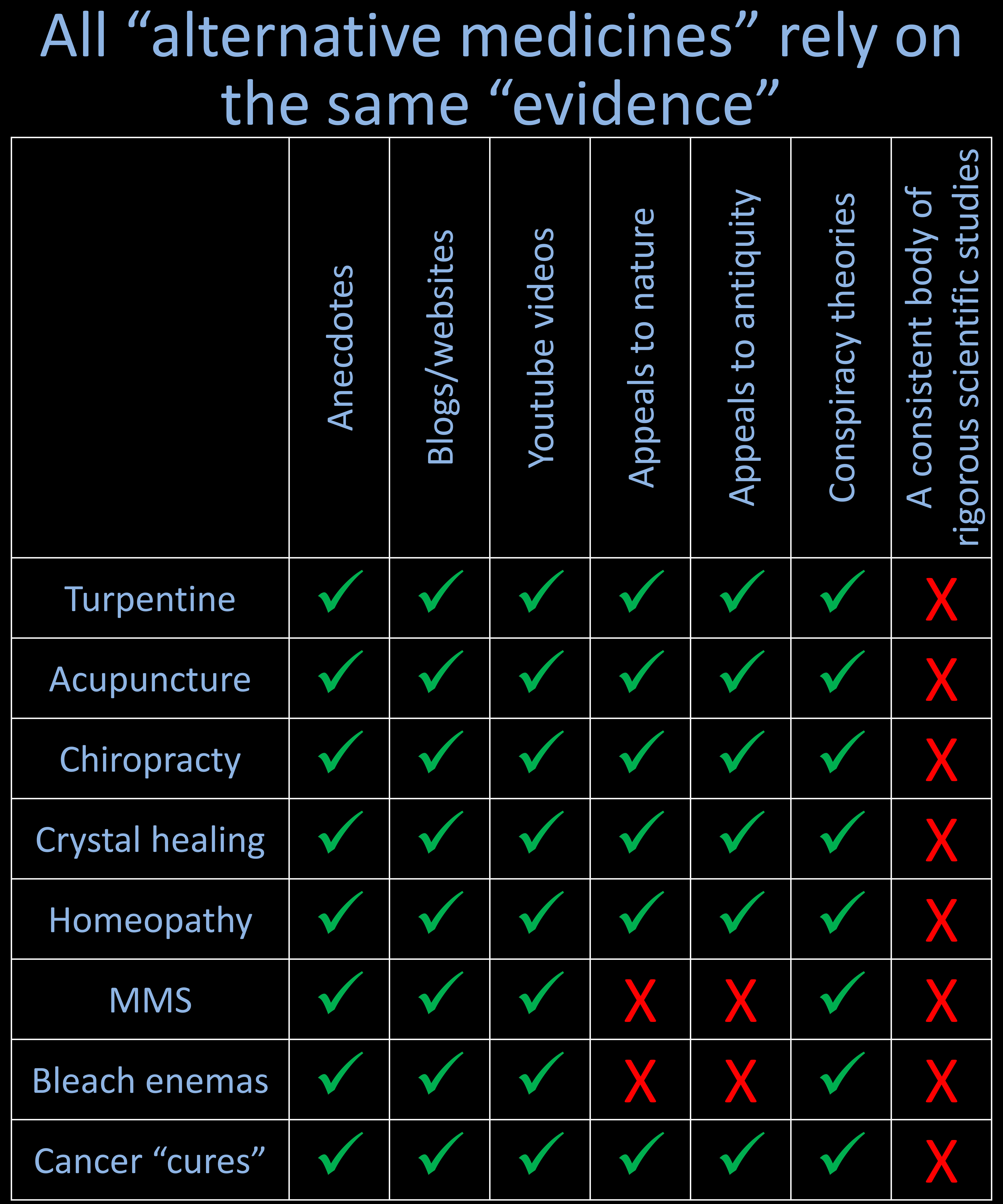
I want to begin this post by doing something atypical for me. I want to tell you about an amazing cure-all that I that was recently introduced to: turpentine (aka paint thinner). According to the vast wealth of knowledge available on the internet, most (if not all) diseases are actually caused by parasites, fungal infections (particularly Candida), and even modern medicine itself. Don’t worry, however, because all of these can be cured by drinking turpentine (or sometimes kerosene or even gasoline). Now, you may think that sounds crazy, but have no fear, because this treatment is totally natural (turpentine is made from distilled tree resin). Also, it has been used for nearly two centuries, and several brave doctors have bucked the medical establishment and are promoting it (e.g., Jennifer Daniels). You may think that is pretty flimsy evidence, but don’t worry, I also have multiple blogs, alternative health websites, and Youtube videos explaining why this is the cheap trick doctors don’t want you to know. Best of all, I have tons of anecdotes. There are countless success stories of people who tried traditional medicines to no avail, but as soon as they started drinking turpentine, their symptoms went away and they could just tell that they were healthier. Take, for example, this person who wrote the following after taking turpentine, “My energy level is so much better, lungs feel cleaner. Can’t tell me this stuff doesn’t work.” With confidence like that, how could they be wrong? Finally, you may be wondering why there aren’t a lot of scientific studies supporting turpentine as a treatment, as well as why there are lots of health recommendations against taking it. The answer is simple: big pharma only cares about profits, so they are suppressing the truth of this amazing treatment.

As most of you have hopefully guessed, the paragraph above is facetious, and I’m not going to try to induct you into a pyramid scheme, but I wanted to open this post that way to illustrate a very important point. Namely, most of the people reading this probably spotted the flaws in my arguments for turpentine. The idea that drinking paint thinner could cure all diseases is so outlandish that you probably realized that blogs, Youtube videos, and anecdotes aren’t sufficient evidence. You probably realized that the fact that something is natural or ancient doesn’t mean it’s safe or effective (appeal to nature and appeal to antiquity fallacies). You probably realized that the fact that I found a handful of doctors that support drinking turpentine doesn’t mean that it works (appeal to authority fallacy), and you probably scoffed at the notion that safety warnings on turpentine were actually part of a conspiracy by “Big Pharma.”

Nevertheless, despite all of that, a large portion of you probably use identical reasoning to support your favorite alternative remedy. Based on what I see in the comments, most of you probably have some “cure for the common cold” or other pseudoscientific practice that you cling to dearly, and if I asked you for your evidence, you would respond with the exact same type of reasoning. Most prominently, you would give me anecdotes and cite blogs and Youtube videos.

Further, on the off chance that someone reading this believes in the magic powers of turpentine, there is still almost certainly some other alternative practice that you think is nuts, even though it is supported by the exact same evidence base. For example, I used to know someone who believed in all manner of nonsense, from crystal healing to anti-vaccine conspiracy theories, but they drew the line at homeopathy. As I tried to explain to them, however, that doesn’t make sense because homeopathy has the same evidence base as things like crystal healing. In other words, when I asked them to give me evidence of crystal healing, they replied with blogs, Youtube videos, and anecdotes, yet they rejected homeopathy even though homeopathy is also “supported” by countless blogs, Youtube videos, and anecdotes. To try to make them grasp this paradox, I once asked them, “If homeopathy doesn’t work, then why do so many people claim to feel better after taking it?” They very correctly responded that those reports could be from placebo effects, total coincidences, regression to the mean [technically a type of placebo effect], other medications, etc. In other words, when it wasn’t their pet belief, they had no problem seeing the flaws in the line of reasoning, but when it was their personal views at stake, suddenly cognitive biases clouded their vision and inhibited their ability to think logically.

The point that I’m trying to make here is that your reasoning has to be consistent. Either anecdotes can establish causation or they can’t. You don’t get to pick and choose when you think that they work. In other words, if an anecdote, or even a collection of anecdotes, is actually sufficient grounds for saying that cannabis cures cancer, acupuncture works, vaccines cause autism, etc. then it must also be sufficient grounds for the effectiveness of homeopathy, miracle mineral solution, bleach enemas, turpentine, kerosene, gasoline, crystal healing, bloodletting, leaches, sacrificing to the sun god, and every other form of woo that has ever been proposed, because they all have anecdotes. If anecdotes actually can establish causation, then you have to believe in all of them. They can’t only establish causation when you want them to. That’s not how evidence works.

To put that another way, if for any one of the thousands of alternative treatments that have ever existed, you are content to say, “the anecdotes could easily be from placebo effects or other factors,” then you must say that for all of the treatments. In other words, by acknowledging even once that the fact that someone took a treatment then got better is not good evidence that the treatment actually works, you have just universally acknowledged that anecdotes can’t establish causation. The logical syllogism, “someone took X, then got better, therefore X works” either works all the time or it never works. It can’t magically work when you want it to, then not work when you don’t want it to.

The same thing is true for the admissibility of blogs and Youtube videos as evidence. If you asked me for evidence that turpentine is a cure-all, and I responded with an unsubstantiated Youtube video, you would very correctly demand actual data. It is inherently obvious that any crackpot can make a Youtube video and say whatever they want in it. To be clear, there are some Youtube videos, blogs, etc. that are packed with non-cherry-picked citations to the original peer-reviewed literature, and there is nothing wrong with linking to a source like that and saying, “this video gives a good explanation and cites the relevant literature.” That is, however, almost never what I see when it comes to conspiracy theories and alternative medicine. The sources that I see people use as evidence are nearly always just someone spouting nonsense as if they were stating facts, and citations to original studies are either non-existent or horrible cherry-picked.

Finally, I want to contrast this type of inconsistency with a science-based view of reality. To put it simply, you can convince me (and scientists in general) of anything if you have sufficient evidence, and by evidence, I mean multiple independent studies that used large sample sizes, adequate controls, and rigorous analyses. If you can show me a consistent body of scientific evidence demonstrating that drinking turpentine is safe and effective, I’ll accept it. If you can show me a consistent body of evidence demonstrating that vaccines cause autism, I’ll accept it. If you can show me a consistent body of evidence demonstrating that crystal healing actually works, I’ll even accept that. Do you see the difference between that and cherry-picking when you do and do not want to accept anecdotes as evidence? Science has consistent criteria for what is and is not evidence, whereas there is no constancy in pseudoscience.

The take home that I want you to get from this is that you need to ensure that your reasoning is consistent. A great way to do this is by trying to think of situations where you would not accept the conclusion that results from your current line of reasoning. For example, if you are using an anecdote to claim that a particular alternative treatment works, stop and try to think of situations where you would not accept anecdotes as evidence. In other words, if you can think of a situation where you wouldn’t accept that X caused Y, even though someone took X then Y happened, then you have just demonstrated that your line of reasoning is flawed, and anecdotes are not sufficient evidence of causation.

Note: To be clear, I am not arguing that the existence of anecdotes is evidence that something doesn’t work (that would be a fallacy fallacy). In other words, when I said things like, “the logical syllogism, ‘someone took X, then got better, therefore X works’ either works all the time or it never works,” it is the syllogism itself that is the problem, not its conclusion. To put that another way, there will always be anecdotes for things that actually do work. The problem is simply using those anecdotes as evidence that it works.

Note: Inevitably when I start talking about anecdotes, pedants get all bent out of shape and argue that anecdotes do have value because they indicate that something may be worth studying. I agree, and never said anything to the contrary. That argument does not, however, in any way shape or form negate my point that anecdotes are not valid evidence of causation. So please spare me your pointless pedantry.

 Related posts

Posted in Vaccines/Alternative Medicine | Tagged , , , , , , , , | 16 Comments

Facts aren’t political (or religious)

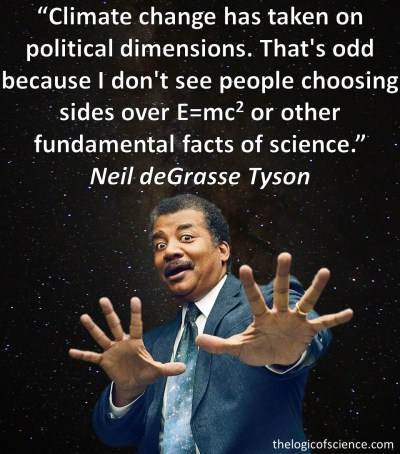
On this blog/Facebook page, I try very hard to stick to scientific facts and avoid discussing politics. Nevertheless, I am frequently accused of being political, even when I am simply reporting a fact. For example, I often post facts about climate change, such as the fact that 2014, 2015, and 2016 all set new records for the warmest year (on average), and when I do that, I nearly always receive comments accusing me of “liberal propaganda” or “pushing a liberal agenda,” but that’s not how facts work. It is demonstrably true that all of those years were the warmest on record, and politics has absolutely nothing to do with it. In other words, facts are inherently not political. They are simply statements of reality. To be clear, facts can, of course, be used to make political arguments and to try to persuade people of a particular political position, but the facts themselves are not political, and that distinction is important.

Let me give an example that I recently encountered which will hopefully demonstrate how this plays out and why it is problematic. This example is from a historical topic, not a scientific one, but I think it illustrates the situation nicely. A few days ago, I saw a clip from Adam Ruins Everything where Adam discussed the history of racism in the US housing markets as well as the lingering effects of that racism. At no point in the video did he make any political statements or arguments. He simply explained the facts (the things that are demonstrably true), and he cited his sources. In other words, he simply made claims like, “bill X was passed which did Y,” and at no point did he give a call to action, advocate for a piece of legislation, etc. He even went out of his way in the video to say that he is simply reporting the history, not trying to guilt white home owners.

As you have probably guessed, however, many of the comments on this video were simply amazing. In the various places that I have seen this video show up, I have seen tons of comments complaining about “liberal propaganda,” “white guilt,” etc. For example, one commenter wrote, “This is just anti-white propaganda,” but, again, all he did was report facts. Also, to be clear, these comments weren’t citing sources showing that the facts in the video were wrong, rather they were simply accusing the video of being political nonsense (in this case liberal nonsense) .

This general reaction can be summed up best with the comment below.


Again, that’s not how facts work. Simply stating historical facts is not the same thing as making a political argument. Arguing for an action based on those facts would be political, but simply teaching people the facts is not political. Nevertheless, people often respond to facts as if they are political, and the great irony is that this reaction often occurs precisely because of political biases. In other words, someone sees a fact that causes some problem for their political ideology, so instead of dealing with the fact, they accuse the fact itself of being politically motivated. This is extremely problematic for obvious reasons. We can’t hope to have a rational discussion about a topic (whether it be scientific, historical, political, etc.) if people don’t accept that basic facts. Any position that ignores facts is doomed to fail.

Note: To be clear, I am not making any general statements about the accuracy of Adam Ruins Everything, but in this particular case, he was simply reporting historical facts.

This situation plays itself out all the time on scientific topics, but climate change is probably where it occurs the most frequently, and I don’t fully understand why, because if I make a statement like, “the earth is a spheroid,” no one accuses me of making a political claim. Everyone realizes that I am simply reporting a fact; however, when I state something like, “we have greatly increased the CO2 in the atmosphere, and that CO2 is causing the planet to warm” suddenly people accuse me of pushing a liberal agenda and my inbox is flooded with comments to the effect of, “I thought this page was about science but it is just liberal nonsense.” Do you see the problem there? It is a fact that our CO2 is causing the climate to change, and I always back that fact up with my sources (detailed in previous posts such as this one and this one), but people mistake that fact for a political argument. To be clear, people can certainly use that fact to make a political argument, and when someone says, “we are causing the planet to warm, therefore we should do X,” at that point they are making a political argument, but the fact itself is not political. In other words, whether or not we should do something about climate change is going to depend moral values, views on economics, etc., but none of that is relevant to the simple fact that we are causing the climate to change.

Note: I realize that both of my examples so far have involved groups who are generally politically conservative (by the US definition), but just to be clear, liberals do this all the time as well.

Propaganda

So far, I have been focusing on the accusation that a fact is political, but this same general problem occurs in other ways as well. For example, when I sate a fact about the effectiveness or safety of vaccines, I am often met with accusations of spreading “pro-vaccine propaganda,” but, as I have stated several times now, that’s not how facts work. Simply stating a fact is not propaganda. To put that another way, the definition of propaganda is not, “a fact that I don’t like.”

Here again, I want to be clear that facts can be used as propaganda if they are reported in a misleading or biased way to push some agenda. For example, anti-vaccers like to cite the fact that in some disease outbreaks, most of the people who became infected were vaccinated. That fact is technically true (in some cases), but using it as an argument against vaccination is misleading and leaves out critical information. Namely, it ignores the fact that the rates of disease are consistently higher among the unvaccinated. In cases like that, you could argue that the argument is propaganda, but even there, it is not the fact itself that is the problem. Rather, the problem is the misleading way in which it is presented. Also, generally when I see people making blind accusations that something is propaganda, the fact wasn’t being in any way miss-represented. Rather, people were making the accusation simply because they didn’t like the fact.

Religion

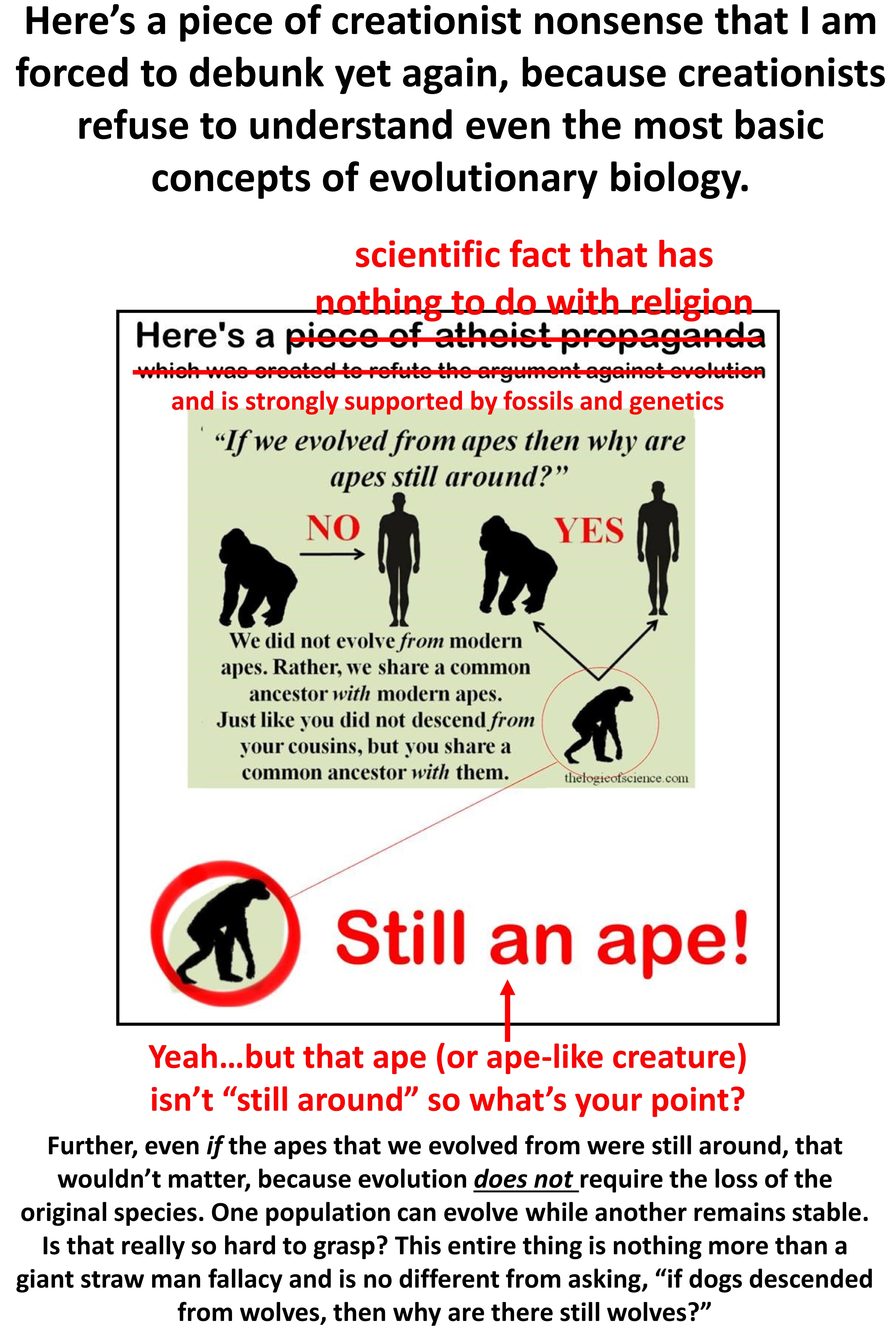
Finally, the same basic problem occurs for topics that have any sort of religious implications. For example, when I talk about the facts of evolution such as the existence of transitional fossils or the fact that evolution predicted genetic patterns, I’m nearly always met with creationists who accuse me of pushing an atheist agenda. You can see an example of this if you look at the meme on the right. I made the original meme (green), and a creationist group tried to “correct” it (including calling it propaganda), and I corrected it back. Here again, I simply stated a scientific fact that has been repeatedly demonstrated by fossils, genetics, biogeography, etc. It is in no way cherry-picked or misleading. To be clear, that fact certainly does present serious problems for young earth creationists (but not theistic evolutionists), but that doesn’t make it propaganda or religious. The fact itself is simply a statement of reality. To put that another way, the fact is relevant to the topic of religion, but religion is not relevant to the fact.

Conclusion

In short, facts are not political, religious, or propaganda. They can be used to make political or religious arguments, and they can even be misrepresented and used as propaganda, but the facts themselves are neutral statements of reality. So, when someone says something like, “vaccines save thousands of lives each year” they are stating a fact, not propaganda. Similarly, when they say, “numerous studies have tested the natural drivers of climate change and found that they cannot explain the current warming,” that is not a political argument, it is a simple, demonstrable fact, and politics have no bearing whatsoever on it.

It is very easy to dismiss information that you don’t like as propaganda, but doing so is intellectually dishonest and you do yourself a disservice by giving into that type of cognitive pitfall. To be clear, you should fact check and make sure that a claim is true, the fact wasn’t cherry-picked or misrepresented, etc., but don’t fall into the trap of blindly asserting that anything that disagrees with you is politically motivated or agenda driven.

Note: Although I have no interest in debating the Adam Ruins Everything video, I will note that many commenters harped on the use of the phrase “insufferably white” at the beginning, and argued that it meant that the video was propaganda. I would respond to that first by reminding everyone that the show is supposed to be comedic and that was meant to be a joke. Second, that was the only part of the video that was even remotely political. Everything else was simple statements of facts. Again, he listed his sources, so it is easy to fact check him.

Posted in Uncategorized | Tagged , , , , | 17 Comments

Evolution doesn’t require all species to change all the time

we did not evolve from apes but we share a common ancestor with themIn this post, I want to deal with what is arguably one of the most common misconceptions about the theory of evolution. Namely, the notion that it requires all species and populations to constantly be undergoing radical changes. You can see this misconception play out in many creationist arguments. For example, creationists often cite living fossils (i.e., organisms that appear essentially the same today as they did in the fossil record) as evidence that evolution is wrong. Indeed, there are entire Facebook pages devoted to presenting examples of organisms that, at least superficially, don’t appear to have changed over millions of years. Similarly, this faulty line of reasoning is on full display in the well-worn creationist trope, “if we evolved from apes, why are there still apes?” The reality is that these arguments are straw men, and the theory of evolution does not require or predict that all populations of all species will constantly be undergoing massive changes. Indeed, there are many well-known reasons why some populations remain stable for long periods of time, and I want to spend this post talking about them.

Several evolutionary mechanisms

At the outset, we need to clarify our terms and specify exactly what we are talking about. Evolution itself is simply a change in the allele frequencies (i.e., genetic makeup) of a population from one generation to the next, but there are several different mechanisms that can cause that change. I previously devoted a whole series of posts to these mechanisms, so I will be brief here.

First, we have mutations. These randomly produce new genetic information for the other evolutionary mechanisms to act on. Usually they are neutral, but sometimes they are harmful (in which case selection removes them) and sometimes they are beneficial (in which case selection increases their frequency).

Next, we have genetic drift. This mechanism acts on the existing variation (mutations) in a population, but it is random (i.e., it randomly increases or decreases the frequency of a genetic trait). As a result, it can be harmful because it can remove beneficial traits. In very small populations, it can even swamp selection and cause harmful traits to rise to prominence.

Gene flow simply alters the genetic frequencies of a population by bringing genetic material in from a neighboring population. This is often good, because it can provide new genetic material to a population, but it can also be bad, because it can bring in traits that are not adaptive for the local environment. Like genetic drift, high rates of gene flow combined with small populations can even swamp selection.

Finally, we have natural selection. All of these mechanisms are important, but selection tends to be the major one that drives dramatic changes. It is simply a mathematical inevitably of two conditions:

  1. There is heritable (genetic) variation for traits.
  2. Those traits affect organisms’ genetic fitness (i.e., their ability to get genetic material into the next generation).

Any time that those two conditions are met, selection will occur and the population will evolve. In other words, if some individuals have a genetic trait that lets them produce more offspring than individuals who don’t have that trait, the individuals with the trait will produce more offspring, pass the trait on to their offspring, and, as a result, that trait will be more common in the next generation. That’s all that natural selection is (sexual selection is best thought of as a special case of natural selection).

Now that you understand the mechanisms that drive evolution, you should be able to easily think of situations in which evolution won’t occur, or, at least won’t cause substantial changes. Imagine, for example, a large, isolated population (thus limited genetic drift and no gene flow), that is at equilibrium with the environment (thus no selection). Mutations will still occur, but most of them will be neutral, and if the population is already well adapted, majorly beneficial ones are unlikely. Thus, lo and behold, we have a population that undergoes very little evolution. I realize that probably isn’t very convincing to many people, so let’s flesh this out further.

Selection adapts to the current environment.

It is crucially important to understand the that selection simply adapts organisms to their current environment. It doesn’t give them what they “need,” it’s not working towards some ultimate endpoint, it doesn’t have foresight, and it’s not trying to perfect organisms. It simply acts on the current variation in a population and adapts it to the current environment. We often sum this up with the simple phrase, “evolution is blind.”

This concept is important, because it means that once a population is well adapted to its current environment, there is little left for selection to do. In other words, selection is limited to the available genetic material, so unless a new mutation arises that makes organisms even better suited to the environment, it has nothing to act on. Thus, it simply maintains the traits that are currently beneficial (via stabilizing selection) rather than evolving the population in a new direction.

To be clear, it’s certainly possible for a beneficial mutation to arise, but keep in mind that mutations are random and are not influenced by what would help an organism. Further, most of them are neutral, and many of them get lost to genetic drift before selection can act on them. Similarly, new genetic material could come from neighboring populations, but populations are often isolated.

A population like this would be described as being in a state of stasis or equilibrium with its environment, and for populations in stasis, only a relatively small amount of evolution occurs. There will pretty much always be some selection occurring just as there will always be some low level of genetic drift and mutations, but populations that have reached an equilibrium like this can persist largely unchanged for millions of years and basically just wobble around a mean value rather than moving in a consistent direction. In other words, some small changes will constantly be taking place, but they tend not to accumulate or form the type of grandiose changes that would be obvious in fossils.

Indeed, this is well supported in the fossil record, with species often persisting largely unchanged for millions of years. Nevertheless, various factors can shift a population out of stasis and cause it to undergo rapid change. For example, if there is a dramatic change in the environment, or if a population colonizes a new environment, then selection can act again, because the population will no longer be adapted to the local environment. Thus, a change in the environment can cause rapid evolution, whereas a stable environment can keep a population in stasis (there are lots of other factors that affect whether populations stay in stasis, but for sake of simplicity, I’ll leave it there).

What I have been describing here is the concept known as punctuated equilibrium (proposed by Eldredge and Gould), and it is a favorite creationist straw man, so let me briefly set a couple of points straight. First, creationists sometimes portray this as the, “hopeful monster hypothesis,” where rapid changes happen essentially overnight. Indeed, I have seen children’s’ books by Answers in Genesis with silly cartoons, such as a drawing of a pair of puzzled-looking T-rex staring at a hatched egg that has a chicken poking out of it. That is not, however, at all what punctuated equilibrium actually states, and if a creationist presents it to you in that manner, they are either ignorant about basic evolutionary concepts or they are deliberately lying. Either way, you shouldn’t be getting information from them. In reality, when a species shifts out of stasis, selection still goes through its normal steps, with each generation gradually accumulating more and more differences from the original one, and the process still takes thousands or even millions of years to produce dramatic changes. So, the evolution is only “rapid” when you put it in the context of the grand geological time scale of the entirety of earth’s history.

Second, creationists often present punctuated equilibrium as a problem for evolution and claim that Darwin was fundamentally wrong, but that is another straw man. Darwin wasn’t really wrong, he was just incomplete. He was absolutely correct about the mechanisms that drive evolution, he just didn’t realize that there are situations in which those mechanisms don’t occur (or, more correctly, don’t accumulate changes). This is very analogous to Newtonian physics vs special relativity. Newton wasn’t wrong, he was just incomplete. His math was spot on and is still taught in every physics course around the world. He simply didn’t realize that there are special cases where his math doesn’t directly apply and other math is needed. Indeed, it would obviously be insane to say that relativity is a problem for physics and discredits the whole field, yet that is exactly what creationists do when they present punctuated equilibrium as a problem for evolution. It is in no way shape or form a problem for the theory of evolution. We understand what causes large evolutionary changes to occur, and if those causes aren’t happening, then of course large evolutionary changes  won’t occur. Indeed, punctuated equilibrium does not say that evolution by natural selection doesn’t occur, nor does it say that evolution by natural selection isn’t the primary cause of the diversity of life on planet earth. All that it says is that there are periods of stasis in which little evolution occurs, and those periods of stasis end abruptly when things like habitat changes or invasion into a new area cause rapid, large-scale evolution. That is simply an expansion of our understanding of evolution, not a refutation of it.

To simplify that, Darwin was right about how and why evolution takes place, he was just incomplete regarding its rate. In other words, there are lots of periods where changes accumulate gradually just like Darwin proposed, but there are also periods where few changes accumulate, which is the piece that he was missing.

Low diversity

Reaching a point of equilibrium with the environment likely accounts for most of the long periods with seemingly little evolution, but there are other things that can limit evolution as well. For example, low genetic diversity can seriously limit a population’s ability to adapt. Remember, selection and genetic drift simply act on the existing genetic variation, but if there is very little genetic variation, then there is very little for them to act on. Indeed, this is one of the key reasons why conservation efforts for threatened and endangered species often focus on maintaining high genetic diversity. Species with low diversity can’t adapt to environmental changes, new predators, etc. because there is no diversity for selection to act on. Again, this is not a problem for the theory of evolution, because the theory stipulates that selection occurs when there is heritable variation. From that, it also follows that selection will not occur when there is no variation.

Some populations can evolve while others don’t

The finally point that I want to make is that not all populations of a species have to evolve simultaneously. Remember, selection acts on populations, and it adapts them to their current environment. Thus, two populations can both remain stable if they are in similar environments, or one can adapt while the other remains stable if one is in a changing environment and the other is in a stable environment, or they can both adapt in different directions if they are both in environments that are changing in different directions, etc. Thus, there is absolutely no reason why the evolution of a new species requires the loss of the original species.

Let me give you an example. Imagine that we have a population of butterflies living on the coast, and one day, a large storm blows a bunch of them out to an offshore island that has a very different environment from the mainland. That population on the island will quickly adapt to the island, and if it continues to be isolated form the mainland, it will eventually undergo speciation (i.e., it will split off from the original species and become a new species). Meanwhile, if the environment on the mainland remains fairly stable, the population there can persist in stasis and retain its original form. Thus, you have the evolution of a new species, without the loss of the original.

On the left you have a creationist meme arguing that Pikaia gracilens is the same as a modern eel. In reality, it is very different from a modern eel, and as is depicted on the right, there were many other lineages that evolved into our modern animals. The image was made by Here’s The Evolution, a Facebook page devoted to refuting creationists’ non-sense memes.

You should, at this point, be able to think of lots of situations that would cause this, and the problems with creationists’ arguments should now be obvious. For example, in response to the question, “if we evolved from apes, why are there still apes,” there is no reason why one lineage couldn’t split off and evolve into us, while another lineage remained largely unchanged (also, we share a common ancestor with modern apes rather than being descended from them, so the premise of the question is also wrong). Indeed, the existence of multiple lineages like this is something that creationists often overlook. In other words, when they present an example of something that “hasn’t evolved” they often ignore the fact that there are usually lots of other branches of its family tree that underwent massive amounts of evolution, and the fact that one lineage remained in stasis is in no way a problem for the theory of evolution.

Conclusion

In short, there is absolutely nothing in the theory of evolution that requires all populations to constantly undergo large-scale evolutionary changes. Natural selection simply acts on the existing variation in a population, and it adapts populations to the current environment. Thus, in situations where the environment is stable, there is little variation, etc. populations may persist largely unchanged for long periods of time. This is not a problem for the theory of evolution. We understand the factors that cause evolution, and if those factors don’t occur, then of course evolution won’t either.

Similarly, there is no reason why all populations of a given species have to evolve simultaneously. If one population is in a stable environment while the other is in a changing environment, then the latter will evolve to adapt to the changing environment, while the former remains in stasis in the stable environment. Eventually, the adapting population will accumulate enough changes that they speciate (i.e., split into separate species). Thus, a new species will form, while the original was retained. Again, this is completely consistent with our understanding of evolution, and it is not at all a problem for the theory.

Finally, I want to conclude by pointing out one of the things that I find most frustrating about creationists. Namely, their intellectual dishonesty and complete lack of curiosity. The things that I have been describing in the post are basic, fundamental concepts about evolutionary theory that you would learn in an introductory course on evolution, yet creationists are willfully ignorant of them. Most creationists have no desire to learn what evolution actually says and would rather plow forward with their straw men arguments. To be fair, there are some who eschew these arguments, but they appear to be the minority, and that is tremendously disappointing, because evolution is truly fascinating. Studying it is enthralling, but rather than bask in the glorious glow of enlightenment, creationists cling to their misconceptions and refuse to acknowledge that they have no clue what they are talking about.

Note: As always, I want to clarify that I am not making any religious arguments in this post. Evolution is a scientific fact, and I am simply explaining the evidence. There are Christians who both accept evolution as fact and believe in god.

Related posts


Posted in Uncategorized | 4 Comments

When can correlation equal causation?

“Correlation does not equal causation.” It is a phrase that everyone has probably heard, but many people seem to ignore or misunderstand it. Indeed, although useful, the phrase itself can be misleading because it often leads to the misconception that correlation can never equal causation, when in reality, there are situations in which you can use correlation to infer causation. I’ve written about this topic before, but it is really important, so I want to revisit it and explain why correlation does not automatically equal causation as well as the situations in which it does indicate causation.

Why correlation doesn’t always equal causation

First, we need to deal with what correlation is and why it does not inherently signal causation. When two things are correlated, it simply means that there is a relationship between them. This relationship can either be positive (i.e., they both increase together) or negative (i.e., one increases while the other decreases). To put that in a more technical way, we could say that when two variables are correlated, the variance (variation) in one variable explains or predicts the variation in the other variable (or at least part of the variation, assuming that the correlation isn’t perfect). Thus, if variable X and Y are positively correlated, then when X increases, Y should increase as well (on average); whereas if they are negatively correlated, then as X increases, Y should decrease.

Now, when X and Y are correlated (we’ll say positively correlated in this case), why can’t we automatically assume that the change in X is causing the change in Y? After all, if every time that X goes up, Y goes up as well, doesn’t that indicate that the change in X is causing the change in Y? Actually, no, it doesn’t. There are essentially four possible explanations for why X and Y would change together (see note at the end):

  1. X is causing Y to change
  2. Y is causing X to change
  3. A third variable (Z) is causing both of them to change
  4. The relationship isn’t real and is being caused by chance

As you can hopefully now see, there are multiple possibilities and you can’t jump to the conclusion that X is causing Y. Further, in most cases, these four possibilities can’t be disentangled.

Nevertheless, there are some helpful examples where the spurious nature of the correlation is pretty clear, and those examples are useful for illustrating why correlation doesn’t automatically equal causation. One of my personal favorites is the correlation between ice cream sales and drowning. As ice cream sales increase, so do drowning accidents. Does that mean that eating ice cream is causing people to drown? Of course not. When you scrutinize the data, it quickly becomes clear that a third variable (time of year/temperature) is driving both the drowning accidents and the ice cream sales (i.e., people both swim more often and eat more ice cream when it is hot, resulting in a correlation between drowning and eating ice cream that is not at all causal).

Additionally, sometimes two things really do correlate tightly just by chance. The website tylervigen.com has collected a bunch of these, such as the comical correlation between the number of films that Nicholas Cage stars in and the number of drowning accidents in a given year (everything correlates with drowning for some reason).

organic food autism corrleation logical fallacy

Correlation does not equal causation. Organic food sales and autism rates are tightly correlated, but that does not mean that organic food causes autism. Image via the Genetic Literacy Project

Examples like that are pretty funny and obvious, but when it comes to pushing an agenda, people often forget just how easy it is for spurious correlations to arise. For example, the anti-vaccine movement likes to cite a correlation between the “rise” in autism rates (see note at end) and increases in the number of vaccines that children receive. The problem is, of course, that this relationship could exist entirely by chance. Indeed, anything that has increased in recent years will correlate with increased autism rates. Thus, things like cell phone use, time spent in front of a screen, etc. will also correlate. Indeed, even things like the sale of organic food correlate with autism.

I singled out autism and anti-vaccers here, but these types of spurious correlations pervade the anti-science movement, and you can find them for anti-fluoride arguments, anti-GMO arguments, etc. As you can hopefully now see, however, those correlations may be completely spurious. Simply saying that X and Y are correlated tells you nothing about whether X is causing Y, unless, of course, you have extra information like I will talk about below.

 Correlation can equal causation

Now that we have gone over why correlation does not automatically mean causation, we can talk about the situations where correlation can indicate causation. You see, essentially all scientific tests rely on correlation, so if there was no way to use it to assign causation, science would be in serious trouble. Fortunately, there is a way to go from correlation to causation: controlled experiments. If, for example, a scientist does a large, double-blind, randomized controlled trial of a new drug (X) and finds that people who take it have increased levels of Y, we could then say that taking X is correlated with increased levels of Y, but we could also say that taking X causes increased levels of Y. The key difference between a situation like this and the situations that we talked about previously is that in this case, we controlled all of the other possibilities such that only X and Y changed. In other words, we eliminated the possibilities other than causation.

To illustrate this further, let’s go back to the correlation between autism rates and organic food sales, but this time let’s say that someone was actually testing the notion that organic food causes autism (obviously it doesn’t, but just go with it for the example). Therefore, they select a large group of young children of similar age, sex, ethnicity, medication use, etc. They randomly assign half of them to a treatment group that will eat only organic food, and they randomly assign the other half to a control group that will eat only non-organic food. Further, they blind the study so that none of the doctors, parents, or children know what group they are in. Then, they record whether or not the children develop autism.

Now, for the sake of example, let’s say that at the end, they find that the children who ate only organic food have significantly higher autism rates than those who ate non-organic food. As with the drug example earlier, it would be accurate to say that autism and organic food are correlated, but it would also be fair to say that organic food causes autism (again, it doesn’t, it’s just an example). So, how is this different than the previous example where we simply showed that, over time, organic food sales and autism rates are correlated? Quite simply, the key difference is that this time, we controlled the confounding factors so that the only differences between the groups were the food (X). Therefore, we have good reason to think that the food (X) was actually causing the autism (Y), because nothing else changed.

Let’s walk through this step by step, starting with the general correlation between organic food sales (X) and autism rates (Y) and looking at each of the four possibilities I talked about earlier.

  1. Could organic food be causing autism? Yes
  2. Could autism be causing people to buy more organic food? Yes (perhaps families with an autistic family member become more concerned about health and, therefore, buy organic food [note: organic food isn’t actually healthier])
  3. Could a third variable be causing both of them? Maybe, though I have difficulty coming up with a plausible mechanism in this particular case.
  4. Could the relationship be from chance? Absolutely. Indeed, this is the most likely answer.

Now, let’s do the same thing, but with the controlled experiment.

  1. Could the organic diet be causing autism? Yes
  2. Could autism be causing the diet? No, because diet was the experimental variable (i.e., the thing we were manipulating), thus changes in it preceded changes in the response variable (autism).
  3. Could it be caused by a third variable? No, because we randomized and controlled for confounding variables. This is critically important. To assign causation, you must ensure that the X and Y variables are the only things that are changing/differ among your groups.
  4. Could the relationship be from chance? Technically yes, but statistically unlikely.

Is the difference clear now? In the controlled experiment, we could assign causation because changes in X preceded changes in Y (thus Y couldn’t be causing X) and nothing other than X and Y changed. Therefore, X was most likely causing the changes in Y.

That “most likely” clause is an important one that I want to spend a few moments on. Science does not deal in proof, nor does it provide conclusions that we are 100% certain of. Rather, it tells us what is most likely true given the current evidence. It is always possible that a result arose by chance. Therefore, even when scientists make statements like, “X causes Y” what they really mean is, “based on the current evidence, the most likely conclusion is that X causes Y.” Indeed, science operates on probabilities, and when we do statistical tests, we are usually seeing how likely it is that we could get a result like the one that we observed just by chance. We then use those statistical methods to put confidence intervals around our conclusions, rather than stating something with 100% confidence. Importantly, however, the fact that science does not give us absolute certainty does not mean that it is unreliable. Science clearly works, and the ability to assign probabilities and confidence intervals to our conclusions is a vast improvement over the utter guesswork that we have without it. Further, for well-established conclusions, numerous studies have all converged on the same answer, and it is extremely unlikely that all of them picked up the same false associations just by chance.

Note: I have written multiple posts about statistics, probabilities, and how chance results sometimes arise, so I suggest that you read them if this topic interests you (for example, here and here).

Before I end this section, I want to make one final point. I talked specifically about randomized controlled trials in this section, and they are generally our most powerful tool, but there are other methods (such as cohort studies) that can also control confounding factors and assign causation. Further, in some cases, cohort studies can even be more powerful than randomized controlled trials, so you should not fall into the trap of thinking that anything less than a randomized controlled trial is unacceptable (I talked more about the different types of studies, their strengths and weaknesses, and which ones can and cannot assign causation here).

 Assigning specific causation when general causation has already been established

Next, I want to talk about causes where you can use a correlation between X and Y as evidence of causation based on an existing knowledge of causal relationships between X and Y. In other words, if it is already known that X causes Y, then you can look at specific instances where X and Y are increasing together (if it is a positive relationship) and say, “X is causing at least part of that change in Y” (or, more accurately, “probably causing”).

graph correlation smoking cancer

Smoking and lung/bronchial cancer rates (data via the CDC). P < 0.0001

Let me use an example that I have used before to illustrate this. Look at the data to the right on smoking rates and lung cancer in the US. There is a clear correlation (lung cancer decreases as smoking rates decrease), and I don’t think that anyone would take issue with me saying that the decrease in smoking was probably at least partially the cause for the decrease in lung cancer rates. Now, why can I make that claim? After all, if we run this through our previous four possibilities, surely we can come up with other explanations. So, why can I say, with a high degree of confidence, that the smoking rate is probably contributing to the decrease? Quite simply, because a causal relationship between smoking and lung cancer has already been established. In other words, we already know from previous studies that smoking (X) causes lung cancer (Y). Therefore, we already know that an increase in smoking will cause an increase in lung cancer and a decrease in smoking will cause a decrease in lung cancer. Therefore, when we look at situations like this, we can conclude that the decrease in smoking is contributing to the decrease in cancer rates because causation has already been established. To be clear, other factors might be at play as well, and, ideally, we would measure those and determine how much each one is contributing, but even with those other factors, our prior knowledge tells us that smoking should be a causal factor.

This same line of reasoning is what lets us look at things like the correlation between climate change and CO2 and conclude that the CO2 is causing the change. We already know from other studies that CO2 traps heat and drives the earth’s climate. Indeed, we already know that increases in CO2 cause the climate to warm. Therefore, just like in our smoking example, we can conclude that CO2 is a causal factor in the current warming. Further, in this case, we have also measured all of the other potential contributors and determined that CO2 is the primary one (I explained the evidence in detail with citations to the relevant studies here, here, and here, so please read those before arguing with me in the comments).

The same thing applies to the correlation between vaccines and the decline in childhood diseases. Multiple studies have already established a causal relationship (i.e., vaccines reduce diseases), therefore we know that vaccines were a major contributor to the reduction in childhood diseases (more details and sources here).

Argument from ignorance fallacies

Finally, I want to talk about a common, and invalid, argument that people often use when presenting a correlation as evidence of causation (here I am talking about examples like in the first section where the results aren’t from controlled studies and causation has not previously been established). I often find that people defend their assertions of causation with arguments like, “well what else could it be?” or “prove that it was something else.” For example, an anti-vaccer who is claiming that vaccines cause autism because of the correlation between autism rates and vaccine rates might defend their argument by insisting that unless a skeptic can prove that something else is causing the supposed increase in autism rates, it is valid to conclude that vaccines are the cause.

There are two closely related logical problems that are occurring here. The first is known as shifting the burden of proof. The person who is making a claim is always responsible for providing evidence to back up their claim, and shifting the burden happens when, rather than providing evidence in support of their position, the person making the claim simply insists that their opponent has to disprove the claim. That’s not how logic works. You have to back up your own position, and your opponent is not obligated to refute your position until you have provided actual evidence in support of it.

The second problem is a logical fallacy known as an argument from ignorance fallacy. This happens when you use a gap in our knowledge as evidence of the thing that you are arguing for. A good example of this would be someone who says, “well you can’t prove that aliens aren’t visiting earth, therefore, they are” or, at the very least, “therefore my belief that they are is justified.” Do you see how that works? An absence of evidence is just that: a lack of knowledge. You can’t use that lack of knowledge as evidence of something else. Nevertheless, that is exactly what is happening in situations like the example of our anti-vaccer above. That is what is occurring when someone says something like, “well, you can’t prove that something other than vaccines is causing the increase in autism rates, therefore I am justified in arguing that the correlation is evidence that vaccines are the cause.” It is an argument from ignorance fallacy and it is not logically permissible.

Conclusion

In short, correlation is not automatically evidence of causation because there are many other factors that could be at play. X could be causing Y, Y could be causing X, some third variable could be causing X and Y, etc. Nevertheless, if you can control for all of those other factors and ensure that the changes in X precede the changes in Y and only X and Y are changing, then you can establish causation within the confidence limits of your statistics. Additionally, once a general causal relationship between X and Y has been established, you can use that relationship to assign causation to particular instances of correlation.

Note: If you want to be really technical, you could argue that there are more than four possibilities to explain correlation, but they are all really just special cases of the four major ones I described. For example, you could argue that rather than a single third variable causing both X and Y, there is actually a complicated web of causal relationships involving multiple other variables that ultimately results in changes in both X and Y. That is, however, just a more convoluted way of stating my third option, and the point is the same: something else is causing both changes.

Note: The reported increase in autism rates is at least largely due to changes in diagnostic criteria, rather than an actual increase in autism rates. In other words, people who wouldn’t have been considered autistic 20 years ago are considered autistic today, resulting in the illusion of an increase in autism rates. More details and sources here.

Related posts


Posted in Nature of Science, Rules of Logic | Tagged , , , , | 5 Comments

In defense of skeptical blogs/Facebook pages

When I started this blog a few years ago, I fully expected that I would make a lot of people upset. I anticipated the hordes of angry anti-vaccers, climate change deniers, creationists, etc. What I didn’t predict, however, was the push-back that I often receive from other skeptics who argue that, at best, my efforts (and the efforts of public skeptics more generally) are a waste of time, and, at worst, are actually harmful. Nevertheless, I frequently receive these comments admonishing me to halt my efforts. I find this both frustrating and concerning, because if these people are right and sites like mine actually do more harm than good, then I agree that I should stop (it would, after all, save me a great deal of time). Therefore, I want to take a few minutes to talk about these criticisms and explain why I don’t think that they have any merit.

The core premise of these arguments is the claim that those who are already entrenched in pseudoscience will never change their minds no matter what evidence or logic you present. From this, they argue that, at the very least, efforts to persuade them are a waste of time, and, in many cases, will simply cause them to dig their heals in deeper and resent science even more. There are, however, a few key problems with this premise that I want to discuss. As I will elaborate on, I don’t think that all die-hards are lost causes (though many certainly are), and, this argument is a bit of a straw man fallacy, because the die-hards aren’t actually my target audience.

Some people can be persuaded

At the outset, I disagree with the notion that debating committed anti-scientists is never fruitful, and I say that because, as I have previously explained, I used to be one of them, and public skeptics helped me to realize just how wrong I was. To be clear, there was no one debate in which I declared the skeptics victorious and instantly rejected my ridiculous views. Indeed, I was just as stubborn as most science deniers, and in every debate, I was the infamous chess-playing pigeon who simply knocked over the pieces, then declared victory. Nevertheless, those debates made me think, they exposed me to evidence, and they gradually wore me down. Further, once I got to the point that I was really willing to question, skeptic websites were invaluable to me. They were extremely useful tools that directed me towards actual scientific evidence and helped me to see the flaws in my logic. So I, for one, am extremely thankful for the existence of skeptic blogs/websites, and I am very glad that skeptics chose to engage with me rather than writing me off as a lost cause.

Having said that, I do fully admit that I am an outlier. There certainly are others like me who have transitioned from science denier to skeptic (and I have met many such people through my blog), but I obviously don’t have any actual statistics to show that there are a substantial number of us, and I suspect that most (but not all) science deniers are indeed lost causes who will never accept any evidence that doesn’t fit their world view. Nevertheless, I think that the fight is worth it for the few who are willing to change their views. However, as I will explain below, those people are not actually my primary targets, and I don’t think that persuading them is the best motivation for writing/sharing pro-science posts, memes, etc.

It’s all about the fence-sitters

Because most anti-scientists will probably never change their position, they are not the ones that I generally have in mind when I write posts. Rather, my target audience is usually the fence-sitters. There are plenty of people out there who just want information and aren’t yet fully committed to one position. They may be leaning strongly in one direction, but if they haven’t gone full anti-scientist yet, then there is hope. So, when I write a post, I try as hard as possible to make it factually accurate, to cite my sources, and to explain the problems with the anti-science arguments thoroughly enough that any fence-sitters reading the post will be able to clearly see the evidence and why the scientific position is correct.

Similarly, when I debate people in the comments sections, my goal is rarely to persuade the person that I am actually debating. Rather, my goal is to make sure that when anyone else reads that thread and sees the anti-science comments, they will also immediately see pro-science comments explaining why the anti-science comments are nonsense. Indeed, a recent study found that the comments sections on posts actually had a large impact on what views people held after reading the post/comments (Witteman et al. 2016). So, people clearly are influenced by those debates, which means that the efforts aren’t futile.

What about the backfire effect?

At this point, people usually bring up the backfire effect. This is the phenomenon where explaining to someone why they are wrong just makes them hold that incorrect view more closely. In other words, it reinforces their misconceptions. I have several responses to that. First, the backfire effect is actually not all that well established in the literature. There are several studies supporting it, but there are also studies that have found that people’s views are pliable and will sometimes adjust to new information. Indeed, a recent study suggested that the backfire effect may actually only apply to a limited number of topics (Wood and Porter 2016). So, at this point I’d say that the jury is out, and we really need more studies before placing too much weight on it (there is a good interview with the authors of the 2016 paper here).

Second, assuming that it is a real and widespread issue, it is not at all clear to me that it causes negative reactions among fence-sitters, which are, once again, my primary targets. In other words, maybe my blog is making die-hard anti-vaccers even more convinced that vaccines are dangerous, but that doesn’t bother me much, because they were already die-hard anti-vaccers before reading my blog. Thus, my blog hasn’t really make the situation substantively worse. For those who are on the fence, however, the backfire effect should not occur (or should at least be minimized) because they aren’t already entrenched in a position. In other words, they don’t already have a core belief that they are desperately trying to defend, which means that they should be more receptive to new information. So, the way I see it, making some anti-scientists even more convinced of their delusions is a small price to pay for preventing others from joining their ranks.

Finally, even with a backfire effect, I would argue that a world with active skeptics is clearly better than one without them. This is a really important point, so I actually want to devote a whole subsection to it below.

What’s the alternative?

This is the key question that those who belittle public skeptics never seem to consider. What would the world be like without us? You would still have tons of anti-science groups, pages, memes, etc., but you would no longer have easily accessible information explaining why those groups are wrong, and that strikes me as a bad thing.

Really think about this. Right now, if you Google “vaccines cause autism,” you are going to find several scientific studies that most people either don’t read or don’t understand, you’ll find lots of anti-vaccine pages like Natural News, Green Med Info, etc. claiming that vaccines do cause autism, and you’ll find lots of pro-science pages like the Skeptical Raptor, I Speak of Dreams, Doc Bastard, and mine talking about the problems with the anti-vaccine position and explaining the scientific studies in a way that most people can understand. Now, imagine the alternative. Imagine a world in which all of the public skeptics gave up and closed down their sites. Then, when people Googled “vaccines cause autism,” they would still find page after page after page claiming that vaccines do cause autism, but they would no longer find the evidence-based pages explaining why we know that vaccines don’t cause autism. That seems, at least to me, to clearly be a worse situation, even with the backfire effect.

Now, you may try to counter that by arguing that anti-vaccers will never take the pro-science pages seriously anyway, in which case I would direct you back to my first two sub-sections and remind you that a small minority will and, more importantly, there are lots of people who aren’t committed anti-vaccers and are just looking for information. When people like that get on Google, I want them to see at least one scientifically accurate post for every pseudoscience post.

What about memes

Sometimes, I encounter people who aren’t necessarily opposed to actual articles, blog posts, etc., but they do vehemently take issue with memes and argue that they are entirely worthless and often harmful. I would respond to that by first saying that memes are tricky because it is admittedly difficult to accurately convey information in such a terse format without over-simplifying. Nevertheless, I do think that they are useful for many of the same reasons listed above. I have, for example, personally encountered several very well-crafted memes that made me stop and really think about a political or philosophical position that I held. That is, admittedly, a personal anecdote, and perhaps I am the only person in the entire world who has had a meme make them stop and think, but I highly doubt it.

Further, the internet is going to be flooded with anti-science memes one way or the other, and it is well known that when people are see or hear a statement over and over again, they are more likely to think that it is true (Lewandowsky 2012). Thus, much like my example of articles about autism and vaccines, I don’t want people to only see anti-science memes. Rather, at the very least, I want their news feeds to contain as many pro-science memes as anti-science memes. To put that another way, an individual meme is probably not very persuasive, but when someone sees their friends and family members repeatedly assert that science works, vaccines are safe, etc. that should have an impact.

Additionally, memes have a huge advantage over articles in that they go viral much more easily and when they show up in people’s news feeds, they are often read, rather than ignored. So, in an ideal world, I would certainly prefer it if people read my lengthy, citation heavy articles on climate change, for example, but I realize that most won’t. In contrast, I can put a few key points into a meme that many people will actually see and read. It’s not ideal, but it’s better than nothing.

Finally, memes have one other huge benefit. Namely (and, honestly, probably most importantly) they drive traffic to skeptic pages. The vast majority of traffic to my Facebook page comes from memes, and posting new memes always results in a spike in my followers, and that gives me a bigger audience when I post actual articles. In other words, perhaps the memes themselves do nothing to influence people, but even if that is true, they help to give me a platform from which I can disseminate actual articles. So, if nothing else, they are useful as a means to an end.

The importance of civility

Finally, I have encountered many who are not necessarily opposed to the concept of skeptical blogs, memes, etc., but they take issue with their execution and argue that they are often too confrontational and belittle their opponents rather than truly educating. On that point, I actually largely agree. I do frequently see people simply bash their opponents and call them idiots rather than actually dealing with the arguments or, even if they do present evidence and arguments, they also take the time to berate their opponents for being stupid. I don’t think that is a particularly helpful approach and would encourage everyone to be civil when dealing with anti-scientists. Again, this largely comes back to the onlookers. Your opponent probably won’t change their view regardless of whether you mock them, but I suspect that someone who is questioning or looking for information will be far more likely to take an argument seriously if it is presented in a calm logical way, rather than as part of a shouting match (I am admittedly speculating here, so if you have evidence that I am wrong about this, by all means show me).

Having said that, I would also stipulate that some people are way too uptight about this. Sarcasm and humour certainly have their place, and lightly pocking fun at a position can often be a useful way of getting people to engage with an issue and see the problems in a position. Also, saying that we should not cruelly mock our opponents is not the same thing as saying that we should be tolerant of ignorant nonsense. Factually incorrect statements should be called out, and there is nothing wrong with explaining to people why they are wrong, but that explanation should be presented in a civil manner (in my opinion).

Summary

In short, I strongly disagree with those who think that skeptical blogs/Facebook pages are damaging or even just a waste of time. Although it is true that many people who are entrenched in pseudoscience will never change their minds, there are some who will, and, more importantly, there are many who are not yet entrenched who can be saved from that fate. Therefore, I think that public skeptics do a tremendous service, and I’m not just talking about bloggers and page admins here. I think that everyone who shares memes and posts, makes rational, evidence based comments on posts, etc. is contributing, and I, for one, appreciate your efforts.

Citations

  • Lewandowsky 2012. Misinformation and its correction: continued influence and successful debiasing. Psychological Science in the Public Interest 13:106–131.
  • Witteman et al. 2016. One-sided social media comments influenced opinions and intentions about home birth: an experimental study. Health Affairs 35:726–733.
  • Wood and Porter 2016. The elusive backfired effect: Mass attitudes’ steadfast factual adherenece.
Posted in Uncategorized | 23 Comments