Is “clean coal” a scam or a legitimate solution?

“Clean coal” has once again become a hot topic, but most people don’t seem to know what it actually is or if it is even a real solution rather than just a marketing gimmick. Therefore, I want to talk about what it is, whether it delivers on its promises, and whether it is economically viable. This is often a politically charged topic, so let me make it clear upfront that I am not going to be discussing politics. I will not talk about policies, specific politicians, etc. I am just going to talk about the facts regarding coal power plants and the concept of “clean coal.” You can use facts to make a political argument, but the facts themselves are not political. They are just statements of reality.

coal mine clean coal

The problems with coal

Before I can talk about what “clean coal” is it is important to understand the problems with our current use of coal. Otherwise, you don’t have the context or frame of reference to evaluate “clean coal.”Probably the most well-known problem with burning coal for energy is that it releases carbon dioxide (CO2), which is a major contributor to anthropogenic climate change (a.k.a. global warming). For the sake of this post, I am not going to debate climate change (and would ask you to refrain from doing so in the comments), but I will briefly state that is in fact occurring, it has not paused, and we are very confident that we are causing it, because we have tested all of the natural drivers of climate change and they cannot explain the current warming by themselves, but including our greenhouse gas emissions in the analyses does explain the warming (more details and sources here). Additionally, it is a myth that volcanoes produce more CO2 than us, and although it is technically true that all natural sources combined produce more CO2 than us, prior to us nature was in balance, with equal amounts of CO2 being produced and removed; whereas, now we produce excess CO2 that accumulates rather than being removed (more details and sources here).

Nevertheless, many people reading this probably don’t accept anthropogenic climate change, but even if you don’t there are plenty of other issues with coal that you should be concerned about. For example, burning coal also releases mercury, nitrous oxides, sulfur oxides, and various other potentially harmful gases. These pollutants cause smog, acid rain, respiratory problems, and a host of other issues. Indeed, several studies have found that living close to coal power plants greatly increases your risk for asthma, lung cancer, laryngeal cancer, etc. (Garcia-Perez et al. 2008; Liu et al. 2012). Further, in countries with really dense populations, coal power plants cause a significant number of mortalities annually. For example, in India, it is estimated that between 2010–2011 there were 80,000–115,000 deaths as well as 20 million cases of asthma because of the pollution from coal power plants (Guttikunda and Jawahar. 2014). To be fair, that is an extreme example, but it nevertheless illustrates just how much of a problem this can be, and mortalities do occur in first-world countries as well (Garcia-Perez et al. 2008).

To be fair, I should point out that in the USA this situation has gotten better. Several pieces of legislation forced many power plants to install things like scrubbers to help curb their emissions (specifically emissions of nitrogen and sulfur). Nevertheless, these technologies have not been implemented in all coal power plants, and even in the ones that use them, they only remove up to 90% of the nitrous and sulfur oxides. To be clear, removing 90% of those emissions is certainly better than allowing them all to enter the environment, but that 10% that still gets released adds up to a lot of emissions when you multiply it across all of the coal power plants in the USA.

Additionally, burning the coal is only half the story. You see, the process of getting the coal is also fraught with problems. Many reviews and books have been written on this topic, so I will just briefly hit the highlights. First, all mining practices result in some level of deforestation and habitat loss. This is particularly pronounced for the practice of “mountain top removal” where very large sections of land are clear-cut and dug up (thus literally removing the tops of mountains). Anytime that you have deforestation, you have a loss of habitat for plants and animals, increased soil erosion, an increase in pollutants entering water ways, and often flash floods (trees slow water, hold the soil in place, and help to filter potentially harmful chemicals), but mining processes exacerbate that, because mining can make the land itself unstable, resulting in landslides (Younger. 2004). In a particularly devastating example known as the Aberfan disaster, 144 people were killed by a landslide that resulted from coal mining (Younger. 2004). Once again, that is admittedly an extreme case, and, fortunately, modern legislation has greatly improved conditions in most first-world countries, but fatal accidents still happen occassionally, and are still common in third-world countries.

In addition to landslides, coal mines discharge large amounts of sulfuric acid, copper, lead, and mercury, which often enter the water supply (Mishra et al. 2008; Zhengfu et al. 2010). Indeed, in the USA, it is estimated that 9,000 miles of our waterways have been polluted by coal mining. That is a huge problem for the plants and animals that live in those streams or get their water from them, but it is also a problem economically. Ecotourism and fishing are both huge industries, and they both benefit from clean water. Further, even if you don’t care about wildlife, fishing, or the economy, you still need to drink clean water, so it is a topic that affects everyone.

In addition to all of that, it is not uncommon for fires to occur at coal mines. This causes all of the aforementioned problems with burning coal, but there obviously aren’t any sulfur or nitrogen scrubbers controlling the emissions, so large amounts of those gases get pumped into the atmosphere (Zhengfu et al. 2010). Also, even without fires, coal mines release a number of air pollutants, and lung and cardiovascular diseases are disproportionately high among people living near coal mines (Hendry and Ahern 2008).

When you sum all of this up, there is a high cost to mining and burning coal, even if you don’t care about the environment. Indeed, one study estimated that when you combine all of these problems, using coal costs America around 345.3 billion dollars annually (the range for that estimate is 175–523.3 billion; Epstein et al. 2011). So even if all that you care about is money, there are serious problems associated with coal.

Environmental impacts of “clean coal”

Now that you understand the problems with coal, let’s talk about “clean coal.” There is, unfortunately, no one exact definition of this term. Sometimes, it is used very broadly to refer to things that are now fairly standard practices in modern power plants, such as washing coal to remove dirt and chemical impurities, as well as scrubbers like the nitrogen and sulfur scrubbers that I talked about earlier. By that definition, however, “clean coal” is anything but clean, because it still has the environmental problems that I talked about earlier. Yes, the emissions of some (but not all) potentially dangerous gases are reduced, but those emissions aren’t fully eliminated, all of the harmful mining practices are still in place, and massive amounts of CO2 are still released. So, that usage of the term is really just a scam by politicians and companies to make their product sound benign when it is actually still quite harmful. Yes, those plants are better than ones that don’t use any scrubbers, but they are still a far cry from anything worthy of the title “clean.”

That broad definition is, however, probably not the most common modern usage of the term “clean coal.” The more common and technical usage generally refers to “carbon capture and storage” (CCS) methods. There are a variety of CCS methods used, and I won’t bore you with the details, but the basic concept is simply that you trap the carbon dioxide from the coal, and you store it somewhere (usually buried deep in the ground) rather than allowing it to be released into the atmosphere. This sounds great, but as you have probably guessed, there are a lot of problems with it.

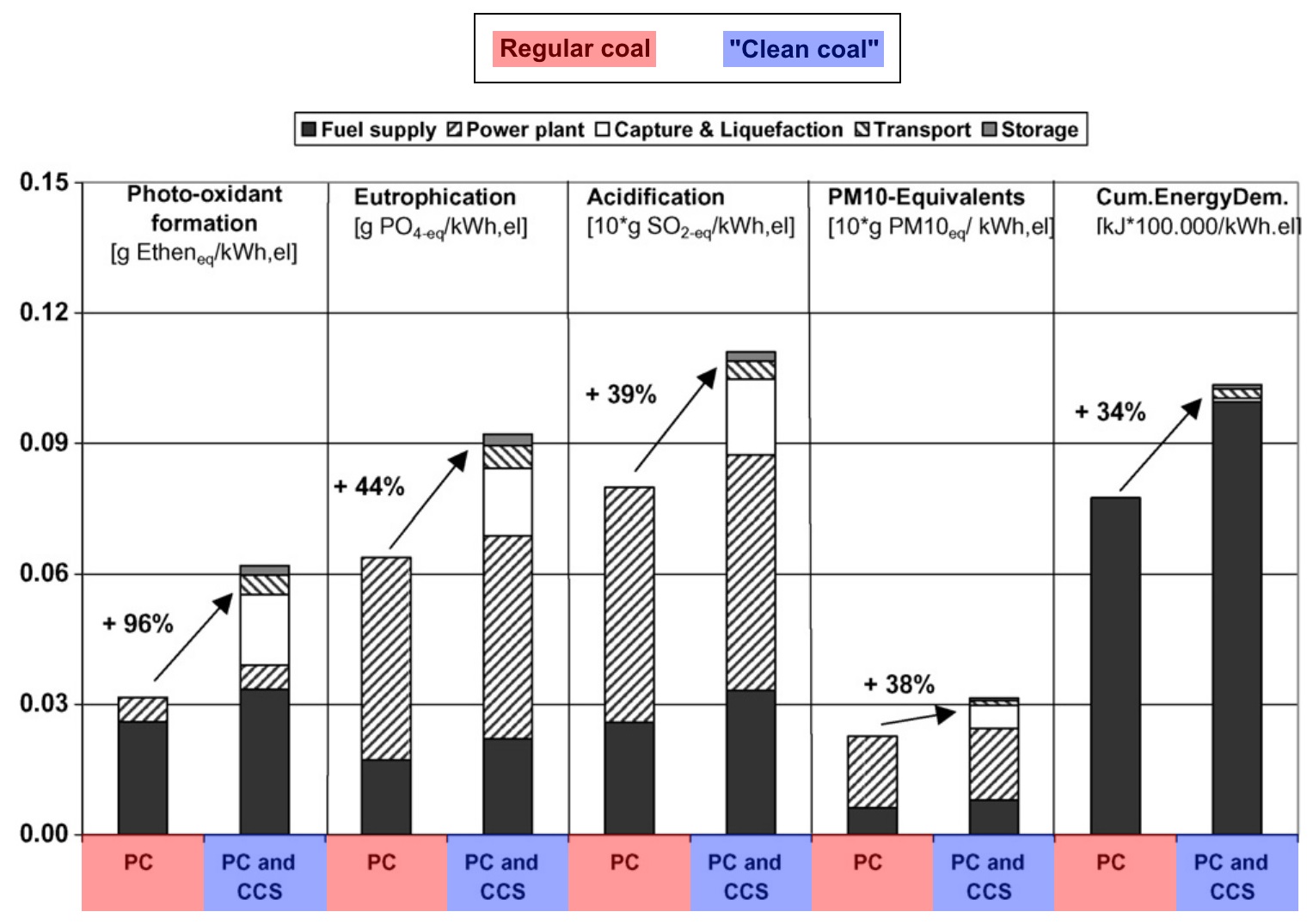
This shows the increase in environmental problems other than CO2 when CSS (aka “clean coal”) is implemented. It shows several different coal technologies. This figure is a copy of Figure 5 from Viebahn et al. 2007 (I added the colored boxes).

First, it only deals with the carbon dioxide that is produced by burning the coal. So, all of those other problems that I talked about still exist. All the erosion, stream pollution, lung cancer, etc., is still there. In fact, those problems become even worse! You see, CCS methods are not energy efficient. As a result, using them requires anywhere from 16–41% more fuel (depending on the type of CCS) than a regular coal plant uses to produce the same amount of power (Rubin et al. 2007; Rubin et al. 2015). That means more mining, as well as more emissions for gases other than CO2. As a result, environmental issues other than CO2 are worse with CCS than with regular coal power plants (Viebahn et al. 2007; Cuellar-Franca and Azapagic. 2015).

This shows the greenhouse gas emissions of CCS (aka “clean coal”) compared to regular coal, solar, and wind power. It shows several different coal technologies. This figure is a copy of Figure 4 from Viebahn et al. 2007 (I added the colored boxes).

In addition to all of that, CCS technology only removes 90% of the carbon (Rubin et al. 2007). Much like the nitrogen and carbon scrubbers I mentioned earlier, that’s good, but that 10% is still a lot of CO2, and, just to be clear, it is a lot more CO2 than we produce from renewable energy sources like solar or wind (i.e., it’s more than the carbon footprints from things like constructing renewable energy sources; Viebahn et al. 2007). Further, once the carbon has been trapped, it has to be transported to wherever it is going to be stored, which also uses energy and releases CO2. Plus, extra fossil fuels are required to mine the extra coal that we need since CCS plants are less efficient. So the net reduction in CO2 drops from 90% to 86–88% (Rubin et al. 2015). Additionally, although the extra CO2 is buried underground, some of it still slowly leaches out of the ground and enters the atmosphere (Viebahn et al. 2007). So, when it’s all said and done, CCS plants produce less CO2 than regular coal plants, but they still don’t even approach being truly clean, they still have a much bigger carbon footprint than renewable energy sources, and there are still tons of other environmental and safety problems. Indeed, “clean coal” makes those problems worse, not better.

Economics of “clean coal”

Beyond the environmental issues, there is another massive problem with “clean coal.” It’s freaking expensive. In addition to the cost of installing the CCS technology, you need more coal to produce the same amount of energy, and, once you’ve trapped the CO2, you have to pay to transport and store it. As a result, CCS plants are 39–78% more expensive than traditional coal power plants (depending on the type of CSS). Indeed, “clean coal” is so expensive that there are currently only 21 operating CCS power plants in the entire world, even though we have had this technology for decades (to be fair, several other plants are currently under development).

In the interest of fairness, I should make two caveats here. First, some people are experimenting with carbon capture and utilization (CCU) systems, where the carbon is used, rather than stored. This does reduce the cost, but probably not by enough to be meaningful because production of CO2 is expected to far exceed demand (Dowell et al. 2017). Second, like with any technology, the cost will come down with more research and widespread use. However, it needs to come down a lot for it to be economical, and the price tag for that research and development is quite high. Indeed, it’s estimated that we would need to invest $100 billion annually to get this technology where it needs to be.

“Cleaner coal”

Before ending this post, I do need to acknowledge one other group of technologies that are sometimes referred to as “clean coal.” These are technologies that focus on burning coal in more efficient ways that reduce the amount of emissions that are produced, rather than technologies that capture the CO2 after it has been released (for example, the DICE project in Australia). These projects still aren’t really “clean coal” though. “Cleaner” perhaps, but not clean. They still produce lots of CO2, and they still have all the issues with mining that I already talked about, as well as issues with emissions other than CO2.

Conclusion

A recent issue of Popular Mechanics may have said it best when it refereed to “clean coal” as, “a political pipe dream.” It is far more expensive than regular coal, and it’s not even clean! It does reduce the amount of CO2 that is released into the atmosphere, but it does not eliminate the release of CO2, and it is less efficient than regular coal plants. As a result, it requires more coal to produce the same amount of energy, which means that we have to mine even more coal, and coal mining causes a wide range of environmental and health problems including water pollution, deforestation, lung cancer, etc. So when you add all of that up, “clean coal” is an expensive misnomer, not a viable solution. It’s not clean, and it’s not economically practical.

I promised that I wouldn’t get political, but I do want to leave you with a question to ponder. Namely, if we are going to invest money into cleaner energy technologies (as we need to do), then wouldn’t it make sense to invest that money into the technologies with the fewest impacts on the environment and human health?

Note: Invariably, someone is going to respond with a host of supposed problems with renewable energy, so let me pre-emptively say a few things. First, that doesn’t change the truth of anything that I said about coal. Second, many of the arguments against renewables are myths or, at the very least, gross exaggerations. So please fact check carefully. Third, having said that, renewable energies certainly aren’t without their problems, and they do have an impact on the environment. However, when you add up all of the environmental costs (as well as costs to human health and the economy), the impact is much lower than fossil fuels.

 Literature Cited

  • Cuellar-Franca and Azapagic. 2015. Carbon capture, storage and utilisation technologies: A critical analysis and comparison of their life cycle environmental impacts. Journal of CO2 Utilization 9:82–102.
  • Dowell et al. 2017. The role of CO2 capture and utilization in mitigating climate change. Nature Climate Change 7:243–249.
  • Epstein et al. 2011. Full cost accounting for the life cycle of a coal. Annals of the New York Academy of Sciences 219:73–98.
  • Garcia-Perez et al. 2008. Mortality due to lung, laryngeal and bladder cancer in towns lying in the vicinity of combustion installations. Science of the Total Environment 407:2593–2602.
  • Guttikunda and Jawahar. 2014. Atmospheric emissions and pollution from the coal-
  • fired thermal power plants in India. Atmospheric Environment 92:449–460.
  • Hendry and Ahern. 2008. Relations between health indicators and residential proximity to coal mining in West Virginia. American Journal of Public Health 98:669–671.
    Liu et al. 2012. Association between residential proximity to fuel-fired power plants and hospitalization rate for respiratory diseases. Environmental Health Perspectives 120:807–810.
  • Mishra et al. 2008. Concentrations of heavy metals and aquatic macrophytes of Govind Ballabh Pant Sagar an anthropogenic lake affected by coal mining effluent. Environmental Monitoring and Assessment 141:49–58.
  • Rubin et al. 2015. The cost of CO2 capture and storage. International Journal of Greenhouse Gas Control 40:378–400.
  • Viebahn et al. 2007. Comparison of carbon capture and storage with renewable energy technologies regarding structural, economic, and ecological aspects in Germany. International Journal of Greenhouse Gas Control 1:121–133.
  • Younger. 2004. Environmental impacts of coal mining and associated wastes: a geochemical perspective. Energy, Waste, and the Environment: A Geochemical Perspective 236:169–209.
  • Zhengfu et al. 2010. Environmental issues from coal mining and their solutions. Mining Science and Technology 20:0215–0223.
Posted in Global Warming | Tagged , | 5 Comments

What is a species?

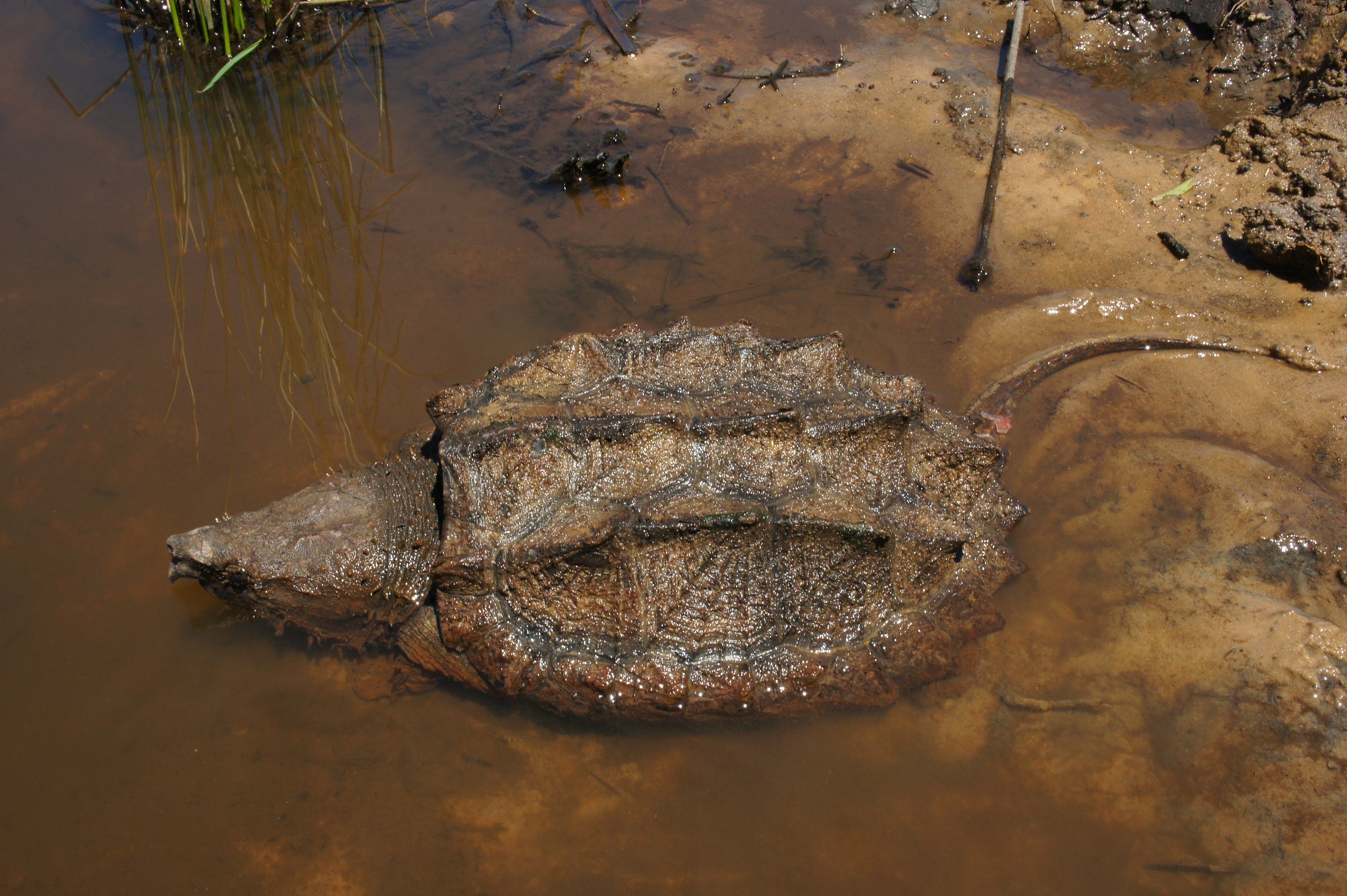
Alligator snapping turtle (Macrochelys temminckii)

Before you read any further, I want you to take a minute and try to answer the question in the title. Go ahead and write down (or at least think about) the definition that scientists use to determine whether or not two organisms are members of the same species. Now that you have hopefully done that, I am going to burst your bubble and tell you that if you wrote down a definition, then no matter what definition you wrote, you’re wrong, or at the very least, incomplete. You see, there is no one universally agreed upon definition of a species. Rather, there are numerous “species concepts” and scientists debate endlessly about what constitutes a species. Further, taxonomic revisions happen constantly and it is extremely common for one “species” to get split up into multiple “species” while other “species” get lumped together into a single “species.” For example, the alligator snapping turtle (Macrochelys temminckii) was historically thought of as a single species, but in 2014, Thomas et al. proposed that it should be split into three species: M. temminckii, M. apalachicolae, and M. suwanniensis. Then, in 2015, Folt and Guyer argued that M. apalachicolae and M. suwanniensis were not actually different enough to be considered distinct species and should, therefore, be lumped back together, resulting in just two species of alligator snapping turtle (M. temminckii and M. suwanniensis).

These types of revisions happen frequently, and scientists routinely disagree about how to separate species. Indeed, when you get right down to it, the whole concept of distinct species is an artificial one that we use to categorize things. It is not an actual property of nature, which is why it is so amorphous. Nevertheless, discussions about what constitutes a species are important, and they have strong implications for topics like GMOs and evolution. Therefore, I want to discuss several of the more common species concepts, how scientists go about deciding what to call a species, and why the concept of a species is artificial and ultimately somewhat arbitrary.

The biological species concept

Let’s start with what is probably the most well-known species concept: the biological species concept. This concept defines species based on the inability of different groups to breed with each other. In other words, if two natural groups of organisms can interbreed, then, according to this concept, they are the same species, whereas if they can’t interbreed, they are considered to be members of different species. Unfortunately, this is probably the concept that you learned in high school, and I say “unfortunately,” because this is a pretty terrible species concept, and scientists don’t really use it much anymore.

One of the most obvious problems is simply that it cannot deal with asexual species (i.e., species where a single individual can clone itself rather than relying on a mate). Asexual species are actually pretty common in nature, and even occur in various groups of vertebrates (e.g., some lizards), but according to this concept, every single asexual individual should be its own species because it cannot interbreed with other individuals, or, at best, this concept simply has no way to define asexual species.

The second problem is that hybrids are extremely common in nature, even among organisms that everyone agrees represent different species. Plants are infamous for their ability to hybridize across species (this happens in nature, not just in horticulture) but animals frequently do it as well. For example, consider the Mallard (Anas platyrhynchos). This is the ubiquitous green-headed duck that you can find at ponds, lakes, and rivers throughout the US. Everyone agrees that it is its own species, but it can hybridize with multiple other species of duck (e.g., American Black Ducks [Anas rubrics], Pacific Black Ducks [Anas superciliosa], Northern Pintails [Anas acuta], etc.). Further, in many cases, those hybrid offspring are not sterile and can reproduce (as can their descendants). Thus, according to the biological species concept all of those ducks should be one species, but based on every other species concept, they should be different species, and no scientist (or birder) in the world would suggest that we should lump them all together. Finally, I need to emphasize that this is not an isolated example. Hybrids are everywhere in nature, and I could show you examples of hybrids in other birds, snakes, lizards, frogs, turtles, fish, mammals, etc. This is a very common phenomenon.

The morphological species concept

This is another very old species concept, but it is still sometimes used today. It proposes that species should be defined based on whether or not they can be distinguished morphologically. In other words, if scientists can look at two groups of organisms and visually distinguish them (or distinguish them by their calls) then they are different species, but if they are indistinguishable, then they are the same species. So, for example, all of the ducks that I mentioned earlier can be visually distinguished, thus, based on this concept, they are different species.

This concept sounds good, but it has multiple problems. First, there are quite a few “cryptic species” (reptiles have tons of these). These are species that are impossible (or at least extremely difficult) to distinguish visually or audibly, yet when we look at things like genetics, it is clear that they are very different from each other and represent different groups (i.e. species). It is also worth mentioning that in many cases, we may not be able to distinguish them, but the organisms themselves may be able to distinguish each other based on traits like pheromones that we are pretty bad at picking up.

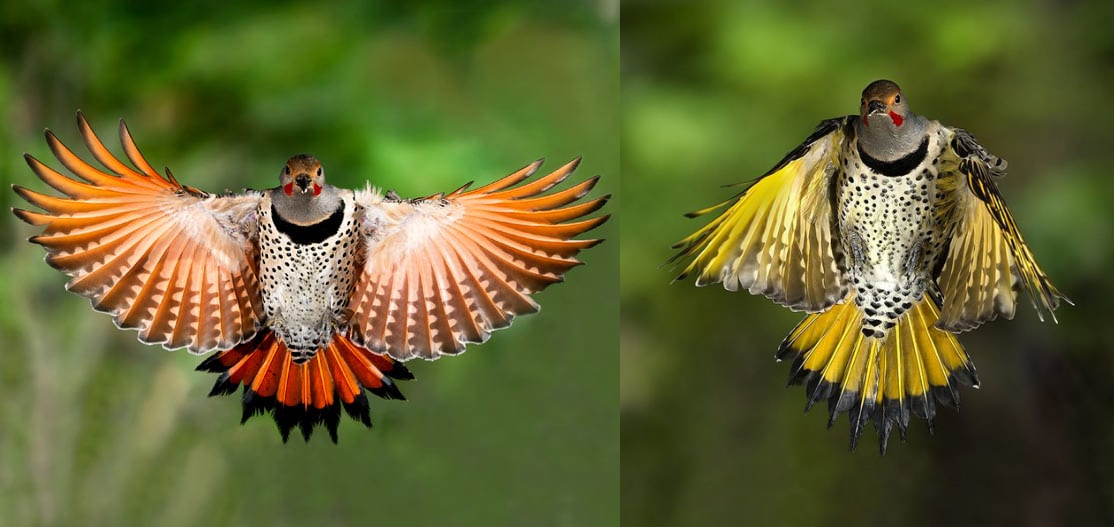
The other problem with this species concept is that many species have tremendous amounts of variation across their range. Take the Northern Flicker (Colaptes auratus), for example. This woodpecker is found all over the US, and in eastern half of the country it has beautiful yellow feathers. In the western half, however, those feathers are red. In other words, there are two morphologically distinct groups of this species, yet we consider it to be a single species. As with the biological species concept, I could give you tons of examples like this, and I would even go as far as saying that regional variations within a species are the norm, not the exception. A good way to think about this problem may be simply to ask the question, “how different do two groups need to be before we consider them to be different species?” There is obviously no objective answer to that, which makes the definition rather arbitrary.

Two color morphs of the Northern Flicker (Colaptes auratus): Red-shafted (left) and Yellow-shafted (right). They are morphological distinct, but are still considered to be the same species.
Images are from BioQuick News and Ewebarticle.

The genetic species concept

This concept is in many ways just a modern version of the morphological species concept, but instead of morphology, it uses genetics. Thus, two groups that are genetically distinct are considered to be different species. As with the morphological species concept, however, the key question is, “how different is different enough to be separate species?” Once again, the answer is, “no one knows, and it is arbitrary.” Various levels of genetic similarity have been proposed and applied, but there is no one universally accepted answer. Further, there are frequently disagreements between the morphological species concept and the genetic species concept. As a result, as I mentioned earlier, it is extremely common for scientists to disagree about whether or not two groups are different species, and species frequently get lumped and split. Indeed, I was recently at a conference where one researcher somewhat facetiously suggested that we should start using the terms “gecies” to refer to genetic species, and “mecies” to refer to morphological species.

The phylogenetic species concept

The final species concept that I want to talk about (though there are many of lesser importance that I did not discuss) is basically an extension of the genetic species concept. Once again, it uses genetic patterns, but this time, instead of simply using the degree of difference among groups, it attempts to look at evolutionary history. Thus, a species is a genetically distinct group with a shared evolutionary history that differs from the other groups. This is certainly useful, and is probably the most widely used concept today, but as with the other concepts, it is still largely arbitrary because there are no universally accepted criteria for determining when an evolutionary history is divergent enough to constitute a separate species.

Which concept is correct?

As you’ve hopefully gathered by now, scientists disagree about the answer to this question. In practice, we tend to try to look for a convergence of multiple species concepts, but again, scientists frequently disagree about whether two things are different enough to be considered distinct species, and proposed taxonomic revisions are often highly contested.

To add another layer of complexity to this, scientists often add additionally sub-categories. For example, many species contain multiple “subspecies.” These are geographical subgroups of a species that are different enough to be noteworthy, but similar enough that they don’t merit species status (the two flickers that I mentioned earlier are subspecies). Here again, however, scientists often disagree about the boundary between species and subspecies, and it is common for subspecies to get elevated to full species and for multiple species to get lumped and demoted to subspecies.

In other cases, scientists prefer to talk about “evolutionarily significant units” rather than dwelling on the species/subspecies distinction. These are simply groups (usually populations) that are genetically (usually phylogenically) distinct enough that they need to be discussed and managed separately, regardless of whether you want to label them as separate species. Similarly, in the world of microbiology, it is common to abandon the label “species” altogether and instead use OTUs (operational taxonomic units) which are narrow taxonomic groups that are distinguished by an arbitrary threshold of similarity (97% similarity is often used).

Why isn’t there a universally accepted species concept and how does this relate to evolution and GMOs?

Finally, and I think most importantly, I need to explain why scientists disagree about how to define a species. It’s not simply that scientists are an argumentative and ornery bunch (though that plays into it). Rather it is because there is actually no such thing as a species. The concept of a species in an entirely artificial one that we invented to help us make sense of the world. It is not an actual construct of nature.

You see, as I have explained before, evolution is a spectrum, not a series of distinct blocks. Thus, nature does not immediately form distinct and obvious species. Rather, a group of organisms splits and gradually evolves in separate directions with each generation resulting in more and more differences. At some point, those two groups become different enough that we consider them to be different species, but where we draw that line is arbitrary. It is a judgement call that we are making, rather than an actual property of nature.

Further, it is important to realize that this also applies to other levels of taxonomic classifications (especially genera and families). Like species, it is often not clear how to demarcate these, and taxonomic revisions are common. For example, a few years ago, the frog genus Rana was split into multiple different genera, with most of the ranids in the USA moving into the new genus Lithobates. Also, just like with species, there are subcategories (subfamilies, supergenera, etc.) and scientists often disagree about where to draw the line. Again, this is because these taxonomic divisions are artificial. They are useful tools for us to understand life on planet earth, but evolution produces a spectrum, not distinct blocks, and when we see distinct blocks, they only exist because the rest of that spectrum died out. Imagine, for example, looking at a rainbow and picking the point where the red stops and the yellow begins. You can’t really do it.

In addition to everything that I have said so far, it is also worth noting that nature is kind of a freak, and it does some really weird things that are nigh impossible to categorize. One example that I am quite fond of is the fact that several thousand years ago, sweet potatoes stole DNA from a bacteria and incorporated that DNA into their own genome (thus essentially making them a natural GMO). Similarly, some butterfly species incorporated viral DNA into their genomes (Gasmi et al. 2015). What do you do with that as far as assigning taxonomy? What do you do when a species forms by stealing DNA from a totally different group of organisms?

Further, those examples aren’t even the most extreme. There is, for example, a salamander in the genus Ambystoma that does something known as kleptogenesis (Bogart et al. 2009). This salamander is unisexual (i.e., only has females), but it is not asexual (i.e., it isn’t capable of reproducing on its own). Rather, they take sperm from up to four other Ambystoma species and use that sperm to fertilize their eggs. Thus, each generation is formed by stealing sperm from a different species (sometimes multiple species) and incorporating part of their genome. What do you do with something like that? It defies classification, which brings me back to my central point that taxonomic classifications are simply imperfect constructs for helping us to understand the world, rather than actual properties of nature.

So, what does all of this have to do with evolution and GMOs? Well, when it comes to evolution, I think that the implications are pretty clear. Evolution predicts a spectrum, and that is exactly what we see. I often hear creationists talk about species or families as totally distinct obvious groups, but that’s just not reality. The distinctions are extremely fuzzy and often arbitrary.  For GMOs, the implications are a bit more nuanced, but important nonetheless. Like creationists, anti-GMO activists often make a big deal about species being distinct and find the notion of moving a gene from one species into another to be abhorrent, but as you can hopefully now see, that view makes little sense once you understand how nature actually works. Organisms exist as a spectrum, not as extremely distinct units, and we all share the same DNA. To be clear, something like a fish and a tomato are obviously distinct, but that is only because they are far apart on the spectrum. Go back to the rainbow analogy for a minute. The pure yellow and pure red are clearly distinct from each other, but you’d do yourself a disservice by treating them as if they are totally separate and detached from one another, because they both fall along the same spectrum. Further, as I explained above, nature does not respect the arbitrary labels that we put on things, and it even moves genes between highly divergent groups (e.g., a sweet potatoes and bacteria).

My point in all of this is simple, organisms exist as a spectrum, not distinct blocks, and categories like “species” and “family” are artificial constructs that we created to help us understand the world around us. So before you make a big deal about different families and species for topics like GMOs and evolution, keep in mind that those categories are simply tools that we use, not actual properties of nature.

Note: The GMO tomato with “fish genes” never went to market.

Literature Cited 

  • Bogart et al. 2009. Sex in unisexual salamanders: discovery of a new sperm donor with ancient affinities. Heredity 103:483–493.
  • Folt and Guyer. 2015. Evaluating recent taxonomic changes for alligator snapping turtles (TestudinesL Chelydridae). Zootaxa 3947:447–450.
  • Gasmi et al. 2015. Recurrent domestication by Lepidoptera of gens from their parasites mediated by bracoviruses. Plos Genetics 11:e1005470.
  • Thomas et al.. 2014. Taxonomic assessment of Alligator Snapping Turtles (Chelydridae: Macrochelys), with the description of two new species from the southeastern United States. Zootaxa 3786:141–165.
Posted in GMO, Science of Evolution | Tagged | 22 Comments

Most anti-GMO papers contain serious flaws

Unfortunately, bad papers sometimes get published, and those faulty results often get hailed by members of the anti-science community as evidence for their positions. As a result, it is extremely important to both look at the entire body of literature on a topic and critically examine the papers themselves. More often than not, when you look at the literature for a scientific topic, you will find that most studies have converged on a consistent conclusion, while a few outliers have reached the opposite conclusion, but those outliers are usually riddled with problems and were published in minor journals. Thus, it is foolhardy to latch onto the handful of papers that agree with you, while disregarding the vast majority of papers that disagree with you.

This is a prevalent problem and one that I write about frequently (for example, I have previously written about how to evaluate scientific papers, Tenpenny’s cherry-picked “vaccine library,” the supposed lists of papers showing that vaccines cause autism, etc.). In this post, however, I am going to focus on GMOs. I’ve talked about this before, and explained that the anti-GMO position is, in fact, a form of science denial that is based on ideology, not evidence. As with topics like vaccines and climate change, the evidence that GMOs are safe for both humans and the environment is overwhelming, yet activists rally around the tiny subset of papers that agree with them. When you critically examine those papers, however, it quickly becomes clear that they are junk science. Indeed, that was the conclusion of an intriguing new review that was published in the journal Plant Biotechnology Journal, and I want to spend a few minutes talking about it.

Note: This paper was specifically on human health implications, not environmental implications, but the same story holds true when you look at the environmental papers.

The paper in question is titled, “Characterization of scientific studies usually cited as evidence of adverse effects of GM food/feed,” and I encourage you to read the whole thing. It is very accessible and easy to follow. Nevertheless, I will talk about a few highlights. In a nutshell, this study reviewed the literature, identified 35 studies that reported negative health effects associated with GMOs, then it evaluated the quality of those studies and placed them in the context of the wider literature. Unsurprisingly, it found that the quality of most of those 35 studies was quite low, and they often contained blatant flaws.

Small proportion of studies

5% anti-GMO studies health safetyFirst, it is important to note that these 35 studies represent a tiny fraction of the literature (only around 5% of the GMO papers the authors were able to identify). Right of the bat, that is a huge red flag. If the results of those studies were correct, then they should be what the majority of studies are finding, not what a tiny minority are finding. Indeed, because of the way that statistics work, we expect about 5% of experiments to produce false positives just by chance (details here). So even if these studies were flawless, they would still be indistinguishable from statistical noise when you look at the entire body of literature.

It is also worth mentioning that an extensive review of the literature, that looked at both human health and the environment, examined 1,783 studies and concluded that GMOs are no worse than conventional crops for humans or the environment and in some cases they are better (Nicolia et al. 2013).

Few labs and authors

The next thing to note is that these 35 papers were produced by a handful of researchers. Indeed, one researcher was an author on 11 of those papers. So what you have is a few labs that are repeatedly publishing papers that support the previous findings of those same labs. This is another problem. If their results were real, then other independent scientists from around the world should have found corroborating results, but they haven’t. That strongly suggests that something wrong is happening in these few labs, and, indeed, in some cases, there is clear evidence of fraud (more on that in a minute).

Low ranking journals

When evaluating a paper’s claims, it is always a good idea to consider the quality and reach of the journal that published it (this is often measured by an “impact factor” which is based on how widely cited a journal’s publications are). Whenever you have a really important, novel result, you try to publish it in a high impact journal. In contrast, if you have a fairly uninteresting result that everyone already expects or a result that is very specific to a narrow field, you generally publish it in a low-ranking journal. Thus, if the science is solid for claims like, “GMOs cause cancer” then you expect those papers to appear in very high impact journals, and you should be very suspicious when they show up in tiny journals that no one has ever heard of. Ask yourself, “why wasn’t a result that is this important and interesting published in a high ranking journal?” The answer is usually that it couldn’t pass their standards.

So, getting back to this list of 35 papers, what did the authors find? Perhaps unsurprisingly, nearly all of those papers were in minor journals. Indeed, eight of those papers were published in journals that are so minor they don’t even have an impact factor (that is another huge red flag), and an additional six had an impact factor less than one (which is a really low impact factor). In fact, only one of those 35 papers (Ewen and  Pusztai 1999) was published in a high ranking journal. This paper was, however, the source of great controversy. One of its reviewers found that it was flawed and should not be published, and another expressed serious doubts over the paper, but thought that, for the sake of openness, it would be best to publish the paper and let the general scientific community evaluate it, rather than risking the appearance of a conspiracy or cover-up (see the article for more details). I personally disagree with that decision, but it is, nevertheless, evidence that the crazy conspiracy theories about scientists suppressing evidence are just as insane as they sound. Additionally, The Lancet (the journal that published it) also published an editorial stating that some of the reviewers took issue with the paper.

Note: It’s worth mentioning that the review I am talking about was published in a well-respected journal with an impact factor of 7.443.

Conflicts of interest

I’m not personally super concerned over conflicts of interest (e.g., funding sources and employment by companies or activist groups), but it is, nevertheless, worth mentioning them. They found that 21 of the papers (60%) had conflicts of interest, which is higher than than the rate of conflicts of interest in the general body of GMO literature (Sanchez 2015 found that 58.3% of GMO studies had no conflicts of interest, 25.8% had clear conflicts of interest, and the remaining 15.9% could not be assessed [i.e., the authors were not linked to companies, but did not declare their funding sources]). The only point that I really want to make here is that this isn’t a situation where all 35 papers are free from conflicts of interest and all the papers saying that GMOs are safe are loaded with conflicts of interest. Rather, you have some of both in each group, which leaves you with 14 anti-GMO papers that have no conflicts of interest and at least 406 pro-GMO papers that have no conflicts of interest (see original paper for details).

Note: The authors of the review paper did acknowledge that they themselves have conflicts of interest, but that does not invalidate their results, and it does not give you carte blanche to ignore their findings. As always, when a conflict of interest is present, you should apply greater scrutiny, but you should not blindly disregard the study.

 Problems with the papers themselves

Finally, and most importantly, the authors found that problems abounded with the studies themselves. They summarized this nicely in table 1 (as well as providing more details in the text), but the problems included things like, “Flawed statistics (fishing for significance)” (de Vendomois et al. 2009), “No use of non-GM soybean as control” (El-Kholy et al. 2014), “No information on crop source; inadequate sample size” (Yum et al. 2005), “No biological relevance” (Tudisco et al. 2007), etc.

Further, the review talks about some of the more well-known examples of flawed GMO research. For example, there is Seralini’s infamous rat study which was so flawed that it was retracted (Seralini then submitted it to a predatory journal where it is currently published). Similarly, there are multiple papers by Federico Infascelli. If you pay attention to news in science at all, then his name might sound familiar, because last year it was discovered that he had manipulated the data on at least two of his papers, resulting in both of them being retracted. His entire body of work is now under close scrutiny and his reputation has been forever tarnished (more details at Retraction Watch and Science-Based Medicine).

Finally, it is worth mentioning that this is not the first paper to address this issue. A previous study (Panchin and Tuzhikov 2016) also found that anti-GMO papers were full of problems (namely, statistical problems), and that when you used the correct statistical tests, the reported negative effects of GMOs vanished.

Conclusion

So where does this leave us? The answer seems pretty clear: anti-GMO studies represent a tiny portion of the literature, they are usually published in low-quality journals, they are riddled with statistical and methodological problems, several of them have been retracted (sometimes because of scientific fraud), and they are refuted by a vast body of literature. Further, before you baselessly suggest that the pro-GMO papers were all bought off by big companies, please note that less than half of the general body of GMO literature contains conflicts of interest, whereas 60% of the anti-GMO papers contain conflicts of interest. In short, the anti-GMO papers are, at best, statistical noise, and they do not, in any way shape or form represent compelling evidence that GMOs are dangerous. Most of them are junk science and should be rejected as such.

Note: A similar paper on climate change papers reached the same conclusion. Namely, the handful of papers arguing against anthropogenic climate change are filled with problems. (Benestad et al. 2016; the supplemental information is particularly useful)

Literature cited

  • Benestad et al. 2016. Learning from mistakes in climate research. Theoretical and Applied Climatology 126:699–703.
  • de Vendomois et al. 2009. A comparison of the effects of three GM corn varieties on mammalian health. International Journal of Biological Sciences 5:706–726.
  • El-Kholy, et al. 2014. The effect of extra virgin olive oil and soybean on DNA, cytogenicity and some antioxidant enzymes in rats. Nutrients 6:2376–2386.
  • Editors of the Lancet. 1999. Health risks of genetically modified foods. The Lancet 353:1811.
  • Ewen and Pusztai. 1999. Effects of diets containing genetically modified potatoes expressing Galanthus nivalis lectin on rat small intestine. Lancet. 354:1353–1354.
  • Nicolia et al. 2013. An overview of the last 10 years of genetically engineering research. Critical Reviews in Biotechnology 34:77–88.
  • Panchin and Tuzhikov 2017. Published GMO studies find no evidence of harm when corrected for multiple comparisons. Critical Reviews in Biotechnology 37:213–217.
  • Sanchez 2015. Conflict of interests and evidence base for GM crops food/feed safety research. Nature Biotechnology 33:135-137.
  • Sanchez and Parrott 2017. Characterization of scientific studies usually cited as evidence of adverse effects of GM food/feed. Plant Biotechnology Journal.
  • Tudisco et al. 2007. Investigation on genetically modified soybean (Roundup Ready) in goat nutrition: DNA detection in suckling kids. Italian Journal of Animal Science 6:380–382.
  • Yum et al. 2005.  Genetically modified and wild soybeans: and immunological comparison. Allergy and Asthma Proceedings 26:210–216.
Posted in GMO | Tagged , , , | 7 Comments

“It’s morally wrong to patent food.” Inconsistent reasoning at its finest

This is one of the most common arguments against GMOs that I encounter (in addition to related attacks on Monsanto), and it is frequently accompanied by claims like, “I am not anti-GMO, but…” or “I accept that GMOs are safe, but…” In reality, however, this argument is usually nothing more than an excuse designed to protect people’s ideology, misplaced fears, and, yes, denial of science. This argument is so riddled with problems and so completely inconsistent with how people behave on any other topic that it is difficult to accept that it is truly the reason that people oppose GMOs, and in my experiences debating GMO opponents, it usually turns out that it is just a symptom of an underlying ideology (generally rooted in appeal to nature/emotion fallacies). As I will explain, if you are truly motivated out of ethics and a concern for feeding the hungry, then you should be embracing GMOs, not opposing them (or, at the very least, you should be very selective about which GMOs you oppose). So, if you are someone who frequently uses this argument, then, as always, all that I ask is that you hear me out and rationally consider whether or not you are being logically consistent.

Inevitably this post is going to receive tons of accusations that I am a “Monsanto shill” so let me state explicitly upfront that I do not now nor have I ever received any money from any agricultural company. I’m not a big fan of large corporations. However, genetic engineering (GE) is an extremely important tool that we need to be utilizing, and this irrational argument about patenting is used to block the progress of that technology. Therefore, I think it needs to be addressed. Regardless of my opinion about companies like Monsanto, there is a substantial body of evidence showing that the products they produce and technologies they develop are beneficial. Therefore, I will defend those products against illogical arguments.

Note: I have been somewhat reluctant to write a post on this because it is not actually an argument about the science. However, I am sick and tired of explaining it to people in comments, and it is such a prevalent argument that it seems worth taking the time to discuss.

Note: The original version of this post was written before Bayer bought Monsanto.

Patents aren’t limited to GMOs

First, it is vitally important to realize that the ability to patent crops is not unique to GMOs, nor is it a result of them. In the US, the first piece of legislation that made it legal to patent crops was the Plant Patent Act that was passed in 1930, over half a century before the first GMO crop. Indeed, many of our common crops are patented (or at least where patented when they were first invented; remember patents only protect intellectual material for a certain period of time). For example, seedless grapes were patented in 1934, yet I don’t hear anyone complaining about them.

The organic industry (and yes, it is a multi-billion dollar industry) also patents plants. For example, Vermont Organics owns patents on five different plants. So, if you are outraged over Monsanto patenting plants, then you had better be equally outraged over Vermont Organics doing so.

The point is that attacking GMOs because they are patented makes no sense, because most crops are patented, regardless of whether they are GMOs. So, this argument holds GMOs to a different standard than all of the rest of agriculture. Further, as mentioned earlier, patents expire. For example, Round-up read soybeans are no longer protected by patent laws because those patents expired in 2015. Does that mean that anti-GMO activists are going to stop protesting them? I somehow doubt it.

Finally, it is worth making it explicitly clear that GE companies, organic companies, etc. are not “patenting Mother Nature.” They are patenting unique crops that do not occur in nature and that they invested in developing (see below). As I have previously explained, virtually none of your food is natural, and essentially all of it has been genetically modified, even if it isn’t typically described as a GMO. So we aren’t talking about products that people would have access to if it wasn’t for greedy GE companies. Rather, we are talking about products that wouldn’t exist if it wasn’t for GE companies, and demanding that GE companies give away the products that they invested in developing is completely inconsistent with how we treat every other company.

Patenting a GMO shouldn’t be different from patenting anything else

Additionally, it is worth talking about why crops can be patented in the first place. Producing a new crop is very expensive, especially for a GMO. It takes millions of dollars to research and develop a new product, and that is money that the company has to invest up front with the expectation that they will be able to turn a profit later. Thus, patents are a way of allowing companies to get a return on their investment. This is true for all patents, and in most areas, people have no problems with that. No one says that Apple is evil because they patent the technology for each new iPhone rather than giving the technology away freely. Similarly, no one complains that Toyota tries to make a profit off its innovations, so why should GMOs be any different? Why should Monsanto and other GE companies be held to a different standard than any other company?

I’m a big believer in the Socratic method, so let me use a series of questions to try to get you to really think about this. If Canon, Nikon, Sony, or any other camera company invested millions of dollars in developing a new camera product, then patented the result and tried to make money from it, would you consider them to be evil for doing that? Would you say that they had done something morally wrong? I’m willing to bet that the answer is “no.” Now, what if Monsanto invested millions of dollars in developing a new crop, then patented the result and tried to make money from it, would you consider them to be evil for doing that? A lot of people would answer “no’ to the first question, but “yes” to the second, but that makes no sense. Why should Monsanto be vilified for doing exactly the same thing that every other for-profit company does?

Additionally, it is important to realize that a lack of patents would stifle innovation. There are non-profits and independent scientists involved in the development of GMOs (more on that in a minute) but a lot of the breakthroughs come from big companies, and there is a very good reason for that. Namely, research costs money, and big companies are the ones who have money to invest. However, companies are, admittedly, after profit. So they aren’t going to invest millions of dollars into something unless they think that they can turn a profit. To be clear, I am all for independent, non-profit research, and I am actually quite progressive politically and am all for various strategies of wealth redistribution, but having said that, it is undeniable that the free market fuels innovation, and if you want agricultural developments (as you should if your goal is really to feed the hungry), then you should allow companies to make a profit, because that is the only way that they are going to invest heavily in researching agricultural advances.

Not all GMOs are about money

Next it is important to realize that although large companies dominate the development of GMOs, not all GMOs are about money. Golden rice, for example, is being developed entirely for humanitarian purposes. You see, many countries suffer from extreme vitamin A deficiencies, and many of those countries grow primarily rice. Thus, scientists and humanitarians developed golden rice, which is simply rice that produces vitamin A. That way, these countries can grow the same crop that they always have (thus they don’t need to change their agricultural practices) but they will get the vitamin that they so desperately need.

Now, if you are truly concerned about feeding the hungry, and if humanitarian concerns are really the reason that you oppose GMOs, then you should be all for golden rice, GMO bananas, and the other non-profit GMOs, but that almost never seems to be the case. Anti-GMO groups constantly attack these crops (including destroying test fields) and they lump them in with all of the other GMOs. That is why in my opening paragraph I said that this argument strikes me as disingenuous. You can’t claim to oppose GMOs out of humanitarian concerns while simultaneously opposing GMOs that are literally life-saving.

GMOs benefit the poor and the hungry

This is related to the previous point, but it is worth making saying it explicitly: GMOs help to feed the poor. Studies have repeatedly shown that using GMOs increases crop yields and reduces the amount of resources need to grow crops. Consider, for example, this 2014 meta-analysis that found (my emphasis),

“On average, GM technology adoption has reduced chemical pesticide use by 37%, increased crop yields by 22%, and increased farmer profits by 68%. Yield gains and pesticide reductions are larger for insect-resistant crops than for herbicide-tolerant crops. Yield and profit gains are higher in developing countries than in developed countries.”

Again, this should be great news if your concern is really feeding the poor. These crops will let impoverished countries greatly increase the amount of food that they can grow, so they are a huge win for fighting world hunger. Really think about this, by opposing GMOs you are trying to force poor countries to grow fewer crops than they could with GMOs. You are literally trying to deny people food. How is that moral?

GMOs benefit farmers

It is also worth mentioning that GMOs are good for farmers (that is why they have adopted them). Anti-GMO activists often try to paint farmers as the victims of evil “Monsatan,” but the reality is that farmers love GMOs, because GMOs allow them to increase their yield and/or decrease the amount of effort/resources that they have to invest. This should be obvious if you just think about it for a second. Why on earth would so many farmers switch to GMOs if they weren’t beneficial? No one is putting a gun to their heads and forcing them to use GMOs. Farmers choose their seeds from catalogues where numerous companies compete for their patronage, and Monsanto doesn’t have a monopoly on the food supply, despite what activists want you to believe. Further, farmers aren’t stupid. They wouldn’t use GMOs if better, cheaper methods were actually available. Farmers have widely adopted GMOs precisely because they are beneficial. So, stop pretending that farmers are the victims. They aren’t (I talked in detail [with citations] about the benefits of GMOs [specifically Bt GMOs] for farmers and the environment here).

Bad counterargument 1: “But Monsanto sues farmers!”

In the remainder of this post, I want to deal with some truly awful counter arguments. The most common of which is that Monsanto sues farmers for accidentally using their seeds/cross-pollination. The rebuttal for this one is easy: no they don’t. Monsanto has never sued a farmer for accidentally using their product/cross-pollination (more here).

Having said that, there have been a few cases where Monsanto sued someone for deliberately violating the patent agreement (e.g. selling seeds or growing crops out of contract). That is, however, an entirely different issue from suing a farmer over accidental contamination. A deliberate violation of the patent agreement is a theft of intellectual property, plain and simple. It is a crime. It is no different from selling bootlegged DVDs. No one complains when a company like Universal brings movie pirates to court, so why should you complain when Monsanto brings seed pirates to court? This goes back to some of my keep points early. Namely, arguments like this hold GE companies to a different standard than any other company. Monsanto invests millions of dollars in R&D, so why shouldn’t it be allowed to protect its intellectual property?

Bad counterargument 2: “But farmers can’t replant the seeds”

Do you know what group of people I almost never hear make this complaint? Farmers. The reality is that in the modern era, most farmers don’t save the seeds regardless of whether or not their crop is a GMO. One of the key reasons for this is simply that doing so results in a lower quality harvest than you would get from buying new seeds (more details here). So, as with so many anti-GMO arguments, this argument is based on a complete lack of understanding about modern agriculture.

Bad argument 3: “The real problem is food waste. If first world countries weren’t so wasteful, there would be plenty of food to feed the world.”

This is what is known as a “nirvana fallacy.” It proposes an extremely unrealistic ideal situation, then claims that any plans that fall short of that standard shouldn’t be used because they aren’t perfect or don’t address the “real” issue. To be clear, food waste is a problem, and I agree with you 100% that we should be limiting it, but limiting it to the point that we could feed the world is an incredibly difficult (probably impossible) thing that is not going to happen in the near future. Meanwhile, there are people suffering from vitamin A deficiencies who could easily be saved by implementing GMOs. People are literally dying while you sit there demanding that we wait for an unrealistic solution.

Further, even if first world countries suddenly majorly cut back their food waste, that solution has several other problems. Most importantly, we have to somehow get that food to the countries that need it (which adds massive transportation costs, increased greenhouse gas emissions, etc.), and it makes those countries entirely dependent on aid from other countries. GMOs solve both of those problems because they can be grown by local farmers in the country where they are needed, thus allowing the country to feed its own citizens without needing constant supplies of food from other countries.

 Bad counterargument 4: “But [insert conspiracy theory]”

There are a plethora of conspiracy theories out there about Monsanto depopulating the world, causing mass suicides, etc. and each one is crazier than the last, so please don’t waste my time or your intellectual integrity on them. Use impartial sources, make sure that you are basing your views on facts, not assumptions or speculation. Demand good evidence before accepting something.

Bad counterargument 5: “We’ll I just don’t think people should profit from food”

The final argument that I want to discuss is this general aversion to the notion of big, money-loving companies being involved in food production. This is important, because I think it is actually a key motivating factor driving everything that I have talked about. As I have shown, the opposition to patents and Monsanto more generally isn’t actually about facts or logic. In some cases it stems from science denial, but in many, I think it stems from this emotional connection to our food, but that is irrational for several reasons.

First, as I explained previously, GMOs benefit the poor, farmers, etc. so this argument is clearly wrong right from the start. Second, this is, once again, inconsistent with how we treat every other company (and even person) on the planet. If, for example, a family that owns a farm tries to make a profit off that farm, no one villainizes them. No one says that they are evil for profiting from the production of food. Indeed, we would applaud their industry and hard work. So if it is fine for them to make a profit off of food, when is it wrong for GMO companies to do that?

Now, you might object to that on the basis that Monsanto is a multi-billion dollar company, but that doesn’t help your inconsistencies one bit for two reasons. First, the initial argument was, “it is wrong to profit from food,” but now you are trying to implement some arbitrary threshold of profit at which it becomes immoral.  Second, organic farming is also a massive, multi-billion dollar industry. Indeed, Whole Foods (a large organic store chain) makes nearly as much money as Monsanto, and is profitable enough that Amazon just paid 13.7 billion dollars for it. So, if making billions of dollars off food makes Monsanto evil, then it must also make Whole Foods evil, but no one thinks that Whole Foods is evil, and many GMO opponents shop there! Also, by extension, it must now make Amazon evil, but I’m betting you’re still going to spend your money there. Do you see how inconsistent that is? You can’t vilify Monsanto for profiting from food, then go shopping at a multi-billion dollar food store.

Finally, this argument is inconsistent not just with organic food chains, but also with how we view companies more generally. Let me break it down this way, at its core, this argument claims that Monsanto and GMOs are evil because they aren’t feeding the hungry, but we could make that same claim about essentially every massive, for profit company. Apple could spend its vast wealth feeding the hungry, yet no one says that they evil for hoarding their wealth. Why should Monsanto be any different? Why should the fact that they are actually involved in food production make their quest for profit any less ethical than any other company’s? Why should the fact that they care more about profit than feeding the hungry make them any more evil than any of the thousands of other companies that care more about profit then feeding the hungry? Further, again, keep in mind that we aren’t talking about products that already existed prior to GE companies developing them. We are talking about products that only exist because companies thought they could profit from them.

Again, to be clear, I’m not a huge fan of massive companies. I do think that they should do more to help the poor, and I am all for re-designing tax codes to limit the amount of wealth that can be hoarded, but that reasoning has to be applied consistently rather than singling out Monsanto.

Note: This post was set to automatically go live while I am away with only intermittent internet access. So, my responses to comments will probably take a while and be intermittent. Also, please stay on topic and don’t go off on other GMO topics (e.g., pesticides, safety, etc.). There are other posts for those topics (see Comment Rules for details).

Related Posts

Posted in GMO | Tagged , | 15 Comments

GMOs and natural selection: Nature doesn’t give a crap about you

Last week, I shared a meme about GMOs on my blog’s Facebook page, and several people responded by arguing that genetic engineering (GE) shouldn’t be used because “it bypasses the natural evolutionary test of fitness.” I’ve heard this argument before, and it is basically just a dressed-up appeal to nature fallacy that asserts that something that has undergone natural selection will somehow be better for us than something that has not. That notion is, of course, ridiculous. It has all the problems of a normal appeal to nature fallacy, plus it relies on numerous misconceptions about evolution, GMOs, and test of natural selection evolutionagriculture in general. So, let’s take this one step at a time and go over why this argument doesn’t work.

Nature doesn’t care about you

The first, and perhaps most obvious, problem with this argument is that it assumes that nature is somehow looking out for your best interests. It implicitly asserts that natural selection is acting on fruits and vegetables to bring about a result that is beneficial for you. In reality of course, nothing could be further from the truth.

Natural selection is nothing more than a sampling bias that operates off of two simple premises. 1). There is heritable variation for traits (i.e., different individuals have different genetic material [alleles] for a given trait, and they can pass that genetic material on to their offspring). 2). That variation affects individuals’ ability to pass genes on to the next generation. When those two conditions are met, individuals with beneficial traits will pass on more genes than individuals who lack those traits, and, as a result, those traits will be more common in the next generation. That’s it. That’s all it is. You will notice, however, that those two requirements have absolutely nothing to do with you or humans more generally. There is no third requirement that states that a given trait has to be beneficial for humans. Indeed, your needs  have no bearing whatsoever on the evolution of other organisms. You’re not that important.

This should, of course, by blatantly obvious, because nature is full of things that are utterly terrible for humans. Consider mushrooms in the genus Amanita for example. They produce chemicals known as amatoxins that are extremely toxic to humans at anything but an incredibly low dose. If you eat a single one of these mushrooms, you will spend the next 24–48 hours with agonizing abdominal cramps, as well as fluids gushing uncontrollably out of both ends of your digestive system. Your only escape from this will most likely be the sweet release of death when your liver eventually shuts down. There is currently no known antidote for amatoxins, and doctors can’t do much for you other than keep you hydrated (or if you’re really lucky, give you a liver transplant).

Now, why would nature produce something so terrible? Because it doesn’t give a flying flip about you. The genus Amanita evolved to be deadly because that is what was beneficial for it, not because of what would have been beneficial for you. Mushrooms that produced a toxin where eaten by animals less frequently than mushrooms without the toxin, and, therefore, survived longer and produced more offspring. As a result, the genes for toxicity became more and more prevalent in the population, until we eventually got the horrifying product that currently grows in our forests. That’s it. That’s how natural selection works. You’ll notice, however, that this supposed, “natural evolutionary test of fitness” had nothing to do with you. It was about the organism that was adapting (i.e., the mushroom) not the organism that was looking for food (i.e., you).

Note: I want to make it clear that although we talk about natural selection as benefiting organisms, it is only acting on the available genetic variation, and it can only adapt populations to their current environment. It does not have any foresight and it does not give organisms what they truly need. More details here and here.

Note: It is true that there are mutualistic relationships in which two organisms evolve together, but those only occur when the organisms are directly interacting, and even then, nature is not trying to adapt one in a way that is beneficial for the other, rather it is all about the organism that is adapting. For example, hummingbirds rely on nectar from flowers, and, in many cases, plants evolved to produce nectar for the hummingbirds (and other pollinators); however, that evolution did not take place because it was good for the bird. Rather, flowers that produced nectar were visited by the birds, and the birds happened to pick up some pollen while they were there, and that allowed the plant to produce more offspring. So, the plant didn’t evolve to produce nectar because it benefited the bird. Rather, it evolved to produce nectar because that ultimately benefited the plant (benefiting the bird was merely a means to that end). Further, organisms are constantly trying to “cheat” and even in these mutualistic relationships, there is usually an evolutionary arms race where each organism tries to game the system. Finally, humans do not have this type of shared evolutionary history with most of our crops (see next point). 

 Our crops didn’t come from natural selection

This is what a wild banana looks like. Nature’s version doesn’t look as tasty as ours, does it?

The next major problem is the simple fact that our crops were produced by artificial selection, not natural selection (i.e., they were made by the same process that made the Chihuahua, not the process that made the wolf). Because nature is a jerk that doesn’t care about humans, we had to step in and make the crops ourselves. We took the small, barely edible products of nature and, over thousands of years of careful breeding, we modified their genetic codes and transformed them into the large, delicious items that we consume today. Wild bananas, for example, are small and full of giant seeds. Similarly, wild corn (teosinte) does not produce the large cobs that we consume. Indeed, virtually none of the items on our produce shelves can be found in nature.

Artificial selection can have unintended consequences

Now, at this point, you might be tempted to assert that the fact that we have been the ones selecting the crops actually makes the argument better, because surely we would not select a trait that is harmful. However, that response ignores basic concepts of genetics. You see, when you select a trait, hybridize crops, etc. via traditional breeding techniques, you don’t just exchange the genetic code for trait that you are interested in. Rather, you exchange genetic information across the entire genome. Thus, you alter thousands of traits, not just the one that you are interested in.

Imagine, for example, that you have two crops, one of which is small but drought resistant, and the other of which is large but not drought resistant. Now, you want to get the drought resistant trait into the large crop, so your cross breed them. This succeeds, and the genes (technically alleles) for drought resistance get moved into your large crops. However, thousands of other alleles also got moved. So, while you were after the drought resistant ones, there may have also been genes for producing a deadly chemical, allergen, etc. that you just moved without ever knowing it.

Note: when I say, “deadly chemical” or “toxic chemical” I mean deadly/toxic at a low dose. The dose makes the poison, so everything is toxic at a high enough dose.

Indeed, this is essentially what happened with the Lenape potato. It was bred for traits like low sugar content, but it was eventually discovered that it also produced high levels of the chemical solanine. This chemical is normally in potatoes, but usually it is at a low enough dose to be safe (unless you eat unripe potatoes), but the levels of it were unusually high in the Lenape potato. Indeed, they were high enough to make people who ate it nauseated. How did this mistake happen? Quite simply, the potato was selectively bred for one trait, but in the process, the breeders accidentally and unknowingly selected for an additional trait (high solanine levels) that was harmful to humans.

natural corn teosinte

Even when it has been organically grown, the corn that we eat is not natural, and it is quite different from wild corn (teosinte). Our crops have been genetically modified via thousands of years of careful breeding, and the fruits, vegetables, and animals that we eat today contain novel genetic codes that are not found in nature. Image via mentalfloss.com.

This is one of the huge advantages of genetic engineering: it is precise. With GE, you could take the specific genes for drought resistance and move them without moving any other genes! As a result, GMOs should actually have fewer unintended consequences than traditional breeding methods (and studies have confirmed that they have fewer than mutation breeding methods). To put that another way, both breeding methods involve moving the DNA from one organism to another (sometimes even across species, e.g., hybrids), and the only important difference is that genetic engineering allows you to be precise and move only the genetic material that you are trying to move.

Further, we can even use GE to correct mistakes that have arisen during traditional breeding methods and/or natural selection. For example, when fried, traditional potatoes release a chemical called acrylamide, which is a suspected carcinogen (like I said, traditional breeding methods and/or natural selection can result in nasty unintended consequences for humans). Thanks to GE technology, however, we have now produced a GMO potato that doesn’t produce that chemical. Further, that technology allowed us to knock out that one specific trait without screwing with any others. By any reasonable standard, that is a good thing and makes GE far superior to traditional breeding methods.

Conclusion

To sum all of this up, nature is not your friend, and the fact that something evolved naturally does not in any way shape or form guarantee or even suggest that it is good for you. Species evolve the traits that are beneficial for them, not the traits that are beneficial for you, and natural selection has produced some of the most horrifying things imaginable. Further, artificial selection and other breeding methods (e.g. mutagenesis) also do not guarantee a safe product. All of them involve altering the genetic code, and that always has the risk of unintended consequences. Genetic engineering is different from these methods in only one important way. Namely, the changes that it makes to the genetic code are more precise. So if we are going to worry about an unintended consequence from changing the genetic code of an organism, surely we should be the least concerned about the method that makes the fewest and most precise changes (i.e., GE).

Related posts

Posted in GMO | Tagged , , , , , | 7 Comments