Incredulity fallacy: I’m right because I can’t believe I’m wrong

incredulityI want to briefly discuss a logical fallacy that is surprisingly common, despite being so obviously absurd. I suspect that most people committing this fallacy do so without ever actually contemplating what they are saying, and it is my hope that discussing this fallacy will help people to both spot and avoid it.

The fallacy in question goes by many names including, argument from incredulity, personal incredulity, appeal to incredulity, appeal to personal incredulity, and argument from personal incredulity. I will simply refer to it as the incredulity fallacy.

“Incredulity” refers to an inability or unwillingness to consider the possibility of something, and the fallacy occurs when someone asserts that they are right about something because they cannot personally imagine that the alternative is true.

Stated like that, hopefully the problem is obvious. Reality is not determined by an individual’s imagination. Whether or not someone can imagine that something is true has absolutely zero bearing on whether or not it is true, and someone’s lack of imagination is not a good argument against something. Nevertheless, this argument is pervasive.

To illustrate this, I’m going to use an example that I have personally run into countless times over the past few years, and I suspect many of you have encountered it as well. The argument is from the political world, but I’m not making any political comments here. I’m just using this one particular argument to illustrate the fallacy.

I know many people, including family members, who think that Trump won the 2020 presidential election, and when I ask them why they don’t accept the results, one of the answers that I inevitably get is something along the lines of, “come on, you don’t really think that Biden got 81 million votes, do you? There’s no way 81 million people voted for Joe Biden!”

This is always stated as if it is a concrete, established fact that 81 million people could not possibly have voted for Biden. In reality, of course, it is nothing other than a self-reinforcing projection of their existing views.

We can rephrase it simply as, “I cannot personally imagine that 81 million people voted for Joe Biden, therefore it didn’t happen.”

The argument is, of course, entirely circular. We can rephrase it yet again as, “I don’t believe Joe Biden won because I don’t believe Joe Biden won.”

At no point are facts or evidence injected into the view. The view is simply stated as a fact.

While that example came from politics, this flawed reasoning also pervades anti-science arguments. For example, I have frequently encountered anti-vaccers who make statements like, “I can’t accept that injecting chemicals into an infant is good for them” or climate change deniers who say things like, “you honestly think that humans producing a little CO2 will alter the climate? lol.” These are both examples of incredulity. Just because someone doesn’t personal think “chemicals” can be good or human CO2 emissions can change the climate doesn’t mean those positions are false.

You’ll also notice that this fallacy is closely related to (and in some cases identical to) the appeal to common sense fallacy or just “gut feelings.” In all of these cases, the arguments are about what someone “feels” is true or false, not about what is actually verifiably true or false.

Going back to one of my interactions with a family member, when I pressed them on why they refused to accept that Biden won in 2020, they said, “It’s just common sense!” The problem, of course, is that “common sense” is not objective and varies from one person to another. As I pointed out to them, my “common sense” tells me that Biden won, so whose common sense should we listen to? If “common sense” is a reliable indicator of reality, then why do our “common senses” disagree with each other?

Likewise, I constantly encounter people who insist that it is just “common sense” that vaccines are dangerous, climate change isn’t being cause by humans, GMOs are dangerous, etc. Meanwhile, my “common sense” says the opposite. So, whose “common sense” is right?

This is, of course, precisely why we conduct rigorous scientific studies (and conduct elections) rather than just asking random people what they think. Sticking with the election example for a minute, if we follow these people’s arguments though to their logical conclusions, then there is no reason to hold an election. All we have to do is ask them who they think would win and we have our result. That, of course, is madness.

All of these brings me back to two central points that I make over and over again on this blog. Honestly, they are the two points at the very core of this blog’s existence.

First, fact check everything using good sources. Take nothing for granted. Verify that something is true before you believe it and verify that it is false before you reject it.

Second, be willing to be wrong. If you are someone who has made statements like the ones illustrated in this post, then really stop and think carefully about your views. Doesn’t it bother you that your argument boils down to “I’m right because I know I’m right?” Don’t you want to have a view of the world that is actually based on evidence and facts?

Always ask yourself, “what evidence would convince me that I am wrong?” If you say that nothing will convince you that you are wrong, then your position is, by definition, willfully ignorant.

Set aside your biases and preconceptions, accept the possibility that you might be wrong, and actually look at the evidence. Don’t trust your “gut instincts” or “common sense” or what you “just know.” Look at what is true, not what you want to believe is true.

Related posts

Posted in Rules of Logic | Tagged , | Comments Off on Incredulity fallacy: I’m right because I can’t believe I’m wrong

Yes, you should fact-check

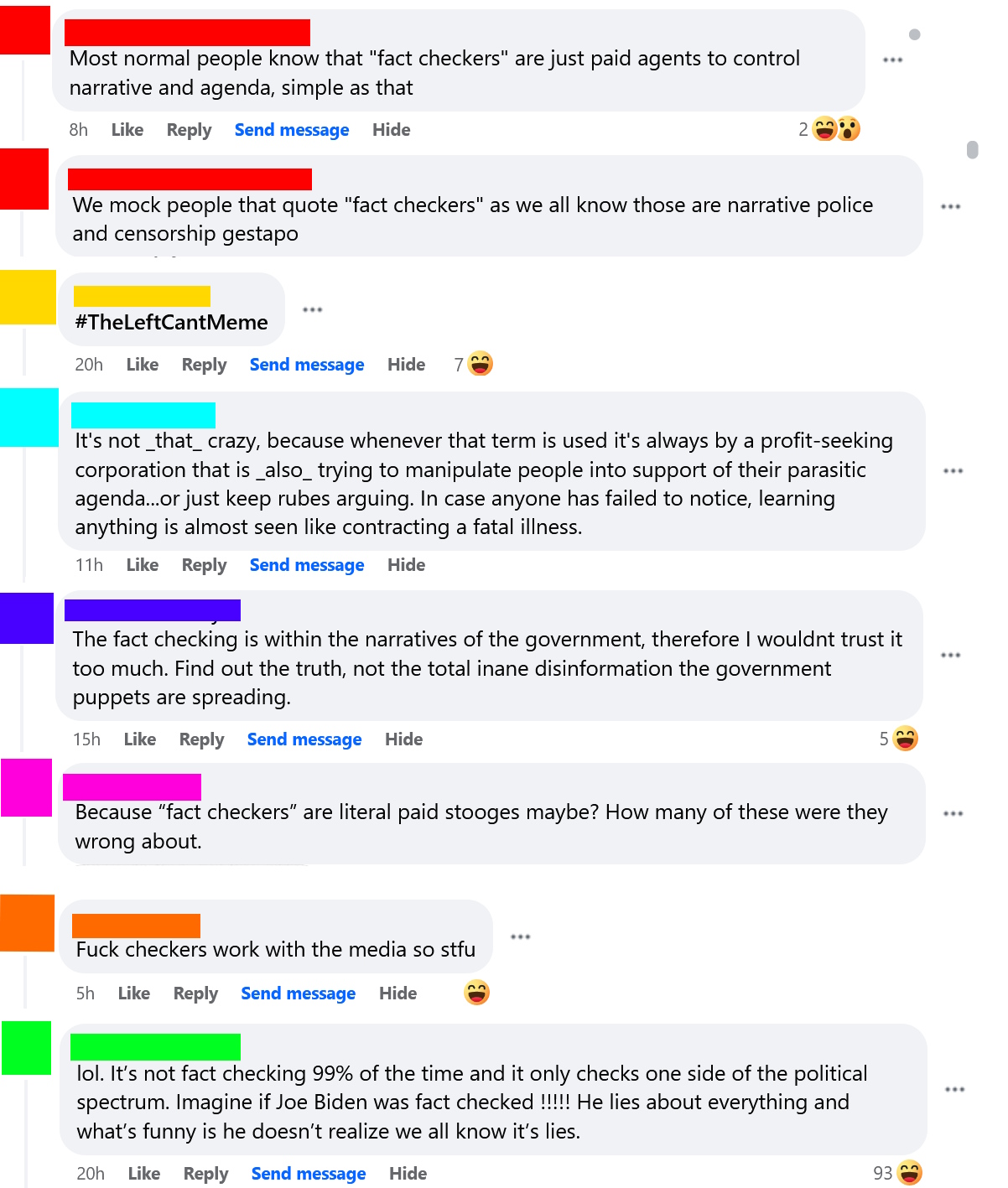
fact-checking, facts, checking, fact, missinformationYesterday, I posted the fairly innocuous image above on the TLoS Facebook page, and the results were both fascinating and horrifying. Numerous people took time out of their day to embarrass themselves by doubling down and attacking fact-checkers, often with truly deranged comments that were totally detached from reality and clearly illustrated why fact checking is so important. Further, multiple people (all on one side of the political aisle) incorrectly interpreted this as a political post, a response which is delightfully revealing. Given the responses that this post engendered, I think it will be instructive to clarify several points and discuss some of the comments. This is hardly the first time that I have written about fact-checking, and you can read a much longer post on it here.

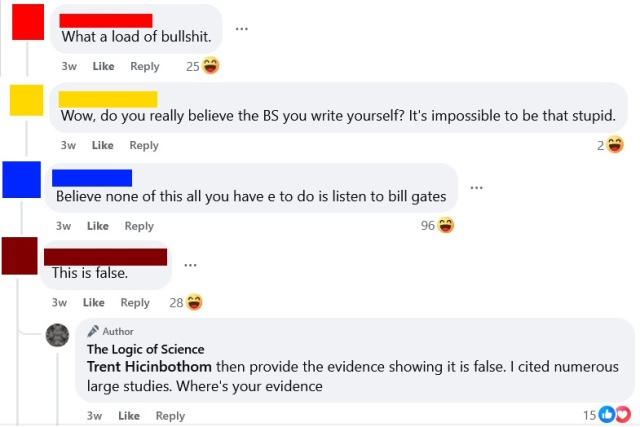
fact checkign post 2First, I want to deal with the strawman that I was suggesting that people should blindly believe fact-checkers (see a selection of such comments to the right). I have never said anything of the sort, and, in fact, the original post wasn’t about professional fact-checkers at all. Rather it was about individuals checking facts before believing something.

That said, professional fact-checking organizations like Snopes, Politifact, and FactCheck.org are extremely valuable (as are science and skepticism websites that often play the role of fact-checker); however, these sources are valuable not because they are authoritative, but rather precisely because they are transparent and cite their sources. I’d never suggest that someone should blindly believe a source like Snopes, but the break-down of why and how they came to their conclusion and what sources they used is incredibly useful. You don’t have to blindly believe fact-checkers because you can look at their sources and verify what they are saying! You can also cross-check multiple fact-checkers to see if they are in agreement or if one has uncovered information that the others missed.

Fact-checking doesn’t mean finding a source you like and blindly believing it. Rather, it means checking multiple sources, verifying the claims they make, and tracing things back to their origin as much as possible.

Other comments went a step further and asserted that fact-checkers are unreliable, biased, and often wrong. When pressed for data to back up those claims, however, no one managed to cite actual evidence, and the attempts were often hilariously flawed.

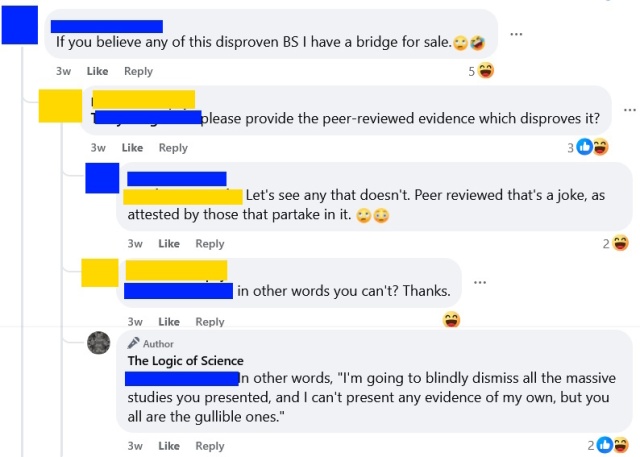
fact checkign post 3Let’s look at one case that I found particularly amusing. After a general statement against Snopes, the person in red doubled down with the claim that Snopes had testified before Congress that their fact checks were actually opinions (note that they did not specify Snopes, but that was the subject being discussed, and the “the” appears to be a typo for “they”). This would have been a great place for red to fact-check before posting, because Google failed to reveal any such testimony, and when pressed for evidence that such a confession had taken place, red posted a NY Post article about Facebook (not Snopes) testifying in a trail (not before Congress), and the NY Post article took things wildly out of context (as it often does). When this was pointed out to red, rather than admitting his mistakes, he doubled down and accused everyone else of being the blind, biased ones.

This exchange is very typical of my experience talking to people who ridicule fact-checkers. Their disdain of fact-checkers is not actually based on evidence or facts. Rather, it is based on their preconceptions about fact-checkers (because fact-checkers often say they are wrong) and their view is propped up by erroneous claims that they have never bothered to fact-check! Further, when caught in an error like this, it is also typical (in my experience) to try to claim that everyone else is the problem rather than just admitting the error.

Don’t be that person. Don’t be the person in red. Fact check before you form your opinions, and if you are caught in an error, just admit it! There’s nothing wrong with being wrong. We’re all humans; we all make mistakes. Mistakes are only a problem when you refuse to acknowledge and correct them.

More broadly, the point here is that while fact-checkers are not infallible, and you absolutely should verify what they are saying, they are really useful, and these claims that they are horribly biased and unreliable have no basis in reality. Having said that, let’s talk about the claim that Facebook admitted that their fact-checks are just opinions for a second, because this one comes up a lot.

First, let me state for the record that Facebook’s fact-checking is admittedly not always the best. It’s not one that I would usually recommend, and it is highly variable with different organizations responsible for the fact-checks in different countries. Most of us science bloggers have had stuff incorrectly flagged by Facebook. Nevertheless, let’s look closer.

Without getting too into the legal weeds, the case was 5:21-cv-07385-VKD, in which John Stossel asserted that Facebook had defamed him in how they rated the factualness of some of his posts. Facebook then made the legal argument that their fact-checkers were simply stating their opinion based on the claims made in his posts. This word, “opinion” was then picked up and taken out of context to assert that fact-checks are just “opinions.”

I really hate semantic arguments, but we need to get into one here. The word “opinion” has different meanings in different contexts. If I say, “in my opinion, bananas are the best fruit,” that is an entirely subjective statement that is based on nothing more than my personal preferences. That is, however, extremely different from something like a doctor saying, “having reviewed your case, in my professional opinion, your best option is surgery.” The latter is a statement based on data and years of experience. See how they are different even though they both use the word “opinion”?

Now, let’s imagine a fact-checker has been carefully reviewing an article. They have looked at the claims made in the article, they have checked them with good sources to the best of their ability, and now they need to make a judgement: is the article completely false, mostly false, misleading, mostly true, totally true, missing context, etc. At the end of the day, that is a judgement call they have to make, and especially in a legal context, we could call that an “opinion.” Again, fact-checkers are not infallible, divine arbiters of absolute truth. They can and do make mistakes, but an “opinion” about how an article should be rated based on a very careful consideration of the evidence is a very different thing from the type of “opinion” that I have about bananas. Despite what outlets like the NY Post would like you to think, the fact-checkers aren’t sitting around going, “well in my opinion Trump sucks, therefore this claim he made is false.” That’s not how this works, and these attacks based on the word “opinion” are highly misleading.

Also, note that some things are very clearly, objectively true or false (in which case an opinion is not being expressed), whereas others (such as the ones in the court case in question) contain a mixture of true and false information or information that is presented in a potentially misleading way. Those situations are much harder to judge (and require more of a subjective call) than something like someone saying “the unemployment rate is X” when it is actually Y.

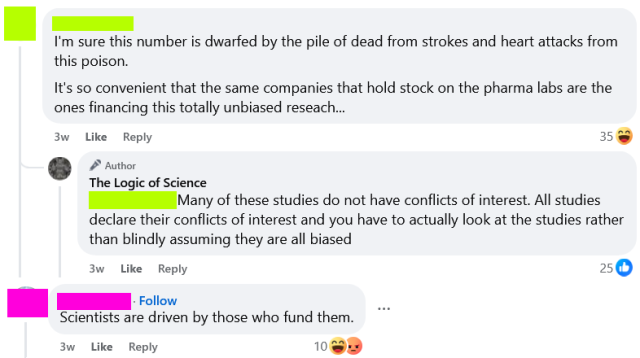
fact checkign postFinally, let’s briefly turn to politics for a second, because when I made my initial post something fascinating happened. The post was not even remotely political. Nevertheless, a bunch of people came crawling out of the woodwork to claim that it (or fact-checking more generally) was part of some leftist agenda. That is, in my opinion, a fascinating and hilarious self-own. It is fundamentally an admission by these people on the right that the facts are not on their side.

I don’t want to dwell on left vs right politics, however, and instead want to look at the claims being made and apparent mindset of the people making them, because they are instructive and illustrate, once again, that people are making claims based on their preconceptions, not facts.

Take, for example, one person who boldly asserted that fact checkers only check the right and don’t fact check people like Biden. This is, of course, completely untrue, and if the person making the claim had spent just a few seconds on Google, they quickly would have found Joe Biden’s Politifact file and tons of other outlets fact-checking him and other liberals (Politifact literally gave Obama one of their “lie of the year” awards). This person didn’t do that fact-checking, however, because they have a world view that is not based on facts and is incompatible with the facts. That is the problem here, and it extends to far more than just politics. People become so entrenched in their world views that they no longer bother to verify what is and is not true and become allergic to anything that opposes their world view.

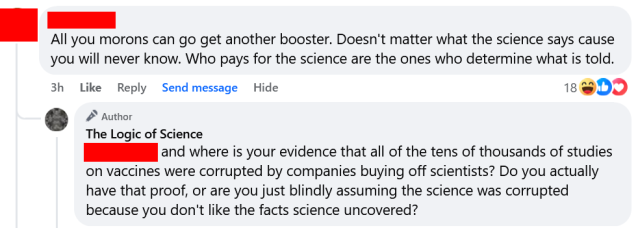
This problematic mindset was on full display in all the comments baselessly asserting that all fact-checking organizations are paid shills secretly working for the liberals. This is fundamentally the same conspiracy theorist thinking used by anti-vaccers, climate change deniers, flat earthers, etc.: if the facts and experts disagree with me, it must be a conspiracy. This is a very easy trap to fall into, but it is deeply problematic.

I’ve written a lot about this sort of conspiracy thinking before, and I’m tired and just don’t feel like going into it right now, so let me instead simply say this: when all the evidence is against you, whether that be scientific studies or the facts presented by fact-checkers, you can either stick your fingers in your ears and shut your eyes and claim it is all a conspiracy, or you can do the rational thing and stop and ask yourself, “am I wrong?” You have nothing to lose by fact checking and everything to gain.

Be humble, accept that there are others who know more than you, be willing to be wrong, and fact-check before you believe something and, especially, before you make a fool of yourself by posting it online for everyone to gawk at.

Related posts

Posted in Uncategorized | Tagged , , , , , | Comments Off on Yes, you should fact-check

Overpopulation or overconsumption? It’s both, and it’s complicated

population-and-demography

Population growth rates by country (personally I think the color scale should be inverted so that red shows higher growth rates). This map is from 2021, but the story is largely the same today. Image via Our World in Data.

Before you start reading, open worldometers.info and take a screenshot (this will give you the world population right now; we’ll come back to it later).

Our world is facing enormous environmental challenges. Climate change is roaring forward at a terrifying rate, we are experiencing the 6th mass extinction, and natural resources like water are becoming increasingly scarce in many parts of the world. Humans are the root cause of these issues, but there is often a debate about whether we are causing them through overpopulation (i.e., too many people using resources) or overconsumption (i.e., too many resources being used per person). The reality is that both factors are occurring.

It is beyond question that we are overconsuming. Humans, especially those of us in heavily industrialized countries like the USA, use a truly extraordinary number of resources. Our society is unconscionably wasteful, and we need to take enormous steps to move away from fossil fuels, reduce food waste, reduce plastic waste, minimize land use, and, in general, move away from our disposable society and towards one that is more sustainable.

So, for the sake of this post, I’m going to largely take the overconsumption side of things for granted and focus, instead, on the overpopulation side, because this is usually where I find contention. In other words, at least in my experience, most people who argue that we are overpopulating also fully acknowledge that we are overconsuming and need to reduce consumption; whereas many others argue that the issue is entirely overconsumption and we shouldn’t be talking about overpopulation.

I am going to argue that overpopulation actually is a real issue, but there is a ton of nuance that has to be included when discussing that topic. So before sharpening your pitch forks, please hear me out. Also, as you read through this, I want you to keep the following central thesis in mind: almost all (possibly all) environmental crises would be easier to solve if there were fewer people on the planet.

Important clarifications

This topic often spawns lots of red herrings about eugenics, China’s one child policy, and other political topics. So let me be clear at the start that I am simply discussing the problem, not the solution (other than some very broad comments and advocation for personal actions). This post is not an argument for eugenics or any government actions to control the population size. Likewise, when I say that we need to rapidly reduce or even reverse the population growth rate, I am talking about slowing the rate at which we add new people to the population (birth) NOT the rate at which people are removed from the population (death). So please spare me your essays on genocide and eugenics; that’s not what I’m talking about here. I am simply describing the problem. The fact that some people have proposed unethical solutions to the problem does not mean that the problem isn’t real.

What the “overconsumption only” argument gets right

Next, I want to acknowledge that those who argue that we shouldn’t be talking about overpopulation do have some good points, but addressing them simply requires nuance, rather than avoiding the topic of overpopulation all together.

First, as I already acknowledged, overconsumption is an enormous problem, and there would be space and resources for a lot more people if we lowered our consumption rate (see section on carrying capacity later). I 100% agree that we need to massively reduce consumption and waste.

Second, a key problem with blanket statements like, “there are too many people on the planet” is that those statements ignore the fact that neither consumption rates nor population growth rates are equal across countries. Indeed, they are inversely correlated, meaning that countries with disproportionately high consumption rates tend to have very low population growth rates (i.e., heavily industrialized countries), whereas populations with very low consumption rates tend to have the highest population growth rates (i.e., impoverished countries). Thus, if you aren’t careful and don’t include appropriate nuance, the overpopulation argument can easily place the blame on the wrong group of people and even become racist.

For example, the USA has a small population growth rate of 0.6% per year (from 2013-2022; worlddata.info) and only roughly 4.2% of the world’s total population (worldometers.info), yet it produces a full 14% of the world’s greenhouse gas emissions (statista.com). India, meanwhile, has an average growth rate of 1.14% per year (2013-2022) and 17.8% of the world’s population (worldometers.info), yet it only produces 7% of the world’s greenhouse gas emissions (statista.com). Put another way, India has twice the population growth rate and over 6 times the population size of the USA, yet it produces half the total greenhouse gas emissions compared to the USA!

Things are even worse when we start looking at the continent of Africa, which has many of the highest growth rate countries, most of which produce minuscule amounts of waste compared to other countries.

To put all of that in its simplest terms, the countries that are contributing the most to the growth of the human population are also generally the ones that are using the fewest resources (especially per capita). So, if you simply say that we have an overpopulation problem, you run into trouble because the countries that are “overpopulating” aren’t actually the ones that are contributing the most to our current environmental catastrophes. This is where we need a lot of nuance, which is what I will try to build throughout the remainder of this post.

Carrying capacity

In this section, I want to explain the fundamental reason why I, as an ecologist, think we have to talk about overconsumption and overpopulation simultaneously. Namely, they are two sides of the same coin that are intrinsically linked.

To understand what I mean by that, we need to understand the concept of carrying capacity. This is the number of organisms of a given species that a given area can sustain. Carrying capacity is determined by both the amount of resources present and the rate of consumption. Thus, overpopulation, in strict ecological terms (though see later section), occurs when the population size exceeds the carrying capacity.

Have you spotted the catch there? Carrying capacity is determined by consumption rate, which means that “overpopulation” is determined by the consumption rate, but also, “overconsumption” is determined by the population size.

Stated another way, if a field of cows exceeds its carrying capacity, you could describe it either as “there are too many cows given their consumption rate” (overpopulation) or “cows consume too much to maintain this population” (overconsumption). Both are accurate descriptors of the situation. To be fair, that analogy is a bit strained because we don’t typically think of cows as overconsuming, but mathematically, those two situations are the same.

Now let’s apply that to humans, and to simplify things, let’s focus on countries like America that have very high consumption rates. I do not think that the per capita consumption rate of America is sustainable given the population size, which is the exact same thing as saying that I do not think the current population size is sustainable given the per capita consumption rate. Those statements are equivalent.

To put that another way, we could sustain this many people if we consumed less, or we could sustain this per capita rate of consumption if the population size was smaller.

“Overpopulation” is determined by consumption rate, and “overconsumption” is determined by population size. You cannot simplify things to one or the other because they are inherently relative to each other.

Understanding this relationship is critical for developing appropriate solutions to our problems. Both factors are at play, and both need to be addressed, rather insisting that only one of them is a problem.

What does “overpopulation” mean for humans?

This is another point at which we need to inject nuance. As described above, ecologically, “overpopulation” means that a population has exceeded that area’s carrying capacity. So in strict terms, “overpopulation” for humans would mean more people than the planet can actually sustain. This is what Malthus was famously concerned with, and proponents of the “overconsumption only” argument often argue that there have been countless estimates of earth’s carrying capacity that have proved to be wrong. That’s not a great argument, in my opinion, because there is a carrying capacity for earth. The fact that we haven’t done a great job estimating it (largely because technology keeps saving our butts) doesn’t mean that one doesn’t exist.

More importantly, I think that this is something of a strawman, because when conservationists like me talk about overpopulation, we usually aren’t strictly referring to the maximum number of people possible. Rather, we are referring to the number of people that can be sustained while still preserving biodiversity. In other words, we could fit a lot more people on this planet if we cleared all the forests, dammed all the rivers, and mined every last resource. Sure, that would cause lots of other issues, but the total number of people we could sustain would go up. However, we would have destroyed all the natural wonder and beauty of this planet, and that is not a situation I want.

I want a sustainable future where we still have massive tracts of rainforest, pristine coral reefs, plains and savannas, untouched deserts full of bizarre lizards, crystal clear rivers, and national parks that stretch to the horizon. I want to conserve all the unique and wonderful plants and animals that call this planet home. I want the splendor of this pale blue dot to persist, and the simple reality is that every additional human makes that goal harder.

Even people who live as sustainably as possible are using resources. Even if you live in a modest house, use entirely renewable energy, and grow your own food, there are still resources that had to be mined to make your solar panels, wind turbines, etc., and you are still using land that would be better for biodiversity if it has been left in its natural state. Further, if you are reading this, then you must have a computer or smart phone which includes components that were shipped from all around the world. Likewise, if you go to the doctor, you will burn through a bunch more resources from medical waste (syringes, medicine bottles, etc.) as well as increasing the burden from manufacturing and shipping those supplies.

Resource usage is inescapable, and it is not inherently a bad thing. All organisms use resources, but the fewer organisms there are, the fewer resources need to be used. This is an unavoidable fact. Even if we all agree to drastically reduce our resource usage, we would still be placing a huge burden on the earth, and that burden would be reduced with fewer people.

How much luxury are we willing to give up?

Let me state again that overconsumption is a huge problem, but the question becomes, how much are we actually willing to give up? It’s easy for those of us in places like America, Europe, and Australia to look at other countries with very low resource usage and high population growth rates and say, “see, if we just reduced our consumption to match those countries, we wouldn’t have a population problem.” The reality, however, is that very few people actually want that. A large part of why those countries consume so little is because they are impoverished. They don’t have massive food waste because they have so little food that they cannot afford to waste it. They don’t have massive medical waste because they don’t have good access to medicine. They don’t have massive greenhouse gas emissions because they don’t have reliable electricity and/or can’t afford all the cars, electronic appliances, and gizmos that we take for granted.

So how much comfort are we actually willing to give up? Are we willing to give up a car (often multiple) per household? Based on the extraordinary number of unnecessary gas guzzlers I see on the road, I highly doubt it. Are we willing to use the same TV, computer, phone, etc. for decades rather than replacing them semi-annually? I doubt it, and even if we were, they aren’t manufactured in a way that makes that plausible. Likewise, while food waste is serious problem, a large part of the food waste comes from us demanding a high quality in our food, which means that old products get disposed of if they didn’t sell, and only the highest quality produce goes to market. Are we willing to reduce those standards, and what will the cost of that be in terms of human health?

I could go on, but I think the point is clear: while we should do everything we can to reduce resource usage, there is a limit to how much we can reduce it without reducing our standard of living. Again, that is not necessarily a bad thing. There is nothing inherently wrong with wanting a comfortable life that makes use of all our modern technological wonders, but, that standard of living inherently comes with a high environmental burden, and we need to seriously consider how many people we can sustain at that standard while still maintaining biodiversity.

Increasing industrialization

Something of the inverse of what I have just described for heavily industrialized nations (low population growth rates) is happening for less industrialized nations (high population growth rates). Namely, they are becoming more industrialized and, in the process, are using more resources per capita. Here again, that is not inherently a bad thing. That increase in resource usage is largely due to an increased standard of living, and most (I hope all) of us would like everyone to be able to enjoy a high standard of living. I want everyone to have access to modern healthcare, reliable electricity, and modern amenities (assuming they also want that access), but this is something we need to think about as we plan for a sustainable future.

Those rapidly growing populations will, hopefully, have access to a high standard of living in the near future, but even if that is done as sustainably as possible, it will still require a large increase in resource usage. In other words, these large, rapidly growing populations have low per capita resource usage now, but that is almost certain to change in the near future. Not all of that change is bad, but is there room for that expansion (while maintaining biodiversity) given how many of us currently enjoy such a high level of resource usage? Unless something drastically changes, I don’t think so, which is a problem. There are too many of us consuming too much for rapidly growing populations to increase their resource usage without it resulting in environmental catastrophe.

It is a complex problem, and our population size, our consumption rate, their growing population size, and their likely future consumption rate are all a part of it. Again, to be clear, I am not blaming anyone. I am simply describing the reality of the situation.

Land use

An additional problem with the “overconsumption only” argument is that it often focuses on the inverse relationship between population growth rates and things like greenhouse gas emissions, while ignoring other problems such as land use. This is an overly simplistic view. Due to their high growth rates, many countries are becoming extremely densely populated, which inherently necessitates clearing land for development and agriculture. Unfortunately, many of these countries are also biodiversity hotspots, and natural areas inherently have to be sacrificed to accommodate those people. Keep in mind that habitat loss is hands down the leading cause of biodiversity loss.

Let’s keep using India as an example, for a minute. It has truly incredible biodiversity, but due to its historically high population growth rate, it now has a density of nearly 500 people per square kilometer (>1200 per square mile; worldometers.info). The USA, by contrast, has a mere 37 people per square kilometer (96 per square mile; worldometers.info). That high density in countries like India inherently requires clearing a lot of land, and, tragically, that land is some of the most biodiverse in the world.

Likewise, I had the opportunity to visit the Philippines last year, which had an average annual growth rate of 1.78% from 2013-2022 (worlddata.info) and now has a population density of nearly 400 people per square kilometer (>1000 per square mile; indexmundi.com). That’s an order of magnitude higher than the USA. I visited multiple islands while I was there and was consistently astounded by the population density and how much forest had been cleared. My wife and I went on a birding tour, and talking to our guide about the state of bird conservation there was truly alarming. Repeatedly we’d ask about a particular species, and he’d tell us that he used to have a reliable spot for them, but now that location has been cleared and he rarely sees that species anymore.

We are losing biodiversity incredibly fast, and clearing land for expanding human population is a huge part of that. We cannot afford to ignore what is happening for the sake of political correctness. To be clear, I’m not blaming people in countries like the Philippines or India for clearing so much land, what else are they supposed to do when they have that many mouths to feed and people to house and employ? Of course, they have to clear lots of land. Resource use is not inherently a bad thing, and they still use less land per capita than those of us in countries like the USA. My point is simply that even though they use far fewer resources and less land per person, their rapidly growing populations still have an enormous impact on the environment. That’s an issue we have to acknowledge if we are going to plan appropriate conservation measures.

Note: I also want to make it clear that those of us in heavily industrialized countries are also playing a huge role in habitat loss in other countries due to our insatiable lust for things like palm oil.

“But growth rates are slowing down!”

A final argument I often hear levied against the overpopulation argument is that the world’s growth rate is slowing, and even rapidly growing countries are experiencing reduced growth rates.

This is true, but is not the same thing as saying that we won’t overpopulate (or haven’t already). There are currently over 8 BILLION people on this planet. Most projections suggest that our population won’t truly level off until well past 10 billion. Two billion extra people is an enormous change! That’s a 25% increase in population size! Which also means a 25% increase in the minimum number of resources needed. In short, it is not slowing nearly fast enough.

Further, as a conservation biologist and ecologist, I’d argue that we are already grossly overpopulated if we want to maintain biodiversity. The 6th mass extinction isn’t something that is going to start in the future. It is something that is happening right now, and adding another 2 billion people is not going to help. We need to be going the other direction. Conserving this wonderful, beautiful planet and all its natural treasures would be so much easier with a couple billion fewer people.

Further, while the growth rates are highest in impoverished countries, that 0.6% increase in the USA is not a small thing. As I am writing this, the USA population increases by a net of 1 person every 24 seconds (i.e., after accounting for births and deaths). If it took you 20 minutes to read this post, then there are (on average) 50 more people in the USA now than there were at the start. Each day, there are 1728 more people! Now, think about the amount of resources that each person in the USA uses. Think about the cars they will own, houses they will build, clothes they will wear, cell phones they will use, fuel they will consume, food they will eat, etc. Then tell me with a straight face that adding 1728 more people per day isn’t a problem.

I find it really difficult to explain the true scale of environmental devastation that is currently occurring to people who don’t work in conservation. The rate of species loss we are experiencing keeps me awake at night with grief, and saving those species would be so much easier if there were fewer people. Fewer people would mean more land that could be left in its natural state, fewer resources that need to be mined, less food that needs to be grown, fewer buildings that need to be built, fewer flights, less intercontinental shipping, less energy that has to be produced, fewer products to manufacture, less waste going into landfills, fewer animals being harvest from the ocean, and fewer emissions being produced. Essentially every environmental problem is easier to solve with fewer people.

Reopen that link that I posted at the start of the article and compare the world population now with the world population in the screenshot you hopefully took. Unless you are an incredibly fast reader, there are several thousand more people than there were at the start. We are still growing at a truly alarming rate.

What do we do?

As I said earlier, I’m not going to give any specific solutions or governmental options, I’m mostly trying to raise awareness about the problem, but I do want to talk about some general broad strokes for a minute.

First, we need to reduce our consumption and waste. This is really beyond question. There are lots of things we can do to live more sustainably without substantially lowering our standard of living, and it is inexcusable for us not to making those changes. Let’s be 100% clear that those of us in affluent, heavily industrialized countries are responsible for the vast majority of our current environmental crises, and the people in the countries that are the least responsible are bearing the brunt of the negative consequences of our actions.

Second, I think we should help impoverished countries to grow financially and industrially, while trying to help them do so in a sustainable way. Beyond ethical reasons, helping them to gain access to better healthcare and a clean energy grid is actually a good investment in all of our futures, because as countries become more industrialized and gain better access to healthcare, they tend to have fewer children (voluntarily) and the population growth rate levels off. The sooner that growth rate levels off, the fewer people there will be and the more resources will be available.

Third, those of us who are already in industrialized countries should halt, or better yet, invert our growth rates to make room for those growing populations. Again, I’m not talking about any government action (that’s a separate topic). Rather, I am talking about individuals choosing to forgo having children (or at least having fewer children). This is where the nuance is so important. A single child born in a country like America is far more damaging to the environment than a single child born in a country like India or many African nations.

“Overpopulation” is relative to resource usage. So simply looking at growth rates doesn’t tell the whole story, and a small growth rate in a heavily industrialized country is far worse than a large growth rate in a comparatively unindustrialized country.

As explained earlier, even if you live as sustainably as possible, you will still use resources. So, assuming that your child will have the same resource usage as you, having a child essentially doubles your impact on the earth (or increases it by 50% if you want to lay some of the blame on your partner). The simple reality is that, for most of us, the single best thing we could do for the planet is to forgo having children. Eating locally grown food, using renewable energy, driving a small car, and making fewer transcontinental flights are all good, but they pale in comparison to the lifetime resource usage of a single human being. Lest anyone accuse me of hypocrisy, I will note that my wife and I decided not to have any children, and environmental concerns were a big part of that decision.

The fundamental point I am trying to make is simply that both population growth rates and resource consumption rates are part of the problem, and we need to acknowledge that in order to develop appropriate solutions. For example, yes, we need to reduce our level of food waste, but imagine if, in addition to doing that, we also had fewer mouths to feed (or at least stopped generating as many new mouths). Think how much more land could be set aside for conservation if we did both instead of insisting that only one of them was a problem. The same is true for essentially any environmental topic. Yes, we should switch to renewable energy, but renewable energy still has environmental costs (e.g., highly destructive mining practices and large areas of land for solar farms) and we would have fewer of those costs if there were fewer people who needed that energy. We are in the middle of a sixth mass extinction, and we cannot afford to ignore a huge part of the problem.

Essentially every environmental crisis is easier to solve if there are fewer people, and the fewer people there are, the more biodiversity we can maintain without having to sacrifice our standard of living.

Posted in Uncategorized | Tagged , , | Comments Off on Overpopulation or overconsumption? It’s both, and it’s complicated

How well do you understand placebo effects?

“Placebo effect” is a term that almost everyone knows but few seem to understand. Misconceptions about placebo effects are rampant and usually center around the idea that a placebo effect occurs when you feel better because you thought a treatment would work. In reality, there are multiple types of placebo effects, many of which have nothing to do with whether or not you expect a treatment to work.

Understanding this is important, because misconceptions about placebo effects lead to erroneous arguments and poor medical decisions. These misconceptions are commonly manifested in the argument that, “a placebo effect is still an effect.” This argument is used as a justification for the continued use of treatments that have failed scientific testing because, according to it, even if the treatment only produces a placebo effect, that effect is still beneficial. As we will see, however, this argument is oxymoronic and completely falls apart once you understand what placebo effects actually are.

Another common argument asserts that a treatment must actually work because benefits have been seen in young children and/or pets who can’t possibly have expected the treatment to work. Likewise, I often hear people make statements like, “well I didn’t think it would work, but I still got better, so it can’t have been a placebo effect.” Both of these arguments are, again, based on the misconception that placebo effects simply mean getting better because you think you will get better. As we will see, the reality of the situation is far more complicated.

What are placebo effects?

You may have noticed that I keep saying “placebo effects” (plural). I’m doing that because the “placebo effect” is actually a collection of lots of different factors that we shove into a single category for convenience. To borrow a definition from Science-Based Medicine,

“A placebo effect is any health effect measured after an intervention that is something other than a physiological response to a biologically active treatment.”

In other words, “placebo effect” is a broad, catch-all term for any measured change in a patient that is caused by something other than an actual, biological effect of the treatment. This is an inherently wide definition, and there are lots of different types of placebo effects that contribute to that change.

Let me elaborate with an example. Suppose I think that diseases are caused by an electrical imbalance and shocking yourself with an electric current will cure you. So, I get people who are sick or in pain to come to me, I zap them, pronounce them healed, and they go on their way. Within a few days, many notice that they are feeling much better. Some may even find that real doctors run tests and conclude that their condition has improved.

Did my treatment work? Maybe, but we can’t actually conclude anything from those anecdotes because there are other possible explanations for that result. Let’s tally up some of those possibilities:

  • Biased reporting (i.e., people who feel better are more likely to go online and post about their miracle cures)
  • Spontaneous remission that has nothing to do with the treatment
  • People sought treatment when their symptoms were at their worst and, as a result, they would have felt better in a few days regardless (i.e., regression to the mean)
  • They made some other change in lifestyle, diet, work, etc. that caused the improvement
  • There were measurement errors or misdiagnoses by the doctors during the initial visit or the follow up
  • They feel better because they think they are supposed to feel better (the classic placebo effect most people think of)

anecdotal evidence anti-science

This is why anecdotes simply are not valid evidence of causation. If we actually want to know whether electrocuting someone (or any other treatment) works, we have to collect a large group of people, randomly assign half of them to receive the treatment while another half receives a placebo (without either group or, ideally, the doctors knowing who is in which group), and control for factors like age, sex, other health conditions, and other medications. When we do that, we will probably still find that there is a change in our placebo group over time. That change will be caused by some combination of factors like the ones listed above. Some people might feel better simply because they thought they should feel better. Others may have improved because of some other change. Others may have sought treatment when their symptoms were at their worse so they would have felt better over time regardless, etc.

All of those things are types of placebo effects, the sum of which gives the total placebo effect in that experiment. It is the background change in patients that has nothing whatsoever to do with an actual biological response to the treatment being tested. So, for the treatment to be effective, it must, by definition, produce an effect greater than the placebo effect. This why we do placebo controlled trials: to tell us whether the recovery rate from the treatment is greater than the background recovery rate without the treatment.

Do you see why that automatically makes statements like, “a placebo effect is still an effect” utter nonsense? The placebo “effect” is an experimental construct. It’s just a measure of the background noise in the system so that we can tell whether or not a treatment actually works. It is madness to try to claim that the background noise in the system is a legitimate therapy!

Regression to the mean

In case I haven’t made my point entirely clear, I’m going to focus for a minute on one of the most common types of placebo effects: regression to the mean. That is a fancy term that basically just means that things usually return to their normal state over time even without intervention (think of it as “return to the average”).

Chronic pain provides a good example of this (see figure). People with chronic conditions typically have good days and bad days. There are days where they are in lots of pain, and those days eventually give way to days with less pain. If we plot the pain over time, we get a wave-like graph with pain oscillating around an average value. Thus, if you start at any given point on the graph and wait long enough, it will eventually go back to the average value (i.e., it regresses to the mean). Critically, times with the worst pain are, by definition, followed by times with less pain. In other words, anything you do when the pain is at its worst will inherently eventually be followed by days with less pain.

This is where things become important for understanding placebos (and anecdotes). People are much more likely to seek treatment (including trying unconventional treatments or enrolling in a clinical trial) when they are experiencing the worst symptoms, but, as we’ve just established, they would have felt better several days or weeks later regardless of the treatment simply because of regression to the mean!

regression to the mean

Chronic pain provides a good illustration of regression to the mean. People with chronic conditions tend to have some good days and some bad days that oscillate around an average (mean) value. Thus, from any given point on the graph, if you wait long enough, the condition will eventually return (regress) to the average value.

Look at the figure for a second and imagine you are the person on day seven. You’ve had a really rough week of severe pain. You’re now desperate enough to try anything, even an alternative treatment of which you are skeptical. So, you try my electric shock therapy, or acupuncture, or homeopathy, or anything else you can think of to relieve your suffering, and, by the next day, like a miracle, you are already feeling better. A few days later, you’re feeling better than you’ve felt in a long time. You might, naturally, conclude that the treatment actually worked. At a quick glance that seems like a perfectly reasonable conclusion, and it’s totally understandable that so many people fall for it, but as you can see in the graph, the treatment didn’t actually work! The condition simply regressed to the mean, and you would have improved even without it.

Conversely, people who are currently feeling good and are at the low points in the waves are much less likely to seek unconventional treatments. If they did, regression to the mean would often make it appear that the treatments made things worse. This disparity in when people are the most likely to seek treatment creates a strong bias towards treatments “working” in both anecdotes and clinical studies, and it is one of the many reasons why it is so critical to run placebo-controlled trials so that we can measure those background changes and test whether the treatment is producing a real improvement.

The common cold provides another excellent example. Countless times I’ve heard people insist that some quack treatment cures colds because they had a really bad cold, and nothing was helping, then they took this treatment, and in a few days, they felt way better. Well, of course they felt better in a few days; that’s how long colds last! Also, if they’d already been suffering for several days, then they were probably at the tail end of it anyway, so even a fairly rapid recovery after the quack treatment isn’t surprising. It is easily explainable once you understand regression to the mean.

My point here is two-fold. First, notice that regression to the mean has utterly nothing whatsoever to do with either getting better because you think you should get better or with an actual effect of the treatment. It is literally just what would happen if you did nothing. This is why arguing that a treatment is valuable even if it is “just a placebo” is madness. When something is studied and found to be no better than a placebo, things like regression to the mean are a part of that placebo effect being measured, and they are clearly not valid therapies.

Second, regression to the mean is responsible for a lot of anecdotes. People frequently tell me with great conviction about how they had suffered for a long time and nothing had worked until they tried X. They often say that they didn’t think X would work, but they became so desperate that they tried it anyway, and afterwards they felt better! As you can hopefully now see, that sort of situation is to be expected from regression to the mean. If people seek treatment when things are at their worse, there is no place to go but better.

To be clear, this doesn’t automatically mean that those treatments don’t work. Rather my point is simply that the anecdotes are not valid evidence that they do work. Science is all about eliminating possibilities so that you can be confident in the conclusion. We have to conduct properly controlled trials to actually test the treatments, and if the treatments fail those tests, we can then be confident that the anecdotes are from factors like regression to the mean, rather than from the treatment actually working.

Pets, children, and unbelievers

At this point, I want to directly address the arguments that, “it can’t have been a placebo effect because it worked on animals/children/someone who didn’t think it would work.”

I’ve described several types of placebo effects throughout this that have nothing to do with belief or a conscious awareness of what is going on (e.g., regression to the mean), and those are already sufficient to deal with these arguments, but for thoroughness, I want to bring up a few additional points.

The first is something known as placebo by proxy. Children and many animals (e.g., cats and dogs) are perceptive. The mood of people around them affects them, and those effects can go on to affect the outcomes of their treatment. So, if you take your dog or child to receive acupuncture (which is just a placebo btw), your dog or toddler might not expect it to work, but you do, and, as a result, your mood is likely to improve because you think your pet/child is receiving a valuable treatment. The fact that you seem more at ease and less worried makes your pet/child more at ease, which improves their symptoms. Again, to be clear, the acupuncture (or whatever treatment it was) did nothing. It was entirely your response that caused the apparent improvement.

A related problem arises because improvements in pets and children are often self-reported by the owners/parents. So, if you think the treatment works, you’re more likely to see an improvement that isn’t really there. That is human nature. If you think acupuncture works (for example), you are pretty likely to think your dog is limping less after receiving it simply because that is the result you expected to see. Our brains are pattern recognition machines, and while that serves us very well in some cases, it also makes us very prone to biases. This sort of bias in the reporting of outcomes is yet another type of placebo effect, and, again, it has utterly nothing to do with an actual improvement in the patient.

The point is simply that placebo effects absolutely can be at play for children, pets, and skeptics; so the fact that an anecdote relates to them does not make the anecdote reliable evidence of causation, nor does it mean that the observed result wasn’t a placebo effect.

It’s not “mind over matter,” and it’s not effective

As I bring this post to a close, I want to stress that none of these placebo effects are situations of “mind over matter.” They are not situations where people are actually getting better because of the placebo. I’ve been largely focusing on placebo effects that aren’t related to the patient expecting to get better, but I should explicitly state that those effects do exist as well. A patient that thinks they are receiving a useful treatment is more likely to report a reduction in some subjective symptoms, such as pain, but even in that subset of placebo effects, emphasis has to be placed on the word “symptoms.” They are not actually getting better; their brain is simply playing a trick on them to make them feel better. So no underlying condition has actually been treated (which is pretty ironic given how often the same people who tout placebo effects like to erroneously claim that “modern medicine doesn’t treat the underlying causes of illness”).

All of this makes it absurd to argue that a treatment is still beneficial even if it is “just a placebo.” As you can hopefully now see, that is a hollow argument. Placebo effects are not actual improvements. They are the background changes that are not caused by a biologically active treatment. They are, by definition, a lack of effect of the thing being tested. Indeed, for some types of placebo effects (such as regression to the mean) they are literally what would happen if you did nothing! So, passing off quack treatments as actual therapies in order to “elicit” a placebo effect is dangerous and unethical.

Further, even if you want to narrowly focus on the subset of effects that result in patients feeling better because they think they should feel better, it should be noted that real treatments can also generate that transient perception of an improvement. So why on earth should we recommend a quack treatment when we can recommend a real one?

Also, on that note, there are certainly things that can and should be done to increase the efficacy of real medicine. We know that things like good patient-doctor relationships improve how patients feel. So absolutely we should work on things like that in tandem with science-based medicine (indeed that is part of science-based medicine), but it absolutely does not mean that we should use discredited treatments and chase magic and wishful thinking in the vain hopes of evoking a placebo effect.

Note: Please read this post and the systematic reviews and analyses discussed therein before claiming that acupuncture actually works.

Related posts

Posted in Vaccines/Alternative Medicine | Tagged , , , | Comments Off on How well do you understand placebo effects?

No, those photos don’t disprove sea level rise/climate change

plymouth rock meme sea level cliamte change hoax

A popular example of the type of meme I’m talking about.

It is an indisputable scientific fact that the average global sea level is increasing. Nevertheless, numerous memes and posts on the internet claim to have photographic proof that sea level rise (and by extension, global climate change) is a hoax. These posts generally contain an old photograph of a shoreline next to a recent photo of the same shoreline, with similar water levels in both photos. Therefore, according to the purveyors of this misinformation, the sea level has not changed and global warming is not real. Checkmate, science nerds, right? Not so much.

There are many versions of this argument (particularly popular ones include the Plymouth Stone, Palm Beach Florida, and various bridges), but they all suffer the same fundamental problem, so there is no need to harp on specifics (with one exception discussed later).

The core problem here is that the photos don’t take into account several critical factors, such as tides. The sea level is not static. It goes up and down twice every day, in some places quite dramatically. Further, the timing of peak high and peak low tides shifts from one day to the next, and the magnitude of the tides changes throughout the year. This means that the sea level at any one location is constantly changing. As a result, two photos of the same spot at two different time points are completely meaningless. If, for example, the old photo was at high tide and the recent photo was at low tide, it is going to look like there was no change in sea level, but that’s clearly a bad comparison because the tides were different! You can’t just ignore the existence of tides.

meme climate change sea level sydney harbour old photo

Another example of the type of meme I’m talking about. Once again, tides were ignored.

Beyond tides, there are factors like storm surges and the ground itself raising or subsiding. Further, because of a wide range of factors, sea level rise is happening faster in some places than in others. All of these things have to be taken into account to actually measure long-term patterns in sea level change. So, just like for temperature, scientists use a massive array of recording stations and satellites and carefully factor in tides, storms, etc. so that they can see the long-term trends.

When scientists account for these factors, they find that on average, the global sea level is rising, and that rise is caused by anthropogenic climate change. Indeed, the most recent IPCC report (IPCC 2022) made the following conclusion (their emphasis):

“Global mean sea level (GMSL) rose faster in the 20th century than in any prior century over the last three millennia (high confidence), with a 0.20 [0.15 to 0.25] m rise over the period 1901–2018 (high confidence). GMSL rise has accelerated since the late 1960s, with an average rate of 2.3 [1.6 to 3.1] mm yr –1 over the period 1971–2018 increasing to 3.7 [3.2 to 4.2] mm yr –1 over the period 2006–2018 (high confidence).”

There are four important things to note from that:

  1. Scientists are highly confident. Scientists are a cautious bunch, and we reserve that terminology for cases where the evidence is extremely clear and compelling.
  2. Over the past 100 years, the sea level rose faster than at any comparable period in the past three millennia. So, to those who try to attribute all of this to natural cycles, no, this isn’t normal. We’ve looked at the natural cycles and they don’t explain what we are seeing now (details here).
  3. The change so far has been relatively small, about 20 cm (7.9 inches). That’s small enough that you might not notice it on an occasional trip to the beach (or when looking at old photos of shorelines and structures), but it is enough that it is already having impacts on coastal properties (McAlpine and Porter 2018; Moftakhari et al. 2015).
  4. The rate of rise is increasing. This is the really concerning part. Things are going to get really bad if we don’t act immediately and drastically, and old photos don’t change that fact.

“but the predictions have all been wrong!”

sea level rise skeptical science

IPCC predictions compared to our actual observations. Figure from the Copenhagen Diagnosis 2009See Skeptical Science for more information.

At this point, I can hear the people shouting, “but the models have all been wrong! What about all those doomsday predictions!? I thought New York was supposed to be under water by now?” This misinformation comes from a range of sources, none of which are the actual scientific studies. The actual predictions made in the peer-reviewed literature have been very accurate (more details here). Studies have compared the IPCC model predictions with subsequent observations and, guess what, the predictions were correct (Wang et al. 2021; The Copenhagen Diagnosis 2009).

You don’t even need to understand complex modelling or scientific jargon to see that the actual predictions by scientists do not match climate change deniers’ caricatures but do match our observations. Just read the executive summary (written in plain English) from the first IPCC report (the report was in 1990 and the summary was released in 1992).

“Under the IPCC Business-as-Usual emissions scenario, an average rate of global mean sea-level rise of about 6 cm per decade over the next century (with an uncertainty range of 3—10 cm per decade), mainly due to thermal expansion of the oceans and the melting of some land ice. The predicted rise is about 20 cm in global-mean sea level by 2030, and 65 cm by the end of the next century.”

Notice that they did not predict that all of Florida would be under water by now, nor did they forecast meters of sea level rise by 2020. They predicted 20 cm of rise by 2030 with 3–6 mm per year, which, you’ll notice, matches the observations I reported earlier, and before you baselessly accuse the IPCC of trickery, you can look at their work and read the studies they cited. The data are unequivocal. It is a simple fact that sea levels are rising and coastal flooding risk is increasing (Church and White 2011; Sweet et al. 2019).

So if scientists weren’t the ones making those inaccurate doomsday predictions, where did they come from? In some cases, the media is to blame, and honestly, I’m surprised that I have to say this because if there was one thing that I thought climate change deniers and I could agree on, it was that the media is often sensational and doesn’t report things accurately. News outlets are notoriously bad at getting the science right and love to latch onto unlikely worst-case scenarios and present them as if they are what most scientists are claiming is likely. This then provides fodder for ideologues who deliberately misrepresent the science for personal gain, and before you know it, the misinformation has been repeated so many times that people take it for granted that scientists predicted the complete demise of Florida by 2020 even though they actually predicted nothing of the kind.

An additional factor is that people simply fail to grasp the timescale of the predictions (and this can again get distorted). There certainly are models that predict that large parts of New York, Florida, etc. will be submerged by 2100 (if we don’t change our actions), but you can’t take a prediction for 80 years from now and say, “well it hasn’t happened yet, so the scientists are wrong.”

Likewise, I’m sure that if you dig around you can find one off statements made by various scientists, that turned out to be wrong. but don’t confuse those off the cuff remarks or the predictions of a few outliers for the actual predictions being made by the actual models in the scientific literature. Again, the actual IPCC predictions have been accurate (in some cases erring on the side of caution).

Please read this post before claiming that scientists predicted an ice age in the 70s (they didn’t)

“but when floating ice melts, the water level doesn’t increase”

It is usually around this point that I encounter a particularly comical counterargument. This one is generally stated as a simple experiment that you can do yourself to prove that climate change isn’t causing the sea level to rise. All you have to do is take a cup of water, put some ice cubes in it, mark the water level, then wait for them to melt. Once they have melted you will find that, lo and behold, the water level is unchanged. Therefore, according to those with degrees from Google University, climate change is a myth and the sea level isn’t rising.

It is true that as floating ice melts the water level is unchanged (but see note), but it is also a straw man fallacy.  Melting icebergs (floating ice) are not the cause of sea level rise. Rather, sea level rise is being caused by the thermal expansion of water as it heats up (i.e., warm water expands and takes up more space compared to cold water) and the melting of land-based ice (Frederkikse et al. 2020).

Note: Although the melting of floating ice does not change the water levels in freshwater, it can have an effect in salt water because of the difference in the density of salt and freshwater (sea ice is predominantly fresh). So melting sea ice does technically have an impact on sea levels, but that impact is quite small compared to the impact of melting glaciers on land and thermal expansion (Noerdlinger and Brower 2007).

Scientists aren’t stupid

As I’ve explained before, if you think that you have found something extremely obvious and simple that every scientist in the world has missed, you are almost certainly wrong and, honestly, are being extremely arrogant. I don’t say that to attack or belittle anyone. Rather, I am trying to get you to think rationally and engage in some basic plausibility checks.

Which one of the following actually seems more likely to you?

  1. Despite years of training and a lifetime spent doing research and studying the factors that affect sea level, all of the world’s scientists (tens of thousands of people from hundreds of universities, government institutions, etc. from all over the world) completely missed an extremely basic fact of physics, and you have completely overthrown decades of research with an elementary school science experiment involving nothing more than a cup, water, and ice cubes, or
  2. Your understanding of the topic is incomplete and scientists know more about their areas of expertise than you do

Believing option A is the very epitome of hubris. If you are intellectually honest, you have to acknowledge that option A is wildly implausible, and that should, at the very least, make you spend a few seconds googling the causes of sea level rise rather than going around pretending that all scientists are absolute idiots. It should make you ask questions like, “if the problem with climate change is this obvious, why aren’t scientists aware of it?”

Likewise, it is absurd to completely ignore a mountain of data collected by thousands of scientists from all over the world using cutting edge technology and sophisticated statistical methods simply because you found a black and white photo online. Really think about this. Does it honestly seem rational that all of that research is so hopelessly wrong that a simple photo will discredit it? Do you seriously think that all of the world’s scientists are that utterly incompetent? Do you really think that none of them bothered to go down to the shore and check? Really ask yourself, which is more likely, that essentially all of the world’s experts are hopelessly wrong, or the situation is more complicated than you realize?

Again, the answer to that question should be obvious, and it should make you do some basic fact checking. As I’ve said repeatedly on this blog, I’m not advocating for blind faith in authority (fact check everything), but you need to have some extremely good evidence before claiming that all of the world’s experts are wrong, and in cases like this, mere minutes on Google would be sufficient to explain why the experts are right and the memes of old photos are wrong.

Indeed, in a particularly laughable display of wilful ignorance, the Plymouth Rock photo has been among the more popular memes I’ve seen floating around, but that rock has, in fact, been moved multiple times! You don’t even need to know anything about tides to know that the claim being made in the meme is bogus, and that fact is easily discoverable to anyone who checks.

This is, in many ways, the most frustrating thing about the anti-science movement, in my experience. The arguments used against science are generally so laughably naive and childish that anyone could easily find and comprehend information explaining why they are wrong if they would only bother to look, but most people don’t bother to look. They see something that conforms to their preconceptions, so they blindly believe and repeated it without ever testing its veracity, thus forcing people like me to spend our days explaining that tides exist and that scientists are in fact aware of how ice melts.

Don’t go through life blindly believing things you agree with and dismissing things you disagree with. Be curious. Be intellectually honest and rigorous. Take the time to check the facts and look at the evidence before you decide what to accept and reject.

Recommended reading:

Related posts

Literature cited

  • Church and White 2011. Sea-Level Rise from the Late 19th to the Early 21st Century. Surveys in Geophysics 32:585–602
  • Frederkikse et al. 2020. The causes of sea-level rise since 1900. Nature 584: 393–397
  • IPCC 1992. First Assessment Report Overview and Policymaker Summaries and 1992 IPCC Supplement.
  • IPCC 2022. Fox-Kemper et al. Ocean, Cryosphere and Sea Level Change. In Climate Change 2021: The Physical Science Basis. Contribution of Working Group I to the Sixth Assessment Report of the Intergovernmental Panel on Climate
  • McAlpine and Porter 2018. Estimating Recent Local Impacts of Sea-Level Rise on Current Real-Estate Losses: A Housing Market Case Study in Miami-Dade, Florida. Population Research and Policy Review 37: 871-895
  • Moftakhari et al. 2015. Increased nuisance flooding along the coasts of the United States due to sea level rise: Past and future. Geophysical Research Letters 9846-9852
  • Noerdlinger and Brower 2007. The melting of floating ice raises the ocean level. Geophysical Journal International 170:145–150
  • Sweet et al. 2019. 2019 State of U.S. High Tide Flooding with a 2020 Outlook. NOAA Technical Report NOS CO-OPS 092
  • The Copenhagen Diagnosis 2009. Updating the world on the Latest Climate Science. Allison, et al. The University of New South Wales Climate Change Research Centre (CCRC), Sydney, Australia, 60pp.
  • Wang et al. 2021. Reconciling global mean and regional sea level change in projections and observations. Nature Communications 12
Posted in Global Warming | Tagged , , | Comments Off on No, those photos don’t disprove sea level rise/climate change