6 reasons why anti-vaccers are wrong that “being sick is good”

Is being sick a good thing? The answer to that question should be an obvious and resounding, “no!” Nevertheless, it is an extremely common claim made by anti-vaccers. They frequently argue that vaccine preventable diseases like measles are actually good for you, and it is a good thing to get sick (for example, in this hilarious video, you can see Tenpenny claiming that it was good that she was so sick as a child that she missed the entire 3rd grade). Therefore, I am going to use simple examples, rudimentary logic, and basic science to explain why this claim is utterly absurd.

Before I begin, I want to clarify that this post is not about vaccines. Although the claim that “being sick is good” is used to argue that we should not use vaccines, the claim itself must be either true or false on its own merits. In other words, the safety and effectiveness of vaccines has no bearing on whether or not it is true that being sick is actually good for you. So although the argument has implications for vaccines, the argument itself is not about vaccines.

1). A simple thought experiment
Let me begin this post with a simple thought experiment that (I think) will clearly demonstrate that the people making this claim are disingenuous. Let’s imagine that we were in the pre-vaccine era when measles was an extremely common and prevalent disease. Now, let’s imagine that someone discovered an herb that was free, 100% natural, 100% safe, and 100% effective at preventing measles (for the sake of example, assume that everyone agreed on all of those points). Would you use the herb or would you allow your children to suffer and potentially die? I find it extremely difficult to accept that parents would actually watch their children suffer through a miserable disease that kills 1 out of every 1000 patients rather than using a preventative measure that they know is 100% safe and 100% effective. I can, of course, make many hypothetical examples like this. For example, if there was a medicine that was 100% safe and 100% effective at preventing colds, I would absolutely take it (and I’m betting you would too).

Now, you may be thinking, “but vaccines aren’t 100% safe or 100% effective.” In which case, you are missing the point. Once again, this is not an argument about vaccines. Rather, it is an argument about whether or not it is good to be sick, and if in the hypothetical situations that I have proposed, you would use the herb to avoid being sick, then you have just affirmed that you do in fact think that being sick is a bad thing. That is what the rules of consistent reasoning dictate.

Note: you can find additional information about why the “vaccines aren’t 100% safe/effective” argument is flawed here.

2). People die from illnesses
Next, I want to bring up what is probably the most obvious problem with the claim that being sick is a good thing. Namely, the fact that many people die from being sick. The diseases that anti-vaccers tout as being “good” are actually deadly. For example, the WHO estimates that measles killed 114,900 in 2014 and 145,700 in 2013. Similarly, every year the flu kills anywhere from 250,000-500,000 people, with over 1,000 deaths in the US (Thompson et al. 2010). Further, in 2008 alone, the WHO estimated that for children under 5 years old, haemophilus influenza type B killed 199,000, pertussis killed 195,000, measles killed 118,000, neonatal tetanus killed 59,000, non-neonatal tetanus killed 2,000, pneumococcal disease killed 476,000, and rotvirus killed 453,000. Indeed, even illnesses that are usually mild can be fatal. For example, prior to vaccines, chicken pox hospitalized 10,500 people annually and killed 100-150. So, being sick is clearly not a good thing for all of the people who die from being sick.

3). It’s hypocritical to claim that being sick is good
My thought experiment (#1) has already established that it is inconsistent to say that being sick is a good thing, but let’s examine the hypocrisy further. I have never once encountered someone who actually lives as if being sick is a good thing (despite their claims to the contrary). Take hand washing, for example. Why do you do it if being sick is a good thing? Similarly, anti-vaccers love to rant about how wonderful modern sanitation is and how it is supposedly the reason for the decline in disease rates (it’s not), but if being sick is good, then sanitation must be bad. In other words, if it is good to be sick, then something that does nothing other than preventing you from being sick must be bad. Am I making my point clear? If someone actually thought that being sick was good, then they would never wash their hands, they would encourage sick people to cough and sneeze in their face, they would make their kids play with feces, etc. They don’t do that, however, because everyone knows that being sick is not a good thing, even if they make claims to the contrary.

4). Getting sick is a terrible way to avoid getting sick
When asked why they think that being sick is good for you, anti-vaxxers typically respond with something to the effect of, “Being sick builds the immune system, and once you get a disease, you’re protected from it for life.” The “logic” of this claim is so outrageously horrible that it makes my head hurt. In its simplest form we can set the argument up using the following syllogism:

  1. Getting a disease will prevent you from getting it again
  2. Therefore, getting a disease is a good thing

This syllogism is obviously problematic for numerous reasons. Perhaps most importantly, it’s missing a premise. You see, being protected from a disease is only a good thing if getting the disease is a bad thing. In other words, the argument has to be structured like this:

  1. Getting a disease will prevent you from getting it again
  2. Getting a disease is bad
  3. Therefore, getting a disease is good

Is the problem with this argument clear now? Lifetime protection from a disease is only a good thing if getting the disease is a bad thing, but if getting the disease is a bad thing, then getting the disease cannot simultaneously be a good thing. It is utterly idiotic to think that it is good to get a disease so that you won’t get the disease. It’s no different from saying, “My friends want me to go snowboarding, but I’m afraid that if I do I will break my leg. Therefore, I am going to break my leg before the trip, that way I have an excuse for not going snowboarding and will be protected from breaking my leg a second time.”

5). Getting sick is a bad way to build the immune system
At this point, you may be thinking, “Fine, getting sick is a bad way to protect yourself from a specific disease, but doesn’t getting sick build your overall immune system?” The answer to that question is a bit complex and multifaceted, but the short answer is, “not really.”

First, there is little evidence (at least to my knowledge) of childhood infections actually strengthening your immune system. In other words, if, as an adult, you get exposed to something like the flu virus, the way that your immune system reacts will not be dependent on whether or not you previous had childhood diseases like measles. Granted, it is true that for many diseases your body will become immune to them after recovering from an infection (if you recover), but that does not impact your body’s ability to fight other infections. Each pathogen contains specific antigens (surface recognition molecules) which your body uses to distinguish friend from foe, and you become immune by producing antibodies and immune cells that are specific for particular antigens. Thus, when you get an infection, your body creates immune cells that are specific for that infection. So, being sick only “builds your immune system” in that it prevents you from getting the same strain of a given disease twice, and we have already established that getting sick to avoid getting sick is idiotic (see #4).

The next important topic is the hygiene hypothesis. In its simplest terms, this states that childhood infections train our immune system, and a lack of early infections is the cause for increases in the rates of autoimmune problems like allergies and asthma. There are several things to note about this. First, although this is a plausible hypothesis, we aren’t really sure if it is correct. There is a lot of support for it, but the immune system is amazingly complex and there is still a lot that we don’t know. So although the hygiene hypothesis seems very likely, it’s not the only possibility, and the true answer is probably the combination of several hypotheses (Rook 2011).

Second, there is growing evidence that it is not the actual infections that are responsible for training our immune systems; rather, it is beneficial helminths and microorganisms (Gaurner et al. 2006; this is a modification of the hygiene hypothesis known as the “old friends hypothesis”). Our bodies are hosts to untold legions of beneficial microorganisms, and our current sanitation standards are likely preventing us from coming into contact with many of the species that we coexisted with historically. Thus, it is likely that rising rates of allergies, asthma, etc. are from a deficiency of beneficial bacteria, rather than a lack of childhood infections.

Third, under the hygiene/old friends hypothesis, microorganisms are not helping to “build” the immune system as much as “control” the immune system. The autoimmune disorders that they prevent are usually situations where the body over-reacts and basically attacks itself. During an allergy attack like hay-fever, for example, your body over-reacts to harmless hay antigens and mounts an unnecessarily strong response. It is the histamines and other chemicals that your body releases that make you feel like crap. So, rather than building a more robust immune system, microorganisms actually teach your immune system to tone things down and not over-react (again, I’m describing things in absurdly simplistic terms, but I’m afraid that I will lose people if I start talking about cytokines, Th1 cells, Th2 cells, etc.).

Finally, even if a lack of childhood illness, like measles infections, was responsible for the increase in autoimmune diseases, that would still not make being sick a good thing, because the argument would still be, “it’s good to be sick, because it prevents you from being sick.” Granted, this time you are getting one disease to avoid getting a different disease, but those first diseases are often horrible (see #2), and we are much better off with the later category. If you don’t believe me, just look at the data for life expectancy, infant moralities, etc. As diseases have been eliminated, child mortality rates have plummeted and life expectancies have steadily climbed. So I, for one, do not long for the good old days where no one had allergies, but 1 out of every 10 infants died (and I suffer from really bad allergies, btw).

6). Measles infections weaken your immune system
Finally, I want to talk about a recent study which found that getting a measles infection actually harms your immune system. This study (Mina et al. 2015) looked at the long term effects of measles infections, and it found that measles is so devastating to your immune system that it takes two to three years for your immune system to return to normal functional levels. In other words, for up to three years after a measles infection, your body is at a greater risk of additional infections. This is extremely clear evidence that being sick is most definitely not a good thing, because measles infections actually weaken your immune system.

Conclusion
In summary, arguing that being sick is a good thing is hypocritical because everyone actively attempts to avoid being sick, and any rational person would use a completely safe and effective preventative measure. Further, being sick only builds the immune system in that it prevents you from getting a particular strain of a particular disease a second time, and getting sick to avoid getting sick makes no sense whatsoever. Finally, some diseases actually result in a decreased immune response for months or even years after an infection. Therefore, being sick is clearly a bad thing and should be avoided (duh).


Posted in Vaccines/Alternative Medicine | Tagged | 3 Comments

Evolutionary mechanisms part 5: Sexual selection

As Charles Darwin sailed on his epic voyage, he noticed something which initially troubled him. In many species, the males had traits which seemed disadvantageous. In birds, for example, the females tended to be dull and camouflaged, whereas the males were often bright and garish. He was particularly impressed with extreme examples, such as the peacock. How, he wondered, is it possible that nature would select for peacocks to have such clearly disadvantageous traits like absurd colors and impossibly long tails? Fortunately, Darwin was a smart man, and he soon uncovered the answer: an evolutionary mechanism known as sexual selection.

I honestly found this post very hard to write, because I find sexual selection to be utterly fascinating and mesmerizing. There are so many cool facets to it and so many amazing examples that I wanted to share with you that writing a single, condensed post seemed nearly impossible. As a result, I have been forced to leave out a ton of great examples, and this post won’t be much more than a Cliff Notes introduction. I would encourage you, however, to study it more on your own. Also, if you want to see a bunch of neat examples, I cannot recommend David Attenborough’s documentaries strongly enough. They are fantastic.

What is sexual selection?
Sexual selection is really best understood as a type of natural selection because it operates off of the same three requirements:
1). The trait is heritable
2). The trait is variable
3). The variation affects individuals’ ability to pass genetic material on to the next generation

Sexual selection also has an additional requirement, however. It deals specifically with the traits that are directly involved with obtaining a mate and forming a zygote (egg+sperm). Exactly what traits fall under the realm of sexual selection is somewhat of a grey area, but it is generally applied predominantly to sexual dimorphisms (i.e., anatomical differences between males and females), especially secondary sexual dimorphisms (i.e., dimorphisms that are involved in obtaining a mate, but not in the actual act of mating). This covers traits such as ornaments and colors that help many males to attract females, as well as features that help in conflict within the sexes (e.g. sexual selection is generally given credit for driving the evolution of antlers in the males of many deer species, because the antlers are used by the males to fight over females).

Sexual selection also differs from classical natural selection in one other important way. In classical natural selection, there isn’t actually an agent doing the selecting. Rather, it is simply a numbers game where the individuals who pass on the most genes are “selected” by simple virtue of the fact that they passed more genetic material into the next generation than their rivals did. Remember, evolution is simply a change in the allele frequencies of a population over time. So, getting a disproportionate number of your alleles into the next generation causes the allele frequencies to shift in your favour. In sexual selection, however, there often is an agent who is actually selecting traits. In many species, one sex (usually females) directly chooses who to mate with, which means that females are actually selecting which traits will become predominant in the population. This is fascinating because, as I will explain, it gives females the opportunity to guide selection, and it often results in them being real jerks (if you’ll forgive me for anthropomorphising).

Note: for most of this post, I am going to act as if females are the ones doing the selecting, but there are a few exceptions which I will discuss at the end.

Females often select for seemingly arbitrary traits
Sometimes, the traits that females select make good sense. For example, females of many insect species demand a “nuptial gift” from their suitors. This is generally something edible, such as another insect, salt crystal, or even sperm (there is some debate about how beneficial these actually are for females; see Gwynne. 2008 for a review). For example, if you have ever seen a group of butterflies congregating around a drying mud puddle, many of those are actually males who are collecting salt crystals to present to potential mates.

Similarly, some birds select for sensible traits like nest construction. In other words, females are choosing their mates based on who makes the best nest. This makes good sense since a well- constructed nest increases the chance of her offspring surviving. In many other species, it is a male’s ability to defend a territory that interests females, and the females choose to mate with males who have large territories with adequate resources for rearing her young.

This bower belongs to a great bowerbird (Chlamydera nuchalis) that lives on my university's campus. You'll notice that in addition to constructing the bower itself (the columns of sticks) he has amassed a larger collecting of green, white, and grey objects. Some of his treasures are natural like rocks, dead coral, and shells, but he also has a lot of human trash like old nails, broken glass, and plastic.

This bower belongs to a great bowerbird (Chlamydera nuchalis) that lives on my university’s campus. You’ll notice that in addition to constructing the bower itself (the columns of sticks) he has amassed a large collection of green, white, and grey objects. Some of his treasures are natural like rocks, dead coral, and shells, but he also has a lot of human trash like old nails, broken glass, and plastic.

For many species, however, the traits that females select initially appear arbitrary. Take color and call, for example. Why do females of so many species prefer their males to be brightly colored, and why do they care if the males make loud, long, complex calls? Other species go far beyond simply wanting calls and colors and demand complex dance routines or even decorations. The bowerbirds are one of my favorite examples of this (Attenborough has some great documentaries on these guys and you can see a clip from one here). In these species, the males build elaborate and often enormous structures called bowers, and they decorate them with all manner of trinkets. Exactly what gets used depends on both the species and the individual. Some species/individuals have a fascination with particular colors and may collect predominantly one color. Others are more eclectic and gather a diversity of objects. Regardless of the specifics, however, they all tend to be a bit OCD, and the males devote themselves to meticulously maintaining their collection. The females then fly around to different bowers and assess the males’ collections as well as their construction abilities, and they use those factors to decide who to mate with. Importantly, after mating, females do not stay at the bower. Rather, they fly off to make a nest and rear the young, while the males waits for more females. In other words, the bower is not a nest or a foraging area, and the females get nothing out of it except sperm. So, once again, why? Why do females care how large the males’ collection is?

Partial answers for these questions do, of course, exist, and, as I will explain, the selection for traits is not as arbitrary as it may initially seem.

The handicap principle and runaway selection
Before I explain why females choose the traits that they do, I need to introduce two other pieces of the puzzle. First, let’s talk about the handicap principle. In short, this states that females generally choose traits that screw the males over. In other words, they are selecting traits that are disadvantageous for males. Think, once again, about colors and calls in birds. It is clearly not in the males’ best interest (as far as survivorship) to be brightly colored or to loudly announce your position to predators, yet the females want the loud, brightly colored males. Similarly, in species like bowerbirds, the males invest an incredible amount of energy and resources into building and maintaining a bower, and they could be spending that time and energy finding food.

The second principle is runaway selection. This states that there is essentially no limit to the females’ obsessive desire for improved traits. In other words, if a bright male is good, a brighter male is even better. The classic experiment on this was conducted on long-tailed widowbirds (Euplectes progne; Andersson 1982). Male widowbirds live in the African savannas and display for females by jumping and flying above the tall grass to display their absurdly long tails. Scientists suspected that tail length was important in mate choice. So, Andersson selected a group of males with similar tails and similar mating success. Then, he cut the tail feathers off of several males and glued them on to the tails of some of the other males. Thus, he had shortened tails, normal tails, and tails that were roughly twice their normal length. What he found, was that females weren’t thrilled about the short tails, would still mate with the normal tails, and were really turned on by the long tails (i.e., the birds with the extra-long tails got most of the mates).

Here, we have a situation with both the handicap principle and runaway selection. Having long tails is not good for the males because it makes it harder for them to fly, and it makes it easier for predators to pick them off. Nevertheless, despite (or perhaps because of) the disadvantages to the males, there doesn’t seem to be a limit on the females’ desire for long tails (the longer the better).

Why do females choose traits that are bad for males?
At this point, we finally have enough pieces of the puzzle to start to put it together. There are several different hypotheses about why females choose the way that they do, but I will just discuss the two predominant ones. First up, we have the “sexy sons hypothesis” (yes, that is its actual name). This basically states that females select for traits that will maximize the reproductive potential of their offspring. In other words, if a female mates with a very attractive male, then her offspring will also be very attractive, which will allow them to get lots of mates (remember, if you don’t continue to get genes into the next generation, then you are evolutionarily dead).

At a quick glance, the sexy sons hypothesis makes good sense, but I am personally not a big fan because I don’t think that it actually answers anything. Consider the following.

1). A female is attracted to red
2). Therefore, she mates with a red male so that her offspring will also be red
3). Other females are also attracted to red
4). Therefore, her offspring will enjoy lots of mates

Do you see the problem? Why were females attracted to red in the first place? The sexy sons hypothesis basically says, “females are attracted to X because other females are attracted to X.” It’s circular, and I don’t like circular logic. To be clear, I’m not saying that the sexy sons hypothesis is worthless. I think that it may help to explain runaway selection, but I don’t think that it is an adequate ultimate explanation for why females choose the traits that they do.

A more compelling explanation (in my opinion) can be found in the “good genes hypothesis.” This proposes that females are using traits like colors and calls to judge whether or not the males have good genes. For example, a male that is able to produce brightly colored feathers and call loudly while still being able to avoid predators and forage successfully probably has good genes, which means that offspring from that male will also have good genes. This may sound superficially like the sexy sons hypothesis, but there is an important difference. In the sexy sons hypothesis, females are selecting a trait that they are attracted to because their sons will also get that attractive trait; whereas, in the good genes hypothesis, the females are simply using that trait as a way to assess whether or not a given male will produce high quality offspring.

The good genes hypothesis provides satisfying explanations for both the handicap principle and runaway selection. It proposes that females choose traits that are disadvantageous for males because that is the best way to actually judge the male. In other words, if females selected a trait that didn’t affect males one way or the other, that wouldn’t let them judge the quality of the males’ genes. In contrast, selecting a trait that is harmful for the males lets them judge the males, because only a male with good genes would be able to have the harmful trait and still survive. Further, it makes sense that a very exaggerated trait will be a better judge of a male’s quality than a minor trait. Thus, judging males on exaggerated traits could drive runaway selection (think back to the long-tailed widowbird experiment: the longer your tail, the harder it is to survive/avoid predators, but the more the females like you). All of this is, of course, predicated on the notion of “honest signalling.” In other words, this only works if the traits that females are selecting do actually reflect the males’ quality.

At this point, you may notice that there is still a problem. I have offered an explanation for why females choose disadvantageous traits, but I have not explained why they choose the particular disadvantageous traits that they do (e.g., why do female Northern Cardinals like red instead of a different color, like blue?). In short, we don’t really know, and there are probably lots of different factors that affect different species. In some cases, it may even be simply a random result of genetic drift, but other possibilities exist.

One really interesting possibility is what’s called a pre-existing sensory bias. For example, let’s say that a certain species eats mostly red berries. This could give them a pre-existing sensory bias for the color red (i.e. they like the color red). Then, after many generations of eating red berries, a male hatches with a mutation that causes him to have red feathers. Because of the pre-existing bias, the females will find that mutation very attractive, and he will get lots of mates. As a result, the mutation will become more common in the next generation and his offspring will benefit greatly from it. Thus, in each generation the mutation becomes more and more common, until eventually all of the males are red.

Sexual conflict
It should by now be clear that there is a conflict between sexual selection and natural selection which ultimately results in a battle of the sexes. On the one hand, female choice and sexual selection are driving males towards increasingly elaborate and disadvantageous traits. Meanwhile, classical natural selection is driving males away from those elaborate traits because they result in dead males. This results in a balance or equilibrium state between the two forces.

Let’s use a bird with a long tail as an example, and let’s say that the normal equilibrium tail length is 10cm, and individuals with 10cm tails have 5 offspring on average. Females would choose longer tails if they were available, but individuals with longer tails have such high predation rates that they don’t live long enough to mate often. As a result, individuals with tails >10cm actually only have four or fewer offspring before dying. Conversely, males will live longer if they have tails that are <10cm, but they won’t get as many mates. So, once again, they will have four or fewer offspring. This is an equilibrium state because longer tails get selected against because of low survivorship, and shorter tails get selected against because of low interest from the females.

There are many different factors that influence the equilibrium point, and it can change with the environment. For example, if a new predator gets introduced, that may cause the point to shift towards slightly shorter tails because survivorship becomes more important than female choice. Nevertheless, it is obvious that in many cases, the equilibrium point was reached in favor of the females, because as far as male survivorship is concerned, it would be best for the males to be just as plain and boring as the females. The reason that the balance is usually shifted towards female choice is the simple fact the if you don’t mate, you don’t get selected. Remember, selection is all about passing on your genetic material, and surviving is only important in that it gives you more time to reproduce. If you live forever, but never have any offspring, then you’re evolutionarily dead.

Why females are the choosy sex
The next important issue to address is why females are usually the ones who choose. The typical answer is, “Eggs are expensive, and sperm are cheap.” In other words, females invest more heavily in the offspring; therefore, they are the ones who choose the mate. To put this another way, females are physiologically limited in the number of offspring that they can produce, whereas males are only limited by the number of mates that they can obtain. If you think about humans for a second, females can have, at most, about one offspring a year (excluding twins, triplets, etc.). In contrast, males could, in theory, produce several hundred children a year because sperm is cheap and easy to produce. This means that females have a much greater investment in each offspring.

Think for a minute about an extremely polygamous, randomly mating bird (i.e., one where males and females both mate with many partners and females mate randomly). If a clutch of eggs is lost, the loss to the female is enormous because of the time, resources, etc. that went into producing those eggs. In contrast, the loss to the male is much less because all that he invested was sperm, and he has plenty more sperm to knock up other females with. By carefully selecting her mates, however, the female can maximize the chance that her offspring survive. Thus, it is in her best interest to make sure that her offspring get the best genes available. In contrast, it is in the male’s best interest to mate with as many females as possible.

Sex role reversal
Throughout this post, I have been acting as if it is always the female that chooses, but that’s not actually correct. There are several species of insect, bird, amphibian, mammal, and fish in which the male chooses (there are also probably some in other taxonomic groups). Based on what I just explained about female vs. male investment, it should not surprise you to learn that in these species, males do most or all of the parental care. In other words, they are the ones with the biggest investment in the offspring, which means that they are the ones who choose. Phalarope species (a variety of shorebird much like a plover) are a common example of this (Delehanty et al. 1998). In these species, the female is brighter than the males (though still fairly dull) and the female displays for the males. After mating and laying her eggs; however, she goes off to find another mate while the males take care of the eggs/young.

A comb-crested jacana (Irediparra gallinacea) near where I am currently living.

A comb-crested jacana (Irediparra gallinacea) near where I am currently living.

Jacanas are another good example (Haf et al. 2003). These super cool birds live on top of the lilies in tropical rivers and swamps, and the females (who are much larger than the males) control a territory with a harem of males. A female will mate with each of her males, but she doesn’t do any of the parental care. Rather, she leaves that to the males. Other than size, males and females look very much alike, so it is likely that they are selecting based on the territory that the females hold.

Summary
In short, sexual selection is simply a type of natural selection that acts on the traits responsible for obtaining a mate. Females are generally the sex that chooses because females have a greater investment in the offspring than the males. Also, females often choose exaggerated traits that are disadvantageous for the males because they use those traits to judge whether or not the male will produce high quality offspring. This results in a conflict where sexual selection is driving the evolution of elaborate features, while classical natural selection is driving the evolution of traits that maximize survivorship. Finally, although females are generally the choosy sex, there are exceptions, and in these exceptions, it is usually the males that do the selecting.

This post has only scratched the surface and I described most things using very broad brush strokes. So, if you found this interesting, I would encourage you to do some more reading (or at least watch Attenborough) because there are tons of great topics that I didn’t get a chance to talk about (sperm competition, dishonest signals, sneaker males, the effects of mating systems on sexual selection, sexual selection in humans, etc.).

Other posts on evolutionary mechanisms

References
Andersson. 1982. Female choice selects for extreme tail length in a widowbird. Nature 299:818–820.

Delehanty et al. 1998. Sex-role reversal and the absence of extra-pair fertilization in Wilson’s phalaropes. Animal Behavior 55:995–1002.

Gwynne. 2008. Sexual Conflict over Nuptial Gifts in Insects. Annual Review of Entomology 53: 83–101.

Haf et al. 2003. Parentage and relatedness in polyandrous comb-crested jacanas using ISSRs. Journal of Heredity 94:302–309.

Posted in Science of Evolution | Tagged , | 8 Comments

5 reasons why anecdotes are totally worthless

anecdotal evidence anti-sciencePersonal anecdotes are often the primary ammunition of those who deny science. If you ask anyone in the alternative medicine or anti-vaccine movements for their evidence, you will almost certainly get flooded with anecdotes. A quick internet search will reveal countless people who are insisting that totally worthless treatments like homeopathy work because they took them and then felt better. These accounts are often accompanied by emotional stories about how they “tried everything but only [insert nonsense miracle cure] worked.”  Similarly, I frequently encounter people who are adamant that detox solutions aren’t scams or that organic food is better than GMOs because “they just feel healthier when they eat organic/use the detox supplement.”

Anti-vaccers are probably the worst group for using anecdotes. They use personal anecdotes to blame vaccines for every ailment imaginable, but they don’t just stop there. For them, collections of reported symptoms such as the vaccine package inserts, VAERS, and cases from the NVICP are the gold standards of evidence that vaccines are bad. Those sources are, however, really just collections anecdotes. Similarly, even when anti-vaccers attempt to use the scientific literature, they often end up accumulating case reports, which are essentially glorified anecdotes.

All of this would be fine if anecdotes were actually useful pieces of evidence, but they aren’t. As I will explain in this post, they are worthless, and if your argument is built on anecdotes, then your argument should be rejected.

Before I begin, I want to clarify what I mean when I say that anecdotes are worthless. They are worthless as evidence, and you cannot use them to establish causal relationships. You can’t, for example, say “Bob took X, then got better; therefore, X works.” You can, however, say “Bob took X, then got better; therefore, X might be an interesting topic for future research.” In other words, anecdotes can be useful in helping researchers decide what topics to study, what potential drugs to investigate, etc. However, in the absence of those large, carefully controlled studies, you cannot jump to the conclusion that a causal relationship exists. In other words, you can’t assume that X works until X has been properly tested, and, perhaps most importantly, if the tests disagree with the anecdotes, you must reject the anecdote, not the tests.

There are also a few other situations in which anecdotes can potentially be useful (e.g., if a patient is dying and a doctor has exhausted all science-based options, then and only then would it be appropriate to try a treatment which has only anecdotal evidence to support it). For the purpose of this post, however, I am just going to focus on why they are completely and totally invalid as evidence for causal relationships.

1). If you are using anecdotes, you are committing a logical fallacy
Anytime that someone uses an anecdote to argue that X causes Y, they are committing a logical fallacy known as post hoc ergo propter hoc (often abbreviated as simply post hoc). The Latin translates to “after this, therefore because of this,” and it occurs whenever an argument takes the following form:

  • X happened before Y
  • Therefore, X caused Y

The astute reader will quickly notice that the vast majority of personal anecdotes are identical to that syllogism. For example, if you say, “I took this supplement, then I felt better; therefore, the supplement works” you are committing a logical fallacy. Similarly, if you say, “I vaccinated my child, then he developed autism; therefore, vaccines cause autism” you are committing a logical fallacy. Also, if you say, “I switched to an organic diet, then I started feeling better; therefore, an organic diet is healthier” you are committing a logical fallacy. Am I making my point clear? Using personal anecdotes as evidence of causation is logically invalid, and the rules of logic tell us that any argument that contains a logical fallacy is unreliable and must be rejected.

The reason that post hoc arguments are invalid should be obvious: the fact that Y happened after X does not mean that X caused Y. Let’s say, for example, that you fill your vehicle with fuel from a reputable gas station, and your car breaks down just a few miles later. Can you conclude that the bad gas killed your car? No. It is certainly possible that bad gas was at fault, but it is also possible your car died from something totally unrelated to the gas, and getting gas was just a coincidence. Even so, the fact that you got better after taking X does not mean that X worked because there are many other factors that could have caused your recovery.

It is worth noting, that you can use the order of events to make a legitimate argument if you are making a probabilistic argument, and if a causal relationship has already been established. In other words, if you know based on actual evidence (not anecdotes) that X can cause Y, then if Y happens after X, it is not unreasonable to conclude that X probably caused Y. So, you can say,

  • Item X is known to cause Y
  • I took X, then Y happened
  • Therefore, X probably caused Y

There is nothing wrong with that if and only if there is actually valid, scientific evidence that X can in fact cause Y. Also, the strength of the argument will depend on the strength of the relationship between X and Y (e.g., if X causes Y in 99% of cases, then it is a very strong argument, but if X only causes Y in 0.0000001% of cases, then it’s not a good argument because X almost never causes Y).

2). Anecdotes aren’t representative
Another major problem with anecdotes is that they don’t give you a proper representation of either the effects of X or the causes of Y. Let’s say, for example, that you are interested in miracle cure X, and when you get online, you find several people claiming that it worked for them. That doesn’t actually tell you much because it doesn’t tell you how many people X didn’t work for, nor does it tell you how many people recovered without X.

To give another example, anti-vaccers love to cite anecdotes of a symptom that followed a vaccine, but for every anecdote that they supply, I can supply anecdotes of people (like me) who received the full recommended vaccine schedule and are perfectly fine. Neither set of anecdotes is actually meaningful, because neither set is representative. To actually know whether or not X caused Y, we need the actual rates of Y relative to X, not just scattered reports. In other words, we need to know how many times Y followed X, how many times Y occurred without X occurring, and how many times X occurred but was not followed by Y (in some situations you may only need one of the later two, but you have to have at least one).

3). Anecdotes aren’t controlled
The third major problem with anecdotal evidence is that fact that they don’t control all possible factors. In other words, you can’t say, “I took X, then got better; therefore X works” because there may be something other than X that caused you to get better. In many cases, people simply get better on their own. For example, I often see people take a “remedy” for the common cold, continue to be sick for a day (or often several days), then get better, but after recovering, they insist that the remedy worked. The problem is, of course, that people normally get over colds in a few days. Therefore, it is utterly impossible (based on that anecdote) to determine if the remedy worked, or if their body simply took care of itself. As I explained in #2, this is why it is so important to know the actual rates of event Y relative X.

The placebo effect is another huge confounder. The placebo effect is often misunderstood and misrepresented (you can find good explanations/discussions here and here), but it is true that in many situations, people will report feeling better if they think that they are taking something that will help them, even if the treatment is totally worthless. This is especially true with highly subjective measurements like pain. So in some cases, people may report feeling better even if the treatment itself didn’t actually do anything.

There are many other potential factors that people fail to account for. Alternative medicine, for example, is famous for recommending a whole slew of treatments, then picking one as the responsible party. For example, I often hear people say things like, “I know X works, because my naturopath told my to exercise more, eat more vegetables, and take X, and I feel great now.” It seems rather silly to give X the credit if you you also started exercising more and eating healthier (both of which are actually supported by scientific evidence). Another one that I often encounter is, “my naturopath told me to do A, B, C, and eat less gluten, and I feel much better now, so gluten must be bad for you.” Again, how do you know that it was gluten and not A, B, or C? Those two examples contain pretty obvious confounding factors, but confounding factors may be much more subtle, and you may not even be aware of them. So, even if, to your knowledge, X is the only thing that has changed, there may be some other change that you haven’t thought about or just aren’t aware of.

Finally, it’s worth noting that the fact that, in some situations, we cannot identify the actual cause of an event does not mean that you can assume that it was X. In other words, if you say, “X causes Y, because I took X and Y happened,” and someone calls you out for using an anecdote, you can’t respond with, “Well if it wasn’t X, then what was what? Unless you can prove that it was something else, it must have been X.” That argument is actually another logical fallacy. Specifically, it is an argument from ignorance fallacy. The fact that I don’t know what caused Y doesn’t mean that it was X, and it’s not logically valid for you to jump to that conclusion. To put this another way, by claiming that X causes Y, you are placing the burden of proof on you, and it is your job to provide actual evidence that X causes Y. It’s not my job to provide evidence that X doesn’t cause Y.

4). An anecdote is a sample size of N=1
The importance of sample size is one of the most fundamental concepts in statistics. The larger your sample size, the more power that you have and the more confident you can be in your results. An anecdote, however, is simply a single observation, and extrapolating from a single observation to a general trend is an absurd thing to do. Imaging, for example, that you want to know whether or not a coin is biased, so you flip it twice and it lands on heads both times. Should you conclude that the coin is biased? Of course not. A sample size that small is meaningless because it is entirely possible (even likely) that you got a biased result just by chance. The same thing is true with anecdotes. Saying, “I vaccinated my kid, then he developed autism; therefore, vaccines cause autism” isn’t substantially different (as far as sample size) from saying, “I flipped the coin twice and got heads both times; therefore, the coin is biased.” Tiny sample sizes simply aren’t reliable.

5). Anecdotes aren’t collected systematically
Following my argument in #4, you may be thinking, “but I have met lots of people on the internet with identical anecdotes, so my sample size is much larger than just one.” The problem with that argument is that the anecdotes were not collected in a systematic way. This is really an overarching problem which overlaps substantially with points 2, 3, and 4, but it is important enough that I want to talk about it separately.

One of the hallmarks of science is being systematic. Real research is done in a careful, planned, controlled, repeatable fashion, and that systematic approach is a big part of why science is such a powerful tool for understanding the universe. For example, when we want to answer a question like, “do vaccines cause autism?” we don’t just haphazardly find someone on the internet. Rather, we carefully select a representative study population, control for confounding factors, use large sample sizes, and measure the actual rates of autism in both children with and without vaccines (for example, Taylor et al. 2014). That approach and that approach alone allows us to overcome the problems described in #2-4 and actually achieve a reliable answer. Anecdotes, on the other hand, are in no way systematic, which makes them exceedingly unreliable and unscientific.

Conclusion
In summary, using anecdotes as evidence of causation commits a logical fallacy, which means that anecdotal arguments must be rejected. Further, anecdotes don’t give you a fair representation of the effects of X on Y, nor do they account for potential confounding factors. Therefore, anecdotes are worthless as evidence. They simply cannot demonstrate causal relationships. As I often say on this blog, if you want to know whether or not X causes Y, the one and only way to do it is by conducting large, properly controlled studies that account for confounding variables. Nothing else will suffice. It doesn’t matter if you have “seen it work,” it doesn’t matter if something has been used for centuries, and it doesn’t matter if a symptom has been reported in a database like VAERS or printed on a package insert. Unless proper scientific testing has shown that X causes Y, you cannot conclude that there is a causal relationship between the two.


Posted in GMO, Nature of Science, Rules of Logic, Vaccines/Alternative Medicine | Tagged , , , , , , , , , , | 14 Comments

Global warming hasn’t paused

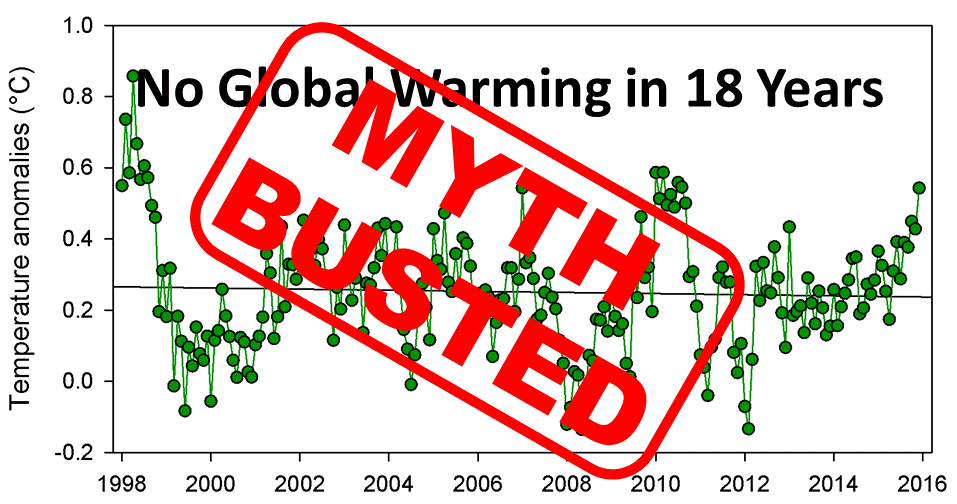
myth bustedThe notion that there has been a recent pause or hiatus in global climate change is one of those myths that just will not die. Numerous studies have shown that it simply isn’t true, and the claim is based on cherry-picked evidence and shoddy statistics. Nevertheless, despite 2015 replacing 2014 as the warmest year on record (based on surface temperature data), the myth lives on. Therefore, I want to provide a simple explanation of why this argument is fraudulent, as well as briefly reviewing several fairly recent studies that have thoroughly demolished the myth of the global warming pause. In short, the “pause” is actually just a normal fluctuation, and there have been multiple similar “pauses” prior to this one. There is nothing truly unique or special about the past two decades, and the climate is still warming.

Cherry-picked dates
Before I talk about the climate data itself, I need to make a few general points about analyzing trends. Generally, when you want to see if something is changing over time, you are going to do a regression analysis to see if there is a significant change in the variable of interest as time progresses (i.e., does it increase or decrease over time). Whether or not you get a significant trend is, however, highly dependent on the dates that you use, and it can be skewed by either starting or ending on an extreme year. This means that for almost any large data set, you can cherry-pick some subset of the data which fits your preconceived view.

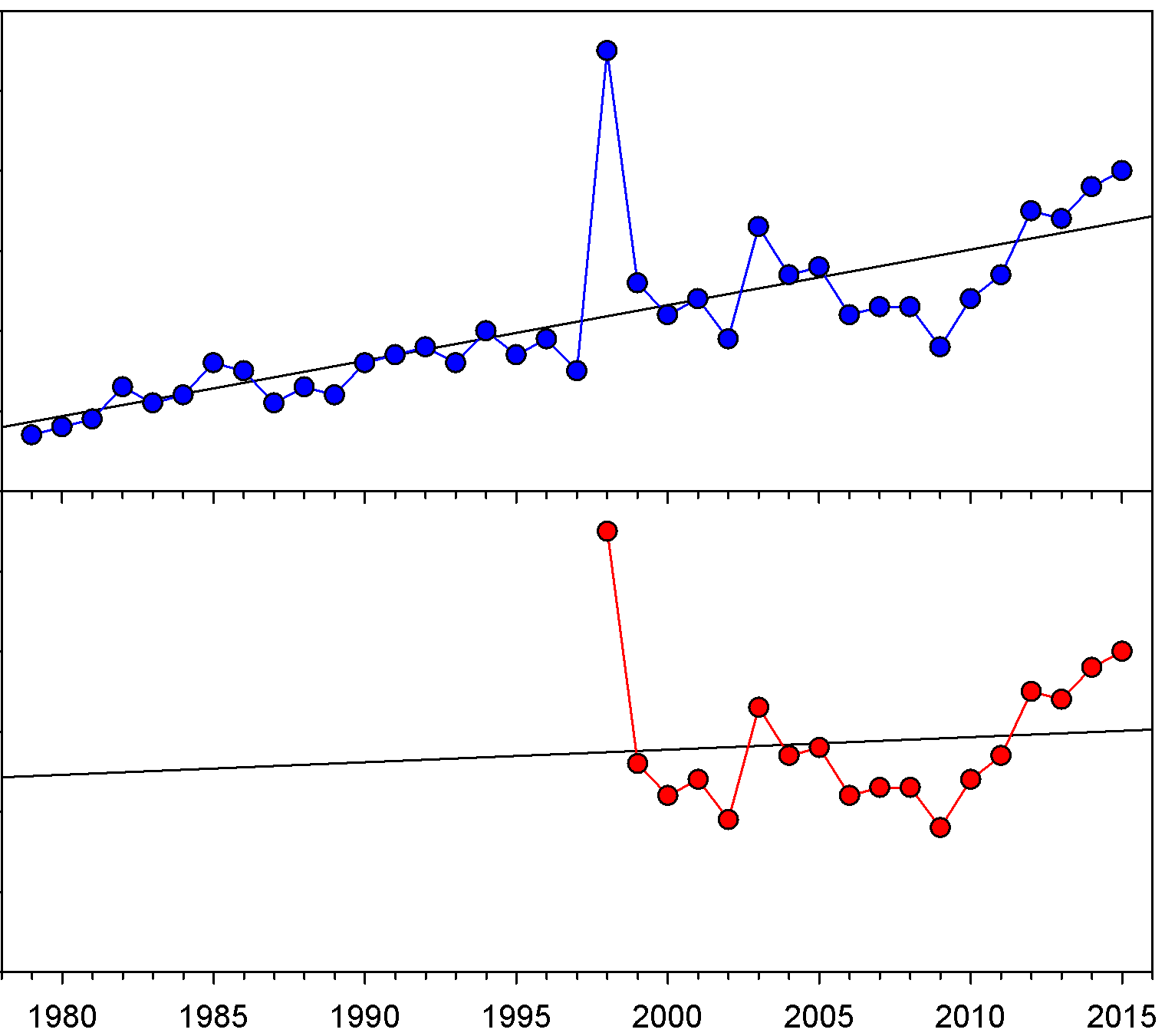
These are fictional data intended to show what happens when you cherry pick your starting point. The top panel is statistically significant, whereas the bottom panel is not.

These are fictional data intended to show what happens when you cherry-pick your starting point. The top panel is statistically significant, whereas the bottom panel is not.

Let me use the following fictional data set to illustrate this (right). I deliberately left the Y axis blank so that you can pretend that these data are whatever you want them to be (net earnings, population size, temperature, etc.). When we look at the full data set, we can clearly see that there is an overall upward trend, and we get a statistically significant increase over time (P < 0.001; I explained P values in detail here, but for now just realize that anything less than 0.05 is typically considered to be statistically significant). Nevertheless, if we cherry-pick our starting point, we can create the illusion of a pause. For example, you’ll notice that 1998 was a particularly high and unusual year, and if we use that as our starting point, we find that there has not been a statistically significant increase since that time (P = 0.717). If we start with 1999, however, we find a significant increase again (P = 0.013). In other words, if you deliberately start with an unusual year, you can mask the overall trend (which, in my book, is fraudulent).

The example above is obviously extreme because 1998 was such a huge outlier, but we can do the same thing with less extreme situations. Consider, for example, that if we cherry-pick the years 1990–1997 we get a fairly flat, non-significant line (P = 0.8694). Similarly, if we start with 2003 and go through 2015, we get a non-significant result of P = 0.061. Further, let’s imagine that it was currently 2010, so you only had the data going up to 2009. In that case, if you started with the 2003 data, you would actually find a significant negative trend (P = 0.004) even though the overall trend is clearly a positive one.

My point here is simply that you can tell almost any story that you want if you cherry-pick your data carefully enough. There will always be natural fluctuations in the data, so if you cherry-pick where you start your analysis, you can twist the data to fit your preconceptions. Doing so is, however, completely inappropriate, yet it is exactly what has happened with the climate data. The people who claim that global climate change has paused nearly always start the pause in either 1997 or 1998 even though we have data going back much further than that. Why do they use those years? Quite simply, because those are the years that fit their story. 1998 was an extremely strong El Niño year, which made it unusually warm. This is particularly pronounced in the satellite data, which is typically the data set that I see people citing as evidence of a pause. Thus, just like 1998 in my fictional example, starting the climate trend in 1998 biases the analysis. In fact, if we start in either 1996 or 1999, we find a significant warming trend (P = 0.047 and 0.021 respectively). So why should we say, “there has been no warming since 1997” when we could also say, “there has been significant warming since 1996” or “there has been significant warming since 1999”?

If you cherry pick your years, you can find quite a few "pauses" in climate change, because short term data are unreliable if you are interested in long term trends. Image via Skeptical Science. Note: some people have claimed that Skeptical Science had to cherry pick their data set to get a flat line for the fourth section of this image, but that is irrelevant since the entire point of this image is to illustrate that you shouldn't cherry pick data because you can misrepresent it by doing so (i.e., climate change contrarians cherry pick data all of the time, and this image shows why that is a bad idea).

Short term data are unreliable if you are interested in long term trends. As a result, if you cherry-pick your years, you can find quite a few “pauses” in climate change. Image via Skeptical Science. Note: some people have claimed that Skeptical Science cherry-picked their data set for the fourth flat section, but that is irrelevant since the entire point of this image is to illustrate that you shouldn’t cherry-pick data because you can misrepresent it by doing so (i.e., climate change contrarians cherry-pick data all of the time, and this image shows why that is a bad idea).

In fact, any starting point prior to 1997 is significant, and there are multiple significant starting points after 1998 (from both the RSS data and NASA’s surface temperature data set). Similarly, Skeptical Science put together a great image (left) for a surface temperature data set showing that if we cherry-pick our years, we can find many “pauses” despite the clear overarching trend. In other words, our current “pause” is nothing more than a natural fluctuation, and it is in no way unique.

This shows the temperature data once the effects of El Ninos, solar fluctuations, and volcanoes. Image via Open Mind.

This shows the temperature data once the effects of El Niños, solar fluctuations, and volcanoes have been removed. Image via Open Mind.


Nevertheless, even though you have to cherry-pick to see a hiatus, it is true that starting the trend in either 1997 or 1998 will give you a flat line (using the satellite data), and some people are understandably bothered by that, so let’s look at it a bit further. Part of the issue is sample size. The smaller your sample size, the harder it is to detect trends (which is also a big part of why the Skeptical Science figure was able to produce so many flat lines). The second and probably more important reason is that there are many factors that influence the climate (output from the sun, volcanic activity, El Niños, etc.) and cause natural fluctuations. These factors create noise that can make it difficult to see changes over the short-term. In other words, over long periods of time, the impact of human activities has a strong enough effect that it is obvious, but over short periods of time, human-induced changes can be masked by natural factors. To illustrate this, look at what happens to the data when we account for the natural factors (figure above and Foster and Rahmstorf 2011). The RSS and UAH data sets are the same satellite data sets that are generally used to show a flat line starting in 1997/1998, but when we account for the natural factors, suddenly, clear warming patterns emerge, even if we look at 1997/1998 and use it as our starting point (i.e., as we remove natural factors, the influence of human activity becomes more clear).

Cherry-picked data sets
A second major problem with the claim that there has been a pause in climate change is the choice of data set. You see, the term “global warming” is somewhat misleading. Yes, the average temperature of the planet has and will increase, but there is a lot more happening than just the temperature changing, and we should really be more concerned with the total amount of heat energy that the earth is trapping, rather than changes to the surface temperature. This is why most scientists prefer the more accurate term “global climate change.”

Because climate change involves a lot more than just the surface temperature changing, there are multiple data sets that we could use to look at it, such as land surface temperatures, ocean surface temperatures, lower atmosphere temperatures (which is what satellites record), and deep ocean temperatures. All of these should ultimately be affected by climate change, but not necessarily at the same rates. Satellite readings are, for example, particularly sensitive to the effects of El Niños. Also, water has a high heat capacity, which means that the oceans will absorb heat energy far more readily than the earth’s surface.

Therefore, if climate change has actually halted, it should be reflected in all of the major data sets, but it’s not. In other words, there is nothing in the science of climate change that says that all areas of the earth will be warmer all of the time. Rather, different components of the earth will warm at different rates, and some may even cool. So we don’t actually expect every year to be warmer than the last across all of the data sets. If it has truly paused, however, then you should not see trends of increasing temperatures in any of the data sets.

So what do the data sets actually show? For a while, there was no statistically significant increase from either the satellite data or the surface data, but as time has progressed, that has changed, and if you look at NASA’s global Land-Surface Air and Sea-Surface Water Temperature Anomalies data set, you will find a significant increase no matter what year you start the analyses in (note: that is only true if you use each month as a data point, if you use the yearly means, then it is significant for any starting point prior to 2005, after that you start to loose significance, largely because of the small sample size). Further, many of the previous analyses of the surface data sets failed to account for methodological changes and reached incorrect conclusions as a result (more on that later).

Meanwhile, the satellite data for the lower atmosphere (such as the RSS data) do show a flat line for some starting points within the past two decades. As I noted earlier, however, there are also years that yield a significant increase. Further, as noted in an earlier figure, once your correct for natural factors, the warming trend becomes obvious. Additionally, there is some debate among scientists about how reliable the satellite data actually are (Weng et al. 2014). The situation is extremely complicated, so I’m not going to attempt to explain it in detail in this post, but in short, satellites don’t actually measure the temperature. Rather, they measure several wavelengths of radiation and use those measurements to infer the temperature. The problem is that particulates and various gasses can interfere with those radiation measurements. Also, satellites tend to drift over time, which makes it hard to get long term measurements from a fixed point. To be clear, I’m not suggesting that the satellites are worthless, rather I am just pointing out that they have clear limitations and elevating them to the status of irrefutable evidence while ignoring the other data sets makes no sense whatsoever.

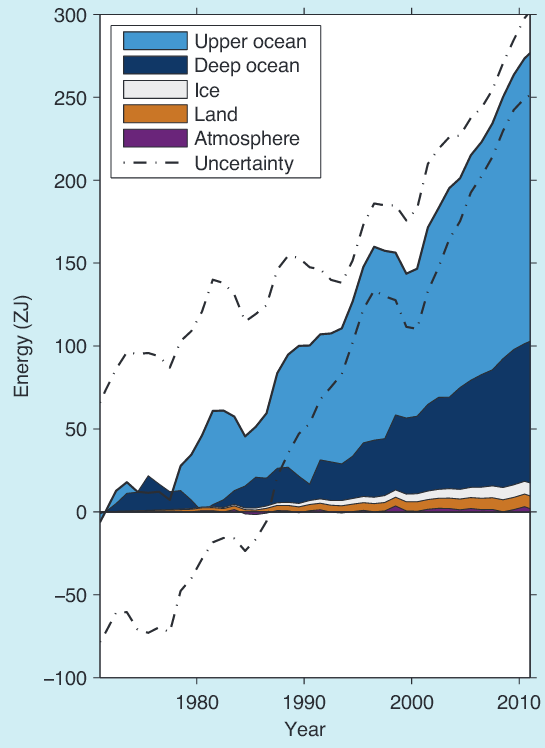
The accumulation of energy over time. You'll notice that most of the energy is getting trapped in the oceans. Image via Rhein et al. 2013.

The accumulation of energy over time. You’ll notice that most of the energy is getting trapped in the oceans. Image via Rhein et al. 2013.

Finally, let’s turn to a very important source of data: the oceans. Our oceans are massive heat sinks. Indeed, it’s estimated that over 90% of the excess energy that the earth has trapped via global warming is stored in the oceans (Rhein et al. 2013). This is because water has a very high heat capacity, which makes it excellent at absorbing and storing heat energy. So, what’s happening to our oceans? Quite simply, they are trapping more heat energy (Balmaseda et al. 2013; Glecker et al. 2016). Look, for example, at Figure 1 in the Balmaseda et al. study or Box 3.1 (page 262) of Rhein et al. (2013)(left). Yes, there are fluctuations, and in Balmaseda et al. you can see a large peak around 1998 (just like all of the other data sets), but there is also a very clear upward trend. In other words, the oceans are continuing to trap more and more heat.

In short, there are many different data sets that we could use to ask whether or not the climate is still changing, and only the satellite data show any indication of a pause, and even then, the pause is only present if you cherry-pick your dates and fail to correct for confounding factors. As I frequently argue, we have to look at all of the data, not just the subset that conforms to our preconceptions, and when we do that, it is very clear that the planet is still warming.

Scientific analyses show that there is no pause
At this point, I have attempted to explain the statistical problems with the claim that there is a pause, but I clearly don’t expect you to take a blogger’s word for it (even though I am also a scientist). I do, however, expect you to accept results from the peer-reviewed literature. Several research groups have looked at the data to see whether or not the recent “pause” is actually unusual, and they have all reached the same conclusion. Namely, there are large natural fluctuations in the earth’s temperature, and, as a result, if you cherry-pick subsets of years, you can find numerous “pauses,” but those simply represent normal fluctuations, not actual hiatuses in climate change (this is the same thing that the Skeptical Science image shows; Easterling and Wehner 2009; Santer et al. 2011; Lewandowsky et al. 2015a; Lewandowsky et al. 2015b). In other words, the fact that (according to some data sets) the earth’s temperature has not risen significantly in recent years is not actually an indication that global warming has slowed or is no longer happening.

Further, Karl et al. (2015) found that the surface temperature data sets had numerous biases resulting from inconsistent methodologies, and once those biases were removed, the data showed that the rate of climate change over the past 15 years is just as great as the rate in the preceding decades. People often have a knee-jerk response to statements like that and say, “see, they are committing fraud and manipulating the data to make it show warming,” but that’s not what is happening here. You can find a really great, thorough explanation of why the data have to be adjusted here, so I’ll just give you the Cliff Notes version (I also previously wrote a post that was specifically about adjustments in the GHCN data set). In short, climate data have been collected for decades from all over the world using many different methodologies, and those methodologies and collection locations have changed over the years. Those differences and changes create biases in the data that have to be accounted for. These types of corrections are normal for real data sets, and failing to make them will give you incorrect results

Let me give one really simplistic explanation to illustrate why adjustments are necessary. Let’s say that you have been recording the temperature in your back yard for years, and originally the thermometer was in an open area. Over time, however, a large tree has grown and now shades the thermometer. If you don’t account for the presence of that tree, you are going to get an incorrect cooling trend. The same type of thing happens with real data, and we have to account for any biases and changes in the collection methodologies if we want accurate trends. There is nothing dishonest or fraudulent about that.

In blind tests, experts and non-experts reject the idea of a pause
People are obviously prone to biases, and when looking at something like a temperature data set, your biases can cause you to see a pause that isn’t there or make you ignore a pause that is real. Some studies have, however, overcome this problem by doing blind tests. In other words, they present people with the data and ask them to determine whether or not there has been a recent pause, but they don’t tell them that the data are climate data, thus eliminating the biases. These studies have found that once the biases are eliminated, people don’t detect a pause (sometimes they don’t detect a pause even with the biases).

The first of these is not actually a peer-reviewed study, but it is nevertheless informative. In 2009, The Associated Press sent two temperature data sets to four different professional statisticians, and asked them to look for trends and determine whether or not there has been a recent pause, but they did not tell the statisticians that the data sets contained climate data. All four of them said that there was no pause. In other words, when professional statisticians unbiasedly examined the data, they did not detect a hiatus.

The next study was actually peer-reviewed and was conducted by Lewandowsky (2011). This study did not use experts, but instead showed long term climate data to 200 pedestrians and asked them to predict the next three data points. Half of the people were told that the data were share prices, and the other half were told that they were climate data. Interestingly, both groups predicted that the next three points would increase, even if the subjects didn’t think that humans were causing the climate to change.

The final study was also conducted by Lewandowsky (2015b), but it used experts instead of non-experts. It did not, however, use climatologists. Rather, it used economists. This may sound strange at first, but it actually makes good sense because both groups are adept at analyzing trends and making predictions about future events based on those trends. All 25 participants had at least a master’s or Ph.D. in economics or a relevant field, and all but four of them had at least five years of professional experience. They were shown the climate data, but they were told that the data were for the world’s agricultural output and they were asked to analyzed the data in light of the following statement,

“A prominent Australian critic of conventional economics, Mr. X., publicly stated in 2006, that ‘There IS a problem with the growth in world agricultural output—it stopped in 1998.’ A few months ago, Mr. X. reiterated that ‘. . . there’s no trend, 2010 is not significantly more productive in any way than 1998.’”

Finally, they were asked several questions about whether or not the data supported that statement. The majority of them did not think that the data supported that statement, and almost two-thirds of them went as far as saying that the claim may be fraudulent.

All three of these tests tell the same story: the data do not actually support the notion that climate change has paused, which implies that people are latching onto the idea of a pause for ideological reasons rather than scientific ones.

Conclusion
In summary, if you want to claim that the earth is no longer warming, you are going to have to violate numerous principles of both scientific and logical investigation. First, you have to cherry-pick your data set and focus on the satellite data even though the surface and ocean data sets show clear evidence of continued climate change. Then, you are going to have to cherry-pick within those data sets to select the years that match your preconceptions, while simultaneously failing to account for factors such as El Niños and volcanoes. You will also have to ignore the expert analyses of the data which found that there was no pause, and you will have to ignore the fact that there have been multiple other similar “pauses” in the past.

In short, global warming has not paused. The past two decades simply represent normal fluctuations, not a hiatus. So please, I beg of you, stop claiming that climate change is no longer happening, because that claim simply isn’t supported by the data. It is happening, and it will continue to happen until we finally decide to take serious action.

Note: I can already hear the keyboards clicking away as people misuse my statements about “natural fluctuations” to assert that climate change itself is just a natural fluctuation. So let me be clear, that claim is in no way shape or form justified. The overall trend is far, far greater than what is caused by natural fluctuations (over the given time frame), and we are extremely certain that we the cause of the current warming.

Other posts on climate change:

Literature Cited:

  • Balmaseda et al. 2013. Distinctive climate signals in reanalysis of global ocean heat content. Geophysical Research Letters 40:1754–1759.
  • Easterling and Wehner 2009. Is the climate warming or cooling? Geophysical Research Letters 36.
  • Foster and Rahmstorf 2011. Global temperature evolution 1979–2010. Environmental Research Letters 7:011002.
  • Gleckler et al. 2016. Industrial-era global ocean heat uptake doubles in recent decades. Nature Climate Change.
  • Karl et al. 2015. Possible artifacts of data biases in the recent global surface warming hiatus. Science 348:1469–1472.
  • Lewandowsky 2011. Popular consensus climate change is set to continue. Psychological Science 22:460–463.
  • Lewandowsky et al. 2015a. On the definition and identifiability of the alleged hiatus in global warming. Scientific Reports 5: 16784.
  • Lewandowsky et al. 2015b. The “pause” in global warming: Turning a routine fluctuation into a problem for science. Bulletin of the American Meteorological Society
  • Rhein et al. 2013. Observations: Ocean. In: Climate Change 2013: The Physical Science Basis. Contribution of Working Group I to the Fifth Assessment Report of the Intergovernmental Panel on Climate Change. Stocker (eds.). Cambridge University Press, Cambridge, United Kingdom and New York, NY, USA
  • Santer et al. 2011. Separating signal and noise in atmospheric temperature changes: The importance of timescale. Journal of Geophysical Research: Atmospheres 116.
  • Weng et al. 2014. Uncertainty of AMSU-A derived temperature trends in relationship with clouds and precipitation over ocean. Climate Dynamics 43:1439–1448.


Posted in Global Warming | Tagged , , | Comments Off on Global warming hasn’t paused

Research, you’re doing it wrong: A look at Tenpenny’s “Vaccine Research Library”

meme research you keep using that word“I’ve done my research.” If you’ve ever debated someone who disagrees with a scientific  consensus, then you’ve probably encountered that sentence, especially if they were an anti-vaccer. It is the mantra of the anti-science movement, but it’s nearly always misused. You see, in science, doing research generally means conducting a scientific study and adding new information to the general body of scientific knowledge. Nevertheless, I don’t want to dwell on semantics, and I think that people should educate themselves; however, if you are going to educate yourself, then you have to read good sources (which in science means the peer-reviewed literature), and you can’t cherry-pick which papers to read and which papers to ignore. This is where our story turns to Sherri Tenpenny’s “Vaccine Research Library” (VRL).

The title sounds great, doesn’t it? A single library that houses all of the literature on vaccines would be a wonderful tool; however, the VRL does not contain all of the literature on vaccines. Instead, it only contains the papers that oppose vaccines. So, rather than being a legitimate research tool, it is actually the most glorious confirmation bias generator that I have ever encountered. I could not have asked for a more beautiful example of cherry-picking sources. Therefore, in this post I will not only explain why the VRL is a load of crap, but I will also use it as an illustration of how not to do research.

Note: Although they don’t house all of the literature on vaccines, you can find most studies on PubMed and Google Scholar. So use them if you want to actually be well-informed.

What is the purpose of the VRL?
I’m going to let Tenpenny answer this question for me, because her statements are better than anything I could write (I suggest that you don’t drink anything while reading this section because her justification for this website is honestly pretty funny).

Pro-vaccine information is as abundant and as easy to find as ice in Antarctica. But there is a large body of overlooked medical and scientific research that shows the other side – and chronicles the heartbreaking disasters and long-term health consequences caused by vaccines. The problem is that locating this information can be challenging, difficult to interpret and very time consuming to dig out.

On a different part of the site, she says,

In 2011, we realized how difficult – and time consuming – it is to find mainstream medical references documenting the harm being caused by vaccines. Finding these “needles in the haystack” is a tedious and time-consuming task.

Now, a rational person would think that maybe there is a scientific reason that pro-vaccine papers are so predominant, but that doesn’t stop Tenpenny from plowing forward. Further, she clearly contradicts herself. First, she says that there is a large body of anti-vaccine literature, then she goes on about how hard it is to find these papers, and she refers to them as “needles in the haystack.” So which is it? Are they abundant or aren’t they, and if this body of “overlooked” research is so large, then why is it hard to locate? Why do you have to dig it out? The vast majority of journals archive their abstracts in Google Scholar so if there is actually a large body of literature showing that vaccines are dangerous, then it should be easy to find those papers. The fact that it is difficult to find anti-vaccine publications actually demonstrates just how weak the anti-vaccine position truly is. So Tenpenny is really defeating her own argument.

Another section of the page says (the bold text and bizarre capitalization are in the original):

Convinced that Vaccines are Unsafe but Need Scientific Proof? You need information that gives you “The Other Side of the Story.”

Here we have the real problem. As I have frequently argued, anti-vaccers (and anti-scientists in general) have no interest in being well-informed. They don’t actually care about facts. Rather, they care about protecting their preconceptions. This “library” is not designed for people who actually want to learn about vaccines. Rather, it is intended for those who have already decided that vaccines are dangerous. Stephen Colbert brilliantly described this way of thinking when he coined the word “truthiness,“and it aptly describes the purpose of this website. It isn’t for people who want to carefully analyze the facts and evidence. Rather, it’s for people who know in their gut that vaccines are bad, and it is intended to bolster an existing belief rather than help people to evaluate evidence. Tenpenny makes this explicitly clear with statements like,

They want evidence to support what they intuitively know: The Party Line about vaccines is a charade, perpetuated to bolster profits and expand Big Pharma’s cartel.

Once again, it’s about cherry-picking evidence to support a belief rather than actually informing yourself about the topic. According to Tenpenny, however, her site will help to balance your knowledge.

Now, all in one place, is the irrefutable science you need to defend your position against vaccines. You will be able to prove your point, protect your health and that of your children, write balanced news stories, or support  legal cases.

Think about how absurd this is for a minute. First, she claims that reading a tiny subset of the literature will give you irrefutable evidence. Then, she claims that totally ignoring the majority of the literature will help you to write balanced news stories! It’s like me saying, “here is a paper proving that the earth is flat. It disproves all of the papers saying that the earth is round, and it will let you write a balanced news story on why the earth is actually flat.”

To conclude this section, I want to give and discuss one final quote from her site which I find particularly amusing (again the emphasis is in the original).

Concerned that reviewing all this information will be time consuming?  “Pre-search” takes the “grunt work” out of your research.

How much time do you spend on the Internet searching and researching…, searching and researching…, and searching and researching…..for reliable scientific facts about the problems associated with vaccines?Because browsers and web crawlers deliver a large number of results, it can take hours to troll through page after page…after page…after page of search results. Then clicking on link after link. Then skimming through reams of material to find a particular fact. What’s worse is the exasperation you feel when you come up empty-handed – after investing so much time, you didn’t find what you were looking for.

Now think about how much you are paid per hour in your Day Job. Take that dollar amount times the hundreds, even thousands, of hours you spend on the Internet, searching for information that can be frustratingly difficult to find.

The annual membership rate has been drastically reduced: A one year membership to the Library is worth thousands of dollars and hundreds of hours of your time, you can have full access to thousands of references for only $9.98 per month (for quick research of a specific topic) or only $99 – for a full year!

Let me paraphrase this, “Are you tired of spending hours trying to find that one anecdote that supports your preconceptions? Is cherry-picking data taking up too much of your time? Are you annoyed with having to scroll past website after website that says you’re wrong? Well then I have a deal for you, because I’ve cherry-picked the internet for you! Now, for the low price of $100 per year, you can have all information that conforms to your distorted view of reality without having to be bothered with the thousands of studies that say you’re full of crap! Order now, and we’ll even include a free jar of cherries.”

Addendum (26-1-2016): Originally, there were two paragraphs here that questioned Tenpenny’s financial motives for making this site, but as someone pointed out in the comments, they were admittedly speculative, and I don’t really think that they are relevant to the point that I am trying to make, so I removed them.

What is in the VRL?
tennpenny anti-vaccine vaccine research library darth vader star warsAt this point, I think it is clear that the VRL is not motivated by an honest desire to be well-informed. Nevertheless, let’s look closer because regardless of the motivations for constructing this site, if Tenpenny actually found a large body of properly conducted studies showing that vaccines are dangerous, then we should take those studies seriously. I’m clearly not about to give Tenpenny one penny of my money, however, so I activated a free trial version of the VRL. This admittedly only gave me access to part of the library, but I see no reason to think that the rest of it would be substantially different.

Before I describe the contents of the library, I want to remind everyone that not all scientific studies are equal. Some designs produce very robust, reliable results, whereas others produce very weak, unreliable results. So you should always be careful to avoid the trap of latching onto a study just because it agrees with you. You have to carefully evaluate the study and look at the design that was used to determine whether or not the results are reliable (I explained the hierarchy of evidence in more detail here).

With that in mind, it probably won’t surprise you to learn that the vast majority of studies in the library rank very low on the hierarchy of evidence. For example, there are a large number of case reports. These are the lowest category on the hierarchy of evidence because they are basically just glorified anecdotes. If a doctor observes someone having a heart attack after receiving a vaccine, for example, they would write a case report on it, but that does not in any way shape or form prove that the vaccine caused the heart attack. It could be a total coincidence that the person had a heart attack after the vaccine. In fact, using anecdotes and case reports to draw causal conclusions is a logical fallacy known as post hoc ergo propter hoc. So, rather than proving that vaccines are dangerous, these case reports should (and are) used as the basis for starting large, robustly designed studies to actually test whether or not vaccines cause the reported symptoms, but you don’t see many of those large studies in the VRL because they tend not to fit anti-vaccers’ preconceptions.

Of the studies that did use robust designs, the sample sizes tended to be small, and many of them suffered serious methodological flaws, were published in questionable journals, etc. So rather than being a collection of studies that prove that vaccines are dangerous, the VRL is really a collection of the lowest quality, weakest studies on vaccines. To be clear, there are a few decent studies in the list, but many of those are misrepresented, and you always have to consider scientific papers within the broader context of the literature (more on that later).

What really amazed me about the contents of the VRL, however, was Tenpenny’s ability to cherry-pick within a study. For example, I was very surprised to see a review paper (Shepard et al. 2006) on Hepatitis B infections and vaccinations (remember, reviews are one of the highest levels of evidence). The presence of this paper confused me because it is overwhelmingly supportive of vaccines. Here is an excerpt from the abstract:

Vaccination against HBV infection can be started at birth and provides long-term protection against infection in more than 90% of healthy people. In the 1990s, many industrialized countries and a few less-developed countries implemented universal hepatitis B immunization and experienced measurable reductions in HBV-related disease…Further progress towards the elimination of HBV transmission will require sustainable vaccination programs with improved vaccination coverage, practical methods of measuring the impact of vaccination programs, and targeted vaccination efforts for communities at high risk of infection.

So why on earth is a paper that encourages increased vaccination efforts in the library that supposedly proves that vaccines are dangerous? It’s there because of three sentences.

The earliest recognition of the public health importance of hepatitis B virus (HBV) infection is thought to have occurred when it appeared as an adverse event associated with a vaccination campaignIn 1883 in Bremen, Germany, 15 percent of 1,289 shipyard workers inoculated with a smallpox vaccine made from human lymph fell ill with jaundice during the weeks following vaccination. The etiology of “serum hepatitis,” as it was known for many years, was not identified until the 1960s, and only following the subsequent development of laboratory markers for infection was its significance as a major cause of morbidity and mortality worldwide fully appreciated.

Before I talk about those sentences, I want to make something else clear about the VRL. Access to this library does not give you access to the papers themselves (despite the fact that her page about the VRL clearly implies that you get the full papers). Rather, you get abstracts and a brief blurb from Tenpenny where she has highlighted the “important” parts of the paper for you. In other words, she is cherry-picking within studies! She is actually encouraging people to not only pick and choose which studies to accept, but to actually pick and choose which sentences to accept. Her excerpt from the Shepard et al. study illustrates that perfectly (the emphasis was hers, btw). Out of an entire review that talks about the massive body of literature showing that the Hepatitis B vaccine is useful, she wants you to read just three sentences. In other words, this entire paper describes why she is full of crap, but she wants you to ignore that and focus on three sentences from the introduction instead. It’s the most absurd and outlandish level of cherry-picking that I have ever seen.

Further, why she thinks that these three sentences show that vaccines are dangerous is beyond me. My guess is that she is arguing that the vaccine was contaminated with Hep B, to which I respond, so what? It makes absolutely no sense to say, “the vaccine was contaminated in 1883, therefore it is dangerous now.” Medical technologies have come a long way since 1883. It’s like saying, “the earliest computers were massive and slow, therefore modern computers are no good.” It seems that Tenpenny is suggesting that we should ignore the massive body of evidence supporting the vaccine and focus instead on a mistake that was made (and corrected) decades ago.

Note: Someone is probably getting ready to accuse me of hypocrisy since I also highlighted just a few sentences from the paper, but before you do that, realize that I was simply using those sentences to show that the paper was pro-vaccine. I am not in any way shape or form suggesting that you use those sentences as evidence that the vaccine is safe. For that, you need to read the entire paper (not just the abstract) as well as the rest of the literature on the topic. Finally, unlike Tenpenny’s quote, mine was actually representative of the paper.

Why Tenpenny’s method doesn’t work
that's not how this works memeScience is a messy process, and reaching a firm conclusion generally involves lots of studies from numerous research groups. As a result, the body of literature on any given topic will contain lots of statistical noise. In other words, there will generally be lots of preliminary studies with small sample sizes or weak designs, and there will be multiple studies that reached the wrong conclusion just by chance. This is why whenever you are trying to learn about a scientific topic, you have to look at the entire body of literature, not just a few cherry-picked studies. There is so much research being done that there are lots of bad papers out there (sometimes at no fault of the authors), and you can find a paper to support almost any position that you can think of. There are, for example, still people who think that the earth is flat, and if you start with that assumption, you can find “evidence” and even a few scientific papers to support it (for example, Benard et al. 1904, which you can find an excerpt from here). This is why it is so important that you avoid the single study syndrome. Individual studies have a high probability of being wrong, but it is far less likely that a large body of studies is wrong.

outlier central trand anti-science meme

I’m not sure who created this image, so if it’s yours, please let me know so that I can give credit.

You should never latch onto a single study as irrefutable proof of your position, but that is exactly what Tenpenny is encouraging you to do. In her mind (and in the minds of anti-scientists more generally) all that you have to do to prove your position is find one study that agrees with you (or even one sentence). It doesn’t matter if the study was done correctly, it doesn’t matter what the sample size was, it doesn’t matter if the study used a robust design, it doesn’t matter if there are a thousand other studies that disagree with you. According to her way of thinking, finding that one study is all that you need, but that’s clearly not how science or logic actually works. Replication is one of the central tenets of science, and scientists only reach a consensus after a result has been replicated multiple times and supported by numerous studies. So Tenpenny is ignoring a fundamental principle of science. Further, what she is doing is actually a logical fallacy known as the Texas sharpshooter fallacy. This fallacy occurs whenever you focus on the subset of data that appears to support your position, while ignoring a much larger body of data that refutes your position.

Additionally, she is ignoring a fundamental principle of rational thought: you always have to start with an unbiased question. It’s fine to ask a question like, “are vaccines safe?” then look for answers to that question, but Tennpenny and her followers are starting with the assumption that they are dangerous, then looking for evidence to support that assumption. The problem is that if you do that, if you start with a conclusion, then you will always find something which supports that conclusion (at least in your mind).

Now, invariably some anti-vaccer reading this is going to say, “you’re committing a hasty generalization fallacy. Not all anti-vaccers are like that. I actually have looked at both sides and become well-informed.” In which case, my response is, why do you reject the thousands of papers that clearly demonstrate that vaccines are safe and effective? I’m guessing that it’s either because you have read a few faulty, low-quality studies and are choosing to rigidly cling to them (in which case you are doing exactly what Tenpenny is) or you are blindly rejecting them for one of the flawed reasons that I described here. To put this another way, where’s your evidence? If your position is actually based on an unbiased review of the data, then surely you can provide me with a large body of high-quality, properly-controlled, robustly-designed studies that have been replicated by other research groups which show that vaccines are dangerous and which provide a valid explanation for why thousands of other studies disagree with them. Unless you can do that, then you are succumbing to the same confirmation bias as Tenpenny, and you are picking and choosing what evidence to accept (no, the vaccine inserts, VAERS, and NVICP do not count as evidence that vaccines are dangerous, see the links for details).

Conclusion
In this post, I have been focusing specifically on Tenpenny and the anti-vaccers who follow her, but everything that I have been talking about is widely applicable to everyone. We are all prone to confirmation biases (myself included). It’s ingrained in our psychology to latch onto evidence that supports our views and disregard evidence that doesn’t. The key, therefore, is to acknowledged that tendency and strive to overcome it. If we are going to actually be well-informed on any topic, then we must ensure that we are not simply succumbing to confirmation biases. We have to look at the entire body of evidence, not just the subset that conforms to our preconceptions. That’s why I find the VRL so infuriating. Rather than helping people to become truly open-minded, it insists that people should close their minds to any evidence that supports vaccines, and it openly encourages people to adhere to confirmation biases. It equates gut feelings with actual evidence, and it encourages people to seek out “proof” for their views rather than testing whether or not those views are actually justified. This, in my opinion, is the worst form of pseudoscience and pseudoskepticism, because it doesn’t just mislead people about the evidence. Rather, it misleads them about the way to evaluate the evidence. If you want to truly understand our marvelous universe, then you must train yourself to recognize and avoid this false skepticism, and you must always accept the possibility that you might be wrong. So to any anti-vaccers reading this, I’m not trying to attack you, and I don’t think that you’re stupid, but you have been seriously mislead and misinformed about the evidence and how to evaluate that evidence. You need to learn to recognize confirmation biases and you have to consider the entire body of evidence, not just the pieces of evidence that support your view.

Posted in Nature of Science, Vaccines/Alternative Medicine | Tagged , , , , | 14 Comments