

Recent comments on a climate change post that illustrate this faulty argument.
I spend a lot of time on this blog debunking bad arguments, and I have previously devoted a lot of effort to debunking bad arguments against man-made climate change. There is, however, one extremely common argument that I have not previously addressed. I’ve been reluctant to deal with it because it is an argument about what we should do, rather than the facts of climate change. Nevertheless, it is extremely problematic and prevalent. Therefore, I think it is worth discussing.
The argument in question is made by Americans and states that there is no point in America reducing its greenhouse gas emissions because developing countries, India, China, etc. aren’t going to change their practices (you can see several examples of this argument in the screenshot from recent comments on my Facebook page). Underpinning this argument (and sometimes directly stated) is the assumption that America does a better job of dealing with emissions than other countries do, and countries like China are really the major guilty parties. This is one of those rare arguments where every aspect of it is wrong. The premises are incorrect, and even if they were true, the conclusion doesn’t follow from those premises. So, let’s talk about this for a minute.

A comparison of absolute greenhouse gas emissions among the biggest contributors. Any country that produced at least 5% of the global emissions is shown, with all other countries grouped into either Africa, Europe (without Russia), South America, or Other. The data are 2012 data from the European Commission Joint Research Centre.
First, we need to be clear about just how much America contributes to the world’s greenhouse gas emissions, because it is substantial. The USA produces roughly 14% of the world’s total greenhouse gas emissions. By comparison, the entire continents of Africa and South America combined produce only 11%. So those developing countries that proponents of this argument are so worried about aren’t the big contributors. Even when you combine a huge number of them, you don’t meet the emissions from the US. Indeed, India, which is one of the countries that nearly always gets singled out by this argument, only produces 7% of the world’s greenhouse gases. To be clear, that’s substantial, and it is a problem, but trying to shift the blame from the USA to India is insane, because the US produces way more greenhouse gases than India does. To be fair, China does produce a lot more than the US in terms of absolute numbers, but, as I’ll elaborate on below, China has a substantially larger population than the US.
If we really want to understand how much of a role each country is having in climate change, we also need to look at the data per capita (i.e., corrected for population size) rather than just the raw numbers. Looking at these data can become messy, because there are a bunch of tiny countries that, for various reasons, produce a lot of emissions per person. As a result, they score very high on per capita emissions, but are only contributing a tiny amount in absolute terms. The sensible approach is, therefore, to look at per capita emissions among the countries that are large contributors to the absolute amount of emissions. For the sake of this post, I set that threshold as countries that produce at least 1% of the world’s total greenhouse gas emissions. As you can see from the graph below, only 19 countries meet that criteria, and most of them aren’t countries that people would label as “developing.”
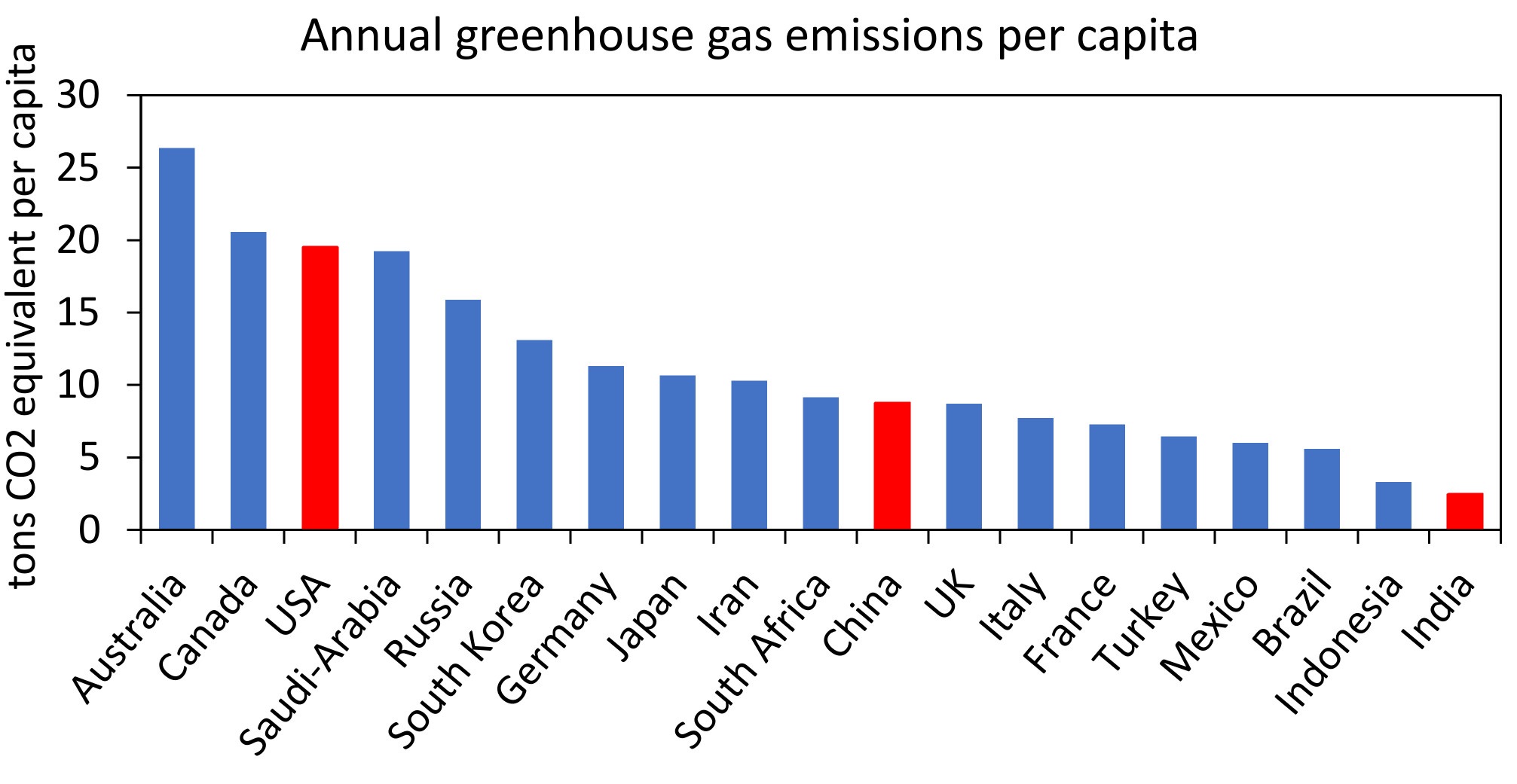
Greenhouse gas emissions per capita for any country that produced at least 1% of the world’s total emissions. I have colored the US, China, and India in red since they are the countries that are usually involved with the argument I am addressing. The data are 2012 data from the European Commission Joint Research Centre.
When looking at the per capita data for those countries, Australia and Canada are the worst offenders, and they absolutely should be held to account for that and should change their practices, but they only produce about 1.3% and 1.6% (respectively) of the world’s total emissions. So they are still fairly small players. The US, on the other hand, is a close third place for per capita emissions and, again, has very high total emissions. But what about China and India, the countries that people are so worried about? China is in 11th place, and India is in last place for per capita emissions (among countries who contribute at least 1% to the total emissions). Let me try to put the numbers this way: China has about 18.4% of the world’s population and produces 23% of the emissions. India has 17.2% of the population and produces 7% of the emissions. In contrast, the US has a mere 4.4% of the population but produces 14% of the emissions! To put that another way, on average, each American produces as many greenhouse gases as 2.2 Chinese people or 7.8 Indians. Again, to be clear, the emissions produced by China and India are a problem. I’m not suggesting otherwise, but stop pretending that they are the problem while simultaneously acting as if the US is some magical greenhouse gas utopia. It isn’t. The US is one of the worst offenders and produces far more greenhouse gases per person than either China or India.
Update 15-01-2022: A third and very useful way to look at the situation is to calculate total historical contribution to greenhouse gasses, rather than focusing simply on current levels (as was done in Hickel 2020). In other words, countries like the USA have been slightly reducing emissions in recent years, but they have a long history of producing lots of emissions; whereas countries like China are increasing their current emissions, but have only recently started producing large quantities of emissions. When you do the math on this, the USA alone is responsible for a whopping 28% of greenhouse gas emissions, the EU is responsible for another 25%, and China is responsible for 11%. That is just based on raw numbers, however. When you add in population size to calculate a fair level of emissions contribution based on population size (this is used for calculating carbon budgets and goals), you find that the USA is overshooting its fair share by 40%, while China is undershooting by 11% and India is undershooting by 34%. Again, the point of all of this is not to say that the USA is terrible and China is great. Both countries are contributing to the problem, and both countries need to take action (indeed, these numbers will change if China does not take strong actions). My point is simply that this notion that the blame for climate change really lies with countries like China is blatantly, factually false. Once you take population size and history of emissions into account, the USA has played the biggest role in causing the current dilemma, and is continuing to contribute strongly to the problem.
Now that we have cleared up the actual numbers, let’s talk for a minute about the notion that the US is the only country that is taking action. This is blatantly false. Indeed, if you’ve paid even the tiniest bit of attention to world politics over the past few years, it should be obvious that this is false because of the Paris Agreement. This agreement was signed by China, by India, by all of those developing countries people are so worried about, etc. Do you remember which country backed out if though? I seem to recall it being the USA. Other countries (including China and India) are, in fact, investing in renewable energy. Similarly, China is implementing an emissions trading program to try to reduce their emissions. This notion that other countries aren’t acting is simply false.
Additionally, even if America was the only country that changed its actions, a large reduction in America’s emissions would still have global benefits, because, again, it is the second biggest contributor to climate change in absolute terms and one of the largest per capita. People seem to have this notion that climate change is a problem with a binary solution: either we fix it or we don’t, but that is an insane way to view the problem. Global warming is a continuum, and every 10th of a degree of warming matters and makes things worse. So, let’s imagine for a second that America drastically cuts its emissions but no other countries do, or perhaps they do so more slowly. What happens? Well, climate change still happens, but it occurs more slowly and/or doesn’t become as extreme. So, there would still be a global benefit even if America was the only country to take serious action (again, other countries are taking action, often more seriously than the US).
Finally, I want to ask, since when was, “other people were doing it too” a valid excuse for harmful actions? Let’s be clear here, how we should deal with climate change is really an ethical dilemma, not a scientific one. Science can tell us what is causing climate change, what we need to do to limit the warming, what happens if we don’t limit the warming, etc., but it can’t tell us what we should do, because that requires a moral judgement that science can’t make. Science does tell us, however, that the consequences of not taking action will be dire. They aren’t going to end modern civilization, but millions of people will die, and, indeed, thousands have already died as a result of climate change. Further, those negative effects will disproportionately impact the poorest members of our planet, even though they are the ones that contributed the least to the problem. I’m not going to enter into a lengthy philosophical rant here, but for me personally, that scenario is a problem. I personally think that human life has value and there is a moral imperative to minimize the loss of human life. Thus, I think that people need to realize that our actions have consequences, and regardless of what other countries do, the actions of Americans contribute to a problem that costs human lives. Now, maybe that isn’t an issue for you. Maybe you don’t value human life. I’m not here to convince you otherwise, but if you do value human life, then you need to take responsibility for your country’s actions rather than trying to pass the buck off to other countries. The fact that another country does something immoral does not justify you or your country doing something immoral.
In conclusion, I want to be clear that I am not attacking America, suggesting that it is entirely responsible for climate change, etc. This is a global problem and every country needs to take responsibility for their role in it. Further, countries like China and India do play major roles, but so does America, and Americans need to stop trying to shift the blame. It is a fact that America produces a disproportionate level of greenhouse gases and is a major contributor to climate change. It produces the second highest level of greenhouse gases in absolute terms, and per capita, it produces far more emissions than either China or India. So, this notion that other countries are the real culprits is blatantly false. America bears a huge portion of the blame for climate change. Additionally, it is insane to act as if America is the only country that is taking action against climate change, because it is lagging behind many countries, and countries like China and India are, in fact, making changes. There are certainly more changes that need to be made across the board, but again, that doesn’t mean that America shouldn’t do its part. Finally, even if America was the only country that was taking climate change seriously (which is clearly not the case), that still would not absolve America of its responsibility, and a reduction in America’s emissions would still be beneficial.
Note: Many people have taken issue with me focusing on per capita data. Let my try to explain why that is necessary with an analogy. Imagine that we have two car companies. One produces 100,000 cars a year at 1 pound of waste per car. The other produces 100 cars per year at 90 pounds of waste per car (90,000 total). Which company is more sustainable? Obviously the one that has their waste down to just one pound per car. That is clearly the more sustainable company, but we can only see that by standardizing the data by the number of cars produced. We have to do the same thing with population sizes as well. Of course bigger countries will have more total emissions, but that is simply because they have more people. We have to look at the levels per person to get a clear picture.
Data: I used the data from the European Commission Joint Research Centre. I originally chose this source because it had fairly recent global data for CO2 emissions (2016), but I ultimately decided it would be more meaningful to look at total greenhouse gas emissions (which only go up to 2012 at the time I wrote this). The patterns in both data sets are very similar and would in no way change my arguments, but feel free to play with the CO2 data if you want.
Related posts:




 The Logic of Science