“If evolution is true where are the missing links?”

This is one of the most common arguments that I hear from creationists. The claim is that if evolution is true, then in the fossil record we should see lots of intermediate species. In other words, we should see transitional fossils showing the changes from one group of organisms to the next. So far, we are on the right track. Evolution certainly does make that prediction. The problem is that creationists then proceed to make the factually incorrect claim that no transitional fossils have ever been found. The reality is that we have hundreds of transitional fossils, and examining them not only provides extremely strong evidence for evolution, but it shows a critical logical flaw in creationists’ thinking.

Note: As always, I want to be clear that I am attacking creationism, not Christianity. I am concerned with science, not religion, and there are plenty of people who accept evolution and still believe in God. So do not confuse an assault on the pseudoscience of creationism with an assault on religion.

First, it is important to realize that the definition of “transitional fossil” is totally arbitrary. Any species that does not go extinct is an intermediate. In other words, evolution generally does not reach “end points” (living fossils being one debatable exception). To put this another way, we tend to think of the species that are alive today as the final products of evolution, but they aren’t. If we could go forward several million years into the future, we would see very few of today’s species but we would see plenty of their descendants. So everything is an intermediate between the previous generations and the future generations. Nevertheless, I understand creationists’ point that we should see obvious transitions between major groups, so I’ll focus this post on them.

To understand the full story of transitional fossils, we have to go all the way back to Charles Darwin. In Darwin’s day, paleontology was a budding field, and the fossil record was extremely incomplete, so he did not have any transitional fossils, but he predicted that if evolution was true, we should find the intermediates once the fossil record is more complete. Further, being a good scientist, Darwin proposed that the fossil record should be a good way to test his theory. You see, science works by making testable predictions and proposing falsifiable hypotheses. Transitional fossils meet both of those criteria: if evolution is true, we should find numerous intermediates, and failing to find them would discredit (falsify) the theory. Creationism, of course, makes the opposite prediction. If all organisms were created basically in their present form, and if evolution is limited to occurring within a “kind,” then there should not be any intermediates between major groups.

Now, let’s jump back to the present and see which predictions have come true. Before I go any further, I want you to picture in your mind what an intermediate between a dinosaur and a bird would look like. No doubt, you have pictured an animal that is halfway between the two: an animal that has some of the features of a dinosaur and some of the features of a bird. That is also what evolution predicts that we should find. Now, the question is, “do we find such creatures in the fossil record?” The answer is, of course, a resounding YES!

The most famous intermediate between dinosaurs and birds is of course the Archaeopteryx, but it’s not alone. We have other examples such as Confuciusornis, Jeholornis, and Sinornis just to name a few. All of these fossils not only display some traits of dinosaurs and some of birds, but they show a spectrum of change. This is critically important. If creationism is true, and organisms are relegated to distinct kinds, then there should be clear gaps between each kind, but if evolution is true, then there should be a gradual transition resulting not in two distinct kinds, but in a spectrum with multiple intermediate species such that there is no clear break between the two groups. Evolution’s prediction is, of course, precisely what we find. On the one extreme, we have dinosaurs such as Triceratops and Stegosaurus that are clearly reptiles, but the group of dinosaurs know as Theropods already show some bird-life features. For example, the furculum (commonly known as a wishbone) was once thought to belong exclusively to birds, but we now know that some Theropods had it. Further, many of these dinosaurs had feathers (again a trait that was once thought to be unique to birds). Dinosaurs known as Oviraptors are even suspected to have guarded their nests (a trait that is rare among reptiles). In fact, many of these dinosaurs are so bird-like that scientists are flummoxed about whether they are birds or reptiles. There is no really clear point at which they stop being reptiles and start being birds (exactly as we would expect if evolution was true).

Jumping ahead a few million years from the obvious dinosaurs, we arrive at the famous Archaeopteryx. At this point, everyone is in agreement that it is a bird and could fly for short periods, but it is still distinctly different from our modern birds. For example, it had a skull with teeth, long forearms, a long tail, a small sternum, and largely unfused digits on the hands. All of these features are found in dinosaurs and modern reptiles, but not in modern birds. In fact, despite being considered a bird, the skeleton of Archaeopteryx is so very dinosaur like that scientists once misidentified an Archaeopteryx skeleton as the skeleton of a Theropod dinosaur know as Compsognathus!

Archaeopteryx exolution missing link transitional fossil intermediate

Archaeopteryx is as clear of an intermediate as we could ever hope to find. Although it is considered to be a bird, it is so dinosaur like that scientists once misidentified one of its fossils as a Compsagnathus (a dinosaur). Image via The Pterosaur Heresies

As we move past Archaeopteryx and closer to modern birds, we slowly accumulate more bird-like features. Confuciusornis, for example, had a beak very much like a modern bird, and Jeholornis had forearms with flight specializations that were not found on Archaeopteryx. One of the best examples of these advancements is Sinornis. It was far more bird-like than Archaeopteryx, possessing a more well developed sternum for flight muscle attachment, greatly reduced tail, and fused digits. Nevertheless, it still retained some dinosaur features such as a skull with teeth.

Finally, we arrive at our modern birds. These are clearly distinct from dinosaurs, but they still retain many reptilian features such as scales. Take a look at the feet of birds such as chickens and herons, for example. The structure of their feet is nearly identical to the structure of the feet of Theropods such as Tyrannosaurus rex. Further, we can test this relationship using genetics. If birds did evolve from reptiles as the fossil record suggests, then we would expect the genetic codes of birds to be much more similar to reptiles than to any other group of animals. Again, this is a testable prediction that evolution makes and creationism does not make. The results are, of course, that the DNA of birds is more similar to the DNA of reptiles than it is to the DNA of any other group of modern animals. In fact, the genetic data very clearly shows that birds are simply a type of reptile. So both the fossil record and genetics are in agreement with the predictions of evolution (more details about the genetics here).

An even more astounding test of evolution’s predictions came in 2007 when scientists were able to obtain soft tissue from a fossilized Tyrannosaurus rex. They weren’t able to actually get DNA, but there were able to get protein sequences. Proteins are made of chains of amino acids. There are 21 different amino acids, and their order determines the protein that is made, but for most proteins there are multiple amino acid sequences that will result in the same protein. Because of this, they are very useful for determining the relatedness among organisms because closely related species tend to have similar amino acid chains (e.g., all mammals have protein sequences that are more similar to each other than they are to the protein sequences of amphibians). This gives us another clear prediction. If birds evolved directly from dinosaurs, then the protein sequence of the T. rex should be more similar to the protein sequences of birds than to reptiles, but if, as creationists maintain, dinosaurs are a uniquely created “kind” of organism that are distinctly different from birds and are in fact a type of reptile, then the protein sequence should most closely resemble a reptile’s. As you probably guessed, however, the sequence of the T. rex is more similar to a bird’s than it is to a reptile’s (or to any other modern animal). Again, evolution’s predictions consistently come true.

I realize I spent a lot of time on the evolution of birds, but I want to stress that they are in no way a cherry picked example. I could show a similar sequence between fish and amphibians, amphibians and reptiles, reptiles and mammals, etc. (I’m generally loath to cite Wikipedia, but they actually have a pretty good list of intermediates). Further, genetic comparisons agree with these fossil trends. This is an extraordinary number of predictions that evolution got right and creationism got wrong.

How do creationists explain these fossils?
So, given this wealth of transitional fossils, how do creationists continue to maintain the belief that there are no missing links? They simply claim that all of these fossils are not evolutionary intermediates, but are in fact uniquely created organism that just happen to appear to be intermediates. So, for example, Archaeopteryx is not an intermediate, rather, God just felt like creating something that had half the features of a bird and half the features of a dinosaur. As I will explain, however, this view is logically incoherent and extremely problematic.

First, I want to stress the difference between what the scientists are doing and what the creationists are doing. As I previously explained, creationists like to argue the scientists and creationists have the same amount of evidence and they just interpret it differently. The fossil record offers an excellent way to illustrate why that is simply untrue and misrepresents how science actually works. You see, creationists are proposing that scientists are looking at the fossils, then interpreting them to fit their preconceived notion that evolution is true. When we look at the history of science, however, we find that evolution predicted the existence of these fossils beforehand.

In other words, scientists aren’t looking at the fossils and concluding that they are intermediates because scientists want evidence of evolution. Rather, evolution predicted that we should find an organism with half the features of a bird and half the features of a dinosaur, an organism with half the features of a fish and half the features of an amphibian, etc. In contrast, creationism predicted that these organisms should not exist, but since they clearly do exist, creationists have simply modified their view so that they now claim that these are not actually intermediates but are uniquely created kinds. There is obviously a huge difference between these two approaches. Evolution correctly predicted what the fossils should look like beforehand, whereas creationism made an incorrect prediction, then made an ad hoc change to try to make the fossils fit the creationist view. Really think about this for a second. If these creatures were uniquely created, isn’t it astounding that evolution managed to successfully predict their existence? Further, evolution didn’t just predict the existence of one bizarre intermediate, it has successfully predicted the existence of hundreds of intermediates! This is why evolution is so powerful: it makes accurate predictions.

To further illustrate the problem, I’m going to demonstrate that creationists are committing a circular logic fallacy (sometimes it is actually question begging or no true Scotsman depending on exactly how they word it). All of these fossils are exactly what evolution predicted beforehand. If you just imagine what an intermediate between these groups would look like, you’ll no doubt imagine something exactly like the fossils that we have, and the intermediates agree with the genetic data. So scientifically, there is no reason not to consider these to be intermediates because they match evolution’s a priori predictions. So the creationist claim that they are unique kinds is not based on scientific grounds, but on the grounds of personal belief (i.e., it’s pseudoscience). To illustrate, imagine the following dialogue between a scientist and a creationist (I have personally had this conversation with creationists):

  • Creationist: Evolution isn’t true because there are no missing links.
  • Scientist: What about Archaeopteryx, Basilosaurus, etc.
  • Creationist: None of those are intermediates, they are actually specially created kinds.
  • Scientist: How do you know that they aren’t intermediates?
  • Creationist: Because evolution isn’t true.

You no doubt see the problem here. There only reason that you would think that these aren’t intermediates is if you have already convinced yourself that intermediates don’t exist. Lest you think that I am committing a straw man fallacy, ask yourself this: what would it take to convince a creationist that something was a transitional fossil? To put it another way, can you imagine an organism that more perfectly embodies the traits of two major groups than Archaeopteryx? Archaeopteryx is as perfect a match for the predictions of what an intermediate should look like as you could ever hope to find. The problem is that no matter what intermediate we find, creationists will always assert that it is just a specially created organism. This is why creationism is pseudoscience and why the claim that “creationists and scientists are both interpreting the evidence” is nonsense. Creationists have decided beforehand that evolution isn’t true, so any evidence to the contrary will be “interpreted” to show that evolution isn’t true no matter how absurd those interpretations are. This is why science cannot ever start with a conclusion. It must always start with the evidence, then draw a conclusion.

Again, to avoid any accusations of a straw man fallacy, consider the history of our knowledge of the evolution of turtles. For many years, we didn’t have any fossils of a proto-turtle (i.e., an early evolutionary step with a partially formed shell). The earliest fossil we had was Proganochelys, which was distinctly different from modern turtles, but still was obviously a turtle with a fully formed shell. Creationists were adamant that turtles disproved evolution because if evolution was true we should see proto-turtles (this is of course an argument from ignorance fallacy given that the fossil record is still far from complete). To quote one of their pages on this topic,

“Given the amazingly unique structure of turtles, it should be a rather easy task to find the transitional forms to trace the evolutionary path from ancestral reptile to turtle, if that is in fact what has happened. He [Dr. Gish] explains that the changes would not be subtle, but obvious, even to someone with no training in anatomy or paleontology…. The biblical account of Creation in Genesis 1—animals created to reproduce after their kinds—would mean that turtles should be instantly recognizable as turtles, with the shell and other unique features fully formed from the start.”

Odontochelys a turtle ancestor, missing link, intermediate fossil.

Odontochelys is a transitional fossil between turtles and their lizard-like ancestors. It perfectly meets both the predictions of evolution and the creationist challenge that a turtle ancestor should be “obvious, even to someone with no training” in biology. Image via Chun et al. 2008.

Once again, we have creationism and evolution making opposing predictions. That quote came from 1999, but if you fast-forward to 2008, you’ll find that paleontologists discovered several species of proto-turtle. Odontochelys is the most striking of these fossils (in my opinion). Its tail and parts of its body and skull are very lizard like, but on its stomach, it has the unmistakable plastron (bottom half of a shell) of a turtle. The ribs, however, have not fully fused into a carapace (top half of the shell). So although it clearly has a partial shell, it also clearly does not have the fully formed shell of a modern turtle. This is a near perfect match for what we would expect a proto-turtle to look like, and it certainly meets creationists’ prediction that a proto-turtle would be, “obvious, even to someone with no training in anatomy or paleontology.”

Nevertheless, despite the fact that evolution’s predictions were clearly met and creationists’ predictions clearly failed, creationists refuse to acknowledge Odontochelys as an intermediate. Rather, they insist that it is a specially created organism which, for unknown reasons, God decided to make look just like a proto-turtle (this is an ad hoc fallacy at its finest). Rather than grappling with the obvious logical fallacy that they just committed, creationists instead spend their time trying to discredit the find by claiming that scientists predictions were actually wrong because of disagreements about where turtles originated (geographically and land vs. sea). What they are missing is that these disagreements are simply healthy academic discussions about the details of turtle evolution. They are not debates about whether or not turtles evolved or whether or not these fossils are one of the steps in turtle evolution. I won’t waste any more time on their “reasoning” about turtles, but the creationists’ arguments on this topic are laughably ridiculous (such as the blatantly and demonstrably false claim that, “we have never observed the development of new genetic information”).

Finally, these intermediate fossils completely shatter creationists’ notion of distinct “kinds.” Go back to the bird fossils for a minute and try to give a definitive answer for when dinosaurs stop and birds begin. You can’t, and neither can scientists! There is this massive grey area where we aren’t sure what to call a bird and what to call a dinosaur. As a result, many scientists now refer to “avian dinosaurs” and “non-avian dinosaurs” (avian meaning “bird”). This makes absolutely no sense if God created discrete kinds, but it is exactly what evolution predicted. Dinosaurs and birds aren’t distinct “kinds,” rather, they represent two ends of a continuum, and that continuum only makes sense if evolution is true.

Conclusion
To conclude this post, I want to directly address any creationists that are reading this. Seriously ask yourself what it would take to convince you that something was an intermediate fossil. In other words, what scientific criteria could you possibly propose for determining if something is an intermediate that would not result in the conclusion that fossils like Archaeopteryx are transitional fossils? We have hundreds of fossils which clearly posses half the features of two different groups, so if you cannot give a scientific reason why you think that none of these are truly intermediates, then you must admit that you are deciding that they are not intermediates based solely on your religious convictions, and, as I previously explained, that is not logically valid and it places you well within the realm of pseudoscience.

Note: creationists often harp on the fact that some of these intermediates (such as Archaeopteryx) are not actually in the direct lineage of our modern birds. Although this fact is true, it does nothing to discredit their stance as bird intermediates, nor does it minimize their evolutionary importance. The evolutionary tree is full of dead branches. In other words, many evolution paths result in a dead end (i.e., extinction). So, in the case of Archaeopteryx, we think that it was a sister taxa to the group that actually evolved into modern birds, rather than being in that group itself. In other words, it was closely related to the group that became modern birds, and, as such, it still gives us good insight to the evolutionary history of birds and represents a transitional fossil, but it is technically an intermediate to a group of birds that went extinct rather than the group of birds that survived to the present day.

Note on sources: I apologize for citing papers for which the full text is not freely available to the general public, but, as a scientist, the peer-reviewed literature is my source for information because it is the most accurate. If you want the free copy of any of the papers I cited, you can usually email the author and ask for one, and sometimes you can get a copy through your library (especially if you go through a university library).

Addendum: After posting this article, yet another proto-turtle (Pappochelys) which is intermediate between Eunotosaurus and Odontochelys was reported. You can read about it here. Each year, more and more intermediate fossils are discovered.

Posted in Science of Evolution | Tagged , , , , , | 4 Comments

Homeopathic beer: a simple test of homeopathy’s absurd claims

Homeopathy is a very popular “alternative” to conventional medicine. Unfortunately, not only is there no evidence that it works, but it flies in the face of basic science and common sense. It is based on three central tenants:vial of homeopathic medicine

  1. Like cures like
  2. Diluting something makes it stronger
  3. Water has memory

If any one of these assumptions is incorrect then homeopathy cannot work. The first premise is downright absurd and has no scientific basis, so I’m not going to deal with it here. Rather, I am going to explain a simple and safe way that you can personally test the last two premises of homeopathy so that you can prove to yourself that it is nothing but a scam.

Homeopathic treatments are made using serial dilutions. Usually, this is done in either steps of 1 in 10 or 1 in 100 (i.e., at each step you dilute 1 part active ingredient in 9 or 99 parts inactive ingredient, usually water). For example, you might take 1 milliliter (ml) of the active ingredient and add it with 9 ml of water. Then, you mix that solution, remove 1 ml of it, and mix that 1 ml with another 9 ml of water. You repeat this procedure over and over again. Common sense tells us that things become weaker as they become more diluted (this is why you have to dilute many cleaning products to avoid damaging your clothes, furniture, etc.), but homeopaths disagree. They argue that the “essential essence” of the active ingredient (whatever that means) becomes increasingly strong with each dilution. Therefore, their most “powerful” treatments are the ones that are extremely diluted. In fact, they are so diluted that there is no active ingredient left at all, which brings up the last premise: water has memory. In between each dilution you have to “success” the fluid. Homeopaths don’t all seem to agree about how to do this, but basically, you shake the vial a certain way or tap it against an elastic surface and somehow this is suppose to make the healing essence of the active ingredient magically leave the ingredient and get trapped (memorized) by the water.

If all of that sounded utterly ridiculous, good, it should have, but in case you’re not convinced here is a simple way that you can prove to yourself that this doesn’t work. Simply make some homeopathic beer. First, take one cup of beer and mix it with 10 cups of water. Pick and use your favorite method of successing the fluid, then pour one cup of that mixture into 10 cups of water and success it again. Dilute and success it a total of four times (note: homeopathic “remedies” typically involve at least 30 dilutions, so if you want to be really realistic, keep diluting it, but four dilutions is more than enough to prove my point). At this point, science tells that you now have a 1 in 10,000 dilution. In other words, you would need to drink 10,000 cups of your homeopathic beer in order to get the same amount of alcohol as 1 cup of regular beer! In contrast, homeopathy tells us that each dilution has made the beer more potent. So one cup of homeopathic beer should have a far greater impact on you than one cup of regular beer, and you should get drunk extremely quickly on the homeopathic beer.

At this point, we have two competing hypotheses with competing predictions. Now, test the hypotheses by seeing which prediction comes true. Go get a group of your friends together and start drinking the homeopathic beer. If homeopathy has any truth to it at all, you should get drunk very easily, but if science is right, then you’re essentially just drinking water and you simply are not going to get drunk off the homeopathic beer.

This simple and safe demonstration clearly illustrates the absurdity of homeopathy. Diluting something does not make it stronger and water cannot remember the “essential essence” of anything. Therefore, homeopathy cannot possibly work.

Note: for this to be a truly scientifically valid experiment, you would need a negative control group (just water) and a positive control group (normal beer) as well as a complete randomization of study subjects, blinding procedures, and carefully controlled rates of intake, but in this case, homeopathy makes such a clear and outlandish prediction that you can be very confident in the result that it doesn’t work without setting up a rigorous experiment. It would however be best not to tell your friends that the fluid they are drinking contains some alcohol as people can trick themselves into thinking that they are drunk while drinking non-alcoholic beverages.

Disclaimer: unless you drink an absurd amount of water, there is now way that you can injure yourself with this experiment, but we live in an insane and sue-happy world. So I am not responsible if you somehow manage to contrive a way to injure yourself while doing this test.

Addendum: Some people on various online groups have been complaining that my test is invalid because I ignored the “like cures like” premise. In other words, they are arguing that if you consider being drunk to be an illness than alcohol should actually make you sober. In this case, however, that is an unnecessary complication. Everyone (including homeopaths) agree that alcohol makes people drunk. Therefore, if diluting something actually makes it stronger, and water actually has memory, then homeopathic beer should be very potent regardless of whether or not like cures like. In other words, I am focusing entirely on those two premises, and we should be able to test them without worrying about the like cures like premise. Further, that premise is particularly irrelevant in my example because I am not proposing a cure for anything (unless you consider sobriety to be a disease). Finally, this argument is actually a misunderstanding of homeopathy. Generally speaking, homeopaths try to cure a disease by giving you something that induces its symptoms, rather than giving you the disease itself. In other words, they would not use alcohol to cure being drunk, but they would (in concept at least) use it to treat someone who is acting drunk but is not actually intoxicated.


Posted in Vaccines/Alternative Medicine | Tagged , | 3 Comments

Peer-reviewed literature: What does it take to publish a scientific paper?

Modern science publishes research through a careful peer-review system, and it is the peer-reviewed literature that scientists rely on for their information. Nevertheless, the peer-review system is very poorly understood among the general public, and opponents of science tend to be very critical and dismissive of it. Indeed, anti-scientists’ default position is usually to blindly reject all peer-reviewed data (unless of course it is one of the handful of studies that seems to support their position). When I ask them why they are so distrustful of the peer-review system, they generally say something along the lines of, “its biased and you can only publish if you agree with the mainstream view.” The fascinating thing about claims like this is that they are nearly always made by people who have no personal experience with the scientific literature (i.e., people who have never written or reviewed a paper). Therefore, as someone who actually participates in the peer-review system (as an author, reviewer, and editor) I want to explain how the system actually works, what it takes to get published, and why it is a pretty good system.

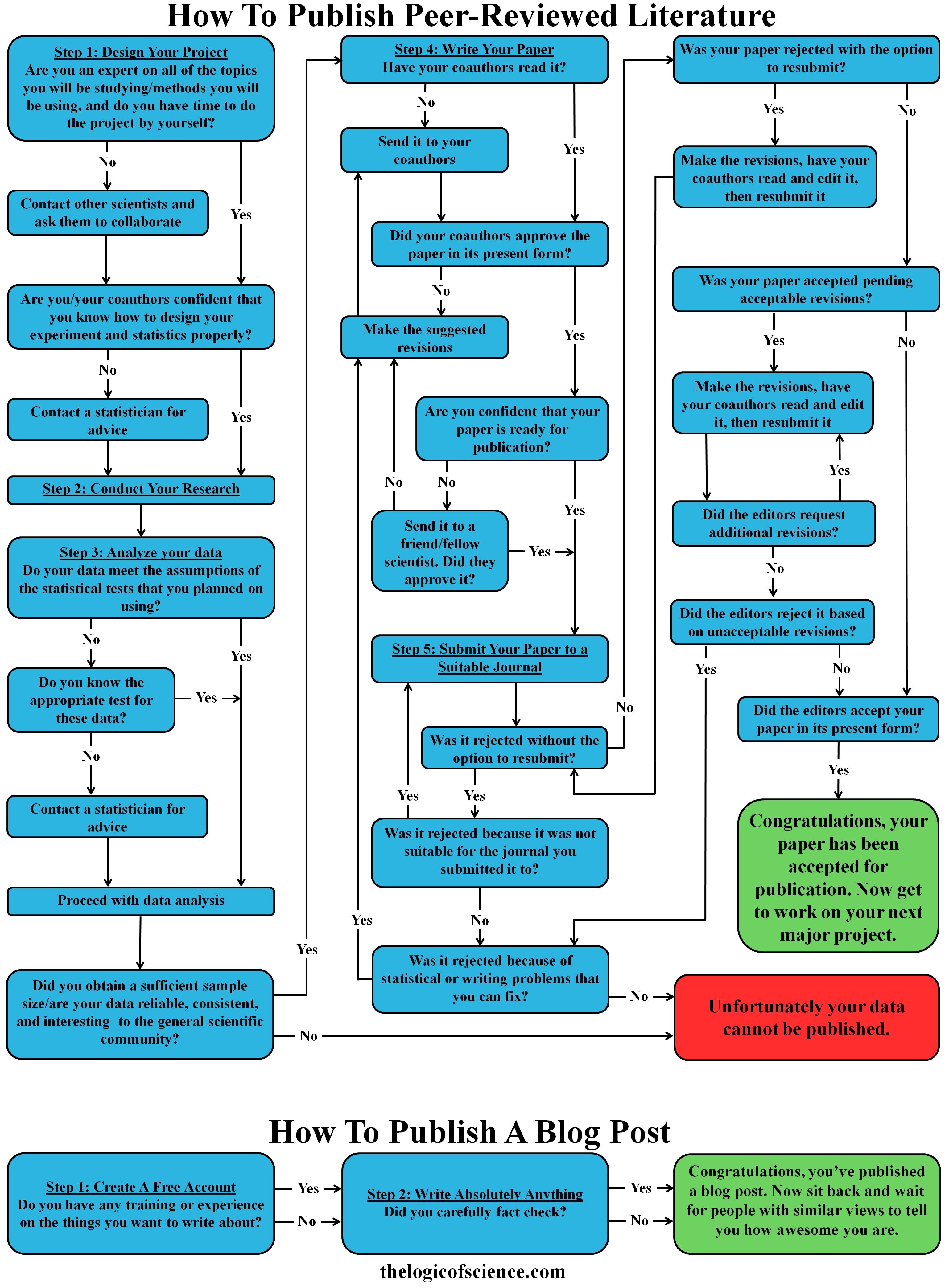
The flowchart below summarizes everything in the post, but keep reading for more details (click the image and magnify to view it more easily).

flowchart diagram how to publish scientific peer-reviewed paper blog

This flowchart summarizes the steps required to publish a peer-reviewed paper and the steps required to publish a blog post. Take a careful look at this difference, then honestly tell me that you think that blogs are a better source of information about scientific topics.

Planning and conducting research
The first step of scientific inquiry is always observation. You make some observation about the universe around you, then you try to understand that observation, usually by making a testable hypothesis. Forming the hypothesis is relatively easy, figuring out exactly how to test it is, however, extremely difficult. Before you can start the experiment, you need to review all the literature on the topic so that you know what has already been found, and you need to design an experiment that follows ethical guidelines, has proper controls, will generate a large sample size, etc. All of this becomes very technical and, generally speaking, it is more than one person can do. So, most studies involve several scientists who collaborate together and share authorship on the final product. This is very important because the more people who are involved, the less likely it is that any one individual will bias the study. Also, different scientists have different specific areas of expertise (even within a single field), so bringing multiple scientists together gives you access to a large body of collective knowledge and experience, thus maximizing the odds that you will design a robust experiment.

Even with a group of various scientists collaborating together, however, it is still never a bad idea to consult with an outside expert. For example, all scientists have a working knowledge of statistics, but most of them are not statisticians in the truest sense. So it is very common for scientists to design their statistical analysis, then run it by an actual statistician just to make sure that there is nothing that they missed. Similarly, if the study involves a complex method that none of the authors have used before, it is a good idea to talk to someone who has used that method and make sure that you fully understand its intricacies.

Finally, once all of the collaborators agree on the design of the project, you can conduct the study and collect your data. This can take anywhere from a few days to a few years (usually at least a few months) depending on what the project is. Hopefully, the data will adhere to the structure that you anticipated, but that is often not the case. Without going into unnecessary detail, the type of statistical test you use depends on the type of data you are working with. So, for example, if you had planned on using a parametric test, but your data turn out to be strongly skewed, you may have to use a non-parametric test instead. Please realize, this is not a manipulation of the data. Scientists are not cherry-picking their statistics. Rather, there are mathematical limitations to how you can analyze data and each test has a specific set of requirements that have to be met before that test will give an accurate result. The point is that you may not be able to use the statistics you had originally planned on using. This often means that you will need to consult with a statistician again to determine the appropriate test given the data that you actually obtained.

Now, you can finally run your statistics and analyze your data. With any luck, you got good, reliable results that provide some useful and novel insight into the world around you, but sometimes your data don’t come out cleanly. Sometimes you failed to get a large enough sample size to accurately test your hypothesis, or your data may simply not add anything useful to our ever growing body of scientific knowledge. The point is that for various reasons many studies die at this stage before they even get submitted for peer-review. For example, I personally have two data sets sitting on my computer at the moment that I cannot in good conscience try to publish because, for various reasons, the experiments did not go as planned and I cannot trust my results.

Preparing and submitting a paper
If your data appear to give useful and reliable results, you can then write your paper. This tends to be a very time consuming process and usually involves many drafts being passed among your co-authors until eventually you all agree on a final product. At that point, however, it is not uncommon for you or some of your coauthors to want an outside opinion before submitting for formal review. Because you all worked on the project, you are all biased to think that the study is good (no matter how hard you try to avoid those biases). So, it is often a good idea to have a friend who works in a related field read the paper and give you some feedback. Depending on what he/she says, you may be ready to submit it, or you and your coauthors may go through several more revisions, or, in some cases, they may point out a fatal flaw that you missed and the paper dies there.

Assuming that your friend did not find a critical error, then once you have made the suggested revisions and you and your coauthors are content, you can finally submit it to a journal for formal peer-review. The first stage of the review process is generally a quick read by one of the editors. At this stage, they are trying to see if it is fairly well written, follows ethical guidelines, gives novel and potentially interesting results, appears to be a potentially valid study, and is the type of research that is published in that particular journal. During submission, most journals also require that you declare any conflicts of interest (e.g., you have a patent pending for the vaccine that you were testing).

If your paper passes all of the initial checks, it gets sent out to reviewers. If it doesn’t pass, it gets rejected and sent back to you. What you do at that point depends on why it was rejected. Often, the editor simply didn’t think it was a suitable topic for that journal. In which case, you can just submit it to another journal. Other times, there are mistakes that need to be fixed before submitting elsewhere (thus sending you back through the revision loops), and sometimes, there is a serious flaw (such as a very small sample size) that will prevent you from publishing anywhere.

If your paper goes out for review, it gets sent to 2-3 (occasionally 4) other scientists who are experts in the field that your paper address. For example, a few months ago, I was asked to review a paper on frogs’ diets because I am a herpetologist, and I have published several diet studies. Thus, I am familiar with the methodologies, literature, etc., and I am in a good position to tell whether or not a diet study on frogs was conducted properly. Importantly, reviewers generally have to be people who are not institutionally linked to the authors. In other words, your friend in the lab next to you cannot review your paper. It needs to be someone who isn’t from the same institution or company as you.

Reviewers look for several things. At the most basic level, they see if the paper is well written, easy to understand, etc. More importantly, however, they scrutinize the methods, statistics, conclusions, etc. to ensure that the study was done correctly, the proper statistics were used, the conclusions are valid, etc. They then send their comments and recommendations back to the editor. The editor then considers their recommendations, often consults with another editor, then sends you their decision.

At this stage, there are several possibilities. The best one is that it was accepted in its current state. In other words, they will publish your paper as is. More often, it gets accepted with either major or minor revisions. In other words, they think that there is merit to your study, but there are some concerns about certain parts of your paper (perhaps details of one of the methods you used). So, you and your coauthors make the revisions, then send it back to them. The editor(s) and sometimes the reviewers then look at your changes and decide whether or not they are acceptable. Usually, papers go through at this point, but sometimes additional changes are still required. Also, journals are increasingly shying away from saying “accepted with revisions” and instead are simply asking for revisions before saying anything about whether it will be accepted after the revisions are made (a situation which is extremely frustrating for researchers).

A third possibility is that your paper gets rejected with the option to resubmit. In this situation, they had very serious concerns about your paper (perhaps they think your statistics were completely inappropriate), but they still think that your paper has good potential. So, you and your coauthors get to make major changes to the paper and analyses. Once those changes are made, you can resubmit back to the same journal, at which point your paper goes back out for review. At this stage, your reviewers may or may not be the same reviewers that you had the first time.

The final possibility, is that your paper gets rejected without the option to resubmit. You are, however, given the reviewers’ comments. Sometimes they found critical flaws that truly render your paper unpublishable. Other times, however, there are serious flaws that you need to fix, but once those have been taken care of, you can submit it to a different journal, at which point you start this whole process over again.

This process is extremely complicated and time consuming, and most papers don’t make it through on their first round. Rejection rates vary among journals, but they are often 70% or higher (in other words, 70% of the papers that get submitted to that journal are rejected). Most importantly, by the time that a paper completes this process and actually gets published, many different scientists from different institutions and companies have looked at your work and given their input. As a result, the final product is usually of high quality, but bad papers do sometimes make it through. Fortunately, the peer-review process does not end with publication.

Dealing with bad papers
Scientists are very critical of each others’ work. In fact, we are trained to be critical of the peer-reviewed literature and to carefully examine a paper’s methodologies before accepting its conclusions. As a result, many papers sit quietly without ever being cited because other scientists are skeptical of their claims. Sometimes, however, a paper contains serious flaws, at which point, scientists can write to the editor of the journal explaining the problems, or they can write and publish a rebuttal paper. Depending on the problems that they point out, this may result in the journal retracting the paper. A very public example of this occurred last year when the journal Translational Neurodegeneration published a paper that supposedly found a link between autism and vaccines. The paper was rife with problems, and the journal quickly retracted it after multiple scientists expressed their concerns about its accuracy.

Other times, it may take years for the problems with a paper to surface. A famous example of this is Wakefield’s 1998 study that first proposed a link between autism and vaccines. This was an extraordinary claim, so scientists did what they always do with a claim like this: they tested it over and over again. The problem was that none of them could replicate Wakefield’s results. This culminated in a formal investigation which found serious ethical and methodological problems with the study, as well as a major financial conflict of interest that Wakefield failed to declare (a huge taboo in academic publishing). This resulted in the paper being retracted and Wakefield loosing the privilege of being allowed to practice medicine.

Important points
There are several important take home messages here. First, the idea that you cannot publish anything that is contrary to the mainstream view or that there are several “big wigs” who are pulling the strings and deciding what to publish and what not to publish is absurd. For any of these notions to work, all of the reviewers, editors, etc. that look at your paper would need to be corrupt and/or biased, but given the number of people involved and the fact that they are from multiple institutions, it is highly unlikely that all of them would be corrupt and/or biased. Further, if you get a biased editor who rejects your paper for absurd reasons, you can appeal to the editor and try to reason with them, or you can just submit to another journal. In other words, if you wanted to suppress any papers that were contrary to the mainstream view, you would need every editor in the world to agree not to publish any controversial papers. This is clearly absurd. Evidence that opposes the mainstream view can be published if you have good data. The reason that there are so few papers opposing evolution, climate change, vaccines etc. is not that there is some global conspiracy, but rather that there is no evidence to support those positions.

The notion that papers supporting a mainstream position are easy to publish is similarly absurd. Scientists are an extremely critical, ornery, argumentative bunch. We love nothing more than to prove each other wrong, and most papers get shredded during review. Publishing is hard, and no matter what your topic is, you are going to have to pass a careful review by objective scientists before you get published. Further, even if you pass the review system, your work will then be scrutinized by thousands of scientists from all over the world.

blogs vs scientific peer-reviewed literature meme

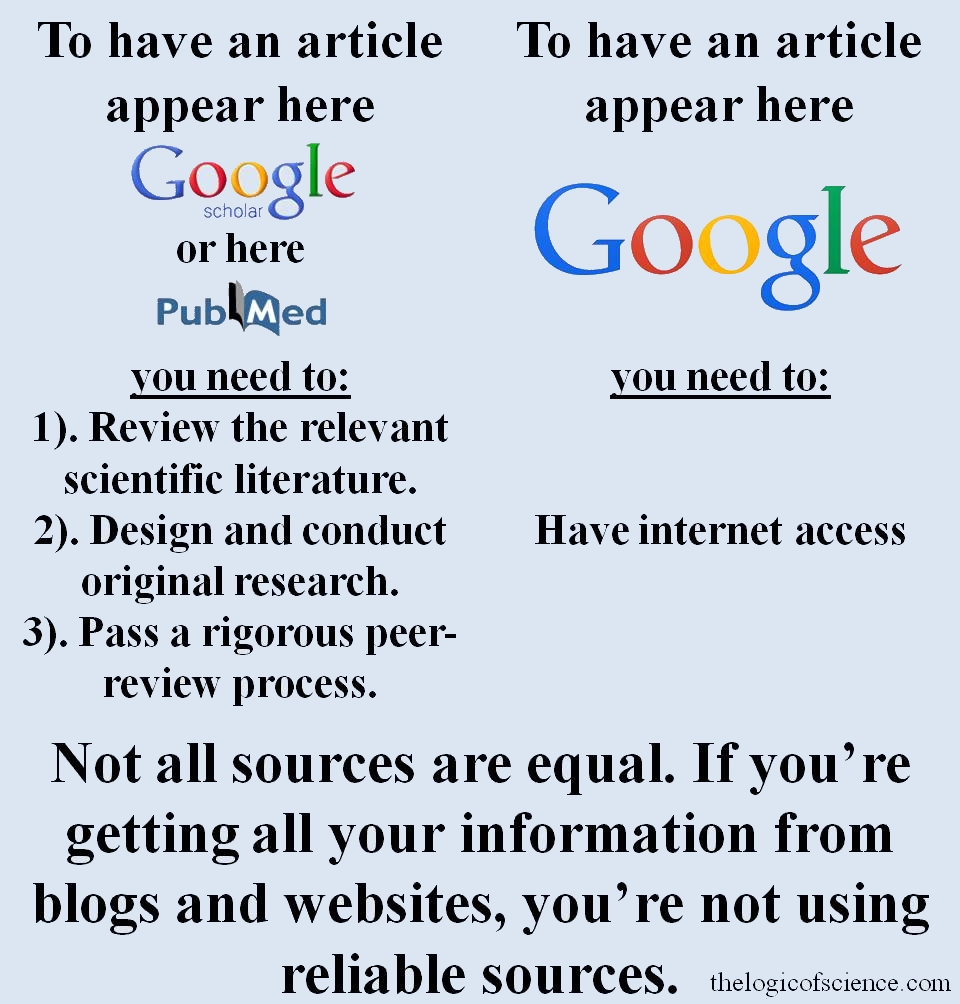
The problem with blogs is not that they are all faulty, but rather that they have no quality control mechanisms, so you have no reason to think that they are correct.

Finally, yes, the peer-review system is not perfect. No one is saying that it is an infallible system, but it is a good system, and it’s better than the alternative. To those of you who insist on trusting blogs rather than the peer-reviewed literature, think about the difference in what it takes to publish via each medium. Scientific papers are evaluated by numerous different experts before they are published, a huge number of papers never get published, and even after being published, papers can be retracted if flaws in them are found. In contrast, blogs are reviewed by no one, and at worst, someone might troll you. So which one do you actually think is more trustworthy: an admittedly imperfect review system that still manages to block a tremendous amount of bad research and ensure high quality in the majority of published papers, or a complete and total lack of review in which absolutely any piece of garbage can be published? The peer-review system may not be perfect, but it’s the best we have, and it’s still several orders of magnitude better than blogs (or Youtube videos).

Note: please read this post before commenting about Ioannidis’s work suggesting that most published papers are wrong.

Related posts

Posted in Nature of Science | Tagged , | Comments Off on Peer-reviewed literature: What does it take to publish a scientific paper?

Are creationists and scientists both interpreting the evidence?

I continually hear creationists make the following claim: “Evolutionists and creationists both have the same amount of evidence, they just interpret the evidence differently.” The argument is basically that evolution and creation are on equal grounds scientifically, and the facts that scientists present are actually just interpretations of the data, and the scientists’ interpretation is no more valid than the creationists’ interpretation. As I will demonstrate, however, this argument is complete nonsense. It, once again, demonstrates that creationists don’t understand how science actually works.

First, this argument inherently assumes that all interpretations are equally valid, but that is obviously ridiculous. Just because there are two interpretations doesn’t mean that they are both rational. More importantly, the way that scientists use the word “interpret” is very different from how most people use it. Personally, I don’t like the term “interpretation” because I don’t think that it accurately represents what scientists do. The term “interpret” implies that the process is subjective, but science relies on objectivity. So, we don’t “interpret” the evidence, rather, we examine the evidence and draw logical conclusions from it. The term “deduce” more accurately illustrates what scientists do.

Allow me to demonstrate this with a court room example. Suppose that John Smith is on trial for murder. We know that he had motive, he has no alibi, we found his DNA at the crime scene, we found the murder weapon in his home, and we found the victims blood in his trunk. The defense, however, has decided ahead of time that Mark Williams is guilty, even though none of the evidence actually points to Mark (there is no motive, no DNA, no weapon, and also no association to John Smith). Now, suppose that the defense gets up in court and says,

“Both sides have the same amount of evidence, we are just interpreting it differently. The prosecution started with the notion that John Smith is guilty, therefore they have interpreted the evidence to indicate that he committed the crime, but if we start with the notion that Mark Williams is guilty, then we can easily interpret the evidence to be consistent with that view. You see, Mark had a secret motive that no one knows about, and after committing the crime, he placed John’s DNA at the scene without leaving any of his own DNA, and he broke into John’s house and car to plant evidence, again without leaving any indication that either had been broken into.”

Obviously, the defense’s “interpretation” is nothing more than baseless speculation, and it would be completely inadmissible in court. It is not an interpretation of the evidence, rather, it is a manipulation of the evidence to try to make it fit a preconceived idea (in technical terms, it’s an ad hoc fallacy). The prosecution’s interpretation, however, is a simple exercise in logic. They started with the evidence, then arrived at the most logical conclusion. This is a key difference between scientists and creationists. Scientists start with the evidence, then draw a logical conclusion; whereas, creationists start with the conclusion that Genesis is literal, then they try to make the evidence fit that conclusion.

Creationists will of course object to this because they claim that scientists are starting with the “naturalistic” viewpoint, then using that viewpoint to interpret the evidence in favor of evolution/an old earth, but this is pure nonsense. We arrived at the conclusion that evolution is correct and the earth is old, because of the evidence, not the other way around. I’ll illustrate this using varves.

Varves are alternating layers of light/fine and dark/course sediment that accumulate in lakes as a result of seasonal changes (light/fine layers = winter; dark/course layers = summer). We can verify that these correlate with seasons because we see varves form today, and at some lakes, we find algae in the dark layers, but not the light layers (algae only blooms in summer). While varves around the edges of lakes can occasionally accumulate more than one layer a year from storms, varves in the center of the lakes only accumulate one layer each year. In the center of some lakes, we have millions of sets of alternating layers. So, how should we interpret the data? The answer is obvious: these lakes are millions of years old. Consider:

  1. A set of two layers (varves) forms every year in these lakes
  2. The fact that these layers represent distinct seasons is confirmed by the algae
  3. Some lakes contain millions of varves
  4. Therefore these lakes are millions of years old.

Notice, this is not an interpretation in the normal sense of the word, rather this is a logical deduction that follows necessarily from the premises. Further, we did not need a “naturalistic” starting point to arrive at the conclusion.

Now, let’s consider the creationists’ “interpretation” of the varves. The most common one goes like this: “actually, these were formed during the flood, through an unknown mechanism. Somehow, the flood managed to sort these particles into alternating layers of sediment, and it managed to sort the algae, and these layers managed to form only over lake beds, and they formed at a rate of over 10 sets of layers per minute.”

This is in no way shape or form an interpretation of the data. It is a complete and total rejection of the data. This is not science, it is pseudoscience. The scientists’ interpretation is a logical conclusion that follows from all known facts. The creationists’ “interpretation” is an illogical ad hoc fallacy that completely ignores the facts, and proposes an unknown and completely absurd mechanism. Even if these layers aren’t precisely one per year, the rate that you would need for creationists’ “interpretation” to be correct is outrageous (roughly one varve every 30 seconds). One of these interpretations is science, the other is not.

Further, if we grant creationists the ability to create unknown mechanisms in order to derive interpretations that match their pre-existing biases, then an infinite number of interpretations become possible. This is the problem with ad hoc fallacies: it is always possible to generate an ad hoc argument. This is also why Occam’s razor is important. It tells us that the solution that makes the fewest assumptions is usually the correct one. In other words, the more unfounded assumptions there are, the less likely something is to be true. The creationists’ “interpretation” consists of multiple assumptions staked on top of each other and is, therefore, logically invalid.

Fortunately, there is an easy way to test whether or not your interpretation is at least potentially valid. Ask yourself the following question, “what if I showed the data to someone who had absolutely no knowledge or biases about the topic, what would they conclude?” In the case of varves, if we showed them to someone who had no knowledge or biases about the age of the earth, they would never conclude that some unknown mechanism caused them to form in roughly one year. Rather, they would conclude that those lakes are several million years old. This clearly demonstrates that scientists are not “starting with a naturalistic explanation” then interpreting the data to fit that conclusion. Rather, we are starting with the evidence, and the naturalistic explanation happens to be the only logical conclusion given those data. To put it simply, if you have to start with the assumption that your conclusion is correct before the interpretation makes sense, then the interpretation is wrong.

Finally, I need to make an important point that usually goes unmentioned in this discussion. Science works best by making a priori predictions. In other words, scientists generally try to make predictions about what the data should look like before examining the evidence. So, for example, the theory of evolution predicted the existence of intermediate fossils, and today we have hundreds of intermediates between reptiles and birds, reptiles and mammals, amphibians and reptiles, fish and amphibians, etc. Creationists look at those fossils and try to interpret them as part of God’s design for creation, but there is a clear difference between what scientists are doing and what creationists are doing. Evolution predicted the existence of the fossils before they were found. In other words, it was proactive. In contrast, creationists are acting entirely retroactively. They predicted that intermediate fossils should not exist, therefore every time that one is found, they try to “interpret” it as a specially created species that just happens to have half the features of a bird and half the features of a dinosaur (for example). The problem, again, is that their “interpretation” is completely ad hoc. You wouldn’t accept it unless you were already convinced that creationism was true.

In summary, scientists are not starting with the assumptions that evolution is true and the earth is old, then interpreting the evidence to fit those assumptions. Rather, we are making and testing predictions about what the evidence should look like if evolution is true and the earth is old, and we are drawing the only logical conclusions from that evidence. In contrast, creationists are starting with the assumptions that evolution is false and the earth is young, then they are manipulating the data to fit those assumptions. So the idea that scientists and creationists both have the same evidence and are just interpreting it differently is completely and totally incorrect. Science always goes from evidence to a conclusion, and anytime that you start with a conclusion, you are, by definition, doing pseudoscience.

NOTE: it is true that scientists do not always agree on interpretations (particularly with phylogentics), but that is because in some complex situations, there are multiple valid deductions and it is difficult or even impossible to determine which one is the best, but these disagreements are generally resolved as more data are collected. Also, a young earth “interpretation” never shows up among the list of logical possibilities. There is no evidence anywhere that leads to the conclusion that the earth is young.

Posted in Nature of Science, Science of Evolution | Tagged , , , , | 14 Comments

The Rules of Logic Part 5: Occam’s Razor and the Burden of Proof

Carl Sagan quote extraordinary evidence claimsOccam’s razor, also known as the principle of maximum parsimony, is one of the fundamental guiding principles in both logic and science. It is commonly explained as, “the simplest solution is usually the correct one.” More accurately, it states that, “all else being equal, the solution that makes the fewest assumptions is usually the correct one.” In other words, when you have multiple competing hypotheses you should default to the one that requires you to make the fewest assumptions, unless there is some compelling, evidence-based reason to think that one of the other solutions is correct. This is closely related to concept of the burden of proof, which states that the person or view making an assertion is the one who is required to provide evidence, not the person who is defending the position that the claim is being made against. As I will illustrate, both of these concepts are essentially just affirmations that ad hoc fallacies are not logically valid.

Before dealing with scientific examples, I want to use some examples from everyday life to illustrate how this works. Suppose you try to start your car in the morning, and it won’t start. There is no indication that anything is mechanically wrong with your car or that anyone has tampered with it, but you notice that you had left the interior lights on the night before. Now answer the question, “why won’t the car start?” The obvious answer is that your battery was drained, but there are multiple other possible explanations for what is wrong with your car. For example, I could posit that a group of teenagers played a prank on you and sabotaged your car. I could also propose that that aliens are experimenting on how humans respond to difficulties; therefore, they sabotaged your car. In fact, there are an infinite number of increasingly absurd ad hoc possibilities (that’s why ad hoc arguments are fallacious), but obviously the battery explanation is the most rational. Why is that? What is it about the battery explanation that makes it more rational than believing that aliens sabotaged your car? Quite simply, it makes the fewest assumptions. In scientific terms, it is the most parsimonious hypothesis. That explanation really doesn’t make any unfounded assumptions, whereas the others become increasingly implausible as the number of assumptions increases. For example, the teenage miscreant hypothesis assumes that there was a group of teenage pranksters near your car last night, they had the motivation and means to sabotage your car, and they actually acted on those motivations and means without leaving any evidence behind. The alien hypothesis is even less plausible, because in addition to slight modifications of the basic assumptions required for the prankster hypothesis, you also have to assume that aliens exist, visit earth, and are interested in seeing how humans solve trivial problems. This is a basic application of Occam’s razor. The hypothesis that your battery died makes the fewest assumptions; therefore, it is the most likely hypothesis.

So where does the burden of proof come into this? It arises when there is contention about which hypothesis to accept. Suppose, for example, that I was with you when your car failed to start, and you asserted that it was the battery, while I claimed that it was aliens. In this case, the burden of proof would be on me to support my hypothesis, rather than being on you to refute my hypothesis. In other words, I am the one making the unparsimonious claim; therefore, I have to support my claim, and you are not required to refute it. So, if you said, “prove that it was aliens” I could not fire back with the well-worn internet response, “well prove that it wasn’t aliens.” The burden of proof is on me, not you. This is very important to understand because people try to shift the burden of proof all the time, and it is not logically valid. The burden of proof is always on the person making the claim.

To further illustrate this, consider a courtroom example. Suppose that an expert forensic witness is brought in to testify in a homicide case, and she carefully explains why the forensic evidence clearly indicates the accused person is guilty. The defense then responds by claiming that the witness is lying. At which point, the judge and prosecutor will invariably demand proof that she is lying. The defense attorney clearly cannot simply respond by saying, “well, prove that she isn’t.” He is the one making the claim; therefore, he bears the burden of proof and must provide evidence to support his claim. The prosecution doesn’t need to provide evidence that the witness is honest because the burden of proof isn’t on them.

That example illustrates a very important point: it’s not just the number of assumptions that matters, the quality of the assumptions is also important. This is part of what is meant by the, “all else being equal” clause in Occam’s razor. Technically speaking, both the defense and the prosecution are making one assumption. The defense is assuming that the witness is lying, and the prosecution is assuming that she is telling the truth, but these two assumptions clearly are not equal. Unless the witness has a past history of lying or there is some evidence-based reason to think that she is lying at the moment, it is clearly more logical to assume that she is telling the truth because her entire job relies on the concept that she will report truthfully on the witness stand. In order for the claim that she is lying to be logically valid, you have to have evidence to support it. That’s how the burden of proof works.

Now let’s apply this to science. When comparing hypotheses and attempting to understand the results of experiments, Occam’s razor tells us that we should default to the answer that makes the fewest assumptions unless we have a compelling, evidence-based reason for doing otherwise. Let me start with a neutral example. I recently wrote a paper on a study of the diet of a particular species of turtle. To conduct this research, I captured turtles in the field, waited for them to defecate into a bucket, then I examined their feces. In their feces, I found a variety of plants, insects, and crawfish. What’s the logical conclusion? As with the battery example, there are an infinite number of possible conclusions. I could, for example posit that they only eat plants but happened to eat a lot of plants that had insect and crawfish molts on them. I could also posit that someone when out before me, captured the turtles, force fed them crawfish, then put the turtles back into the pond just to screw with me. Similarly, I could again invoke aliens as an explanation. Obviously, however, the most rational explanation is that these turtles eat a variety of plants, insects, and crawfish, because that explanation makes the fewest assumptions. In this particular example, the other hypotheses are technically committing question begging fallacies. In other words, they are starting with the conclusion that these turtles only eat plants, then they are making unsupported premises to try to argue for that conclusion. This approach is not logically valid and it is one of the hallmarks of pseudoscience.

Now, let me show how this works in a more contentious example. Young earth creationists argue that the entire world was destroyed in a flood roughly 4,500 years ago. As I plan on elaborating on more in a coming post, one of the big problems with this view is coral reefs. You see, corals are very sensitive, and even most creationists agree that reefs could not survive the flood. This means that all the corals we see today would have had to grow after the flood. The problem is that corals grow very slowly, and to get reefs the size that we see today, you would need a sustained growth rate that is many times faster than the fastest growth rates ever observed under ideal conditions (many reefs are estimated to be several hundred thousand years old). When faced with this problem, creationists generally respond by claiming that growth rates were much faster in the past than they are now. This is a perfect example of an ad hoc fallacy. Think about parsimony for a second, which explanation makes more unjustified assumptions?

  1. Corals do not grow nearly fast enough to form modern reefs in only 4,500 years, therefore there wasn’t a recent worldwide flood.
  2. Corals used to have a sustained growth rate that was many times faster than the fastest growth rate that we have ever observed even under ideal conditions, and for unknown reasons they no longer grow that fast.

Clearly the second explanation is the one making unfounded assumptions. The burden of proof is on creationists to provide evidence that corals used to be able to grow much, much faster than they can today; whereas scientists don’t have to prove that they didn’t grow faster, because there is no a priori reason to think that they did. In other words, the only reason that anyone would accept creationists’ claim is if they already thought that the flood occurred. This is why the argument is not logically or scientifically valid. It starts with the assumption that the flood occurred, then it tries to make the evidence fit that assumption, but science always goes from evidence to a conclusion, never the other way around.

Finally, I want to conclude this post by bringing Occam’s razor and the burden of proof to bear on the common conspiracy theorist claim that virtually all scientists are corrupt and are only in it for the money. For example, whenever I present anti-vaccers with the copious papers that show that vaccines do not cause autism, they invariably claim that all of the scientists involved in those papers were paid off by the pharmaceutical companies. Consider, which explanation makes more unfounded assumptions?

  1. Most of the scientists are doing honest research
  2. All of the hundreds of pro-vaccine researchers from countless institutions and companies from all around the world are being paid off to falsify data

burden of proofClearly the second one is the explanation that is making more unfounded assumptions. This is no different from the courtroom example. Just as the burden of proof was on the defense to prove that the expert witness was lying, even so, the burden of proof is on the anti-vaccers to prove that all of the scientists are paid off. Another way to think about this is to ask whether or not there is any reason to think that the scientists are corrupt other than simply the fact that you don’t like their conclusions. The answer is obviously that there is no a priori reason to think that all of them are corrupt. This same reasoning applies to people who claim that climate scientists are only in it for the money, that Monsanto has control over all the food scientists, etc. Anytime that you claim that a consensus is wrong, you have just placed the burden of proof on your shoulders. Carl Sagan said it best when he said that, “extraordinary claims require extraordinary evidence.” If you’re going to claim that the scientific consensus is wrong about climate change, vaccines, etc. you cannot get away with an unsupported cop out like, “warming is just a natural cycle” or “it’s a conspiracy.” The burden of proof is on you to provide clear and irrefutable evidence for your position. Until you can do that, logic and rational thought are not on your side.

Other posts on the rules of logic:


Posted in Nature of Science, Rules of Logic | Tagged , , , | 2 Comments