Meeting creationists on their own terms: understanding the Genesis flood

In this post, I am going to do something highly atypical for a science blog: I am going to talk about theology. I want to be very clear about why I am doing this and why you should pay attention (regardless of your personal religious beliefs or lack thereof). I have spent a great deal of time talking to creationists, and what I have found is that most of them are concerned primarily with what the Bible says, and they only accept science when it happens to line up with their religious views. In other words, it’s not that the creationists are unintelligent, it’s simply that they have different priorities. As a result, if you initiate a conversation with creationists by talking about the science of evolution, you won’t get anywhere because they think that the science conflicts with their religion, but if you start by explaining why the science doesn’t have to conflict with their religion, then you have a chance of actually having a rational conversation about the scientific evidence. So, if you want to effectively talk to creationists, you need to spend some time learning theology, even if you aren’t religious yourself. So, to the creationists reading this, I hope you that will rationally consider the possibility that evolution and the Bible can be compatible, and to the atheists, agnostics, theistic evolutionists, etc. I hope that you will learn some useful talking points for having fruitful discussions with creationists.

The flood that is described in Genesis (a.k.a. Noah’s flood) is one of the cornerstones of young earth creationism. A literal, world-wide flood that occurred roughly 4,500 years ago is absolutely essential for their position because they use it as the “alternative explanation” for the evidence that the earth is old. Whether it’s the extensive fossil record, sediment layers, ice cores, or varves, they consistently fall back on the flood as their answer. Therefore, if you want to be able to convince creationists that the earth is billions of years old and evolution is true, you are first going to have to be able to give them an alternative interpretation of the Genesis flood, and this will require you to know some theology. To be clear, I’m not suggesting that you try to convince them that the Bible is wrong, that will almost certainly result in them ignoring anything else that you say. Nor am I trying to say that you personally have to accept the Bible. Rather, I am proposing that for the sake of debate, you should give them the benefit of the doubt (i.e., proceed as if the Bible is true), and direct them to the alternative interpretations of Genesis. To that end, the rest of this post will be written as if the Bible is true, and I suggest that you use similar language when talking to creationists (regardless of your personal beliefs).

Note: To be clear, I am not personally endorsing any of these views or making any statements about my personal religious or philosophical views. I am simply trying to explain the best way to talk to creationists.

The most parsimonious interpretation is simply that the flood account is a parable. I have previously explained this idea in more detail, so I will be brief here. There are lots of parts of the Bible that are figurative or are written as parables rather than as literal, historical accounts (even hard core creationists agree with that), and there are many sections of the Bible that were interpreted literally until science showed that they could not be literal (the passage of Joshua that says that the sun moves around the earth is a great example of this). Therefore, given the fact that there are numerous passages of the Bible which are clearly not literal, and given the fact that some of those were interpreted literally until the advent of science, there is no reason why the flood account cannot also be interpreted as a parable, and interpreting it in light of modern science is completely consistent with the way that creationists interpret other passages of the Bible (again, see my previous post for more details and examples).

The second option is less parsimonious, but I often find that creationists are more willing to accept it. This interpretation says that Noah was a literal person, and there was a literal flood, but the flood was regional, not world-wide. At a first glance, most creationists find this argument laughably absurd because Genesis repeatedly describes the flood as covering the whole earth. Nevertheless, it is vital to remember that one of the key principles of Biblical interpretation (as set forth by creationists) is to interpret the Bible in light of its original audience, and, to the original readers, it would have seemed that the entire earth was under water. To them, the flood would have been world-wide.

Importantly, this use of the phrase “world-wide” is not at all unprecedented. For example, Daniel 6:25 says, “then king Darius wrote unto all people, nations, and languages, that dwell in all the earth” (my emphasis). To the original readers, that literally meant all people, all nations, and all languages anywhere in the earth, but today, thanks to the science of archeology, we realize that this statement couldn’t have actually meant the entire earth because there is no way that Darius contacted the Aborigines in Australia, the Native Americans in North America, etc. Similar verses can be found throughout the Bible. For example, I Chronicles 14:17 says that all nations feared David. Similarly, Deuteronomy 2:25 says that God put the fear of the Hebrews in “the peoples who are under the whole heaven.” Importantly, the phrase “under the whole heaven” is the exact same Hebrew phrase that is used to describe the flood in Genesis 7:19 when the Bible says, “and the waters prevailed exceedingly upon the earth; and all the high hills, that were under the whole heaven, were covered.” Perhaps most famously, Luke 2:1 says, “there went out a decree from Caesar Augustus, that all the world should be taxed” (my emphasis), but no one interprets that as literally meaning all the world.

At this point, the most common, knee-jerk response that I get is simply to claim that if my argument was correct, then the Bible would not be true, but that is not what I am actually arguing. Rather, I am simply pointing out that we have to read the Bible from the point of view of its original readers, and to the original readers, these statements would have been true, even though today we know that they are not strictly speaking accurate.  Further, consistency of interpretive judgments is another hermeneutical principle that creationists often stress, and this interpretation is actually extremely consistent. As I pointed out, the exact same phrase is used in both Deuteronomy and Genesis, yet most creationists interpret it as figurative in Deuteronomy and literal in Genesis, which is extremely inconsistent. Let me use two parallel syllogisms to illustrate this inconsistency:

  1. The Bible clearly says that King Darius contacted all nations: Daniel 6:25 “Then king Darius wrote unto all people, nations, and languages, that dwell in all the earth.”
  2. Modern archeology tells us that he could not possibly have contacted all nations but was actually only in contact with all nations of the “known world” at the time that Daniel was written.
  3. Therefore, the Bible is not in error, but this verse was simply written from the viewpoint of its original readers.

There are very few creationists who would challenge that syllogism. Now consider the parallel:

  1. The Bible clearly says that the flood covered the whole earth.
  2. Modern science tells us that it could not possibly have covered the whole earth.
  3. Therefore, the Bible is not in error, but this story was simply written from the viewpoint of the original readers.

The two syllogisms are perfectly analogous. Therefore, according to the laws of consistent reasoning, if you accept one of them you must accept both of them.

In addition to the fact that interpreting the flood as a regional event is internally consistent, there is actually evidence in the account itself which suggests that it should not be interpreted as world-wide. First, the Hebrew word for “earth” that is used throughout the passage is “eh’-rets” which can also mean “region” or “country.” So all of those verses that say, “the whole earth” in your English translation may actually have been read as “the whole region” by the original Hebrews. Also, this interpretation is in no way ad hoc, because eh’-rets is translated as “region” or “land” elsewhere in the Bible.

Another clue comes from the fact that Noah was told to use “pitch” on the ark. Answers in Genesis claims that pitch was from tree sap, but getting enough tree sap to cover the ark seems like a truly impossible task. Alternatively, some translations use “bitumen” instead of “pitch.” Bitumen is a petroleum-based product which was historically used by ship builders and is readily available in the Middle East. Thus, it seems more likely that Noah would have used bitumen. This is important because bitumen comes from sedimentary rock, and creationists think that sedimentary rock all formed during the flood. So, the world-wide flood model must be wrong if Noah built the ark by using something that supposedly formed during the flood.

The final piece of evidence comes from an apparent contradiction between Genesis 8:5 and 8:9. Genesis 8:5 says “And the waters decreased continually until the tenth month: in the tenth month, on the first day of the month, were the tops of the mountains seen” (my emphasis), and Genesis 8:9 says, “But the dove found no rest for the sole of her foot, and she returned unto him into the ark, for the waters were on the face of the whole earth” (my emphasis). If you want to claim that the flood literally covered the whole earth, then these two verses are extremely problematic, because 8:5 clearly establishes that by this time, there was land that was not underwater, but 8:9 uses the exact same “whole earth” phrase that creationists take literally in every other part of the passage. In this verse, the phrase “whole earth” unequivocally refers to a region, rather than the entire planet, and it is extremely inconsistent to insist that the references to the “whole earth” must be literal everywhere except this one verse. That interpretation violates creationists’ own rules of Biblical interpretation. If, however, you consistently interpret “the whole earth” to mean, “the whole region,” then there is no contradiction.

In summary, there is no reason why the Christian faith and the science of evolution have to conflict with one another. It is entirely possible to interpret the flood account as either a parable or a regional flood, and doing so is completely consistent with how other parts of the Bible are interpreted. Therefore, if you are a creationist who is resistant to evolution because you think that it contradicts your faith, I encourage you accept the possibility that the contradiction is only between science and one interpretation of the Bible, rather than between science and the Bible itself. Similarly, if you are an atheist, agnostic, theistic evolutionist, etc. I encourage you to really familiarize yourself with theological arguments, and when you are talking to creationists, make every effort to avoid attacking their faith (even if you personally strongly disagree with it). Based on my personal experience, you will be far, far more effective if you begin by convincing them that science and their faith can be compatible, rather than assaulting their faith or demeaning their intelligence.


Posted in Science of Evolution | Tagged , , | 18 Comments

Debunking “10 scientific studies proving GMOs can be harmful to human health”

I recently stumbled across an article titled “10 Scientific Studies Proving GMOs Can Be Harmful To Human Health.” This article was written by Collective Evolution, which is a site that is right up there with Natural News and Whale.to for being unreliable and laughably inaccurate. Nevertheless, many people trust the information provided therein; therefore, I am going to carefully consider the 10 papers that they presented, and I will demonstrate that none of them actually prove that GMOs can be dangerous, and that, as usual, Collective Evolution has ignored the rules of logic and science, and has misconstrued the evidence to suit their preconceived biases. It’s always important to remember that not all peer-reviewed papers are trustworthy, and you should always critically evaluate them to make sure that they were done properly.

Note: Once I was almost done writing this, I discovered that the Genetic Literacy Project has also debunked Collective Evolution’s post, so please read their rebuttal if you are unsatisfied with mine.

1. “Multiple Toxins From GMOs Detected In Maternal and Fetal Blood” (Collective Evolution’s title)

This is a great example of anti-scientists abusing scientific results to suit their own needs. In short, this study (which is actually called “Maternal and fetal exposure to pesticides associated to genetically modified foods in Eastern Townships of Quebec, Canada“) tested the blood of pregnant women, non-pregnant women, and fetuses for the presence of chemicals associated with the pesticides and herbicides that are used on GMOs. Unsurprisingly, they found trace levels, but that does not in any way, shape, or form prove that GMOs are dangerous. Collective Evolution made the classic error of ignoring the fact that the dose makes the poison. Everything is toxic in a high enough dose, and everything is safe in a low enough dose. The doses found by this study were extremely tiny. For example, gluphosinate was only found in 18% of non-pregnant women (it was not found in any pregnant women or fetuses), and its highest concentration was 53.6 nanograms per milliliter (average 28.7). Let me try to explain just how tiny that is. A normal sized paper clip is roughly 1 gram. A nanogram is one billionth of a gram. So, take a paper clip and cut it into 1,000,000,000 pieces, then take 53 of those: that’s 53 nanograms. It’s an extremely, extremely small amount. Further, as the authors of the original paper note, the toxic effects for these chemicals were documented at much higher doses. For example, the study which documented negative effects of gluphosinate in mice used a concentration of 10,000 nanograms per milliliters (Watanabe and Iwasi 1996). In other words, it used a dose that was 186.6 times larger than the highest dose found in someone’s blood (348.4 times higher than the average). Further, the studies on gluphosinate toxicity (Watanabe and Iwasi 1996; Garcia et al. 1998) were on embryonic and congenital effects, but the GMO study did not find gluphosinate in pregnant women or fetuses, it only found it in non-pregnant women. Finally, let’s not forget that GMOs often require less pesticides than traditional crops, and even organic crops use chemicals that are toxic in high enough doses.

TL;DR This study found trace levels that are well below toxic levels. They did not document any harm.

2. “DNA From Genetically Modified Crops Can Be Transferred Into Humans Who Eat Them” (Collective Evolution’s title)

This study is actually called, “Complete Genes May Pass from Food to Human Blood,” and it is not about GMOs. What this study did, which is actually pretty cool, is looked for DNA fragments from our food in our blood stream. It succeed at finding food based DNA, which indicates that some DNA can survive digestion and be absorbed. How Collective Evolution managed to jump from that scientific conclusion to the conclusion that GMOs are dangerous baffles me. First, realize that the study did not document that the DNA in our blood stream was dangerous, it just documented that it was there. Second, the study wasn’t specifically looking at GMOs. Almost all of our food comes from living organisms, which means that essentially all of it has DNA. So it’s not that DNA from GMOs  can be transferred to humans, it’s simply that DNA from food can be transferred. This can happen regardless of whether or not the DNA came from a GMO. Therefore, the way that Collective Evolution framed this paper is exceedingly deceptive and dishonest. (It’s important to note that this study did not document that the genes were actually doing anything, they were not being incorporated into the human genome, they were simply floating in the blood stream.)

Now, some people may be thinking, “fine, DNA can come from either type of food, but the DNA in GMOs is unnatural, so it must be more dangerous.” First, that is simply an appeal to nature fallacy, and it’s not logically valid. Second, realize that essentially all of our food (even organically grown food) contains genetic codes that aren’t found in nature. Third, it’s important to note that the majority of the genome in GMOs is left alone. Only a handful of genes are modified. So given the thousands of genes in an organism, the odds that your body would happen to uptake the modified region are very low. Finally, and perhaps most importantly, why would you assume that the modified region would be dangerous to you? Where is the justification for that assumption? Keep in mind that the altered genes are often pulled from other organisms. For example, at one point we experimented with putting a fish gene into a tomato (that product was never commercialized). So, according to the argument set forth by Collective Evolution, you should be concerned that your body will uptake that fish gene if you eat the tomato, but here is the important thing, your body could also uptake that gene if you eat a fish. Again, there is no reason to assume that the DNA in GMOs is more dangerous than the DNA in traditional foods.

TL;DR This study found that DNA from our food (including non-GMO food) can be absorbed into the blood stream. It was not about GMOs and it did not document harm.

3. “New Study Links GMOs To Gluten Disorders That Affect 18 Million Americans” (Collective Evolution’s title)

The “study” that is being referred to here, is a self-published, non-peer-reviewed article written by an activist with no scientific credentials and published by a leading source of misinformation (i.e., the Institute for Responsible Technology). You cannot characterize that as a scientific study. Its like claiming that an article written by Ken Ham and published by Answers in Genesis is a scientific study. There is a word for what Collective Evolution did here: its called lying.

organic food autism corrleation logical fallacy

Correlation does not equal causation. Organic food sales and autism rates are tightly correlated, but that does not mean that organic food causes autism. Image via the Genetic Literacy Project

Nevertheless, I looked at the “study” to see what it had to say. I was unsurprised to be greeted with the usual pseudo-scientific ramblings, anecdotes, and logical fallacies that I have come to expect from the anti-science movement. For example, there are numerous figures showing correlations between an increase in GMO consumption and an increase in digestive problems, but anyone who knows anything about statistics knows that correlation does not equal causation, and claiming that it does is a logical fallacy. After all, there is a very tight correlation between organic food sales and autism, yet I don’t see anyone claiming that organic food causes autism. Beyond that, I’m not going to bother going into the details of the “report” because it will take me an entire post to debunk all the nonsense contained in it, and the purpose of this post is to talk about the scientific papers which people attempt to use to against GMOs (also, several of its sections are on the actual papers that I talk about in this post). If there is a section of that report that you find particularly compelling, please let me know and I will explain the problems with it (though I’d appreciate it if you would save me the time and just fact check it yourself).

TL;DR This was a report published by an anti-GMO activists group, not a scientific study. It is riddled with untruths and logical fallacies.

4. “Study Links Genetically Modified Corn to Rat Tumors” (Collective Evolution’s title)

This study is probably the single most cited anti-GMO study ever published (cited among GMO activists that is). It is also one of the most seriously flawed publications. In fact, its methods were so horribly incorrect that it was retracted. Collective Evolution notes that it was retracted, but the way that they do so is interesting and, as always, misleading. So I want to go over their comments before I deal with the study itself. Collective Evolution makes the following statement:

This study has since been retracted, which is odd, because the journal it was published in is a very well known, reputable peer reviewed scientific journal. In order for a study to be published here it has to go through a rigorous review process.

There are several important things here. First, this is a misunderstanding of the scientific process. As I have explained before, the peer-review system is good, but admittedly imperfect. Sometimes, bad papers do get through, but the good thing about science is that it is self-correcting and the peer-review process never actually ends. Even after a paper is published, it gets scrutinized by the entire scientific community, and if they find significant flaws in it, the paper may be retracted. Therefore, retracting this paper is in no way, shape, or form odd or unprecedented. Rather, it is the scientific process working the way that it is supposed to.

The second thing that I want to note is how totally disingenuous this comment is. Collective Evolution acts as if scientific journals like this are respectable and generally trustworthy (which they are), yet when those same journals publish papers saying that GMOs are safe, they ignore them or claim that fraud is involved. Further, they are saying that this journal is trustworthy and simultaneously saying that we shouldn’t trust their decision to retract the paper. Which is it? Are they trustworthy or aren’t they? This is a textbook example of inconsistent reasoning.

Next, Collective Evolution states:

It’s also important to note that hundreds of scientists from around the world have condemned the retraction of the study. This study was done by experts, and a correlation between GMOs and these tumors can’t be denied, something happened.

Finally, we get to the heart of the issue, namely the claim that there was a correlation between GMOs and tumors. This is yet another correlation fallacy (also note the blatant appeal to popularity fallacy and the appeal to authority fallacy). So, what actually happened in this study? It was really quite simple: they gave rats GMOs, and the rats developed tumors. The problem was that they used a very small sample size, and they used Sprague-Dawley rats. This strain is extremely prone to tumors. So, the tumor rates that they observed were normal for that strain of rats. In other words, you expect those rats to get tumors regardless of whether or not they ate GMOs. So the fact that they got tumors after eating GMOs is meaningless.

The most telling piece of information, however, is not the study itself, but rather the other studies which have looked at whether or not GMOs cause health problems. Remember, part of science is repeatability. If your results are correct, they should be repeatable. In other words, if GMOs actually caused the grotesque and frequent tumors reported by this paper, then all of the other feed studies should be finding them, but they aren’t. For example, a massive study which looked at livestock health both before and after the introduction of GMOs failed to find any significant health differences, even with a sample size of over 100 billion post-GMO animals. Remember that large sample sizes are very important in science, so if GMOs were actually dangerous, and actually caused these tumors, we would surely expect to see evidence of that in a sample of that size.

TL;DR This paper used small sample sizes and a strain of rats that is prone to cancer. Its methods were so flawed that the study was retracted, and its results have not been replicated by other studies.

Note: the original paper is called, “Long term toxicity of a Roundup herbicide and a Roundup-tolerant genetically modified maize.” Also, this paper was later republished, but in a very minor journal with a questionable reputation.

5. “Glyphosate Induces Human Breast Cancer Cells Growth via Estrogen Receptors” (actual title)

For once, Collective Evolution didn’t terribly misrepresent the study, but they did leave out some important information. Namely, they failed to mention that this was a cell study only, and they ignored all of the other scientific literature. When I say that this was a cell study, I mean that it was working with cells on a petri dish, not an entire living organism. There is certainly something to be said for a reductionist approach like this, and these sorts of studies do yield useful information, but they are also inherently problematic because living organisms are very complex. In other words, just because a chemical acts one way on an isolated plate of cells does not inherently mean that it will act that way on a living organism because there are so many other chemicals and tissues for it to interact with. Indeed, cell-based studies are at the very bottom of the hierarchy of evidence and are considered to be very weak evidence.

Because of that limitation, you have to couple cell-based studies with organism level studies to get a full picture of what is going on. This is where Collective Evolution gets into trouble. Claiming that this article is proof that GMOs are dangerous is a Texas sharpshooter fallacy because it ignores all of the other studies which have failed to find any evidence that glyphosate is dangerous. You always have to remember that sometimes you get erroneous results just by chance. This is one of the many reasons why scientists try to replicate each others’ work, and it is why systematic reviews (which compile the data from all available studies) are so powerful. In the case of glyphosate, this study is a clear outlier. Numerous other studies have confirmed that it is safe, and reviews of both cell and organism level studies have failed to find good evidence that it is dangerous (Mink et al. 2011; Williams et al. 2012; Keir and Kirkland 2013).

IL;DR This study used a very weak methodology that has limited applicability to humans. Further, it was cherry-picked. The vast majority of studies on glyphosate have found that it is safe.

6. “Glyphosate Linked To Birth Defects” (Collective Evolution’s title)

As with #3, this is not a scientific study! It was published in Earth Open Source (EOS), not a peer-reviewed journal. So again, it is downright dishonest for Collective Evolution to characterize this as a scientific study. Nevertheless, let’s look briefly at the report. It makes a number of remarkable claims about glyphosate being dangerous and the public being lied to (its actual title is, “Glyphosate and Birth Defects: Is the Public Being Kept in the Dark?”). It’s a lengthy report, so I am not going to go through it in detail, but I will direct you to a publication by the Australian Pesticides and Veterinary Medicines Authority, which very carefully examined each of the claims in the report and compared them to the relevant literature (this is actually a really good source in general for understanding the papers which seem to show that GMOs are dangerous). In short, non-technical terms, it found that the report is full of crap. Basically, EOS cherry-picked the studies that seemed to support its position and totally ignored the ones that refuted it. Also, (like Collective Evolution), it ignored the fact that the dose makes the poison. In other words, many of the papers that it cited as evidence that Glyphosate is dangerous used a dose that was much higher than the one that humans are actually exposed to. It also cited several studies that used poor methodology and papers that used a model system that is not relevant to humans. I encourage you to read the full APVMA response for more details, but the core message is that the EOS report was extremely biased and agenda driven, and it terribly misrepresented the science.

TL;DR This is not a peer-reviewed study. It cherry-picked papers, ignored a massive body of literature, cited weak studies, and ignored the fact that the dose makes the poison.

7. “Study Links Glyphosate To Autism, Parkinson’s and Alzheimer’s” (Collective Evolution’s title)

This study is actually called, “Glyphosate’s Suppression of Cytochrome P450 Enzymes and Amino Acid Biosynthesis by the Gut Microbiome: Pathways to Modern Diseases” and was published in Entropy. I had never heard of the journal Entropy before, which always makes me suspicious. In this particular case, my suspicions were extra high because entropy is a concept in physics, and indeed the journal claims to publish papers on “entropy and information systems.” What that has to do with glyphosate, microbiomes, and diseases is anyone’s guess. A quick internet search confirmed my suspicions and revealed that Entropy is likely a predatory journalPredatory journals are publications (usually for-hire) that masquerade as legitimate peer-reviewed journals. Most of them will publish just about anything if you are willing to pay your publication fee. So again, this isn’t really a proper scientific publication, and we cannot be sure that it went through the full review process.

Nevertheless, let’s look at the “paper.” I (and others) have previously explained that a good first order check is to see whether or not the claims being made about a product seem reasonable. This article absolutely fails that check. It claims that glyphosate causes:

“Most of the diseases and conditions associated with a Western diet, which include gastrointestinal disorders, obesity, diabetes, heart disease, depression, autism, infertility, cancer and Alzheimer’s disease.”

That is an extraordinarily absurd claim. For one thing, autism, Alzheimer’s, infertility, most cancers, and most cases of depression are not linked to diet. Further, if glyphosate actually caused those, then surely we would see a massive spike in those disorders following its introduction, but no such spike exists. Also, note that the abstract is not written in the typical dispassionate language of science. That is another big clue that this is not a legitimate study. Finally, realize that if these claims were true, they would be front page news and this study would have been published in one of the world’s top journals, not some minor journal that I had to look up because I had never heard of it.

When I look at the actual paper (everything else was just from the abstract), my eyes were assaulted with numerous scientific inaccuracies, citations to poor studies, and unjustified speculation. For sake of time, I won’t go into the details since Skeptoid has already done that for me, but I do want to point out that this is not an experimental study. Rather, it pulled together tons of different studies and tried to mesh them into a hypothetical and convoluted pathway that leads from glyphosate to all the disorders listed. For that pathway to work, however, each step must work, and as Skeptoid explains, many of their steps are fundamentally flawed. Further, as Derek Lowe points out, the ability of glyphosate to inhibit cytrochrome P450 has been directly tested and it is a very poor inhibitor! In other words, the actual experimental evidence shows that this convoluted pathway is total crap.

TL;DR This is not a real study. It was published in a predatory pay-to-publish journal, rather than a legitimate peer-reviewed study. It does not test anything and merely proposes a hypothetical pathway, even though experimental studies discredit that pathway.

8. “Chronically Ill Humans Have Higher Glyphosate Levels Than Healthy Humans” (Collective Evolution’s title)

Unlike several of the other studies, I didn’t find any easily accessible refutations to this one on Google, so I will take the time to debunk it step by step myself, but for those of you who don’t want to read a lengthy discussion of statistics, here is the Cliff Notes version:

  1. It was published by a predatory journal, not a real peer-reviewed journal
  2. The experimental design was extremely flawed and didn’t use proper controls
  3. The statistical analyses are invalid
  4. The authors left out critical information
  5. At least one of the p values is impossible, indicating that the authors either lied or were very sloppy
  6. Even if the stats were good, they only show correlation, not causation
  7. Even if the reported levels of glyphosate are accurate, they are very low and are well below the levels that are known to be toxic (see paper #1)

Now, for those of you who would like more details, this paper (which is actually called “Detection of glyphosate residues in animals and humans”) was published in yet another predatory journal (see #7). So, once again, we cannot be at all confident that it went through a proper peer-review process, and, as such, it does not constitute a proper scientific publication.

There are also several clues in the paper itself which raise suspicion. For one thing, it cites the claims from studies like #7 (above), which suggests a lack of critical discernment on the part of the authors.  There are also editorial mistakes, such as a reference to “Figure 2” which should be “Figure 3.” It may seem like I am being nit-picky, but mistakes like that are actually a good sign that this paper wasn’t reviewed properly. When you are reading (and especially reviewing) a paper, and that paper makes a claim and directs you to a figure, you always go to that figure to make sure that the claim is valid. That is, in fact, how I found this mistake. So the presence of that error suggests that the editors and reviewers did a very poor job of making sure that the paper’s claims were substantiated (if there even were any reviewers, which is questionable from OMICS).

More importantly, the methodology and statistics of this paper are nonsense. For one thing, there is absolutely no evidence of any form of standardization. For example, they compared levels of glyphosate in the urine of 343 cows that were fed GMOs and 32 cows that were not, but that is all the information that we are given about those cows. Were they the same breed, sex, age, etc.? What were their diets like other than the GMO difference? What was their housing condition like? etc. For this to be a proper study, all of those things should be standardized, but there is no indication that the authors did that.

Similarly, the claim that Collective Evolution focuses on is the claim that sick people had higher glyphosate levels than healthy people, but the only information we are given about these people is, “a total of 102 and 199 urine samples were collected of healthy and chronically diseased humans.” That’s it. That is all that we are told about those people. For this study to work, they need to have the same age, sex, weight, etc., but none of that seems to have been standardized. Further, what do the authors mean by “chronically diseased”? What disease do they have? Do they all have the same disease? That is extremely important information that is totally lacking.

Further, the authors’ description of the statistics makes no sense whatsoever. All that we know about their statistics is the program that they used and, “Two-way analysis of variance followed by unpaired Student t-test was used to identify significant differences between means.” First off, following a two-way analysis of variance (ANOVA) with a t-test is not statistically valid. That will inflate your type 1 error rate and give you false positives. The correct analysis is a post hoc test like Tukey’s test. If you are going to insist on using the t-tests, you have to run what is called a Bonferroni correction to control the family-wise error rate, which is something that the authors of this study did not do (I explained the statistical jargon in more detail here).

Additionally, the two-way ANOVA doesn’t make sense here. You use a two-way ANOVA when you have two variables operating. So, for example, let’s say that I was comparing the effects of GMOs on men and women. I would have two variables: sex and GMO consumption.  So I would have a group of males, half of whom ate GMOs and half of whom did not, and I would have a group of females, half of half of whom ate GMOs and half of whom did not. The test would then give me three P values. It would look for an overall effect of GMOs (what we call a main effect), an overall effect of sex, and and an interaction between them. When we look at the experiments described in this paper, however, none of them have two factors. For example, you have cows with conventional diets vs cows with GMO diets. That is just one factor (diet), not two, which means that you cannot use a two-way ANOVA. Similarly, we have healthy individuals vs. chronically ill individuals. That is one factor (health). So its not even possible to use a two-way ANOVA on these data, and I am left with no clue what they actually did with their data. This is another clear indication that this paper did not receive a proper review. One of the requirements of a real paper is that the statistics are described in enough detail that other researchers can assess and replicate what you did. That is clearly not the case with this paper.

There are many other blunders that I could talk about (such as the fact that the sampling of cow organs was not done using a replicate design where one of each organ was taken from each individual and the individuals were included as a blocking variable in the statistics), but I am just going to focus on the result that chronically ill people supposedly have higher glyphosate levels. First, realize that even if that were actually true, it would simply be a correlation and would not indicate that glyphosate caused the illnesses (especially since we don’t even know what the illnesses are!). Second, realize that the test had a meager p value of 0.03. If the authors had actually controlled their type 1 error rate like they should have, that would not be a significant result. Further, that p value looked suspicious to me based on the data in Figure 3. The means are almost identical, and there is a massive overlap in the error bars, which generally indicates that there isn’t a significant difference. So, I pulled the data from the figure and ran the t-test, and I got a p value of 0.4786. To be fair, it can be difficult to accurately read numbers from a figure like that, so I tried again, and again, each time fudging the numbers in the direction that would help the authors. To get a p value less than 0.03 (which is what the authors report), I had to use 1.6 and 2.3 as the means, and there is no way that those are the actual means in that figure. So what does this mean? Either the authors were extremely sloppy or they were dishonest, because you cannot get the p value that they reported from the data that they presented (note: I assumed that the error bars were standard deviations, not standard errors [again, the authors failed to specify] but if they were standard errors, that only makes the result even more impossible).

There are many other blunders that I could have pointed out, but hopefully you get the picture. This study is absolutely horrible and should not be trusted.

TL;DR This is not a proper peer-reviewed study. It was published in a predatory journal. The statistics are a mess and the values in the text don’t match the figures. The experimental design is not explained in sufficient detail to make sure it was carried out correctly. Even if it was, it only documented correlation, not causation.

9. “Studies Link GMO Animal Feed to Severe Stomach Inflammation and Enlarged Uteri in Pigs” (Collective Evolution’s title)

This paper (which is actually called “A long-term toxicology study on pigs fed a combined genetically modified (GM) soy and GM maize diet”) is what we like to call a “statistical fishing trip.” I had a good laugh when I read it because the problem is blatantly obvious to anyone with a good understanding of statistics. As with several of the other papers that I have talked about in this post, the authors did not control the family-wise type 1 error rate. What they did was take a shot gun approach and measure lots and lots of different factors. The problem is that when you do that, you get multiple false positives just by chance, so you have to control the error rate so that you don’t get the false positives (I explained this in more detail here). The authors completely failed to do this, but we can actually do this retrospectively. For a given set of tests, we simply take the desired significance value (0.05), divide it by the number of tests, and that is our new alpha (significance level). So, for the results in table 2, the correct alpha is 0.006, for table 3 it is 0.003, for table 4 it is 0.006, and for table 5 it is 0.0029. When we compare the results with these correct significance levels, we find that there are no significant differences. So, rather than proving that GMOs are dangerous, this paper actually shows that they did not have a significant effect on the pigs health! That is why you have to understand statistics before you can assess scientific papers.

Having said that, I would never cite this paper as evidence that GMOs are safe because there are other problems with it. Some of them are described here and here, but I want to focus on another statistical problem. They state that they removed extreme outliers from their data, which is a huge problem and can majorly affect your results. They claim that this approach is, “well established,” but they don’t give any sources to back that up, and I don’t know of any times when it is OK to do that with the type of data that they were analyzing. In fact, several years ago at a conference, I saw a poor masters student state that she had removed outliers from her data, and she got chewed up during the Q&A session. Several scientists in the room were quick to point out that it was not acceptable to manipulate your data in that way. So this is yet another piece of evidence that this study was not conducted properly and shouldn’t be trusted.

TL;DR They didn’t use the correct statistics, and applying the correct statistics reveals no significant patterns. There are also several other methodological problems.

10. “GMO risk assessment is based on very little scientific evidence in the sense that the testing methods recommended are not adequate to ensure safety” (Collective Evolution’s title)

Collective Evolution actually lists three papers here (apparently they can’t count). The papers are Schubert 2002, Freese and Schubert 2004, and Magaña-Gómez and Calderón de la Barca 2009. By this point, I am tired of writing and I’m sure that you all are tired of reading, so I’ll try to be brief. First, remember that Collective Evolution’s claim was that they were going to provide papers which “prove that GMOs can be dangerous” (my emphasis). None of these papers present hard evidence that GMOs are dangerous, rather they all basically state that we need more research and there may be health impacts that we haven’t anticipated. There are several problems here.

First, realize that just because someone says something isn’t well studied doesn’t mean that it isn’t well studied. For example, Schubert (who is an author on two of the three papers) is a well known anti-GMO activist. So the fact that he claims that we need more research does not constitute actual evidence that we need more research (one of those papers is simply an opinion piece, it’s not even a review). Also, realize that both of his papers were from over a decade ago. A huge number of studies have been conducted since then, so a paper from over 10 years ago saying that we need more research isn’t relevant since tons of research has happened in the intervening years.

This leaves us with but one paper. That paper doesn’t actually state that GMOs are dangerous or that they haven’t been tested. Rather, it states that we need to start standardizing our tests across crops, species, etc., (i.e., all studies should follow the same protocol). That is all well and good. I’m all for standardizing future tests, but it is utterly dishonest to characterize that as a statement that the safety of GMOs hasn’t been well tested or that GMOs are dangerous.

TL;DR These papers do not present any evidence that GMOs are dangerous. They simply say we need more studies.

Conclusion

Collective Evolution claimed that it was going to provide 10 scientific studies which proved that GMOs can be harmful to humans, but of the 12 studies that it produced, 2 were not actually peer-reviewed studies, 2 were from predatory journals, and 2 were fundamentally flawed (one so much so that it was retracted). Of the remaining six, three of them simply claimed that we need more studies (rather than providing proof that GMOs are dangerous), and two of those papers were very outdated. This leaves us with only three actual experimental scientific studies, but all of those were terribly misconstrued and Collective Evolution reached conclusions that were not warranted by those papers (one of the papers wasn’t even about GMOs). So, in summary, Collective Evolution has utterly failed to provide even one paper which proves that GMOs can be dangerous, let alone 10. In contrast, I can provide you with papers which demonstrate that GMOs are safe (we don’t like the word “proof” in science). For example, here is a massive review which looked at over 1,700 publications and found that, “the scientific research conducted so far has not detected any significant hazard directly connected with the use of GM crops” (Nicolia et al. 2014).

Posted in GMO | Tagged , , , , , , | 2 Comments

10 hypocrisies/double standards of the anti-vaccine movement

The anti-vaccine movement is full of all sorts of inaccurate claims, bizarre views, and  distorted facts. This dissociation with reality often causes anti-vax arguments to conflict with one another. Therefore, in this post I am going to describe 10 anti-vax arguments or claims which are either hypocritical or conflict with other anti-vax claims (i.e., they fail to follow the law of non-contradiction). There are plenty of other self-contradictory claims that I could have chosen, but these 10 are ones that I frequently encounter.

Note: Before you accuse me of a straw man fallacy or reductio ad absurdum fallacy, realize that I deliberately worded the claims in a way that illustrates their absurdity. I did not, however, distort their meaning. They are all either claims that anti-vaccers make or positions which logically follow from the arguments against vaccines. Finally, just because you personally do not use the exact variation of the arguments that I am presenting does not mean that they are straw man fallacies. I have personally heard plenty of anti-vaccers use them.

1. Only parents know what is best for their children…unless you’re pro-vaccine, then you are a blind sheeple that poisons your children.

anti-vaccine bad arguments. parent instincts, mommy instincts are always rightOne of the most common anti-vaccine tropes is that “only parents know best.” The idea is that being a parent automatically gives you some form of magical knowledge about your child’s medical needs. This notion is clearly absurd. Parental instincts tell you that you shouldn’t let your kid climb into a van with that shady looking stranger, but they can’t inform complex medical decisions, only science can do that. More to the point, however, anti-vaccers completely deny pro-vaccers this luxury of child-induced knowledge. This is a serious contradiction. You see, if becoming a parent truly gives you superb medical knowledge, and if it is true that only parents know what is best for their children, then it logically follows that pro-vaccine parents should know what is best for their children, which means that vaccines should be best for their children, but anti-vaccers clearly think that vaccines are bad for children. You can’t have it both ways. You cannot insist that only parents know what is best for their children and simultaneously claim that the majority of parents are wrong about what is best for their children.

Now, inevitably someone is going to say that parents don’t get any “magical” knowledge, but they still know what is best for their children by virtue of the fact that they know their children better than anyone else does. Again though, knowing your child and understanding the complex science of how the immune system works are two totally different things. Further, this still doesn’t address the problem that pro-vaccine parents also know their children better than anyone else does, yet anti-vaccers think that they are wrong about what is best for their children.

2. Vaccines aren’t well tested, so I use totally untested alternative treatments instead.

I encounter this one a lot. A parent insists that there isn’t enough testing to support the safety and effectiveness of vaccines, then proceeds to tell me about all the herbs, oils, and other “natural” treatments that they use instead. First, the claim that vaccines haven’t been well tested is a downright lie. Vaccines have been more thoroughly tested than any other pharmaceutical in history, and there are literally thousands of papers on their safety and effectiveness. Second, and more germane, alternative medicines haven’t been well tested. As Tim Minchin eloquently put it, “by definition, alternative medicine has either not been proved to work, or been proved not to work. Do you know what they call ‘alternative medicine’ that’s been proved to work? Medicine.” This situation is utterly mind-boggling to me. Parents reject the most well tested medicine in history in favor of something with little or no testing all while claiming that they are unbiasedly looking at the evidence. My fundamental point here is simple: even if it was true that vaccines hadn’t been well tested (which it isn’t), then to be logically consistent, you must also avoid alternative medicines because they haven’t been well tested.

Now, you may be thinking, “but alternative medicine is natural, so it can’t be dangerous.” First, that’s an appeal to nature fallacy, and is not logically valid. Arsenic, cyanide, cesium, etc. are all natural, but that doesn’t mean that they are good for you. Second, that still doesn’t absolve you of the fact that your reasoning is logically inconsistent. At this point, I often encounter people who say, “but alternative treatments have been tested by hundreds of years of people using them.” First, that is an appeal to antiquity fallacy, and it is not logically valid. Second, there have been plenty of treatments that were used for hundreds of years before we realized that they didn’t work. Leeches are a good example of this (yes, I know leeches are still used in medicine today, but they are not used for the same things that they were used for historically. Now they are used for things like getting blood flowing to a re-attached appendage). Further, many of these ancient treatments were actually dangerous. Using leeches to drain a sick person’s blood, for example, actually makes them worse. Similarly, tobacco was used medicinally for centuries before we realized that it was carcinogenic. In other words, there is utterly no reason to assume that something is safe or effective just because it is “natural” or “ancient.”

Note: Originally, I include plutonium in the list of dangerous natural chemicals, but after several comments from readers, I decided to remove it. It technically is natural, but it is extremely uncommon. So the vast majority of plutonium is actually man-made.

3. The FDA and the scientific literature are untrustworthy, unless they are reporting the side-effects of vaccines. Then they are irrefutable.

Anyone who has ever debated anti-vaccers knows that they really don’t care about scientific results. They blindly reject any evidence which opposes their position and they consider the FDA, WHO, pharmaceutical companies, scientists, and doctors all to be untrustworthy. There is, however, one exception to this. Anytime that a side effect from vaccines is reported, it is latched onto as irrefutable evidence that vaccines are dangerous. This is extremely inconsistent. You cannot blindly reject everything that a group says except when they say something that you think supports your position. For example, anti-vaxxers routinely say that you cannot believe what “Big Pharma” tells you, but they consider the vaccine package inserts (which are written by Big Pharma) to be irrefutable evidence engraved in stone. That is the worst form of cherry-picking and is a clear sharpshooter fallacy. The logically consistent position is to admit that vaccines do have side effects, but all of the available evidence says that serious side effects are extremely rare, and the health benefits far outweigh the risks (Note: It’s also important to realize that the side effects on the vaccine inserts are all reported side effects, the vast majority of which have not been causally linked to the vaccines. You can read more about what the inserts really mean here).

4. We need more studies, but I’m going to ignore any actual studies that you produce.

As explained in #2, one of the rallying cries of the anti-vaccine movement is that there aren’t enough studies on the safety of vaccines. Again, this claim is utterly ridiculous and empirically false. More to the point, this claim is absurdly hypocritical because anti-vaccers don’t actually care about scientific studies. The claim that they don’t vaccinate because there aren’t enough studies is a blatant lie because there are thousands of safety studies. The problem isn’t that there aren’t enough studies, the problem is that anti-vaccers blindly reject the studies.

Consider the following: if tomorrow, a study is published that has a sample size of over 1.2 million children and finds no evidence for any association between autism spectrum disorders and either vaccines or vaccine components, would that convince anti-vaccers that vaccines don’t cause autism? No, it wouldn’t. I know this because the study I described came out in 2014 and anti-vaccers ignore it.What if a study came out which specifically looked for a link between vaccines and autism in children that were at a high risk of autism, would that convince anti-vaccers? No, it wouldn’t. I know this because that study actually came out earlier this year. What if a more general study came out that looked more broadly at the health conditions of vaccinated and unvaccinated children and found that the only difference was that vaccinated children had fewer vaccine-preventable diseases, would that make anti-vaccers change their minds? No, it wouldn’t, because a study that did exactly that was published in 2011, and anti-vaccers ignore it.

I could give countless other examples like this, but hopefully you see my point: despite all their claims of having “done their homework,” anti-vaccers clearly don’t care about the facts because they routinely ignore every study that disagrees with them. So it is downright dishonest to claim that you are an anti-vaccer because there isn’t enough evidence. There is plenty of evidence, you may be willfully ignorant of it, but that doesn’t mean that it doesn’t exist. (Note: Many of the safety studies were, in fact, conducted by independent scientists with no financial ties to pharmaceutical companies).

5. Vaccines are all about money. See it says so on this alternative health website, right here next to the link for their store.

This is a contradiction that I have previously elaborated on (briefly here and in more detail here) so I’ll be terse. The claim that vaccines are all about money is demonstrably false, but I want to focus on the contradiction. You see, the vast majority of popular anti-vaccine sites have stores where they sell you their books and natural alternatives to vaccines. Sites like Natural News and Mercola.com which write articles about how awful vaccines are and how much better the alternative remedies are just happen to sell either the exact remedy they are praising, or a book where you can learn more about it (but they aren’t in it for the money [sarcasm]). Do you see the problem here? The most vocal opponents of vaccines have a clear financial incentive for opposing vaccines. To be clear, I believe in examining the evidence for a view, not the people who hold the view, but my point is that the anti-vaccine argument is a paradox. It is logically inconsistent because the alternative medicine movement is a massive multi-billion dollar industry that profits tremendously from scaring people about vaccines.

6. Measles are good for you, but vaccine shedding is bad.

Recently, many anti-vaccers have begun insisting that diseases like measles are actually good for you (even though that claim is demonstrably absurd) because it gives you natural immunity, yet they simultaneously dread “vaccine shedding” and insist that it is one of the most insidious things about vaccines. Vaccine shedding is the notion that a vaccinated person can “shed” the virus and thus infect others. Without going into the details, it is possible to shed the virus in a small subset of vaccines, but that doesn’t necessarily mean the virus will be transmitted. For example, for many vaccines, the virus is shed through the feces, so unless you handle the vaccinated person’s poop, you’ll be fine. Also, the virus is altered for the vaccine, so you don’t get a full infection from it. So someone becoming infected from vaccine shedding is absurdly rare and is just not a serious concern, but for sake of argument, let’s say that it was. We still have another clear contradiction. Anti-vaccers claim that vaccine-preventable diseases are actually good for children, but simultaneously fear vaccine shedding (which would mean getting the disease). If the disease is good, and vaccine shedding gives you the disease, then vaccine shedding should also be good. That is rudimentary logic.

7. You have no right to make health decisions about my child, but I do have the right to make decisions that affect your child’s health.

Anti-vaxxers often like to present themselves as being victimized. They complain that they are being stripped of their parental rights, and they ardently insist that no one but them should have any say in health decisions about their child. The problem is that by not vaccinating, they are putting other people’s children at risk. So on the one hand, they think that decisions about a child’s health are solely the realm of the child’s parents, but on the other hand, they proceed to make decisions that affect the health of other children.

Inevitably, many anti-vaccers reading this are going to say, “well if vaccines actually work then you shouldn’t care whether or not I vaccinate.” If you just thought that, then congratulations, you don’t understand even the basics of how vaccines work. As I explained in more detail here, there are a number of reasons why your child’s vaccine status effects everyone else. First, many people are immunocompromised and cannot receive vaccines. Those people are protected by herd immunity, which is the second key point. Vaccines aren’t perfect. They do not work 100% of the time. They simply give your body a first line of defense that reduces the risk of getting an infection, but they cannot make you truly immune. As I frequently state, if someone with H1N1 sneezes in your face, you are probably going to get the flu even if you are vaccinated. So, the more infected people that you are around, the more likely you are to get sick, but, if lots of people are vaccinated, then the disease has trouble taking hold and you don’t get an outbreak (you can find more details and citations to sources that clearly show that herd immunity works here). As a result of herd immunity, disease rates plummeted following the introduction of vaccines, and today we enjoy low disease rates because of vaccines, but that situation will reverse if enough parents decide not to vaccinate (there are plenty of disease outbreaks that illustrate this). My point is simple, it is disingenuous and selfish to insist that others can’t make health decisions about your child while simultaneously making decisions that put others at risk. Vaccines are a community issue, not a private one.

8. I know that vaccines cause autism because I know someone who was vaccinated, then developed autism. The fact that most of the people that I know are vaccinated but did not develop autism is, however, totally irrelevant.

I often pontificate about the problems of using anecdotal evidence, but the “vaccines cause autism” argument is one of the best examples. Despite the fact that numerous studies have shown that vaccines don’t cause autism, I still frequently encounter people who insist that the studies must be wrong because they know someone who was vaccinated, then developed autism. Beyond the glaring post hoc ergo propter hoc fallacy (i.e., A preceded B, therefore A caused B), the people who use this argument are walking around with blinders on, because they are totally ignoring the fact that in the industrialized world, most people are vaccinated and most people don’t have autism. This is the problem with anecdotal evidence: every time that you say, “well Bob was vaccinated and developed autism,” I can say, “but Bill, Jane, Sarah, etc. were vaccinated and didn’t develop autism.” That is why the anti-vaccine position is inconsistent: it latches onto the anecdotes that support it, and it blindly rejects the anecdotes that refute it (i.e., its a Texas sharpshooter fallacy). This is why carefully controlled studies are so important: they reveal what is truly happening, rather than what our biased minds think is happening, and they consistently show that vaccines do not cause autism.

9. I don’t vaccinate because it’s a preventative measure and my children’s immune systems are exactly they way God/nature intended. I do, however, insist that they wash their hands, brush their teeth, wear sunscreen, dress warmly in winter, etc.

There are multiple forms of this argument (depending on your philosophical and religious predilections), but they generally follow one of two general paths. Either the person claims that their child’s immune system is the way that nature intended it and we cannot improve on nature (which is a blatant appeal to nature fallacy), or they claim that the immune system is exactly the way that God intended it and we cannot improve on God’s work (another variant of this simply insists that God will magically protect their children). The problem (or at least the problem that I am going to focus on) is that none of the people who make these claims actually live according to them. For example, washing your hands is really just a preventative measure that reduces the work load for your immune system. It is also totally unnatural and non-intuitive (the medical community scoffed at it when it was first proposed). So, by any reasonable definition, hand washing is an improvement over our natural immune system. If nature/God made the immune system so perfectly, then why do we need to help it out by washing our hands? Similarly, why do we have to wear sunscreen to protect us from the sun. Was God/nature so busy perfecting the immune system that there wasn’t time to perfect the skin? Further, if our bodies are so perfect, and we are so incapable of improving them, then why do anti-vaccine parents insist that their children brush their teeth? Brushing our teeth is nothing more than a preventative measure in which we improve on the body’s natural ability to protect our teeth. Hopefully you see my point here. If you actually think that we cannot improve on nature/God, or that we shouldn’t take preventative measures, then you should not brush your teeth, use sunscreen, wash your hands, etc. If you do any of those things, then you clearly do think that we can improve what nature/God gave us and your reasoning is inconsistent.

10. I’m not anti-vaccine, but I am anti-injecting children with TOXIC chemicals.

This statement is exceedingly disingenuous. First, to be completely pedantic about the semantics, if you are opposing vaccines for any reason, then you are, by definition, anti-vaccine. Nevertheless, I understand that the intent of this comment is that the person in question doesn’t oppose the concept of vaccines, but opposes their current reality. The problem is that the chemicals in vaccines are completely safe in the low doses that are present in the injections, and, in fact, they are necessary to keep the vaccine safe and avoid things like bacterial contamination. Anyone who has honestly and unbiasedly studied vaccines knows that, but the people claiming not to be anti-vaccine have succumbed to the anti-vaccine paranoia rather than actually doing their homework. Further, every time that I have encountered one of these “non anti-vaccine” people and presented them with the evidence that vaccines are safe, they have blindly rejected it. This tells me something very important. Namely, they are, in fact, opposed to the very concept of vaccines because they will not even consider the evidence that says that vaccines are safe (see #4). If you oppose vaccines, use the same faulty arguments that anti-vaccers use, and refuse to accept contrary evidence, then you are in fact anti-vaccine whether you like it or not.

Posted in Vaccines/Alternative Medicine | Tagged , , , , , , , , | 51 Comments

Yes, vaccines did save us from disease: a graphic analysis

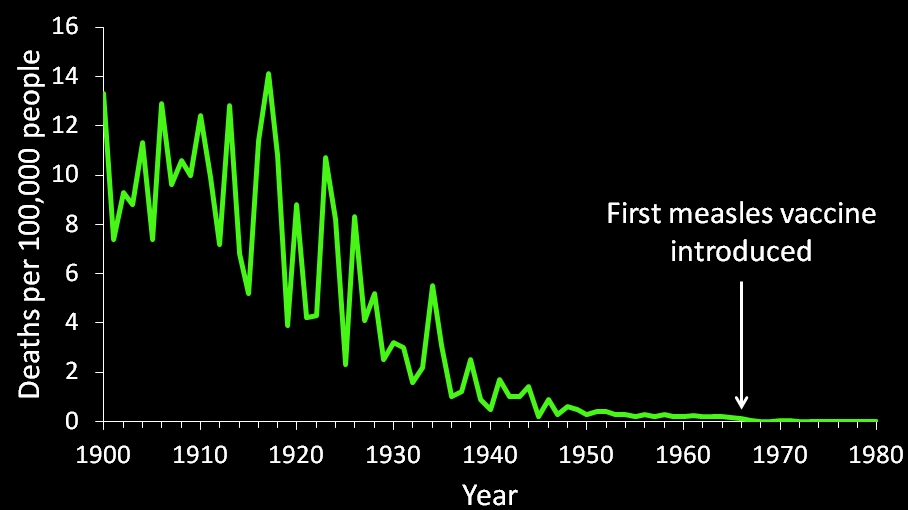
If you have spent any time reading anti-vaccine pages, then you have inevitably come across graphs like Figure 1 (below) which claim that death rates were already declining prior to vaccines, and, therefore “vaccines did not save us from disease.”

us measles death rates vaccine anual

Figure 1: US measles death rates. Anti-vaxxers erroneously claim that this graph proves that vaccines don’t work/didn’t save us (sources are available at the end of the post)

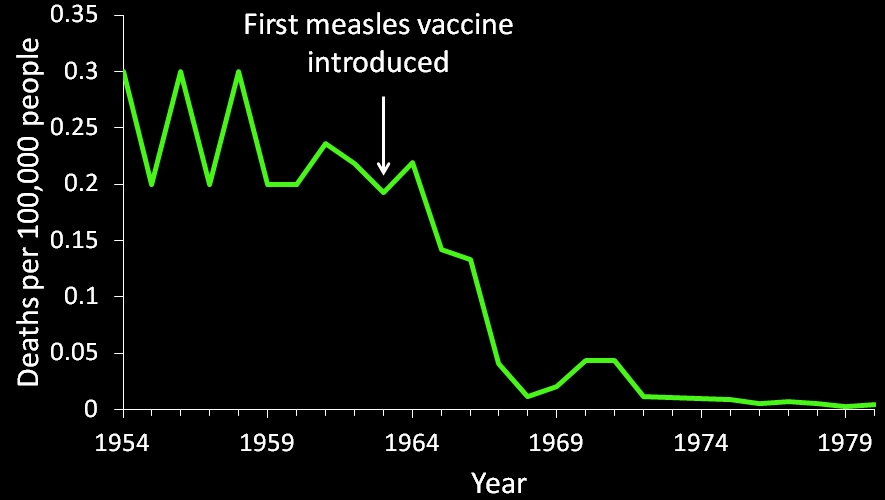
Conversely, pro-vaccine pages present the following graph (Figure 2) as evidence that vaccines do work and helped reduce disease rates.

us measles death rates by year annual vaccines work

Figure 2: US annual measles death rates before and after the introduction of the vaccine (sources are at the end of the post).

Interestingly, both groups are using the same data, and both groups claim that the other is misrepresenting the data for their own purposes. As I will demonstrate, however, it is the anti-vaccers which are ignoring the rules of statistical analysis and manipulating the data to tell an inaccurate story.

Before I go into the proper analysis for these data, I want to point out that we have tons of evidence other than these graphs on which we base the claim that vaccines work and save millions of lives. For example, numerous experiments have confirmed that herd immunity does work, and having a large number of vaccinated people decreases the community wide disease rates by protecting the unvaccinated (Rudenko et al. 1993; Hurwitz et al. 2000; Reichert et al. 2001; Ramsay et al. 2003). Similarly, multiple studies have documented that introducing vaccines into a population causes the disease and death rates to plummet (Clemens et al. 1988; Adgebola et al. 2005; Richardson et al. 2010). Other studies have clearly demonstrated that people who are vaccinated have lower disease rates than people who are not vaccinated (Schmitz et al. 2011). Finally, there have been numerous documented instances of disease outbreaks accompanying low vaccination rates (Antona et al. 2013; Knol et al. 2013). All of this is incontrovertible evidence that vaccines do work and do play a vital role in saving us from disease. So, without even looking at the anti-vaccer graphs, we can tell that something about their argument is wrong, because we have a mountain of experimental evidence which says that vaccines save lives.

Nevertheless, let’s take a look at the anti-vaccine graphs and see if we can figure out what’s going on. First, it is important to realize that anti-vaccers are correct that death rates from measles had declined greatly prior to vaccines. This was largely due to improved medical treatments that allowed people with measles to have a higher chance of surviving (more on that later).  The fact that measles death rates had declined prior to vaccines does not, however, mean that vaccines didn’t play an important role. This is the problem with the anti-vaccine graph, it is deliberately zoomed out so far that you can’t see the impact of vaccines. That is why the pro-vaccine graph is a better representation. It’s not zoomed in as an effort to conceal something, rather it is zoomed in because that is the only way to see that vaccines did actually have an important impact.

Anti-vaccers typically take one of two approaches to dismiss the obvious drop in measles death rates after vaccines. The first is simply to downplay it. For example, anti-vaccers are fond of stating that the death rate from measles (deaths/per a population of 100,000 people) had declined by almost 100% before vaccines. That claim is actually true, but what they ignore, is the fact that after vaccines, it dropped by almost 100% from the pre-vaccine rate. In other words, in the 10 years preceding the first measles vaccine (1953-1962) there were an average of 0.25 measles related deaths per 100,000 people per year, and in the first 10 years after 1968 (when the much more effective live vaccine was introduced) there were an average of 0.017 measles related deaths per 100,000 people per year. As I’ve previously explained, this means that in the ten years before the vaccine, an average of 440.3 people died every year from measles, and in the ten years following the live vaccine, an average of only 34.5 people died annually from measles. In my opinion, saving over 400 people annually is a big deal.

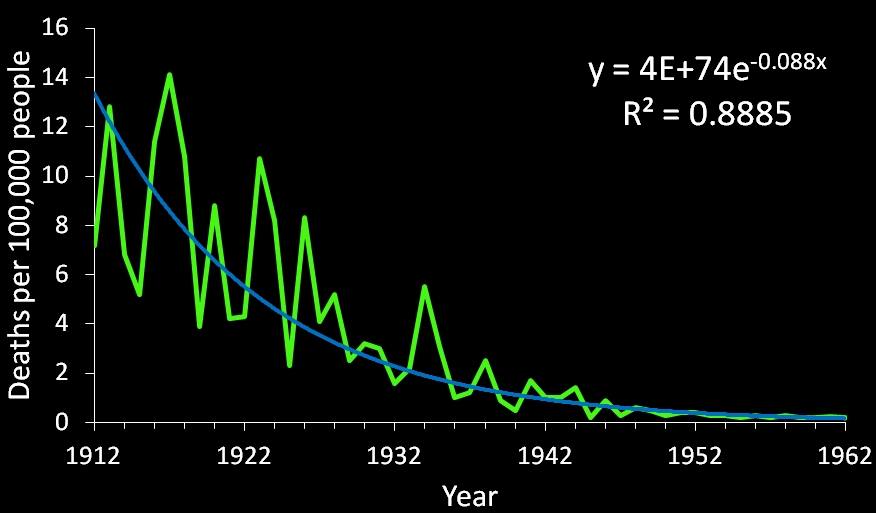
The second strategy is simply to claim that the drop in death rates was just a continuation of the previous trend, and vaccines weren’t responsible. A quick glance at Figure 2 is enough to debunk that claim, but let’s look more closely. To do this, we are going to have to do some math. The decrease in measles deaths prior to vaccines exhibits a mathematical property known as an exponential decrease. This lets us calculate the rate of decrease and extrapolate it out into the future. So, let’s look at the data from 1912-1962 (Figure 3; note: 1912 was chosen as an a priori starting point because it is the first date for which I was also able to find measles infection rates [more on that later] and picking an earlier date would actually make things worse for the anti-vaccers, so its not cherry-picked. 1962 is the last year prior to vaccines).

exponential decrease in measles death rates vaccines work

Figure 3: Exponential decrease in US annual measles death rates prior to vaccines (sources are at the end of the post).

The exponential trend line in in Figure 3 is very informative, because it shows that the decrease in measles deaths had reached an asymptote prior to vaccines. Mathematically, that means that we only expect a very gradual decline following 1962. In fact, we can use the equation of a line to calculate future declines (the R2 is a just statistical measure of goodness of fit, and 0.8885 for this many data points is a very good fit, meaning that the trend line should be very accurate). So, let’s look at the death rate 10 years after the first vaccine was introduced. In 1973, there were only 0.01 measles deaths per 100,000, so if we plug that value into the equation as our Y, then we can solve for X (the date). If the decrease in deaths was not from vaccines, then we expect the calculation to give us a date that is close to 1973, but when we actually do the math, we find that we should not get a death rate of 0.01 until 2004! In other words, the death rates following the vaccine are much, much lower than what we would expect if the vaccine wasn’t having an effect, and 1973 was not a cherry picked date, for any post-vaccine death rate that you enter, the line says that we shouldn’t see it for several decades after we actually saw it. To update this for us, over the past decade, there have been an average of 0.00013 measles related deaths in the US (note: I used 2005-2014 because 2015 data is not yet complete, and I assumed that the possible measles deaths in 2009 and 2010 were actually from measles, failing to make that assumption makes things even worse for the anti-vaccers). So, when we plug 0.00013 in as our Y value, we should not see our current death rates until 2053! This is clear mathematical evidence that the measles vaccine is saving lives every year. This is, of course, common knowledge to the scientific community. For example, the WHO estimates that the measles vaccine saved 15.6 million lives world-wide from 2000-2013.

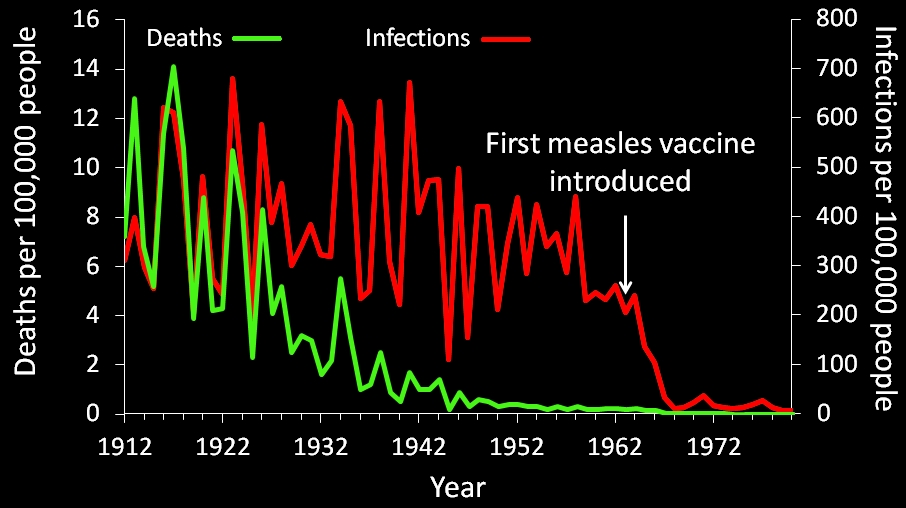
I realize that exponential regression isn’t everyone’s cup of tea, so I want to look at the same basic situation from another angle. Everyone seems to focus on death rates, but the infection rates actually give a clearer picture (Figure 4).

vaccines work US measles annual infection rates and death rates

Figure 4: US measles infection and death rates prior to and following the introduction of the measles vaccine (sources are available at the end of the post).


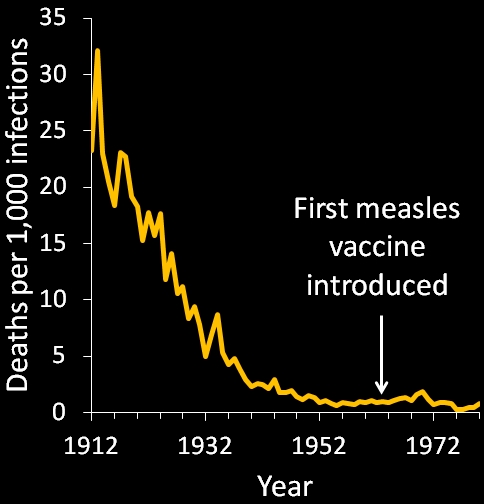
vaccines work measles deaths mortality rates

Figure 5: US annual measles mortality rates prior to and following the introduction of vaccines (sources are at the end of the post)

What you can clearly see from Figure 4 is that unlike death rates, measles infection rates had not declined prior to vaccines. Indeed, actually running a linear regression analysis on the data (1912-1962) reveals a P value of 0.121, and to be statistically significant, the P would need to be less than 0.05. In other words, there is no significant decrease in infection rates. This is extremely important because it debunks the anti-vax trope that “clean water and improved sanitation eliminated diseases.” What this graph tells us is that the number of people who were surviving measles increased without vaccines, but the number of people who were getting measles had not changed. Indeed, if we look at the mortality rates of those who were infect by measles (Figure 5), we can see that they leveled off before the vaccine was available. In fact, in the years immediately prior to the vaccine, the average mortality rate was roughly 1 in 1000 (i.e., 1 out of every 1000 infected people died), and that is the same mortality rate that we have today. Together, these data paint a very clear picture: medical advances had improved the survivorship of those who became infected, but it had done nothing to eliminate the disease itself. This means that the number of people who became infected was the factor controlling the annual number of deaths, and it is abundantly clear that vaccines were responsible for reducing the annual number of infections.

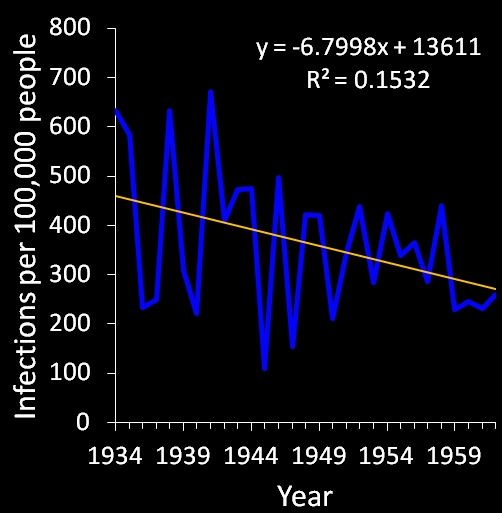
Figure 6: A statistically invalid decrease in US measles infection rates prior to vaccines. This graph is a copy of one that was made by the always inaccurate International Medical Council on Vaccination

Figure 6: A statistically invalid decrease in US measles infection rates prior to vaccines. This graph is a copy of one that was made by the always inaccurate International Medical Council on Vaccination

Of course, not everyone agrees with me. The perpetually terrible and counter-factual “International Medical Council on Vaccination” claims that the rate of measles infections was actually declining prior to vaccines. Their “evidence” for this claim is a  graph (replicated in Figure 6) that simply shows that they are as bad at statistics as they are at logic. You see, the graph goes from 1934-1962 even though we have data going all the way back to 1912. So why did they start at 1934 instead of 1912? Quite simply, because 1934 is the only year that gives them a significant result. In other words, they cherry picked it. Whenever you are analyzing a data set like this, you need a justification for using the date range that you use. Usually, it is best just to use the whole set, but sometimes it may make sense to look only at a ten year period or some subset like that, but if you are going to choose a seemingly arbitrary 29 year period, you need a good justification for it, and they don’t have one. The reality is that if you run a linear regression on those 29 years, you do in fact get a significant result, (P = 0.036), but the years around it don’t yield anything significant. If we start with in 1933 we get P = 0.055, if we start in 1935 we get P = 0.101, and if we look at the ten year period before the vaccine we get P =0.108. In other words, what they did to produce that figure was not statistically valid because they cherry picked their data. You cannot just pick the data points that suit your argument and ignore the rest (note: this is the same problem that you get with the “global warming pause” argument: the dates are cherry picked). Finally, just to be totally fair, let’s ignore the fact that they are clearly wrong about the decline, and take a look at the regression line. Just as before, let’s use the 1973 data (10 years after the first vaccine) and plug that in for our Y value. There where 12.6 cases of measles per 100,000 people in 1973, but, according to their regression line, we shouldn’t see a value that low until 1999. Again, 1973 wasn’t cherry picked, you get the same story if you use 1972, 1974, etc. My point is that the observed decline does not match their predicted decline, which clearly indicates that their predicted decline was wrong. The best explanation for the observed decline is that vaccines are effective and were responsible for the decline in disease rates.

Conclusion

In summary, the notion that vaccines did not save us from disease is a distortion and misrepresentation of the facts. It is true that death rates had declined prior to vaccines, but this was from improved medical practices and treatments, and actual infection rates had not decreased significantly. It is, therefore, completely dishonest to say that vaccines did not play a major role in eliminating diseases, and the data clearly show that we would have much higher disease rates and fatalities today if it were not for vaccines.

Data

The primary data for this post were compiled from several sources. Mortality rates for 1900-1960 were collected from Vital Statistics Rates in the United States, 1900-1940 and Vital Statistics Rates in the United States, 1941-1960. Infection rates were collected from the Census Bureau No. HS-18. Specified Reportable Diseases-Cases per 100,000 Population 1912 to 2001. Additional data (after 1960) were collected from CDC Appendix E Reported Cases and Deaths from Vaccine Preventable Diseases, United States, 1950-2013. In some cases it was necessary to calculate rates based on total numbers and population sizes. Population size data were collected from Google Fusion Tables US Population 1776 to Present. The data can be downloaded as a spreadsheet here.

Annual measles infections and deaths in the US from 1900 to 1980. vaccines mortality

Table of annual measles infections and deaths in the US from 1900 to 1980. Shaded cells contain data that were calculated from data in the other cells. All other data came from the sources listed above. The table can be downloaded as an Excel spreadsheet here.


Posted in Vaccines/Alternative Medicine | Tagged , , , , | 9 Comments

Miracle Mineral Solution (MMS): If it sounds too good to be true, it probably is

There is an old saying that if something sounds too good to be true, it probably is. I really like this saying because it is a basic principle of skepticism, and it goes hand in hand with a statement that was made famous by none other than Carl Sagan. Namely, “extraordinary claims require extraordinary evidence.” I find that these two principles are broadly applicable to the many “miracle treatments” and fad diets that pervade the internet, but in this post I am just going to focus on the “Miracle Mineral Solution” (a.k.a. Miracle Mineral Supplement or MMS) as an illustration. Basically, this post is just an exercise in common sense in which I am going to point out some obvious hallmarks of snake oil.

What is MMS?

To put it simply, it’s bleach. To put it more technically, it is a 28% solution of sodium chlorate which breaks down to release chlorine dioxide, and it is the chlorine dioxide which actually reacts with pathogens (remember this chemical, it is going to show up a lot in this post). To be clear, MMS is not the same type of bleach that is used to clean your house (sodium hypochlorite), but it is nevertheless a type of bleach and is used to bleach various paper, wood, and textile products. This is also one of the chlorines that is sometimes used in very low concentrations to disinfect drinking water. Now, the fact that someone is selling a concentrated bleach solution as a miracle cure should throw up some red flags, but let’s investigate further. After all, the skeptic principle is to demand evidence, not to blindly reject something without looking for evidence.

Are its effects plausible?

According to the almighty internet, MMS cures pretty much everything. Spiritportal.org states that it “CURES” (their emphasis) “malaria, AIDs, most cancers, any type of hepatitis, tuberculosis, typhoid, pneumonia, asthma, herpes, HPV, chicken pox, smallpox, measles, influenza (including bird flu), colds, food poisoning, snake bite, Lyme disease, ringworm, roundworm, tapeworm, yeast infections, and many other common diseases.” Many other websites list additional ailments, and one hilariously unfactual website even goes as far as saying that it kills 95% of all diseases! Similarly, MMSWiki has an insanely long list that includes things like Down syndrome, Alzheimer’s, diabetes, depression, etc., and, of course, what good would a miracle cure be if it didn’t cure baldness and erectile dysfunction.

This type of list is characteristic of supposed miracle cures, and it provides really obvious evidence that these “cures” are a load of crap. For one thing, diseases like AIDs, cancer, and Alzheimer’s should jump out at you. Anytime that someone claims to have found a simple cure for one of those diseases, you should be very, very skeptical. Further, the sheer range of diseases that MMS supposedly cures gives us a good reason to be cautious. The list includes cancers, viruses, fungi, bacteria, auto-immune disorders, protozoan infections, parasites, genetic disorders, neurological disorders, snake bites, etc. I’m going to walk through some of those in more detail below, but first, just ask yourself if it is actually plausible that something is going to be effective against all of those maladies (spoiler alert: it’s not).

Pathogenic diseases

First, let’s look at the list of pathogenic diseases that it supposedly treats. In other words, all of the viruses, bacteria, protozoa, intestinal parasites, and fungi. When I first started looking into MMS, I was very skeptical that it would be able to kill so many different types of organisms, because all of these organisms are extremely different from each other. For example, bacteria have a cell wall made of peptidoglycan, whereas fungi have walls made of chitin; protozoa and intestinal parasites have no cell walls, and viruses don’t even have cells. So, generally speaking, treatments are specific for each group (e.g., antibiotics work for bacteria, but not viruses).

Much to my surprise, there is actually very good evidence that chlorine dioxide (the chemical that is produced by MMS) is very effective at killing all of these organisms in water. This is a very important point. Just because something kills “germs” in a glass of water or even when it is poured on a cut, that does not inherently mean that it will kill the targeted germs inside you. There are several reasons for this, but the most important one is that the chemical will react with lots of other things before it gets to the target organism. One of the primary mechanisms through which chlorine dioxide kills cells is by reacting with amine groups through oxidation/reduction reactions (type “chlorine dioxide amine” into Google Scholar for a host of articles about how it behaves). Amines are a type of chemical that contains a nitrogen with a lone pair of atoms, and they are ubiquitous in living organisms. They are, for example, part of some of the amino acids which are used to make proteins. So, we have amines, good bacteria have amines, bad bacteria have amines, etc. This is important because MMS is going to react with the first amines it encounters. Remember, this is just a chlorine atom bound to two oxygen atoms. It doesn’t have any way to detect good cells and bad cells. It’s just doing simple chemical reactions. So, let’s say that you take a few drops of MMS to treat chicken pox, most of it is going to react with the amines in the bacteria that populate your mouth and throat long before it gets circulated to the viruses that you want it to react with. True believers of course claim otherwise. According to one website:

“It [MMS] does not react with organic matter, such as food, body cells or even our ‘good’ intestinal bacteria, but is specific in destroying pathogenic microbes.”

This statement is hilariously impossible. First, all living things are made of organic matter. Amines are, for example, organic matter. So this statement is clearly false. If it were true, then MMS wouldn’t kill pathogenic microbes because they are made of organic matter. In fact, here is a paper entirely devoted to the fact that chlorine dioxide dissolves organic matter. Also, MMS does not discriminate between bacteria types. Both good bacteria and bad bacteria are made of the same chemicals, and chlorine dioxide will react with the amines in good bacteria just as quickly as it reacts with the amines in bad bacteria. Finally, there is evidence that chlorine dioxide reacts with bacteria more quickly than it does with our cells (this is the case because bacteria are much smaller than our cells so the chemical can react with them more quickly), but that is not the same thing as saying that it won’t react with our cells. If you put chlorine dioxide on living human cells and give it enough time, it will enter the cells and react with the amines. This is simple chemistry.

Cancer

Next up, we have cancer. I can admit that it is technically possible that MMS could treat some infectious diseases (though that still doesn’t mean it’s a good idea to take it), but it is completely absurd to think that it could treat cancer. Cancer is not like most diseases because it is caused by our own cells mutating and replicating uncontrollably. This makes cancer extremely difficult to fight because we are fighting against our own cells! So almost anything that will kill a cancer cell will also kill our healthy cells. Cancer cells are made of the same chemicals as normal cells. They are both full of amines, and nothing about the chemistry of chlorine dioxide suggests that it would be able to tell the difference between a cancer cell and a regular cell. Again, it’s going to react with the first amines it encounters, regardless of whether those are in healthy cells or cancer cells.

Asthma

Asthma is also included in the list. This inclusion is rather non-specific as there are many types of asthma that can be triggered by many different things, but most asthmas fall under the umbrella of autoimmune. To put it simply, they are caused by the body over-reacting to something harmless and, as a result, damaging itself. It would, therefore, be rather curious if MMS could treat asthma since there isn’t anything for it to kill (unlike the vast majority of other things it supposedly does). Rather, it somehow has to suppress an immune response. As with cancer, there is no reason to think that chlorine dioxide is in anyway capable of doing that.

Snake bites

Next, we have my personal favorite: “snake bites.” I have to assume that this means venomous snake bites (you don’t typically need medicine for a normal snake bite), but this raises the obvious question of what type of snake bit it treats. You see, there are two broad categories of snake venom: neurotoxins (which affect the nervous system) and hemotoxins (which affect the cardiovascular and muscular systems). There are, however, numerous sub-categories, and there is a tremendous amount of variation. In other words, different species have very different venoms that act very differently. Some block nerve signals, some coagulate the blood, some destroy cell membranes, etc. The chemistry of snake venom is extremely diverse and it simply isn’t plausible that one single chemical would be able to counteract all of the different types of snake venom. As someone who does research on venomous snakes, I am begging you, if you are bitten by a venomous snake, get to a hospital ASAP and do not take MMS for the bite. (On a side note, snake bite kits are also totally worthless and typically do more harm than good. Getting to the hospital as quickly as possible really is your only option [unless you live in Australia, in which case snake bandages are a good stop-gap measure to give you more time to get to a hospital])

Disorders

Finally, I want to briefly look at a few of the most absurd claims about MMS. For example, MMS supposedly cures Down syndrome. This would be truly remarkable because Down syndrome is caused by a trisomy (extra copy) of chromosome #21. So people with Down syndrome have an entire extra chromosome which is giving commands to the body. So to cure Down syndrome, you would have to somehow shut off that entire extra chromosome without interfering with the other chromosomes (which are made of the same chemicals, btw). There is simply no mechanism through which chlorine dioxide could possibly do that.

The procedure for “curing” autism is similarly absurd (and downright barbaric). For some reason, people got it in their heads that autism is caused by intestinal parasites (which is one thing that we know doesn’t cause autism). So, to treat it, well-intended, but dangerously misguided parents are giving their children MMS enemas (sometimes daily)! Remember, MMS is a bleach, and it is caustic enough that it sometimes causes the children to shed their intestinal linings. To the true believers, however, these linings aren’t the results of bleach killing their children’s intestinal cells, rather they are parasitic “rope worms,” and their presence in a child’s discharge confirms that the MMS is doing its job.

Summary of supposed effects

To review, this chemical is supposedly able to cure an extremely broad array of aliments, each of which requires a different mechanism. A mechanism that kills bacteria won’t cure cancer, won’t treat snake venom, won’t suppress the immune system, won’t cause hair to grow, won’t cure Down syndrome, etc. It just isn’t plausible for one chemical to do all of these things. Now, you may be thinking, “fine, maybe the claims are exaggerated, but just because it doesn’t cure all of these doesn’t mean that it can’t cure some of them.” That is true, but there are still several problems. First, without rigorous testing, you have no way of knowing which (if any) ailment it actually treats, and you have no reason to trust the people selling this stuff. I think that I have clearly demonstrated that at least some of the claims about MMS are scientifically incorrect. This means that the people making these claims are either dishonest or ignorant. Either way, you shouldn’t be getting medical advice from them. Second, without rigorous testing, you don’t know if it is safe. There are, for example, many things that will kill bacteria (such as iodine, gasoline, Clorox, rubbing alcohol, etc.), but that doesn’t mean that drinking them is a good idea.

Is the scientific evidence to support these claims?

Every once in a great while, a truly extraordinary claim turns out to be true, but we need some really solid evidence before concluding that it is true. So, are the claims of MMS peddlers supported by science? NO! There is not a scrap of scientific evidence that ingesting MMS does anything beneficial! The only “studies” are poorly designed, uncontrolled, and self-reported tests that were conducted by the inventor of MMS (Jim Humble). You can read about his “tests” in one of his many books which he would be more than happy to sell to you. All of the other “evidence” comes from anecdotal reports. I have previously elaborated on why anecdotes are meaningless, so I won’t do it here.

Are there side effects?

According to the charlatans that sell this stuff, it has “no harmful side effects or damage to healthy cells.” This claim is characteristic of quack treatments and miracle cures, and it is a dead giveaway that you are being lied to. Any medicine that has an effect on our bodies will also have side effects. This is an inevitability of our bodies’ chemistry. All medicines (including the handful of alternative medicines that are actually effective) work entirely because of chemical reactions inside of our bodies, and for at least some people, these reactions will invariably produce unintended consequences. So, the only way that something won’t have any side effects is if it doesn’t have any effects in the first place (on a side note, this is why homeopathy doesn’t have any side effects).

This claim is especially absurd for MMS because we know that MMS has side effects. Remember that that we are dealing with an industrial strength bleach. To be fair, it is not as caustic as regular bleach, and it attacks bacteria more readily than it attacks human cells, but, it will still kill human tissue in a high enough dose. Most people only take one or two drops of this stuff, which probably isn’t enough to do much harm, but some people take large quantities of it and use it daily, which is potentially dangerous. Despite all of the claims that MMS doesn’t affect your body’s good cells, it is a scientific fact that chlorine dioxide can be lethal. Fortunately, the LD50 (the does that will kill 50% of the mice that are given that dose) is estimated to be greater than 10,000 mg/kg, which is a very high LD50. So you probably aren’t going to kill yourself with this stuff, but at the same time, there have been plenty of lab trials where animals died from chlorine dioxide exposure. The non-lethal effects vary. Some studies haven’t found much in the way of harmful side effects, but other studies have found good evidence the chlorine dioxide causes problems such as ulcers, lesions, altered blood chemistry, nausea, and diarrhea (you can find a good review of the toxicity of chlorine dioxide here).

So, as far as a bleach goes, MMS is fairly safe, and it probably won’t do much serious damage in the doses that most people take. Nevertheless, the evidence against it is strong enough that health agencies from multiple countries warn against using it. These countries include: USA, Australia, Canada, and several others. The FDA even comically states that:

“Consumers who have MMS should stop using it immediately and throw it away.”

But, of course, we all know that every major health organization in the world is paid off by Big Pharma (note the immense sarcasm), so let’s look at the information given to us by the supporters of MMS. Miracle-mineral-supplement.com makes the following statement:

“Note: If you notice diarrhea, or even vomiting that is not necessarily a bad sign. The body is simply throwing off toxins and cleaning itself out. Some people say they feel much better after having diarrhea.”

Now, a rational person might stop and think that perhaps they were throwing up because they drank bleach, but according to the true believers, that is simply the MMS doing its job of removing vague “toxins” and whatever else might ail you (all of course without damaging your cells or the good bacteria that live in your gut). This is clearly rubbish. First, even if the claim that your nausea and diarrhea were from the MMS working was true, that is still a side effect! You cannot simultaneously say “this has no side effects” and “while taking this you may lose your lunch and your anus may be converted into an upside-down volcano.” If taking something gives you diarrhea, then diarrhea is a side effect. Second, except under very rare circumstances, the death of bacteria, virus, etc. will not make you sick. You have these wonderful cells called phagocytes that go around removing old cells and harmful materials. They do this all the time, and you don’t get sick from it. Every day, thousands of your cells die, and phagocytes run around disposing of them.

Things are similarly bizarre when we look at the procedure for “treating” cancer. According to spiritportal.org you should start off with 1/2 drop and see if that makes you nauseated. If it doesn’t, you should keep slowly increasing the dose until you find an amount that does make you nauseated. You want to reach the dose that makes you nauseated because being nauseated supposedly means that it is working. You see, after the MMS kills your cancer cells, they become “a poison to your body,” and it is those poisonous dead cells (not the bleach) that are making you sick. I honestly laughed the first time that I read this. For one thing, Occam’s razor tells us that we should default to the explanation that makes the fewest assumptions, and that explanation is clearly that you are throwing up because you drank bleach. Further, why on earth would a dead cancer cell be poisonous? The chemical composition of cancer cells isn’t substantially different from other cells, and, as previously stated, your cells die constantly. So why would a dead cancer cell be poisonous when a normal dead cell is not? Once again, you have phagocytes that do a very good job of getting rid of dead cells.

Why isn’t MMS an approved treatment?

No miracle cure would be complete without a conspiracy theory, and MMS supporters are more than happy to concoct one. In classic conspiracy theorist form, almost every MMS website that I have looked at has stated that pharmaceutical companies are suppressing the truth of MMS because they make so much money treating these ailments, and, of course, all of the world’s health organizations (and bloggers like me) are paid shills. There are so many problems with this argument that I plan on eventually devoting an entire post to it, but for now, I’ll just hit the highlights.

First, pharmaceutical companies spend billions of dollars looking for cures to cancer, Alzheimer’s, etc. Why would they do that if they already have a cure that they have no intention of using?

Second, if MMS actually works, why wouldn’t they start marketing it themselves and make billions of dollars of off it? Inevitably they would charge way more for it than it costs to produce, and, yes, they would have to compete with the unlicensed internet retailers, but there are still plenty of people who would rather pay a little bit more and get something official than use something from the internet. Surely that would make more sense than spending billions of dollars paying off all of the world’s doctors while simultaneously spending billions of dollars looking for a cure that they already have.

Third, realize that all of the thousands of doctors who work for pharmaceutical companies have friends and family who are afflicted by these diseases (especially cancer). Do you really think that they are just going to sit by and watch tons of people suffer and die when they know that a cure exists?

Finally, realize that this claim is a question begging fallacy/ad hoc fallacy (depending on how it is worded). In other words, I would never accept this absurd conspiracy theory unless I was already totally convinced that MMS worked. So it’s a logically invalid argument.

Conclusion

Hopefully this post has made it clear that MMS is nothing but snake oil and shouldn’t be trusted. More importantly, I hope that this post has given you some basic common sense guidelines for examining miracle treatments, fad diets, etc. The following list gives some of the hallmark characteristics of quack treatments, and you should watch out for them.

  • Implausible effects (e.g. an absurdly wide array of ailments that it cures, unrealistic recoveries, improbable amounts of weight loss, etc.)
  • No plausible mechanisms for causing those effects
  • No scientific evidence to support its claims
  • Claims that it has no side effects
  • Conspiracy theories

For MMS, we find that it doesn’t pass any checkpoints, and there is absolutely no reason to think that taking it is a good idea.

Posted in Vaccines/Alternative Medicine | Tagged , , , | 7 Comments