10 common myths about evolution

Evolution is the single most important concept in all of biology. It is absolutely vital for understanding both the history of life on earth and why our modern organisms have their current traits and behaviors. Nevertheless, it is also one of the most misunderstood concepts in modern science. Much of the confusion stems from creationists’ faulty arguments, but even those who accept evolution often don’t really understand it. Therefore, I am going to describe and debunk ten of the most common myths and misconceptions about evolution.


Myth 1: Evolution is just a theory

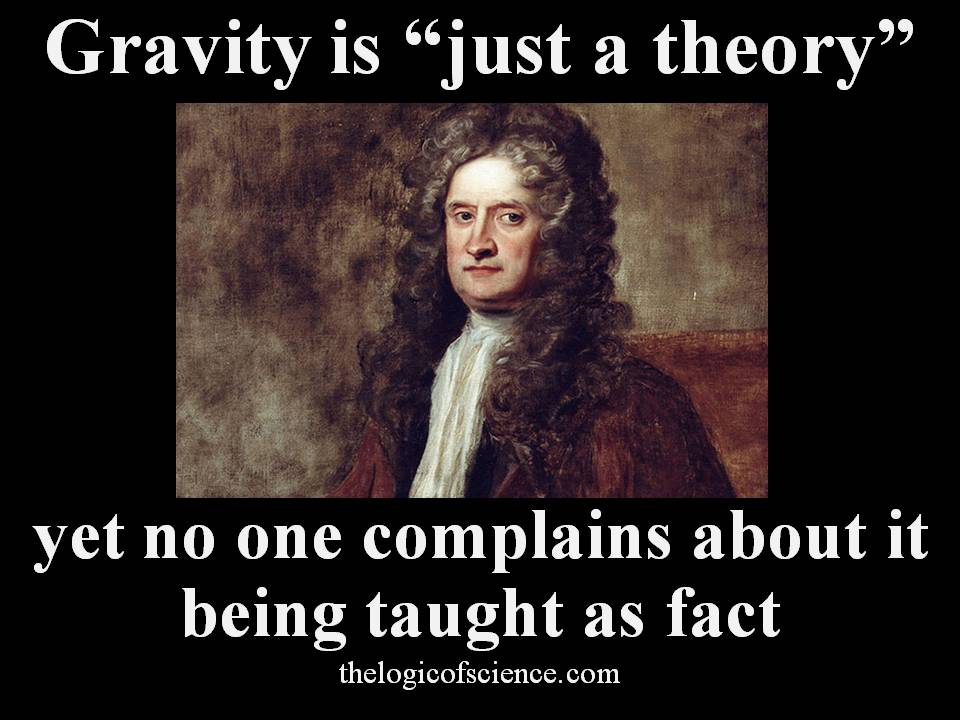
This is arguably the most common myth about evolution, and it is probably creationists’ most well worn trope. It is also a fundamental misunderstanding of how science works. I’ve explained this in more detail before, but briefly, evolution is both fact and theory depending on exactly what we are talking about. The idea that all modern organisms (including humans) evolved from a single celled organism over a period of millions of years is a scientific fact. It has been confirmed by the fossil record, genetics, biogeography, etc. Like it or not, it’s a fact, but there is also a theory component. You see, theories explain facts. So, the theory of evolution by natural selection states that natural selection has been the dominant mechanism causing species to evolve. In other words, it is a fact the evolution occurred, and the theory of evolution by natural selection explains how that evolution occurred. Indeed, it is a common misconception that Charles Darwin came up with the idea of evolution. In reality, many scientists before him thought that organisms evolved, but they couldn’t figure out how or why they evolved. So, what Darwin (along with Alfred Russel Wallace) did that was so extraordinary, was to provide a mechanism that drove evolutionary change (i.e., natural selection).

Finally, it is worth noting that theories are actually among our highest forms of scientific certainty. They have been rigorously tested and consistently make accurate predictions. So gravity (i.e., the theory of universal gravity), the idea that all matter is made of atoms (i.e., atomic theory), the idea that all living things are made of cells (i.e., cell theory), the idea that bacteria make you sick (i.e., the germ theory of disease), etc. are all “just theories.”


Myth 2: We evolved from monkeys/apes

we did not evolve from apes but we share a common ancestor with themWe did not evolve from modern apes, but we share a common ancestor with them. In other words, if we back the clock up a few million years, we will find an ape-like ancestor whose populations split, and different groups went down different evolutionary paths. One group evolved into us, and another group evolved into chimps. So we and chimps share a great, great, great…great grandparent who went extinct a few million years ago, but we did not evolve from chimps, monkeys, or modern apes.


Myth 3: Evolution conflicts with the second law of thermodynamics

People often  describe the second law of thermodynamics as, “the disorder of a system always increases,” which leads people to erroneously claim that evolution violates the second law because it says that overtime life becomes more organized. The problem is that the above definition is a terrible one which misrepresents the law and overlooks several key components.

The best way to understand the second law is in conjunction with the first law. The first law (also known as the law of the conservation of energy) states that energy cannot be created or destroyed, but it can change forms (e.g., it can go from potential energy to kinetic energy). The second law then describes the natural flow of energy within a system (i.e., the direction in which the changes take place). Both of these are dealing with energy states, and taken together, they say that a system cannot go from a low energy state to a high energy state without the input of additional energy. The classic example of this is a diving board. Someone standing on a tall diving board is in a higher energy state (i.e., they have more potential energy) than someone standing at the bottom of the ladder. So, to a physicist, the person at the bottom is more “disorganized” than the person at the top, because the person at the top has more potential energy. In technical terms, this concept of disorganization is known as entropy, and the person at the top of the board would have less entropy than the person at the bottom.

Notice, these laws do not state that it is impossible for systems to go from a low energy state to a high energy state. Rather, they say that the transition cannot take place without the input of additional energy. In other words, it is completely possible for the person at the bottom of the ladder to climb up onto the board and reach a higher energy state (i.e., become more organized/have less entropy), but doing so requires an input of energy (i.e., they have to use energy to move their muscles and climb the ladder). Another way to describe this is to say that a closed system cannot become more organized, at least in the long term (a closed system is one that receives no energy from outside sources). These laws do not, however, state that an open system cannot become more organized (an open system is one that does receive energy from outside sources).

Now, let’s apply all of that to evolution. The earth is most definitely an open system. It is constantly receiving energy from the sun. In fact, the sun drives nearly all life on earth. So, since the earth is an open system, there is no conflict between evolution and the thermodynamics. Let me use an example to prove that. I think we can all agree that a tree is more organized (has a higher energy state) than a seed. So, if thermodynamics worked the way that creationists claim, it should be impossible for a seed to grow into a tree, but it clearly is possible for seeds to grow. Why? Quite simply, because the earth is an open system. Even so, it is entirely possible for life to become more organized because organisms are constantly receiving energy from the sun (or from food which grew because of energy from the sun). So there is no conflict between evolution and thermodynamics.

Note: Myth#3 was edited on 5-Sept-15


Myth 4: We haven’t found any “missing links”

Odontochelys a turtle ancestor, missing link, intermediate fossil.

Odontochelys is a transitional fossil between turtles and their lizard like ancestors, complete with partially formed shell.  Image via Chun et al. 2008.

The term “missing link” is a misnomer because they aren’t missing. We have hundreds of fossils that clearly represent transitions between two groups of organisms. Creationists invariably claim that these fossils are simply uniquely created organisms that happen to look like transitions, but this is a clear and enormous ad hoc fallacy because evolution predicted the existence of these fossils. If, for example, I asked you to describe what an intermediate between a turtle and its lizard-like ancestor would look like, you would inevitably describe a creature with half the features of a lizard and half the features of a turtle (e.g., a partially formed shell, a turtle like skull that still retains lizard like teeth, a somewhat specialized neck, etc.). Well guess what, that’s exactly what we see in the fossil record with species like Odontochelys and Pappochelys which have some lizard features and some turtle features. Similarly, if I asked you to describe an intermediate between a dinosaur and a bird, you would probably describe a featured dinosaur with partially formed wings and some skeletal modifications like an enlarged breastbone, but which still retains some dinosaur features like teeth. Indeed, the creature that you are imagining closely matches fossils like Archaeopteryx, Confuciusornis, and Jeholornis. The same is true for the transition for fish to amphibians, amphibians to reptiles, reptiles to mammals, etc.

In each of those cases, we have multiple fossils that are exactly what we would expect if evolution was true, and the only way that you would reject the notion that these are intermediates is if you were already convinced that intermediates don’t exist. This is the fundamental problem with creationism (and a big part of why it is pseudoscience). Creationists have determined ahead of time that no intermediates exist, so no matter how perfect a transitional fossil may be, they will always claim that it is just a unique species that happens to look like a transitional (I explained this in much more detail here and you can find a good list of intermediates here [yes, I know Wikipedia isn’t a good source, but this list is actually quite useful and you can use it as a starting point to look up the details of specific fossils in more reputable sources]).


Myth 5: Evolution isn’t science because it hasn’t been observed/repeated

First, we have to specify what we mean by “evolution.” You see, evolution on a small scale has been observed numerous times. Bacteria evolving resistance to antibiotics is the most well-known example of this, but there are many others. For example, we have been able to observe finches on the Galapagos evolve and change their beak sizes in response to droughts (Grant and Grant 2002). We have even been able to observe entirely new species form (lots of good sources here).

Nevertheless, when most people make this claim, there are generally referring to evolution over a long period of time. In other words, they are saying that we have not observed or repeated something like a relative of the T. rex evolving into a chicken. First, it is important to realize that there is no real difference between “microevolution” and “macroevolution.” Macroevolution is just an accumulation of microevolutionary steps. So if evolution on a small scale occurs (as has been observed and experimentally demonstrated) then ipso facto, evolution on a large scale occurs. One inevitably leads to the other (more details here).

Finally, the idea that we have to directly observe something and repeat the event itself in order for it to be science is a fundamental misunderstanding of science. Most science is not based on direct observation of the actual event of interest. Rather, we observe clues that are left behind by the event, and we infer information about the event from them. For example, no one has directly observed two hydrogen atoms joining an oxygen atom to form a water molecule, but we know that it happens because we can conduct chemistry experiments which give observable results that we can use to infer the sharing of electrons that lets those atoms combine. Similarly, we constantly solve crimes without either observing or repeating them because there are clues left behind that we can use to infer who committed the crime (this is known as forensic science). Even so, we do not need to observe a dinosaur evolving into a bird to know that it happened because there are clues left behind in the fossils, DNA, etc., which we use to infer evolution. There is nothing unscientific about that, and, in fact, it is how most science works. We make predictions like, “if and only if birds evolved from reptiles, then birds should share more DNA with reptiles than any other group.” We then test those predictions, and when they consistently come true, we conclude that our hypothesis is most likely correct. That is the scientific method at its finest (I explained this in more detail here).


Myth 6: Individuals evolve

Populations evolve not individuals. Evolution is just a change in the genetic composition of a population over time, so, since individuals cannot change their genetic composition, they cannot evolve. For example, if a drought comes along and destroys all seed-bearing plants except for ones with very large seeds, an individual bird with a small bill cannot evolve in response to that drought. In other words, it cannot change its genetic makeup and alter its bill size to eat the large seeds. In biological terms, it cannot adapt. As a result, the birds that have small bills will get less food and produce less offspring than the birds with large bills. This means that there will be more genes for large bills in the next generation. So the population will evolve and adapt to the drought, but the individuals will not evolve.


Myth 7: Evolution has a direction or goal

People often talk about evolution “trying to accomplish” something, or they may describe primates and other mammals as being “more evolved” than other animals, but statements like that are extremely problematic because they inherently imply that evolution has a direction or goal, which it doesn’t. Biologist often like to say that, “evolution is blind.” All that evolution can do is adapt an organism for its current environment and way of life (I’m talking specifically about evolution by natural selection here). Evolution has no foresight, and it is completely incapable of predicting what will be useful in the future, so a trait that has been selected for thousands of generations may suddenly become harmful if the environment changes.

Because evolution just adapts organisms to their current environment and way of life, it doesn’t really make sense to describe one species as “more evolved” than the other. For example, a monkey is not “more evolved” than the fly that gets its moisture from the monkey’s poop. The monkey is certainly more complex, but it’s not really more evolved because both the monkey and the fly are extremely well suited to their way of life. If you try to say that the monkey is more evolved than the fly, then you are implying that evolution has a direction, which it doesn’t.

Finally, this explains the common creationist criticism that certain species have “evolved backwards” (e.g., penguins lost the ability to fly, whales went back into the ocean, etc.). This again assumes that evolution has a direction or goal, when in reality, it’s just adapting organisms to their current environment. So, at one point in time, flight was useful so evolution selected for it and produced flying birds, but as those birds invaded the antarctic, the ability to fly was not as important as the ability to swim and stay warm, so evolution selected against adaptations for flight and produced penguins.


Myth 8: Some systems are too complex to evolve

This is one of the oldest criticisms of evolution, and it has recently resurfaced under the moniker “irreducible complexity.” The basic idea is that some systems are too complex to evolve because they aren’t functional until all of the parts are in place. For example, an eye that is missing a single piece no longer sees, and a bacterial flagellum that is missing a single protein can no longer act as a flagellum. So the argument claims that these systems could not have evolved because there would have been steps that served no useful function, and nature could not have selected for those steps. The problem is that this argument ignores the fact that evolution is blind. Traits don’t need to function for some ultimate final product in order to be selected for. Rather, if they provide any useful function at all, nature will select them. Indeed, no one has ever been able to find a truly irreducible system, and we have evolutionary pathways that explain how complex systems evolve. For example, an early precursor of the eye would have simply involved a few light sensitive cells (much like some flatworms have). They don’t function as an eye, but they still function, so nature will select for them. Similarly, the proteins that make up a flagellum all serve other functions in the cell, and we have even figured out a step-wise series of events that would form a flagellum with each step serving a useful function for the cell, even though only the final step actually serves as a flagellum. So there is just no truth to the notion that some systems are too complex to evolve (I explained this in more detail here).


Myth 9: Evolution describes the formation of the universe/the first cell

I often hear people argue that, “evolution isn’t true because blah, blah, blah…big bang” or some nonsense about how we haven’t figured out how the first cell formed. Beyond the specific issues with those arguments (which I won’t go into here), those arguments are totally irrelevant to evolution. The big bang theory deals with the formation of the universe, and abiogenesis deals with the formation of life. Evolution only comes into play after life formed. So, even if you managed to disprove the big bang or disprove abiogenesis, you would not have in any way shape or form disproved evolution. Indeed, there are some people who think that God created the first cell, then let evolution take its course. In other words, they reject abiogenesis but accept evolution (to be clear though, there is no good scientific reason to reject abiogenesis or the big bang).


Myth 10: Evolution is faith based

To anyone who makes this claim, I would like to know which part exactly you think is faith based. As I explained in #5, the fact that we did not directly observe millions of years of evolution doesn’t disqualify it as science. In fact, evolution is one of the most well supported ideas in all of science, and if you actually read Origin of the Species it is packed with evidence. Further, Darwin was an exceptional scientist and made clear predictions about what future researchers should find if his theory was correct. For example, he explicitly stated that we should find intermediate fossils, and we have (see #4). Think about that for a second. Evolution predicted the existence of organisms decades before we found them. That is an utterly incredible feat. Similarly, evolution predicted a strong agreement between the fossil record and genetics, and, once again, its predictions have come true with remarkable consistency. So if you are going to claim that evolution is based on faith, I want to know precisely what part of it you think is faith based, because there is no aspect of it which I cannot back up with empirical data.

Finally, it is worth noting that, contrary to popular perception, evolution is not inherently atheistic. Darwin was not an atheist and there are scientists who both accept evolution and believe in God. Evolution is not based on faith, and it doesn’t stem from a philosophical or religious desire to reject God. Rather, it is a scientific fact which is supported by an insurmountable mountain of evidence.
Posted in Science of Evolution | Tagged , , , , , , | 21 Comments

Settled science part 2: Creating the illusion of a debate

In the previous post, I explained what we mean by “settled science” and why there often aren’t two legitimate sides to a story. Nevertheless, despite a massive scientific consensus on issues like climate change, there is still widespread disagreement among the general public. A fascinating recent survey showed just how massive the disconnect between the public and scientists is. For example, it found that 88% of surveyed scientists thought that GMOs were safe to eat, but only 37% of the general public agreed! Similarly, 87% of surveyed scientists thought that man-made climate change was real, whereas only 50% of the public agreed. Human evolution was similarly divided, with 98% of scientists agreeing compared to only 65% of the general public (note: the survey was conduced across all AAAS scientists, and all of those numbers are higher when you just look at the experts within the given field). So why does this disconnect exist? The answer is a combination of deceptive tactics by the anti-science movement and disproportionate coverage by the media (as well as an unhealthy dose of personal bias). So in this post, I want to examine the ways that people create the illusion of a debate.


evolution just a theory gravity creationism

Gravity, the idea that bacteria make you sick, the idea that matter is made of atoms, the idea that all living things are made of cells, etc. are all “just theories.”

Downplay the certainty
One common tactic is to downplay the level of certainty that scientists have. There is no better example of this than the well-worn creationist claim that evolution is, “just a theory.” In reality, a theory is among the highest forms of scientific certainty. A theory is an explanatory framework that has been repeatedly and rigorously tested and has a high predictive power (in other words, it consistently predicts the outcomes of experiments and it explains facts). So when we say that evolution is a theory, we are actually acknowledging that we are extremely certain about it, but this deceptive argument tries to make it appear that we aren’t very certain by tapping into the popular (and erroneous) concept that a theory is just an educated guess.

Another way that people try to diminish the certainty is by claiming (or implying) that since science can’t actually prove anything, it isn’t reliable and there is reasonable doubt (this has long been one of the cornerstones of the intelligent design movement). Not being able to prove something with 100% certainty and having reasonable doubt are, however, two very different things. We have not proved gravity, cell theory, germ theory, atomic theory, etc., but having doubt on any of those topics would be completely unreasonable.

Finally people often simply defer to the argument that, “scientists have been wrong in the past.” I have debunked this one before, so I want waste time one it here.


Point out minor disagreements and pretend that they are massive
Science is complicated, and for most things that qualify as “settled science,” the core concepts are widely agreed upon, but the details are debated. Anti-scientists love to hop on these disagreements about details and conflate them into core disagreements. For example, creationists like to present disagreements about certain dates or certain evolutionary histories as evidence that scientists don’t agree about evolution, but the reality is that we agree about the core concept that all life on planet earth evolved from a single cell, we just disagree about some of the details about exactly when and how certain evolutionary changes took place. So quibbles over which fossils represent the ancestor to whales, or whether a rock is 65 million years old or 70 million years old are completely irrelevant to whether or not evolution itself is actually true and widely agreed upon.

Similarly, climate change deniers like to claim that the models have all been wrong, and they cite this as evidence that scientists don’t really know what they are doing, but the reality is that most of the models have been very accurate. Some of the details have been a bit off (which is to be expected for any model), but the core concepts (increasing temperatures, increasing sea level, etc.) have all consistently come true (Marotzke and Forster 2015).


Cite pseudo-experts
All anti-science positions have a host of “experts” that they frequently cite as evidence that their position is correct or, at the very least, that there is debate about the issue. More often than not, however, their experts aren’t actually credentialed in the relevant fields. The anti-vaccine movement is particularly full of examples of this. Take Jenny McCarthy, for example. Anti-vaccers follow here religiously, but she is just a celebrity, she has no scientific credentials. Further, even most of their actual doctors and scientists have no credentials or experience with vaccines, immunology, or any other relevant field. For example, Dr. Sherri Tenpenny is often cited as an expert who opposes vaccines, but she is an osteopath, which has nothing whatsoever to do with vaccines (see this video for a hilarious example of her ignorance). Becoming a doctor doesn’t automatically endow you with knowledge about all aspects of medicine. Both medicine and science are extremely complicated, and most scientists don’t know a tremendous amount about areas outside of their own research. So, when you are trying to figure out whether or not there is a real debate about an issue, make sure that you are looking for a debate among experts. If the only ones who disagree with the mainstream view are people who have no experience or credentials in the relevant fields, then its safe to conclude that there isn’t a real debate.


Cite a handful of people with credentials
Every once in a while, the anti-science movement will dig up someone who agrees with them and actually has credentials in a relevant field, but, as I explained in the previous post, that is still not enough to actually demonstrate that there is a significant debate on an issue. There will always be a few dissenting voices no matter how certain we are of something. Nevertheless, the anti-science movement loves to present what are truly a handful of experts as if they were an overwhelming throng of scientists abandoning the mainstream view like rats abandoning a sinking ship.


Write petitions with lots of signatures
This strategy jumps from simply citing “experts” to getting a bunch of them to actually sign a petition. There are several reasons why this is problematic. First, science isn’t a democracy. In science, you prove your point with evidence, not petitions. Further, the signatories of these petitions often have no credentials in the relevant fields, and even when they do, they invariably represent only a very tiny portion of people working in that field. Probably the most famous example of this is the “Oregon Petition” which claims to have the signatures of 31,000 scientists who disagree with anthropocentric climate change. This petition was debunked more thoroughly here, but in short, only a small portion of the signatories were actually scientists, and only a handful of them were climatologists. So this petition did not in anyway shape or form succeed at establishing the notion that there is a significant scientific debate about climate change, and you cannot use it as evidence of such.


Have public debates
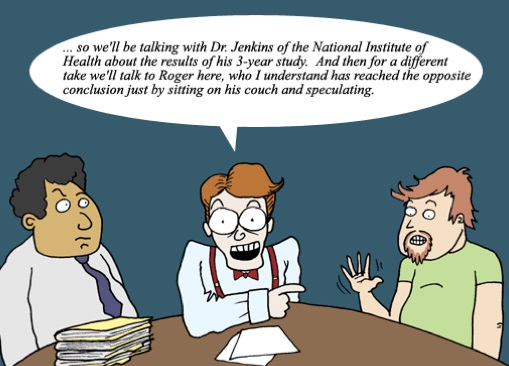
This is one of the most obvious ploys, and the media is largely responsible for it. They present two people (one for a position and one against it) and two sides. This false balance creates the illusion that both sides have equal (or least good) merit and should be taken seriously. It makes it appear that there is a strong disagreement among scientists even when one position is actually only held by an extremely small minority of researchers. As Jon Oliver hilariously explains, a truly representative debate on climate change, for example, would be three deniers vs. 97 scientists. Further, in these debates, the anti-science position is often represented by someone who is not actually an expert on the topic at hand.


Cover “both sides” of a story
This is another fault of the media that is closely related to public debate problem. The media, in their obsession to cover “both sides” of every story, gives equal time to the scientific position and the anti-science position even though one of them is demonstrably false. For example, it is not uncommon to see stories that start with something like, “experts are blaming the current disease outbreak on low vaccination rates…” then shift to, “but not everyone is convinced [insert interviews with people who aren’t convinced].” Who cares if some people aren’t convinced? The science on this is extremely clear, and anyone who thinks that low vaccination rates don’t cause disease outbreaks is simply wrong. There is utterly no reason to give time to a position that is factually incorrect. To be clear, I’m not trying to “suppress peoples’ opinions,” because I am talking about facts, not opinions.

Let me try to give a silly example to illustrate what I am saying here. Imagine a news story about the shape of the earth that goes something like this, “Scientists have refined their estimate of the earth’s diameter by an addition two meters, but not everyone is convinced. We talked to several people who argue that the earth is actually flat (insert interviews with flat-earthers).” That story would obviously be absurd. The flat-earthers wouldn’t deserve equal time (or any time) because they are clearly wrong.  Even so, when news stories devote time to people who think vaccines don’t work, climate change isn’t real, the earth is 10,000 years old, etc. it is deceptive because those people are simply wrong. You’re welcome to believe something that is factually incorrect (like the earth is flat), but the rest of us aren’t obligated to listen to you, take you seriously, or give you equal time.


Conclusion
There is really only one criteria that matters for determining whether or not there is significant scientific debate about an issue, and that criteria is the peer-reviewed literature. If there is significant debate, you will find it there. Media debates, Youtube videos, petitions, personal opinions, etc. are all irrelevant and frequently fabricate conflicts where none exist. If the recent peer-reviewed literature contains numerous high quality papers on both sides of an issue, all of which present new data and are carefully testing the predictions of both sides, then there is a debate, but, when the literature is dominated by one position while the other is represented by only a handful of low quality papers, then there isn’t a debate, and you have to accept the fact that your position flies in the face of a strong scientific consensus (or better yet, re-examine in the evidence and see if just maybe you are on the wrong side of history).


Posted in Nature of Science | Tagged , , , , , | 17 Comments

Settled science part 1: Is science ever actually settled?

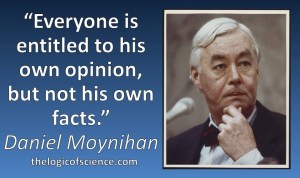
Daniel Moyniham quote everyone is entitled to his own opinion but not his own factsWe are constantly told that “everyone has a right to their opinion” and “there are two sides to every story.” Our entire news system is predicated on the notion that we need to give fair time to both sides of every situation. The problem with this type of thinking is that it leads to the misconception that both sides are equally valid, or, at the very least, that there must be some truth to both sides, but in many cases, only one side has any merit. In other words, it’s often not opinion #1 vs. opinion #2, rather, it is fact vs. fiction. One “side” is reality, while the other “side” is a fairy tale. For example, if you want to say that the island of Jamaica is being carried around on the back of giant sea turtle, that’s not your opinion, you’re just wrong. There wouldn’t be two legitimate sides to that story. Rather, there would be the fact that Jamaica is not being carried by a sea turtle, and there would be the crazy person who thinks it is.

This problem is never more relevant than in “debated” scientific concepts. For example, we have all probably heard creationists insist that we need to “teach the controversy,” and if there actually was a controversy about evolution, I would agree with them. The problem is that from a scientific standpoint, there is no controversy. Similarly, the “debate” about climate change only exists in the minds of climate change deniers. There aren’t two sides to that story. Rather, there is the fact that we are causing the climate to change, and there are people who are wrong. Nevertheless, the media and anti-scientists do a marvelous job of creating the illusion of conflict where none exists. In technical terms, this is what is known as an inflation of conflict fallacy, and it is what I will devote this post to. I want to first explain what we mean when we say that something is settled in science, then (in a second post) I want to look at some of the tactics that are used to fabricate a debate.

The topic of settled science is a complicated one. You see, science doesn’t deal in proofs (with the exception of mathematical proofs in certain areas of physics). Rather, it deals in probabilities. In other words, it tells us what is most likely true, but it does not tell us what is absolutely true. It is inherently incapable of proving anything with 100% certainty because we are inherently incapable of knowing everything, which means that we always have to acknowledge the possibility that there is some other piece of evidence which eludes us. Another way to think about this is that science tells us what is correct given the current evidence, but it cannot completely eliminate the possibility of unknown evidence. So in the strictest sense, there is no such thing as “settled science.” It is always possible that some new discovery will overturn previous ideas, but, and this is the really important part, that doesn’t give you the right the assume that other evidence is out there. In other words, the fact that something technically might be wrong, doesn’t mean that you can assume it is wrong (that would be logical blunder known as an argument from ignorance fallacy). Many things in science have been so thoroughly tested and so consistently make accurate predictions that it is almost inconceivable that they could be wrong. So even though we cannot be 100% certain that they are correct, we can be 99.9999999% sure, and that is good enough to consider them essentially “settled” (note: the argument that “scientists have been wrong in the past” is flawed for numerous reasons which are explained here).

Laws and theories are good illustrations of this concept. Consider cell theory, for example. It tells us that all living things are made of cells. It is accepted by essentially everyone everywhere because it has been tested over and over again (i.e., every time we stick a living thing under a microscope, it is made of cells), and it makes consistently accurate predictions (i.e., it predicts that when we stick something under a microscope, it should be made of cells). So it is, by any reasonable definition, “settled,” but we can never be 100% sure that it is correct, because that level of certainty would require examining every single living thing in the entire universe.

burden of proofNow, let’s say that for one reason or another, you think the there are organisms that aren’t made of cells (perhaps your religion says so), it would be utterly absurd of you to argue that because cell theory can never be proved, we don’t have to accept it. This all comes back to a topic that I discuss frequently: the burden of proof. According to the rules of logic, the one making the claim is required to provide the evidence. In other words, if you are going to claim that cell theory is wrong, the burden is on you to provide strong evidence that it is wrong. In the absence of that evidence, it would be absurd to claim that there is debate about the issue. The fact that you disagree does not mean that there is debate. Further, you don’t get to be offended when people make fun of you for your ridiculous belief, because that belief is clearly wrong. You have a right to believe whatever you want, but that doesn’t mean that everyone else has to take you seriously and respect your delusions.

Cell theory is obviously an extreme example because virtually everyone accepts it, but I wanted to start with it to demonstrate the concept that science gives reliable answers even though it doesn’t provide proofs. Now, let’s turn to topics like vaccines, evolution, GMOs, climate change, etc. There is no significant scientific debate on these issues. There just isn’t. Yes, there are a handful of scientists who disagree with the mainstream view, but that doesn’t mean that there is a significant debate. As I often like to say, no matter what crackpot notion you believe, you can find someone somewhere with an advanced degree who thinks that you are right. Becoming a scientist doesn’t guarantee that you are smart and it doesn’t guarantee that you know what the crap you’re talking about. So for almost any position (including things like heliocentrism and the germ theory of disease) you can find a handful of scientists who disagree with the consensus, but that clearly doesn’t mean that these issues aren’t settled or that there is debate about them.

So if we are never going to get 100% of scientists to agree, then how do we define a debate? One quick and easy approach is to look at the number of scientists who hold a position. For example, roughly 97% of climatologists agree that climate change is happening and it’s our fault. That is an extremely strong agreement. There actually aren’t many topics on which 97% of scientists agree, so by that point it is fairly safe to say that there isn’t a debate. Nevertheless, some topics don’t have quite that strong of a consensus, and relying on a consensus is inherently problematic because science isn’t a democracy. It’s decided by facts, not what people think.

climate change global warming infographic peer-reviewed papers scientific consensus

There is an overwhelming consensus in the scientific literature that anthropogenic climate change is real. Image via DESMOG.

Therefore, a better approach is to look at the recent literature. If there is still significant debate about an issue, then you should find lots of high quality, peer-reviewed studies which supply evidence in support of the minority view. If, however, the only studies that you find are of low quality and are published in minor or questionable journals, then you can fairly safely conclude that there isn’t a significant debate. For example, good luck finding high-quality, peer-reviewed articles supporting creationism. They are essentially non-existent. Why? Quite simply, because there is no evidence to support creationism, and, as a result, there is no scientific debate about it. Anthropogenic climate change is a similar story, with virtually no papers denying it. Vaccines and GMOs are a bit trickier because there are papers that disagree, but those papers are still in the extreme minority, and the vast majority of them are of low quality and are published in less than reputable journals (for example, see my recent post debunking several anti-GMO studies or this post about a peer-reviewed study showing that most anti-GMO studies are seriously flawed or this post explaining the problems with Tenpenny’s “Vaccine Research Library), so they still do not constitute evidence that there is significant disagreement among scientists.

Invariably, someone is going to say either that the publications are all about the money (debunked here) or that it is peer-pressure and it’s just not possible to publish anything that goes against the mainstream view (debunked here). In short, the fundamental problem with these claims is that scientists absolutely love to publish papers that defeat common views. Discoveries like that are what we live for. No one becomes a great scientist by agreeing with everyone else. You become a great scientist by discovering new things and discrediting old ideas. If you actually had solid evidence that climate change wasn’t happening, evolution wasn’t true, etc. you would have just guaranteed yourself a Nobel Prize.

In conclusion, for all of these topics (and many others) the science really is settled. Yes, there are still a few scientists who disagree, and yes, it is technically possible that we are wrong, but so many studies have confirmed the “mainstream” views and so little evidence is available against them that it is not logically valid to assume that the consensus is wrong. For all intents and purposes, the topic is “settled” and scientists should spend their time studying other topics.

Posted in Nature of Science | Tagged , , , , , | 47 Comments

It’s just water: how homeopathy debunks itself

Homeopathy is one of the most popular and fastest growing alternative “medicines.” People are drawn to its alluring claims of “treating the whole person” and “having no side effects” like moths to a flame. Nevertheless, I generally find that most people who believe in and use homeopathy don’t actually understand how it supposedly works, and many of them are shocked when they learn its actual claims. In fact, homeopathy is based on such utterly ludicrous premises that you don’t even need complex science to debunk it. Its claims are so outlandish that it basically debunks itself. If, for example, you tell me that an herb cures a particular illness, then in the absence of scientific testing, I will grant you that the claim is plausible, because some herbs do actually have medicinal value. To know for sure whether or not it works, we would, of course, have to actually scientifically test the herb in a controlled experiment. In stark contrast, homeopathy doesn’t even need to be tested because it’s supposed mechanisms are extremely implausible and conflict with some of the most basic and well established scientific laws and concepts. Therefore, it is my intention to simply explain the fundamental claims of homeopathy and apply some basic common sense and everyday examples to illustrate how truly insane they are.


Premise 1: Like cures like
Homeopathy is based on three fundamental premises (all of which were derived well before modern science), and if any one of these premises is flawed, then homeopathy fails.  The first premise is that “like cures like” (also known as the “Law of Similars” which, to be clear, is not a “law” in the scientific use of the word). The idea is that if you are sick, then you should take something which would give a healthy person your symptoms. If that sounded insane, that’s because it is. Remember, homeopathy predates modern science and the germ theory of disease. So it was invented before we realized that bacteria, virus, etc. make us sick, and before we understood how the immune system works. So it’s hardly surprising that its fundamental claims seem absurd today now that we know how diseases actually work. What is surprising, however, is that people still write massive checks to buy this stuff.

Just in case the idea of like curing like didn’t seem silly to you, let me give an example. Suppose that you have insomnia and are having trouble sleeping. Caffeine would give a healthy person your symptoms. Therefore, according to the concept that like cures like, caffeine should cure your insomnia. Think about that for a second: caffeine (a drug that we know keeps you awake) is supposed to make you sleep. That just doesn’t make sense.

To give one more example, if you are having allergy problems resulting in sneezing and your eyes watering profusely, homeopaths often recommend “Allium Cepa” (a.k.a. onion extract). You see, onions make healthy people sneeze and cry, therefore (according to the twisted “logic” of homeopathy), onions should make people who are already sneezing and crying stop sneezing and crying. Makes perfect sense right? (note the sarcasm)


Premise 2: Diluting something makes it stronger
The second premise has to do with serial dilutions. To make a homeopathic remedy, you take your active ingredient (see premise 1), then put it through a series of dilutions, and, supposedly, the more diluted that it is, the stronger that it is (this is also known as the “Law of Infinitesimals”, again the term “Law” is being used inappropriately here). So, for example, if you were going to use the Allium Cepa treatment that I mentioned earlier, you wouldn’t simply use an onion, rather you would repeatedly dilute it. So you would take a volume of the chemical extract and dilute it in nine times that amount of water, resulting in a 1 in 10 dilution. In other words, if you had 1 milliliter (ml) of chemical, you would add it to 9 ml of water. Next, you would take 1 ml of that solution and add it to 9 ml of water. Then you would take 1 ml of that solution and add it to 9 ml of water. You would do this over and over again. Typical homeopathic treatments usually involve about 20-30 dilutions, but some use 60 or more, and, importantly, the more diluted they are, the more powerful they are (according to homeopaths anyway). Note: some homeopathic dilutions use 1 in 100 rather than 1 in 10, which makes them even more dilute.

Common sense and everyday experience tells us that this is utter non-sense. At some point in time, all of us have probably bought a concentrated cleaning solution and the bottle told us to dilute it to avoid damaging the surface that we were cleaning. Why did it give us that instruction? Because diluting something weakens it! This is just common sense: if you add more water, it will become less powerful. It doesn’t take a genius to figure that one out.

To further illustrate this, I want to use an example that I have previously used: homeopathic beer.  If this premise was actually true, if diluting something actually made it more potent, then you should be able to make beer far more potent simply by diluting it in water. So, give it a try the next time that you are having a party. Take one cup of beer and mix it with nine cups of water, then take one cup of that and mix it with nine more cups of water. Set a bowl of that out at your party and see what happens. If this premise is true, then people should get drunk from that much more easily than from regular beer, but I think we all know what would actually happen: the people drinking the diluted “homeopathic beer” would remain sober  (note: last time that I used this example, some people were critical because I didn’t account for the other premises, but that response completely misses my point: if it was true that diluting something makes it stronger, then [regardless of the other premises] my “homeopathic beer” would be more potent then regular beer, but it’s clearly less potent, therefore that premise must be wrong).

Finally, realize that most actual homeopathic treatments are so dilute that there is literally no active ingredient in them. Homeopathy was invented before we understood that chemicals are made of molecules which are made of atoms. In other words, it was invented before we understood that chemicals could not be divided an infinite number of times. Now that we understand that, we have this fun thing called Avogadro’s number which every freshman chemistry student learns about. It tells us how much of a giving chemical is in a solution, and when we crunch the numbers for homeopathic solutions, we find that anything that has been diluted more than about 12 times usually won’t contain one single atom of the original chemical. Further, remember that many solutions are diluted 30 or even 60 times! They are quite literally just water. Chemically, that is what they are: water.


Premise 3: Water has memory
Unsurprisingly, homeopaths have a response to the criticism that their medicines are just water. Namely, they claim that water has memory. According to them, during the dilution process, the essential essence or healing properties of the chemical get memorized or retained by the water. When making a homeopathic remedy, you’re supposed to tap the solution against something between each dilution and that is supposed to magically make the chemical’s properties enter the water. It also helps if you click your heels together three times and say, “there’s no place like Quackville” (sarcasm). Once again, modern science (and common sense) tells us that this isn’t how things work. For one thing, we know how and why chemicals work, and it has to do largely with the exchange of electrons. There is no magical “healing property” that can be extracted from a chemical, rather, it is the chemical itself which reacts. Further, there is utterly no evidence that water has memory, and every day life tells us that it doesn’t. Think about it for a second, all water on the planet is constantly recycled. So, the water that you drink has been through various rivers, streams, swamps, underground reservoirs, etc., it has been pooped and peed in countless times (in fact, at one point it probably was pee), it has had dead fish decay in it, it has been exposed to countless chemicals that are toxic in high doses, etc. So why doesn’t water remember all of those things? As one of my friends likes to say, “if water had memory, then it would mostly have the properties of s***.”

An obvious flaw in honeopath's "logic"

An obvious flaw in honeopath’s “logic”

Just in case you aren’t convinced, let me ask you this: do you or anyone you know own a fish tank? Do you/they use a filter? If water actually has memory, then filters are totally pointless because filters remove chemicals and particulates, but if water has memory, then the water itself (which passes through the filter) should remember the properties of the chemicals and particulates. If homeopathy works, then filters cannot possibly work and vice versa. However, we all know that filters work, which means we all know that water doesn’t have memory, which means we all know that homeopathy doesn’t work. It’s that simple.

Finally, the hypocrisy of homeopaths is on full display if you read their recommendations for making remedies, because many of them recommend using distilled water (some recommend ethanol instead, but the same basic criticisms apply). Distilled water is simply water that has been evaporated off, then condensed from the steam in order to purify it and remove chemical contaminants. Like filters, it works quite well, but it shouldn’t work if water has memory! Think about it, if water can remember the properties of chemicals after the chemicals themselves have been removed, then what good is distilling or filtering it? According to homeopathy’s own premises, distilled water should be no different from regular water.


Claim: Homeopathy has no side effects
This is not a premise of homeopathy, but it is one of their most common claims, and it’s actually true, but here is the catch, it’s true because homeopathy is just water! As I have previously explained, anytime that something claims to have no side effects, you can be assured that it is a load of crap. It’s  just not plausible that something is going to have effects without also having side effects. Chemicals simply aren’t specific enough to only do what you want them to in something as complex as your body.


Conclusion: It’s just water!
Let me put this in a way that everyone can understand: if you had two identical bottles, one of which contained distilled water and the other of which contained a typical homeopathic remedy (i.e., made using over 12 dilutions), there is not one single chemist anywhere in the world who could tell you which one was which because they would both be pure water! All three of homeopathy’s fundamental premises are obviously flawed to the point of being absurd, and there is just no science to back them up. Nevertheless, millions of people swear by it. As a result, at this point I usually get one of two claims. First, people will say, “but I’ve used homeopathy (or know someone who has) and it worked!” The problem is of course that this is an anecdote. It’s meaningless. In fact, it’s a post hoc ergo propter hoc fallacy to claim that the homeopathic remedy cured you. There are countless other variables that you didn’t account for. For example, it could have simply been a placebo affect, or perhaps your body just healed itself shortly after you took the remedy, thus giving the appearance that the remedy worked. You simply cannot rule out those possibilities, only careful scientific testing can do that, which brings me to the second response: citing studies on homeopathy.

It is true that there are a number of studies that claim to support homeopathy, but it is important to remember that not all scientific publications are of a high quality (see my recent post on how to assess scientific research). The vast majority of those studies suffer from poor methodology and extremely small sample sizes. Further, even the ones that appear to have been done properly are invalidated by the fact that they aren’t repeatable (suggesting that they were statistical flukes). If a scientific result is actually correct, then other scientists should be able to replicate the results, but that just isn’t the case with homeopathy. In other words, if homeopathy actually worked, then you should consistently get the result that it is better than a placebo, but the reality is that numerous studies have confirmed that it is just a placebo. Here are a bunch of literature reviews and meta-analyses, all of which lead to the same conclusion: it’s just water (Ernst and Pittler 1998; Ernst 2002; Shang et al. 2005; Ernst 2010; NHMRC 2013 [this last one is perhaps the most thorough one to date]).

Posted in Uncategorized, Vaccines/Alternative Medicine | Tagged , , | 8 Comments

10 steps for evaluating scientific papers

In the past few weeks, you have probably seen or heard claims that a new study has found that GMOs contain dangerous levels of formaldehyde; however, the reality is that the study itself is questionable at best, and the claims … Continue reading

More Galleries | Tagged , | 5 Comments