Global warming is arguably one of the most controversially topics among the general public. The internet is full of websites that are devoted to arguing against climate change, and politicians routinely claim that it’s a myth. Nevertheless, among the scientific community, there is no serious debate. Yes, there are a few contrarianism (as there are for virtually every topic), but there is an overwhelming agreement that we are causing the climate to change, and that agreement is based on an extraordinary mountain of evidence. Nevertheless, given the amount of junk science on the internet, this disconnect between what people think and what scientists have found is hardly surprising. Therefore, I want to clear up some of the confusion surrounding this topic, and in this post, I will debunk 25 myths, misunderstandings, and faulty arguments about climate change.
At the outset, I want to explain the basics of anthropogenic climate change because there seems to be a lot of confusion over the fundamental concepts. In a nutshell, energy from the sun enters the earth as a spectrum of wavelengths, including both visible light and some higher energy wavelengths (such as ultraviolet [UV] radiation), but some energy is lost and absorbed as the light passes through our atmosphere. The remaining energy is partially absorbed by the earth itself, but much of it is radiated back off of the earth’s surface as lower energy infrared radiation (IR), which is basically just heat energy. Not all of that energy leaves our planet, however, because we have numerous greenhouse gasses in our atmosphere (such as carbon dioxide [CO2]) that do not absorb the higher energy wavelengths (like UV), but do absorb the lower energy IR. Thus, they trap some of that heat energy and prevent it from exiting the planet. This is usually a good thing, because earth would be inhospitably cold if all of that IR escaped. However, if those gases are too dense, then too much heat gets trapped, and the earth warms. Indeed, fluctuations in greenhouse gases concentrations were largely responsible for past climate changes (see #8). This is a problem because our modern society produces a large quantity of greenhouse gasses, and we have greatly increased their concentration in the atmosphere (see #10). Now, let’s think about this rationally for a second. If CO2 traps heat, and more CO2 traps more heat, and we have greatly increased the levels of CO2 in the atmosphere, what do we logically expect to happen? The answer is obvious: the climate should warm on average. Indeed, that is exactly what the theory of anthropogenic climate change predicts, and, as I will demonstrate, we have repeatedly verified that prediction.
At this point, I imagine that no one is convinced, and you are probably getting ready to hurl some counterargument. Before you do that, however, please read the arguments below and actually consider the possibility that you might be wrong. I want you to critically evaluate your views and rationally examine the evidence that I have presented. I have backed up every factual claim with citations to the relevant peer-reviewed literature, so you can go to the original sources and make sure that I am not misleading you. Also, for your convenience, I have grouped the arguments into categories and included hyperlinks for them below (you can also just scroll down the page).
Because this post is quite long, I have also written an abridged version in which I deal with each argument in five sentences or less.
Climate change isn’t happening
Climate change isn’t caused by us
Scientists have been wrong before and/or they are incompetent and corrupt
Miscellaneous
Bad Argument/Myth #1: It snowed, so global warming must not be true
Reality: Weather and climate are not the same thing
 There are several logical fallacies and problems that are occurring here. First, this is a straw man fallacy/reductio ad absurdum fallacy, because no climate change models have predicted that it will never snow. Winters will, on average, be warmer but that doesn’t mean that it will never snow or even that we won’t have large snow storms. Second, this argument confuses weather with climate. Weather is what occurs over short period of time; whereas, climate is what occurs over long period of time. An individual blizzard is a weather event, and you cannot use that as evidence against climate change.
This brings me to the final major problem with this line of reasoning: using individual weather events to argue that the planet isn’t warming commits a Texas sharpshooter fallacy. That’s basically just a fancy way of saying that you are cherry-picking. You can’t focus on a single weather event, and ignore the overarching warming patterns and changes that are taking place all over the world (see #2, 3, and 22). On that note, it is also invalid to use individual heat waves as evidence for climate change; however, when we look at the big picture and use all of the available evidence, the warming trend is unequivocal, and heat waves are increasing (Luber and McGeehin 2008).
In short, the fact that it was cold for a brief period in the specific part of the world that you live in does not in any way, shape or form suggest that the average temperature of the entire planet is not increasing.
Jump back to the top
Bad Argument/Myth #2: The ice in Antarctica is actually increasing
Reality: Antarctic sea ice is increasing, but most ice shelves are melting
It is true that the sea ice in the Southern Ocean (around Antarctica) is increasing, but there are several reasons why that doesn’t discredit climate change. This is another Texas sharpshooter fallacy. You can’t focus on increases in this one ice shelf while completely ignoring the fact that Arctic sea ice has declined substantially (Stroeve et al. 2015), glaciers are rapidly retreating all over the world (WGMS 2013), sea levels are rising (Yi et al. 2015; NOAA), etc. The planet is warmer now (on average) than it was in the recent past. That is a fact that is not up for debate (for example, see NASA’s excellent visualization of climate change from 1880–2015, as well as bad argument #3). Also, it is important to note that climate change does not predict that every part of the earth will be warmer all of the time. The average temperature is increasing, but that does not mean that every single spot will be warmer.
Finally, it is worth mentioning that the situation with the Antarctic Sea ice is more complicated than simple temperatures. The full explanation far too complex to be dealt with in detail in this post, but in short, the increase is from a combination of factors including ozone levels, changes in wind currents, and changes in ocean currents (some of which are caused by melting Arctic ice; Gillett and Thompson 2002; Zhang 2007).
Note: some people erroneously argue that the Arctic sea ice isn’t decreasing either, but that argument simply cherry-picks a handful of years and ignores the overarching trend, so it is not logically or statistically valid (Swart et al. 2015).
Jump back to the top
Bad Argument/Myth #3: Global warming has paused
Reality: No it hasn’t. This claim is based on cherry-picked data and inappropriate statistics
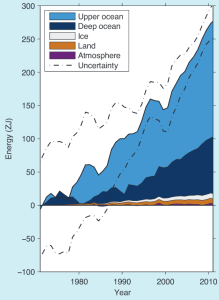
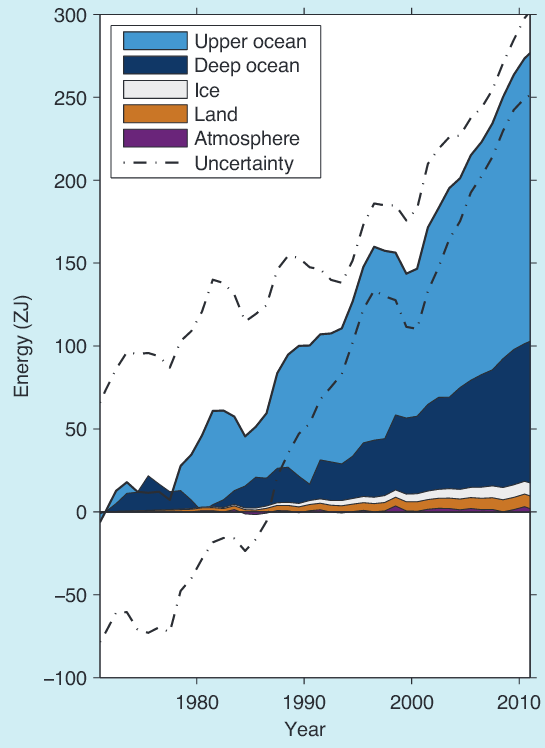
The accumulation of energy over time. You’ll notice that most of the energy is getting trapped in the oceans. Image via Rhein et al. 2013.
I have explained this one in detail elsewhere, so I will be brief. First, to argue that the climate has paused, you have to cherry-pick your data set. We can measure the temperature lots of different ways and different places (satellites, ocean surface temperatures, deep ocean temperatures, etc.), and there is nothing in the science of climate change that says that all of the different parts of the earth will warm equally or at the same rates (in fact we expect them to respond differently). In contrast, if you are going to say that climate change has paused, you will need to demonstrate a pause across all of the data sets (i.e., for climate change to have paused, the total amount of energy that the earth is trapping needs to have leveled off). When we look at the data, however, only the satellite measurements show a “pause.” The other data sets (such as NASA’s global Land-Surface Air and Sea-Surface Water Temperature Anomalies data set) very clearly show that warming is continuing. The warming is especially pronounced in the oceans, which seem to have absorbed most of the excess heat (Balmaseda et al. 2013; Rhein et al. 2013; Glecker et al. 2016).
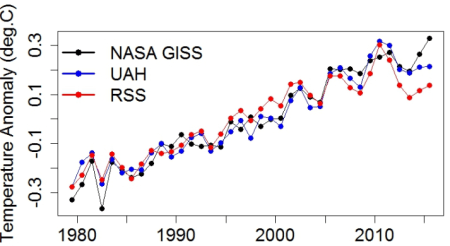
This shows the temperature data once the effects of El Ninos, solar fluctuations, and volcanoes. In other words, this is the change that is attributable to us. Image via Open Mind.
Additionally, within the cherry-picked data set, you are going to have to cherry-pick the year that you want to start looking for a trend (usually 1997 or 1998). Any year prior to 1997 shows a significant warming trend, and many of the years after 1998 (including 1999) show a significant warming trend. So if you want to say, “the climate hasn’t warmed since 1998,” I can respond with, “the climate has warmed since 1999.” Additionally, those satellite measurements are extremely sensitive to El Niños, and 1998 was an El Niño year. However, if we remove the effects of El Niños, the anthropogenic warming trend clearly emerges (Foster and Rahmstorf 2011).
So to claim that global warming has paused, you have to cherry-pick your data set, cherry-pick your years, and ignore the confounding factors, none of which is logically or scientifically valid. Indeed, the actual scientific analyses of the data show that warming has not paused at all (Easterling and Wehner 2009; Santer et al. 2011; Karl et al. 2015; Lewandowsky et al. 2015a,b).
Jump back to the top
Bad Argument/Myth #4: Global warming wasn’t happening so they changed the name to climate change
Reality: Global warming is happening, and the name change is irrelevant
If find this argument rather bizarre, and honestly, to me, it reeks of desperation, but let’s talk about it for a minute anyway. Overtime, scientists have “switched” from talking about “anthropogenic global warming” to “anthropogenic climate change” (they actually still use both, but climate change tends to be the preferred term). This has erroneously led some people to argue that they switched the names to cover their tracks because the planet wasn’t warming. In reality, scientists have been talking about changes to the entire climate from the outset. In fact, scientists were talking about “climate change” before they knew that the direction of the change would be towards warming. In other words, climate change has always been about far more than just warming because it involves shifts in rainfall patterns, storms, the timing of seasons, etc. So the “change” in name had nothing to do with a change in the predictions or observations about what was happening.
If you need more evidence that scientists have always been talking about climate change consider the fact that the IPCC (Intergovernmental Panel on Climate Change) was founded back in 1988, yet it has “climate change” right in the name.
So why do most scientists today use the term “climate change” more than “global warming” even though both apply? Well, the term “global warming” was leading to all manner of silly arguments (like #1 and 2). People erroneously inferred that “global warming” meant that all parts of the world would be warmer all of the time, which is incorrect. The average temperature is increasing, but that doesn’t mean that it will always be warmer everywhere. Indeed, some areas may even become cooler. Further, the actual change in temperature is only one part of what is happening. So the name “change” was just an attempt to be more accurate and avoid confusion, but apparently it backfired. Regardless of what you want to call though, the climate is changing, the average temperature is increasing, and we are causing it.
Jump back to the top
Bad Argument/Myth #5: The models have all been wrong
Reality: The models have been very accurate
The models have actually done a remarkably good job of predicting climate change (Hansen et al. 2006; Marotzke and Firster 2015). I’m sure that if you dig through the literature, you can find some models somewhere that have been wrong, but the biggest models that most governments and scientists cite have been largely correct. If you want to see this illustrated, Skeptical Science did a nice job of visually comparing the IPCC predictions with the observed warming as well as the failed predictions of climate change deniers. Nevertheless, as a scientist my preference is always the peer-reviewed literature, so in addition to the two papers that I cited at the start of this section, you can also read Frame and Stone (2012) which compared the IPCC’s 1990 prediction with the current warming and found that it was very accurate. Similarly, Rahmstorf et al. (2012) looked at the predictions from the third and fourth IPCC models, and found that the observed trends matched the models. Then there is Hausfather et al (2019) which looked at a wide range of models and found that they accurately predicted the increase in temperature. Additionally, the figures that you often see comparing the predictions with the observations often used disparate methodologies, which result in serious biases. Once you correct for that problem, the agreement between the models and the observed warming is much better than what many climate change deniers would have you believe (Cowtan et al. 2015; also, see #22 for evidence that many of the predictions other than increasing temperatures are already coming true).
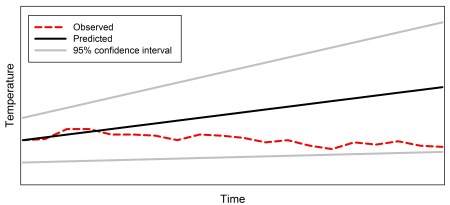
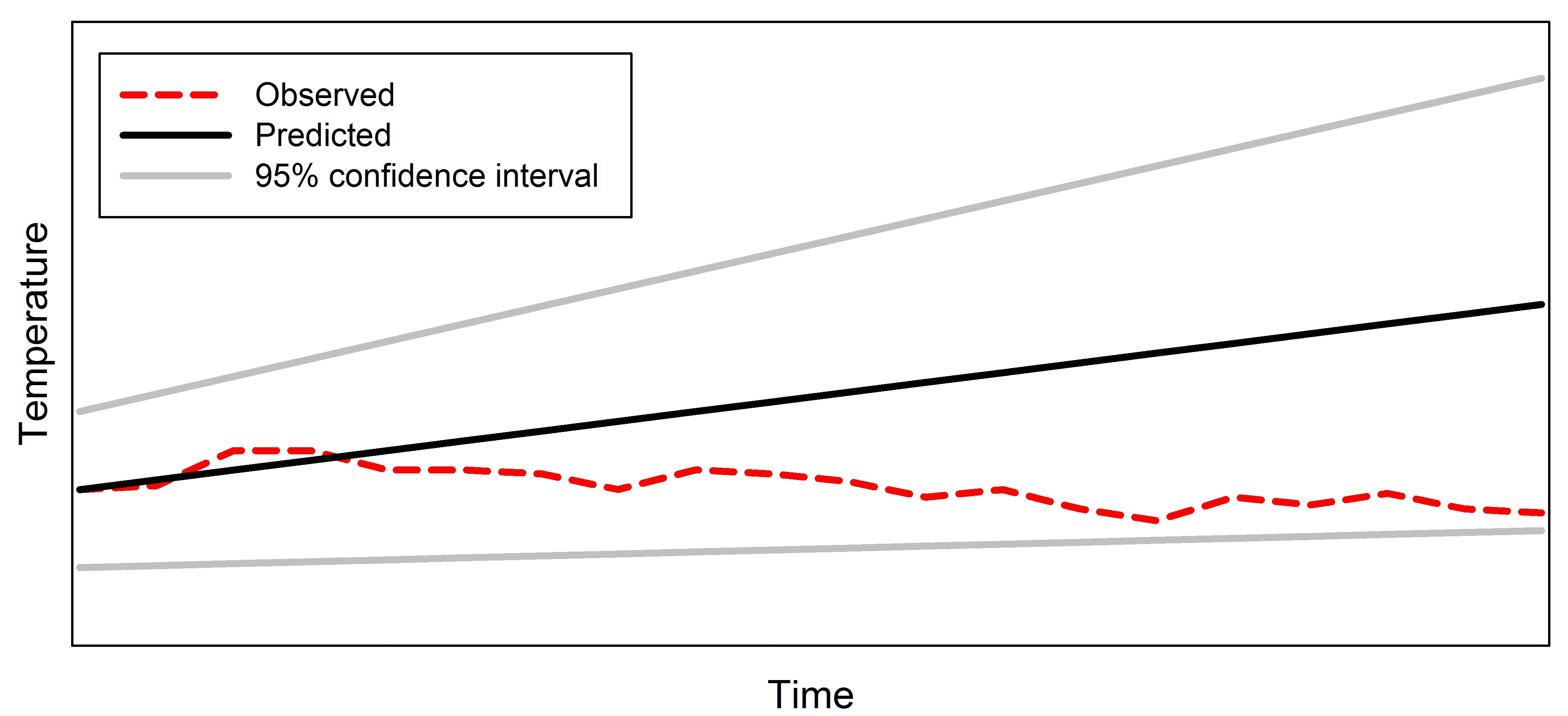
These are hypothetical data that illustrate the fact that whether or not a model worked should be evaluated based on whether or not the observed data fell within the 95% confidence interval of the model.
Part of the problem here stems from people either misunderstanding or deliberately misrepresenting how predictive models work. Many people have the unrealistic expectation that the observed data need to be a near perfect match for the prediction line, but that’s not actually how things work. For example, take a look at the hypothetical data above. If I asked you whether or not the model’s predictions came true, you would likely say that they didn’t, but in actuality, they did. You see, when scientists use statistics, whether it is making a prediction, stating a mean, etc., we never expect the true value to exactly match our predictions/estimates. Rather, we report a central value and calculate confidence intervals around that central value. This is the case because there is always variation in the data, and there will always be lots of factors that affect it. So models predict a range of values that are denoted by the confidence intervals. As a result, when you look at a figure like the one above, you should not be seeing whether or not the observed line perfectly matches the predicted line. Rather, you should be seeing whether or not the observed line falls within the 95% confidence intervals for the predicted line. When we apply this to climate change models, we see that in some cases, the observed temperatures are below the central prediction line, but they are still within the 95% confidence intervals, which means that the models were reasonably accurate. This is a really important point. If someone is showing you a comparison between a model and an observation, but they don’t include confidence intervals, you should extremely skeptical, because those confidence intervals are absolutely essential.
Additionally, it is worth noting that many of the models made several predictions based on different levels of greenhouse gas emissions, so you always have to make sure that you are comparing the observed warming with the predicted warming given our rate of emissions. In other words, if you compare the worst case scenario lines with the observed warming, you find a very poor match, but that is because the worst case greenhouse emissions didn’t occur, so that comparison is invalid. Also, realize that these models are affected by natural factors that we can’t predict. For example, our predictions about the effects of greenhouse gasses may be spot on, but if there are more volcanic eruptions than expected, that will affect the overall trend.
Finally, and perhaps most importantly, realize that the models are simply predicting future climate change. The fact that we are currently causing the climate to change is not in any way based on the models in question (see #7, 8, 9, 10, and 11). So even if all the models were wrong, that would not in any way shape or form discredit the fact that we are changing our planet’s climate. Rather, it would simply mean that we don’t have a good idea of how those changes will affect the future.
Note: You may have seen a very popular graph by Roy Spencer and John Christy that claims to show a large disagreement between the predictions and observations, but that graph has numerous problems such as cherry-picking data sets and start points, and it is not at all statistically valid (details here, here, and here).
Jump back to the top
Bad Argument/Myth #6: Polar bear numbers are actually increasing!
Reality: No, they aren’t. They are decreasing
First, this isn’t actually an argument about climate change. Even if it was true (which it’s not), it would not mean that climate change wasn’t happening. Nevertheless, many people seem to view it that way, and polar bears certainly are the poster child of global warming activism, so let’s briefly talk about this.
This claim is actually a complete and total myth. It is perpetuated by citing dodgy an inaccurate estimates of past polar bear numbers and cherry-picking examples. Sure, if you did aground, you can find certain situations in which a particular group of polar bears is doing well (often from increased hunting restrictions), but when you look at the big picture, and the comprehensive reviews that look at the polar bear population as a whole (rather than cherry-picking populations) there is a very clear downward trend (Schliebe et al. 2006; Stirling and Derocher 2012). Additionally, the full impact of the vanishing ice shelves becomes clear when you model future polar bear declines given the current loss of ice. This, once again, predicts “drastic declines in polar bear populations” (Hunter et al. 2010; Molnar et al. 2011).
At this point someone will probably make a ridiculous comment like, “but polar bears can swim.” Yes, they can, but that is not the point. The ice shelves are where they hunt, raise their young, etc., and that habitat is disappearing. They can’t just swim to better habitat. That isn’t how this works, and the effects of this reduction in ice are extremely clear. It’s not just that the populations are declining, rather, cub mass is going down, juvenile recruitment is going down, body condition is going down, etc. (Rode et al. 2010, 2012). All of these factors are because the habitat that they need is vanishing, which means that they can’t find enough food, can’t raise proper-sized young, and will ultimately disappear from much of their current range if climate change isn’t halted.
Jump back to the top
Bad Argument/Myth #7: The climate has changed in the past, so the current warming is natural. It’s the sun, volcanoes, Milankovitch cycles, etc.
Reality: We have tested the natural factors, and they cannot explain the warming
This is probably the single most common argument against climate change, and it is often accompanied by ridiculous questions like, “who was producing CO2 in the past? Dinosaurs?” However, despite its common use, this argument is extremely flawed. I explained this one in detail here, but in short, the fact that climate changed naturally in the past only tells us that it is possible for the climate to change naturally. It does not indicate or even suggest that the current warming is natural (i.e., this is a non-sequitur fallacy). You have to provide actual evidence that the current warming is natural.
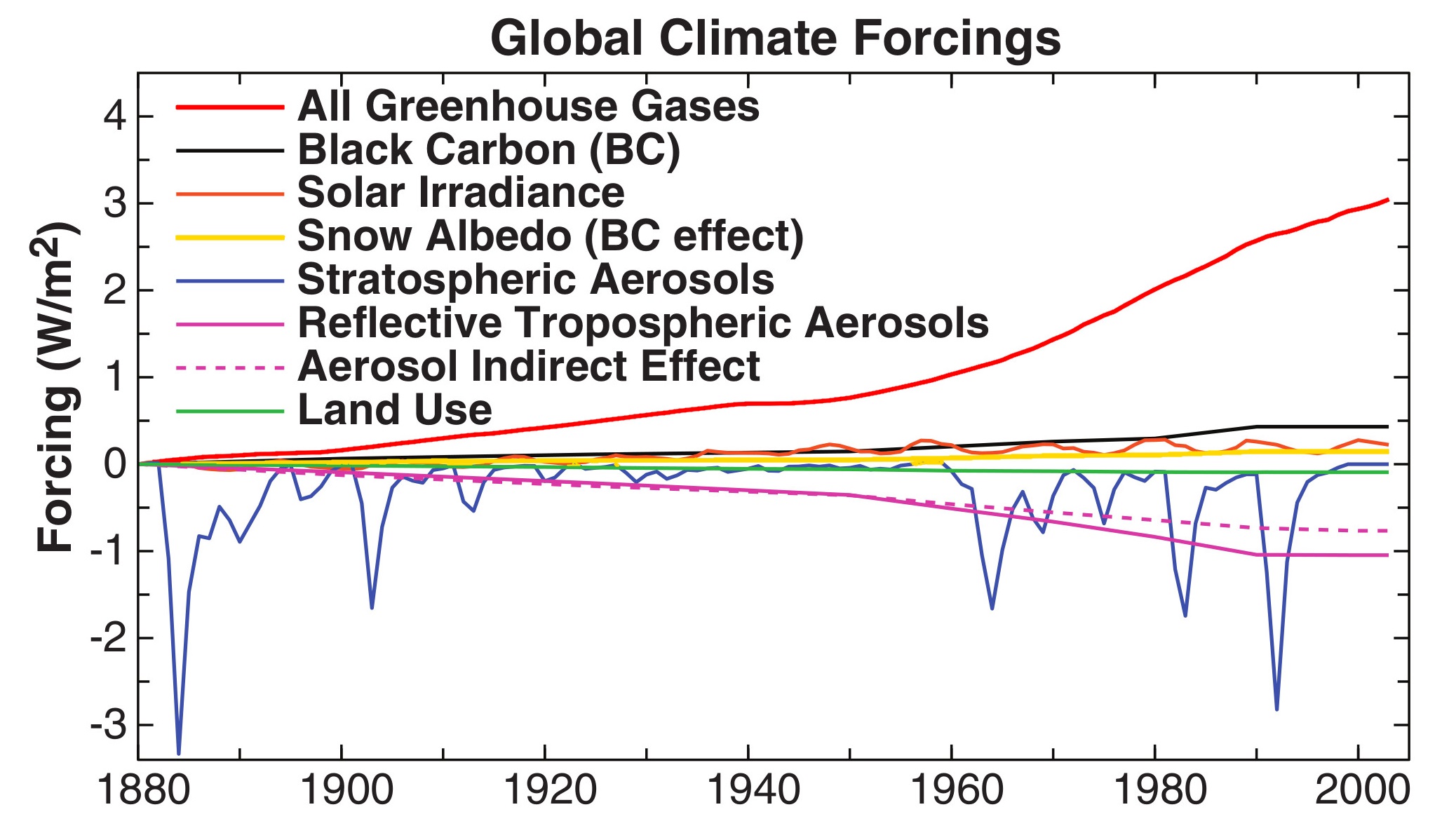
Additionally, we have carefully examined the sun, volcanoes, Milankovitch cycles, etc. and none of them can explain the current warming trend (Meehl, et al. 2004; Wild et al. 2007; Lockwood and Frohlich 2007, 2008; Lean and Rind 2008; Foster and Rahmstorf 2011; Imbers et al. 2014). Indeed, numerous studies have used statistical models to examine the possibility that the current warming is natural, and they have consistently found that natural factors alone cannot explain the current warming. When you add anthropogenic greenhouse gasses into the statistical models, however, you get a tight match between the observed and expected values (Stott et al. 2001; Meehl et al. 2004; Allen et al. 2006; Lean and Rind 2008; Imbers et al. 2014). To put it simply, we have tested the natural factors and we have tested the anthropogenic factors, and the anthropogenic factors are necessary to explain the warming trend. This is extremely clear evidence that we are the cause. Additionally, several studies have found that CO2 was actually the major driver of past climate change (Lorius et al. 1990; Tripati et al. 2009; Shakun et al. 2012), so it should hardly be surprising that we can cause the climate to change by producing CO2. Finally, as I will explain in #9, we have directly, empirically tested the notion that our CO2 is causing the planet to trap more heat, and (spoiler alert) it is (see #8, 9, 10, and 11 for more about CO2).
I short, we know that the current warming is not natural because we have tested that hypothesis and it failed. That is how science works. When a hypothesis fails, you reject it and move on.

This figure from Hansen et al. 2005 shows the effect of both the natural and anthropogenic drivers of climate change. Notice how only anthropogenic sources show a large warming trend. Also, see figure 2 of Meehl et al. 2004.
Jump back to the top
Bad Argument/Myth #8: During past climate changes, the CO2 follows the temperature increase
Reality: Temperature leads CO2 at first, but CO2 soon overtakes it and drives most of the warming
This argument claims that when we look at past climate changes, we see that the temperature changes, then the CO2 changes (i.e., the CO2 lags behind the temperature). This is true at first, but it is only part of the story. There are numerous feedback mechanisms involved in climate change. In other words, one event can trigger another event, which triggers another event, etc. In this case, what happened in the past was that a small amount of warming (usually regional) from factors other than CO2 (such as Milankovitch cycles) caused the oceans to warm up and release the CO2 stored in them (Martin et al. 2005; Toggweiler et al. 2006; Schmittner and Galbraith 2008; Skinner et al. 2010). Then, that increase in CO2 caused the majority of the warming (Shakun et al. 2012). So CO2 was actually the major driver of past climate changes (Lorius et al. 1990; Tripati et al. 2009; Shakun et al. 2012).
Jump back to the top
Bad Argument/Myth #9: CO2 only makes a small portion of the atmosphere
Reality: CO2 is not abundant, but that does not make it unimportant
This argument claims that CO2 only makes up roughly 0.04% of the earth’s atmosphere, which is such a small amount that it cannot be important for climate change. The premise that CO2 is relatively uncommon is true, but that does not make it unimportant. It is extremely well established that CO2 traps heat (you can find a list of papers demonstrating this at AGW Observer), and it is a scientific fact that CO2 is extremely important for regulating the temperature of our planet. Indeed, that tiny percentage of CO2 is the difference between our nice warm world and an inhospitably cold world, and we know that past climate changes have been largely driven by CO2 levels (Lorius et al. 1990; Tripati et al. 2009; Shakun et al. 2012; see #8). Additionally, for any situation like this, you need to look at the actual amount of change, and the fact is that we are rapidly approaching a doubling of CO2 in the atmosphere (see #10). So since we know that CO2 is important even though it is not abundant, it should not be surprising that doubling that important gas will have huge consequences.
Finally, the CO2 hypothesis makes a nice, testable prediction. Remember, the theory of anthropogenic climate change postulates that our CO2 is trapping outgoing IR (heat), thus warming the planet (see introduction). If that claim is true, then we should see that the amount of IR leaving the planet has decreased over time, and that decrease should match the increase in CO2. That is, of course, exactly what satellite data show (Harries et al. 2001; Griggs and Harries 2007). The IR leaving the earth since the 70s has decreased, and that decrease matches the increase in CO2. This is a direct test of anthropogenic climate change and cannot be explained by anything other than our CO2 trapping heat. If you want to argue to the contrary, then please explain to me where the IR is going?
Jump back to the top
Bad Argument/Myth #10: We only emit a tiny portion of the earth’s CO2
Reality: Before us, the CO2 cycle was in balance, now more is produced than is removed

It is true that natural sources of CO2 produce far more of it per year than we do. Indeed, we produce around 29 gigatonnes annually, whereas nature produces around 771 (IPCC AR4). However, prior to us, the system was in balance, with roughly the same amount being removed and produced (plants, the ocean, etc. all remove some CO2). Thanks to humans, however, that balance has shifted and now more CO2 is being produced than is being removed. Think of it this way: if I give you $1,000 and at the same time, you give me $1,000, we can keep doing that forever, and neither of us will gain money. Now, suppose that we both continue doing that, but during every transaction someone else gives you $30, and you don’t give that money back. Thirty dollars is tiny compared the $1000 that was already being exchanged, but because that extra $30 isn’t removed, suddenly, you are going to be gaining money, and after a few dozen transactions, your money will have doubled. That is exactly what is happening with CO2. More is being produced than removed, therefore it is increasing. Indeed, CO2 levels have increased rapidly since the start of the industrial revolution, and they are currently at their highest point in past 14–16 million years (Tripati et al. 2009).

These data come from Wei et al. 2009, but the legend of this figure was modified for readability by skepticalscience.com (the data themselves were in no way manipulated as you can see in Figure 4 of Wei et al.)
Finally, we know that the CO2 is from us because of the isotope ratios. I explained this in detail here, but briefly, carbon has two stable isotopes: carbon-12 and carbon-13, but the ratio of carbon-13/carbon-12 in the atmosphere was historically different than the ratio in our fossil fuels. Thus, if burning fossil fuels is putting CO2 into the atmosphere, we would expect the ratio of carbon-13/carbon-12 in the atmosphere to shift to be closer to the levels in the fossil fuels, and that is exactly what studies have found. This is extremely clear evidence that the CO2 is from us (Bohm et al. 2002; Ghosh and Brand 2003;Wei et al. 2009).
On a side note, it is also worth mentioning that volcanoes produce less than 1% of the Co2 that we do annually.
Jump back to the top
Bad Argument/Myth #11: Water vapor is a far more potent greenhouse gas than CO2
Reality: Water vapor increases in response to temperature and is a feedback mechanism that increases the effects of CO2
It always amazes me that people assume that scientists missed something as blatantly obvious as the fact the water vapor traps far more heat than CO2. In reality, scientists are well aware of this fact and have incorporated it into their calculations, but there is something very important that you need to realize about water vapor. Namely, it increases or decreases in response to temperature. The amount of water vapor in the atmosphere is dependent on the temperature of the environment, as a result, to increase the water vapor in the atmosphere, you must first increase the temperature. So, water vapor is a feedback mechanism, wherein CO2 from us causes some warming, that warming increases the amount of water vapor in the atmosphere, and that water vapor causes even more warming (Held and Soden 2000; Philipona et al. 2005). So ultimately, the warming is still from us producing CO2.
If you don’t believe me, you can easily do an experiment yourself. Take several glasses with equal amounts of water and place some in a cool shaded area while you place others in the hot sun, then see which ones evaporate first (i.e., which one is converted into water vapor). Or, to put this another way, if you place a glass of water in a stable environment, it will not spontaneously start evaporating more rapidly. If you want to increase the rate of evaporation then you need to increase the temperature, decrease the humidity, etc. So, in short, the recent increase in water vapor levels is a result of the global warming that we are causing, and scientists are fully aware of this and include that information in their models (Held and Soden 2000).
Jump back to the top
Bad Argument/Myth #12: In the 70’s scientists predicted an ice age
Reality: Very few scientists predicted global cooling
There was never a scientific consensus on global cooling. It is true that there were a handful of papers on the topic (7 to be exact), but during that exact same time, 42 papers were published on global warming (Peterson et al. 2008). That’s right, there were six times as many papers on global warming as there were on global cooling. So there was never a large consensus that we were causing cooling, and even in the 70’s many scientists were saying that we were causing global warming (to be clear though, it was not well established yet).
Inevitably, someone is going to read that and say, “You don’t know what you are talking about, I lived through the 70s, and I remember all of the ice age predictions.” However, while you may have lived through that time period, I am willing to bet that you weren’t reading the scientific literature. I’m not denying that the media went nuts with the idea of an ice age, but that is not at all the same as saying that scientists were predicting an ice age. The media (and even popular science magazines like National Geographic) love to sensationalize things, and they continuously get scientific facts wrong. So it really shouldn’t surprise anyone to learn that the media was making a mountain out of a mole hill.
Finally, it is worth pointing out that even if scientists had predicted global cooling in the 70’s, that wouldn’t mean that they are wrong now (science has come a long way in the past four decades). Also, the first prediction that our emissions would lead to global warming dates all the way back to 1896. Climate change is not a new hypothesis that scientists invented in the 80’s.
Jump back to the top
Bad Argument/Myth #13: It’s just a theory, not a fact
Reality: In science, a theory is a well-established concept that explains facts, not an educated guess
For this argument, climate change deniers take a page straight from the creationist playbook, but the argument doesn’t work any better here than it does for creationism. You see, the term “theory” has a very different meaning in science than it does in the general public. Let me explain.
Many people think that a “fact” is something that has been proven and scientists are totally sure of, whereas a “theory” is something that is more speculative and has not been properly confirmed. That dichotomy is, however, completely incorrect. Nothing in science is ever “proved.” Rather, things are simply supported by the current evidence. So the difference between a theory and a fact has nothing to do with our certainty. Rather, a fact is a single observation, result, etc. whereas a theory is a broad and rigorously-tested explanatory framework that both explains the facts and allows us to make predictions about what future experiments should show.
For example, if I drop a pen, then I have just demonstrated the fact of gravity (i.e., it is a fact that gravity caused my pen to drop), but what does that really mean? That’s not really an explanation. The explanation comes from the theory of universal gravity, which states that all bodies that have mass produce gravity and are acted upon by the gravity of other bodies. That theory explains the fact and allows us to predict the outcomes of future experiments (e.g., if I drop another pen, it will fall). Evolution is the same thing. It is a scientific fact that life on earth has evolved over millions of years, and the theory of evolution by natural selection explains how and why that evolution occurred as well as allowing us to make predictions about the results of future experiments. Similarly, if you get the flu, it is a fact that a virus made you sick, but it is the germ theory of disease that provides the general explanation that diseases are caused by viruses, bacteria, etc. I could go on, but hopefully you get the point. You should notice in all of these cases that we are extremely confident that the theory is true. So they aren’t theories because they are speculative or haven’t been confirmed. Rather, they are theories because they are explanatory frameworks rather than isolated results.
The exact same thing is true for climate change. It is a scientific fact that climate change is occurring, and the theory of anthropogenic climate change is the explanation for why that change is occurring. Just as with the other theories, this theory is supported by thousands of scientific studies. It is, by any reasonable standard, “settled science.” Sure, there are still aspects of it that we don’t understand (just as there are aspects of evolution that we don’t understand), and sure, there are a few dissenting voices (just as there are for the other theories), but we are incredibly certain that climate change is occurring. We have tested the predictions of the theory of anthropogenic climate change over and over again and they have consistently come true (see #5, 7, 9, and 22).
Note: Sometimes gravity is referred to as a “law” rather than a “theory.” The distinction between the two is not well agreed upon at all, and many people use them interchangeably. Other people suggest that we should use “law” to refer to the mathematical component and “theory” to refer to the explanatory component. However, regardless of the technical definition that you want to apply, they are both generally considered to have the same level of certainty.
Jump back to the top
Bad Argument/Myth #14: But scientists have been wrong in the past, and we can’t be totally certain that climate change is true
Reality: It is always possible that the current scientific consensus is wrong, but you have to present actual evidence that it is, otherwise you are making a baseless assumption
I explained the problems with this argument in detail here, but in short, the fact that scientists have been wrong before does not mean that they are wrong now. You have to present actual evidence that they are wrong now, otherwise this is what is known as an argument from ignorance fallacy. Indeed, if this argument worked, you could use it anytime that you wanted. For example, you could say, “scientists say that gravity is true, but scientists have been wrong before so I don’t have to accept them now” or “scientists say that we are breathing oxygen, but scientists have been wrong before so I don’t have to accept them now.”
Second, realize that it is not about the scientists themselves, rather it is about the scientific evidence, and the scientific evidence for climate change is extremely robust. It is supported by literally thousands of studies. There really aren’t any topics that have been this thoroughly studied where it turned out that the scientific evidence was totally wrong. Remember, science as the formal system of study that we know today has only existed for the past 150 years or so, and there have certainly been many great advances during that time, but few (if any) ideas with this level of support have been totally overthrown. It is also worth mentioning that because science is a fairly recent discipline, you cannot compare scientists today to the “scientists” who thought the earth was flat, alchemy worked, etc. Those people were not doing “science” by today’s standards.
Finally, regarding the claim that we can’t be totally certain of climate change, that claim is true for every single avenue of science. It is always possible that there is an answer that we missed. Indeed, it is possible that we are all in the Matrix, and none of this is even happening. That is why science never “proves” anything. Rather, it shows us what is most likely true based on the current evidence. It is, for example, possible that we are wrong about gravity, but it would obviously be absurd to say, “we can’t be totally certain about gravity, therefore I reject it.” Indeed, this is another argument from ignorance fallacy. The fact that there might be something else does not make it logical to actually think that there is something else. This is especially true in this case because we have tested all of the known drivers of climate change, and none of them can explain the current warming (#7). Further, we know that CO2 is largely responsible both for our climate and for past climate changes (#8), we know that we have greatly increased the CO2 in the atmosphere (#10), we know that the earth is trapping more heat (#9), and we know that including our CO2 in the calculations explains the current warming trend (#7). So if you want to claim that something else is happening, you need to provide actual peer-reviewed evidence for the existence of this mysterious factor. That is how the burden of proof works.
Jump back to the top
Bad Argument/Myth #15: There are thousands of scientists who disagree (e.g., the Oregon Petition)
Reality: Science is not a democracy, most climatologists agree that we are causing climate change, and the Oregon Petition is a fraud
First, it is important to realize that this argument is nothing more than an appeal to authority fallacy. It is always possible to find people with advanced degrees who agree with you, but that does not make your position any more legitimate. You have to look at the evidence, not the people who support it. Further, if you want to focus on the scientists themselves, you are going to run into huge problems because an overwhelming majority (well over 90%) of climatologists agree that we are causing the planet to warm (details here), and many of the prominent climatologists who disagree are funded by oil companies (for example, Dr. Willie Soon). To be clear, that doesn’t make them automatically wrong, but it does mean that we should scrutinize them closely.
Nevertheless, many people try to assert that in actuality, thousands of scientists deny anthropogenic climate change, and they usually do this by citing the “Oregon Petition” which (depending on what source you look at) received the signatures from 16,000, 30,000, 31,000 or 32,000 US scientists affirming that they do not agree that humans are causing climate change. There are several important things to note here. First, science is not a democracy. You don’t vote on whether or not something is a fact. That’s just not how this works. Second, 32,000 people with a B.Sc. or higher (which was the criteria for this petition) is actually a tiny percentage. Skeptical Science estimates that it is around 0.3% of “scientists” (by the standards of the petition). So that is hardly compelling.
More importantly, however, most of the signatories weren’t climatologists, and many weren’t even real scientists. Having a B.Sc. does not make you a scientist. Further, even among those with advanced degrees, there were signatures from veterinarians, architects, orthopedic surgeons, etc. That is important, because it really doesn’t matter whether or not a surgeon thinks that climate change is real. That is ridiculously far outside of their field.
When it is all said and done, it appears that only 39 of the signatories were actually climatologists. Thirty-nine is hardly an impressive number. There were also many other problems with the petition that you can read about here and here.
Jump back to the top
Bad Argument/Myth #16: “Climategate” showed that scientists are falsifying data
Reality: The stolen emails did not show any evidence of corruption
This myth has largely died out, but I still encounter some who use it, so let’s talk about it for a minute. Several years ago, over 1,000 private emails and documents from leading climatologists were hacked and released to the public, and many climate change deniers claimed that those emails showed evidence that scientists were falsifying data and it was all a conspiracy. Let’s think about that for a second. If that was actually the case, we would expect most of those emails to be about orchestrating a conspiracy, and very few (if any) should be about doing real analyses on real data. In contrast, what the emails showed were tons of conversations about real data, and a handful of emails that were twisted and taken out of context to try to create the illusion of unethical behaviour.
The most commonly cited email is one from Phil Jones, which states:
“I’ve just completed Mike’s Nature trick of adding in the real temps to each series for the last 20 years (i.e. from 1981 onwards) and from 1961 for Keith’s to hide the decline.”
Out of context, that sounds really bad, but in context, it is obvious that “trick” was being used to mean “a clever way to do something” not “a deceptive way to do something.” Indeed, we use the word “trick” that way all of the time, and it is not uncommon to hear people say things like, “the trick to doing this is…” Second, the “decline” there is not referring to temperatures. Rather, it is referring to a decline in the quality of tree ring data. So when you understand the analyses that they were working on, and look at the quote in context, it is obvious that nothing unethical was occurring.
Another common quote is from Kevin Trenberth:
“The fact is that we can’t account for the lack of warming at the moment and it is a travesty that we can’t.”
Again, out of context, that sounds pretty damning, but in context, he was not talking about the warming of the entire planet, but rather the flow of energy through the earth, and the fact that there are parts of that system that we do not yet understand. Here is the paper that Trenberth was discussing (Trenberth 2009) and you can find more details at Skeptical Science.
There were a handful of other emails that people pounced on, but they had the same problems (i.e., they were taken out of context). Indeed, the situation has been examined by multiple different independent investigations (including the National Science Foundation, US Environmental Protection Agency, UK House of Commons Science and Technology Committee, Pennsylvania State University, and University of East Anglia), and all of them concluded that there was no evidence that the scientists were manipulating data, involved in a conspiracy, etc. So like the vast majority of conspiracy theories, this is a whole lot of nothing. It sounds bad at first, but when you actually look at all the details, there is nothing there.
Jump back to the top
Bad Argument/Myth #17: Scientists are manipulating the data to make it look like warming!
Reality: Scientists are correcting for biases, not “manipulating” the data
This argument has been popularized by Paul Homewood on the blog notalotofpeopeknowthat.wordpress.com, where he argues that scientists are manipulating the data to make it show an unrealistic warming trend (specifically data in the Global History Climatology Network database (GHCN)). Other authors, like Christopher Booker, have run with this idea publishing articles with eye-catching titles like “The fiddling with temperature data is the biggest scientific scandal ever.” It is true that scientists have made adjustments to the data, but it is completely false that there is anything dishonest or deceptive about those adjustments. They are “corrections” rather than “manipulations.”
I explained this in more detail here, but in short, essentially all real data sets have biases and errors that have to be corrected. Scientists almost never collect perfect data sets that are ready to be analysed as soon as they are gathered. Rather, they almost always have to be corrected for errors and biases. That is just a fact of real data. In the case of climate data, the data have been collected over many years using different methods, and different methods have different biases. Therefore, the only way to use all of those data sets is to adjust for those biases in methodologies.
Let me illustrate. Imagine that 40 years ago, you set up a thermometer in your back yard, and used it to record the temperature every day at 9:00AM, but after several years, you switched to 10:00 AM. If you want to look at long term trends, you are going to have to adjust your data to account for that change in methodologies, otherwise you’ll get an unrealistic warming trend. The same type of thing happens with real data sets. Ocean buoys drift, methods change, the environment around weather stations changes, etc. All of those factors have to be accounted for to properly analyse the data. So rather than being a “scandal” these adjustments are the proper way to treat the data. Further, climate change deniers act as if this is some secret that scientist have been hiding, but the reality is that they have been extremely open about these adjustments, and have publically documented all of their methods from day 1. So this argument is baseless.
Note: you can find more information about how and why the GHCN data are adjusted in their technical report (Williams et al. 2012), and you can find a very detailed and useful general explanation about adjustments to temperature data sets by Scott Johnson at arstechnica, “Thorough, not thoroughly fabricated: The truth about global temperature data.”
Jump back to the top
Bad Argument/Myth #18: It’s a liberal conspiracy/It’s all about the money!
Reality: There is no basis for this claim. It is an assumption, not a legitimate argument
First, for both of these claims, in order for them to be legitimate, you must provide actual evidence to support them. Otherwise, the claims are invalid and commit ad hoc fallacies. In other words, you cannot just assume that essentially all scientists are corrupt. You have to provide actual evidence that they are corrupt. Further, it is utterly absurd to think that the vast majority of the world’s climatologists, virtually every government agency in the world, essentially all of the worlds most respected scientific organizations, etc. are involved in a massive conspiracy. Do you really think that nearly all of the world’s governments are collaborating together?
Also, it is important to ask why they would conspire to make the entire world think that climate change is happening. You could argue that scientists are in it for grant money, but that argument misunderstands how grants work, and it doesn’t really solve the problem, because you need to explain why governments would give out grant money for climate change research. I have yet to have anyone explain to me how governments would benefit from creating such a huge hoax.

Details and sources here
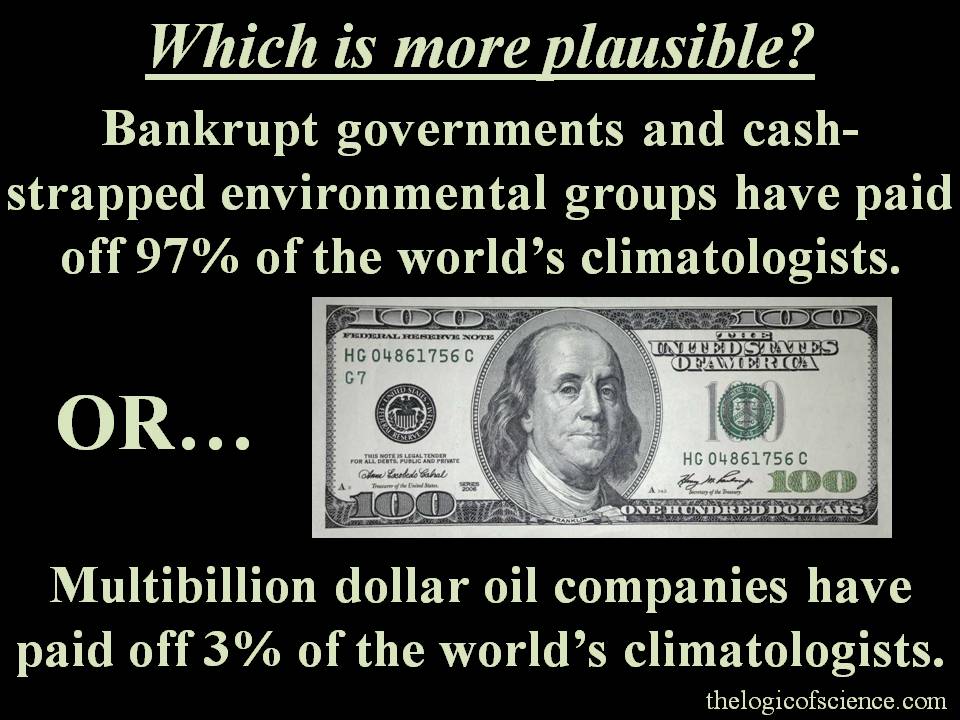
With regards specifically to the claim that it is all about money, I explained the problems with that in detail here, but to be brief, first, there is once again no clear financial motive. There is no obvious reason why governments would make this conspiracy. Additionally, if we are going to go down this road, then let’s flip things upside down and ask the opposite question: who would benefit from opposing climate change research? The answer to that question is pretty obvious: oil companies. Indeed, it is well known that oil companies have been extremely active in funding denialist organizations and politicians as well as funding the handful of climatologists who don’t think that we are causing climate change. At this point, we have run into one of the biggest problems with this argument. Namely, if scientists could really be bought off so easily, then why haven’t multi-billion-dollar oil companies been able to buy off more than a handful of them? Given the vast wealth of oil companies, the millions of dollars that they have poured into denialist organizations, and the economically unstable state of most governments, surely oil companies could offer scientists more than governments could. So if scientists are really just in it for the money, why aren’t they all denying climate change?
Finally, throughout this post, I have provided actual evidence that climate change is happening and we are causing it (see #2, 3, 5, 7, 10, and 22). Also, I have debunked several specific conspiracy arguments such as Climategate (#16) and the claim that scientists are manipulating the data (#17).
Jump back to the top
Bad Argument/Myth #19: But politicians and the media…
Reality: They are irrelevant
Let me stop you right there, because, quite frankly, I don’t give a crap what politicians and the media think or say. Both of them are repeatedly wrong about the science (on both “sides” of the topic). So I don’t care what Al Gore said or thinks, I don’t care what erroneous claims CNN has made, etc. I care about the science, and the scientific evidence overwhelmingly shows that climate change is happening and it is our fault. Can people spin that for personal gain? Sure, but that doesn’t make the science any less true. Using politicians and the media to attack science is a guilt by association fallacy, because what they think, say, and do is completely, 100% irrelevant to whether or not the science is correct. I care about what peer-reviewed studies have found, not what politicians and news anchors say.
Jump back to the top
Bad Argument/Myth #20: Climate change is being caused by the ozone hole (or vice versa)
Reality: The ozone hole and climate change are two separate phenomena that sometimes interact.
There seems to be a lot of confusion about the ozone hole. Many people seem to think that either the hole is causing climate change or climate change is causing the hole. I have heard other people argue that the ozone hole illustrates a great failure of science, because scientists predicted that it would be a problem, but nothing happened. In reality, the ozone hole and climate change are separate phenomena, and “nothing happened” because people actually listened to scientists and changed their behaviors.
I explained the basics of climate change in the introduction, so I’ll just focus on the ozone hole here. Ozone is simply three oxygen atoms bonded together, and it forms from a high energy source (such as UV radiation or electricity) hitting oxygen gas (the O2 we breathe). Thus, it naturally forms in the atmosphere from UV hitting oxygen, and it forms a layer commonly called the ozone layer. This is a good thing because ozone absorbs UV radiation, preventing it from reaching the earth (as opposed to CO2 which does not absorb UV radiation, but does absorb IR). Thus, the ozone layer shields the earth from a large amount of UV that would otherwise reach the surface and cause skin cancer and numerous other problems.
The concept of an ozone hole became an issue when scientists realized that certain chemicals that we were using (such as chlorofluorocarbons, halons, and other chemicals with chlorine or bromine) were entering the atmosphere, chemically interacting with the ozone layer, and actually depleting the ozone. As a result of this depletion, the ozone layer was thinning, with a particularly thin area forming seasonally over the Antarctic. This large thin spot is what is generally referred to as the “ozone hole.”
Scientists realized that this was a problem, and (for once) many governments listened to them and banned the harmful chemicals. As a result, the ozone layer stopped thinning. So the ozone hole does not illustrate a time that science failed. Rather, the science was spot on, and things never became worse because people actually listened to scientists. Indeed, the ozone layer does appear to be recovering (Lefevre et al. 2013), but there is some debate about the extent of the recovery, and the rate of recovery is certainly quite slow (partially because many of the harmful gases persist in the atmosphere, and some countries are still using them).
In short, the ozone hole was caused by our chlorofluorocarbons and similar chemicals depleting the ozone layer, and it was bad because the ozone layer prevents some UV from entering the earth. In contrast, climate change is caused by us releasing greenhouse gasses (an entirely different set of gases), which results in less IR leaving the earth. Thus, they are two separate phenomena, but they do sometimes interact. It is, however, incorrect to say that one causes the other.
Jump back to the top
Bad Argument/Myth #21: But CO2 is actually good for plants
Reality: CO2 is good for plants, but the other effects of climate change won’t be
It is true that increased CO2 levels will generally result in more plant growth, but that relationship is complicated (Robinson et al. 2012). Indeed, there are lots of other factors to consider, such as changing precipitation patterns, which are often very harmful to plants (Allen et al. 2010; Carnicer et al. 2011). So many plants will actually be negatively impacted. Finally, this argument is really quite irrelevant, because even if plants would universally benefit from increased CO2, that wouldn’t mitigate the sea level rise, increased heat waves, etc. (see #22). In other words, the CO2 levels are increasing, so the plants clearly can’t keep up (i.e., plant growth isn’t increasing fast enough to balance out the CO2 that we are producing; see #10).
Jump back to the top
Bad Argument/Myth #22: It’s not really a big problem because the planet will only warm by a few degrees
Reality: Even 1°C degree would be extremely damaging
There are those who argue that climate change is happening, but it won’t really be serious because the predictions show that it will “only” warm by 1–3°C (the real number will probably be in the middle). First, for my American readers, I should point out that the prediction is in Celsius, so that is 1.8–5.4°F, and that is actually a big deal. Imagine, for example, a hot week of summer with temperatures at 98°F. Now imagine that those days just jumped up to 100°F. That makes a noticeable difference. Similarly, imagine precipitation during a 31°F winter day. That will cause snow, but now imagine that those days are 33°F. See the difference? A few degrees’ matter, and I have just been describing the lowest end of the predictions. In all likelihood, the changes will be in the range of 3–4°F, and that is enough to make a huge difference.
Indeed, we are already seeing the changes. Glaciers and ice caps are melting (WGMS 2013; Stroeve et al. 2015), the sea is rising (Yi et al. 2015), animals and plants are shifting their ranges and behaviours (Root et al. 2003; Tingley et al. 2012), forests are being affected (Allen et al. 2010; Carnicer et al. 2011), heat waves and heat associated mortalities are increasing (Patz et al. 2005; Luber and McGeehin 2008; Kuglitsch et al. 2010), extreme weather events are increasing (Coumou and Rahmstorf 2012), coral reefs are bleaching (Hoegh-Guldberg and Bruno 2010), droughts are increasing (Dai 2013), etc., and all of these things will only get worse with time. In many parts of the world, it will be harder to grow crops (Schlendker and Roberts 2009), coastal properties will be lost, diseases will expand their ranges, etc. To be clear, this isn’t going to end life as we know it (see #23), but it is an extremely serious problem that will cause a large loss of life, property, and resources, and we need to treat it as the impending threat that it is.
Jump back to the top
Bad Argument/Myth #23: It will make humans go extinct/it will be the end of the world
Reality: It will be very damaging, but it won’t end life on planet earth
Following #22, it is important to clarify that although climate change is a very serious problem that will make life on earth more difficult, it is not going to end life as we know it. Indeed, people (especially the media) tend to exaggerate and blow it out of proportion. For example, I once heard a news reporter suggest that food would become so scarce that we would have to resort to cannibalism. Claims like that are just nuts, and they are not supported by the science. I think that this is important to state for two reasons. First, well-intentioned people who accept the science often make unmerited claims, and, second, I often meet people who write climate change off as absurd because they think that the scientists themselves are proposing that climate change will destroy the world. In reality, there are very, very few professional climatologists who make such dire predictions. Again, that is not to say that climate change isn’t a serious problem. It absolutely is a serious problem (see #22), but it’s not going to make me kill you in your sleep and eat your flesh, nor will it cause the human species to become extinct.
Jump back to the top
Bad Argument/Myth #24: God is in control
Reality: If you actually think that this claim absolves you from responsibility, then you should never try to prevent anything bad from happening
I am always loath to bring religion into what should be an entirely scientific discussion, because the scientific evidence should be the only thing that matters here. Nevertheless, I often find that Christians try to cop-out of any responsibility for climate change by simply asserting that “God knows best” or “climate change won’t happen unless God allows it to, so there is no point in us worrying about it.” Given that a large portion of the world’s population is Christian and the fact that many Christians won’t accept science if they think it conflicts with their religion, I want to deal with this argument here.
For the sake of debate, let’s assume for a second that the premises of this argument are actually true (i.e., there is an omnipotent, supernatural being who knows everything and is in some way interacting with things on planet earth). If those premises are true, does the conclusion that we don’t need to try to stop climate change follow from those premises? NO! If this argument worked, then Christians should never take action on anything. If, for example, you see that a child is about to get hit by a bus, there is no point in trying to save him because the bus won’t hit him unless God allows it. Similarly, if you see that two countries are about to go to war, you shouldn’t do anything because “God is in control.” Do you see the point? If this argument worked, then it would absolve you of all responsibility for anything. To put this another way, even if God exists and nothing happens without him allowing it, what makes you think that he wouldn’t allow us to cause climate change? We’ve done tons of terrible things to ourselves and this planet, so why do you draw an arbitrary line at climate change? This is a huge assumption and ad hoc fallacy, nothing more (i.e., I would never accept this argument unless I was already convinced that climate change wasn’t true).
Finally, just to prove that I am not committing a false equivalency fallacy, let me set up two analogous arguments.
Argument 1:
1). Science shows that smoking causes cancer
2). God is in control and I won’t get cancer unless he allows it
3). Therefore, I can smoke and not worry about it
Argument 2:
1). Science shows that burning fossil fuels causes climate change
2). God is in control and we won’t cause climate change unless he allows it
3). Therefore, we can burn fossil fuels and not worry about it
Those two arguments are identical, which means that you must either reject them both or accept them both, but I don’t know any Christians who would agree with argument 1 (and just in case you do, we could make it even more extreme by replacing the first premise of argument 1 with something like “Science shows that jumping off a 400-foot cliff causes death”).
Note: To any Christians reading this, before you get all bent out of shape and accuse me of attacking God/the Bible/Christianity, please realize that I am not attacking any of those things or mocking you. I am simply pointing out the logical flaws in one specific argument that many Christians make. I am not making any statements about Christianity as a whole, because this is a post about science, not religion.
Jump back to the top
Bad Argument/Myth #25: Man is not powerful enough to cause climate change
Reality: This is a baseless ad hoc assumption, not a logical claim
Following the previous argument, many Christians respond by saying, “but man is not powerful enough to affect the climate.” That response is, however, an ad hoc fallacy. Again, let’s assume for the sake of argument that the premises are true (i.e., God is real, the Bible is true, etc.). There is nothing anywhere in the Bible (at least to my knowledge) that says that man can’t change the climate. If God exists, then he has obviously given us tremendous freedom. Look at the things that we have done and accomplished (some good, some bad). We have eliminated diseases that used to kill thousands of people annually, we’ve removed mountains, we’ve created lakes, we’ve cleared forests, we can take an organ out of one person and put it into someone else, we can restart a heart that has stopped beating, we’ve built planes that can travel around the world, we’ve gone to the moon, we’ve created weapons that can annihilate entire cities in mere seconds, we’ve started wars that have engulfed the entire planet, etc. Given all of that, it is completely arbitrary to draw the line at climate change, which is why this is a perfect example of an ad hoc fallacy. I would never accept that such an arbitrary line exists unless I was already convinced that we aren’t causing climate change. In other words, this argument is a baseless assumption.
At this point, some Christians try to cite Bible verses that say that there will always be a harvest and a winter. That is, however, a straw man fallacy, because no one is saying that winter will cease to exist or that there will be a world-wide famine. Winters will be warmer, and climate change will strain the food supply, but it’s not going to end the world (see #22 and 23).
Finally, I think that everyone can agree that if every country fired their entire nuclear arsenal, we would create a nuclear winter and alter the earth’s climate, which proves that man does have the ability to change the climate, and no, it doesn’t matter that my example used nuclear weapons. Christians’ argument makes an absolute statement: “man cannot change the climate,” and it only takes one counter-example to disprove an absolute (i.e., my example shows that man can change the climate). Nevertheless, many Christians often try to worm out of this by changing the argument to, “man isn’t powerful enough to change the climate via greenhouse gasses,” but by making the argument more specific, you only make the ad hoc fallacy more absurd.
Note: To any Christians reading this, before you get all bent out of shape and accuse me of attacking God/the Bible/Christianity, please realize that I am not attacking any of those things or mocking you. I am simply pointing out the logical flaws in one specific argument that many Christians make. I am not making any statements about Christianity as a whole, because this is a post about science, not religion.
Jump back to the top
Conclusion
Let’s review what we have learned, shall we? Many people seem to be under the impression that scientists are hopelessly incompetent and have never bothered to look for obvious natural causes of climate change, but that notion is completely incorrect. In reality, scientists have carefully examined natural sources of climate change, and none of them can explain our current warming (#7). Indeed, the greenhouse gasses that we produce are the only thing that can explain the warming that we are currently seeing (#7 and 9), and yes, we have confirmed that the increase in CO2 is actually from us (#10). It is true that we produce only a small amount of the earth’s CO2, and it is true that CO2 is not abundant to begin with (#9); however, uncommon though it may be, we know that it is incredibly important for regulating our climate and has been largely responsible for past climate changes (#8), and we know that prior to the industrial revolution, the CO2 cycle was in balance with roughly the same amounts of carbon being released and removed (#10). We have now shifted that equation so that more is being released than is being removed, and the result is that the planet is warming. No, the fact that it snowed where you are does not discredit this notion (#1), nor does the fact that Antarctic sea ice is increasing (#2). Those are cherry-picked data points that ignore the overarching pattern of warming and climate changes (#22). Additionally, it is a myth that all of the models have been wrong (most have been quite accurate; #5), and it is a myth that in the 70’s there was a scientific consensus that we were entering an ice age (#12). Also, scientists are well aware that water vapor traps more heat than CO2, but water vapor is simply a feedback mechanism that increases in response to warming (#11). So CO2 is the ultimate cause. Finally, this is not “just a theory” (#13). The science of climate change has been extremely rigorously tested, and its predictions have consistently come true (#5, 7, 9, and 22).
Look, this is happening, people. We know that it is happening. We are already seeing the consequences, and we know that it is our fault. The scientific community stopped debating about whether or not we were causing climate change years ago, and it is about time that the general public stopped debating it as well.
In closing, I want to leave you with a logical proof that we are causing climate change. According to the rules of logic, if you want to reject this argument, then you must either discredit one of my premises or show that I have committed a logical fallacy. If you cannot do one of those two things, then you must accept the conclusion that we are causing the planet to warm. To do otherwise would be illogical.
- CO2 traps heat and is largely responsible for regulating our climate
- When you increase something that traps heat, more heat will be trapped
- We know that increasing the CO2 results in more heat being trapped from both laboratory experiments and past climate data
- We have greatly increased the CO2 in the atmosphere
- The earth is trapping more heat now than it used to, and this increase matches the increase in CO2.
- Therefore, we are causing the climate to warm
Jump back to the top
Related Posts
Literature Cited
- Allen et al. 2006. Quantifying anthropogenic influence on recent near-surface temperature change. Surveys in Geophysics 27:491–544.
- Allen et al. 2010. A global overview of drought and heat-induced tree mortality reveals emerging climate change risks for forests. Forest Ecology and Management 259:660–684.
- Balmaseda et al. 2013. Distinctive climate signals in reanalysis of global ocean heat content. Geophysical Research Letters 40:1754–1759.
- Bohm et al. 2002. Evidence for preindustrial variations in the marine surface water carbonate system from coralline sponges. Geochemistry, Geophysics, Geosystems 3:1–13.
- Carnicer et al. 2011. Widespread crown condition decline, food web disruption, and amplified tree mortality with increased climate change-type drought. Proceedings of the National Academy of Sciences 108:1474–1478.
- Coumou and Rahmstorf 2012. A decade of weather extremes. Nature Climate Change 2:491–496.
- Cowtan et al. 2015. Robust comparison of climate models with observations using blended land air and ocean sea surface temperatures. Geophysical Research Letters 42:6526–6534.
- Dai. 2013. Increasing drought under global warming in observations and models. Nature Climate Change 3:52–58.
- Easterling and Wehner 2009. Is the climate warming or cooling? Geophysical Research Letters 36.
- Foster and Rahmstorf 2011. Global temperature evolution 1979–2010. Environmental Research Letters 7:011002.
- Frame and Stone 2012. Assessment of the first consensus prediction on climate change. Nature Climate Change 3:357–359.
- Gillett and Thompson 2002. Simulation of recent Southern Hemisphere climate change. Science 302:273–275.
- Ghosh and Brand. 2003. Stable isotope ratio mass spectrometry in global climate change research. International Journal of Mass Spectrometry 228:1–33.
- Gleckler et al. 2016. Industrial-era global ocean heat uptake doubles in recent decades. Nature Climate Change.
- Griggs and Harries. 2007. Comparison of spectrally resolved outgoing longwave radiation over the tropical Pacific between 1970 and 2003 Using IRIS, IMG, and AIRS. Journal of Climate 20:3982-4001.
- Hansen et al. 2005. Earth’s energy imbalance: confirmation and implications. Science 308:1431.
- Hansen et al. 2006. Global temperature change. Proceedings of the National Academy of Sciences 10314288–14293.
- Harries et al. 2001. Increases in greenhouse forcing inferred from the outgoing longwave radiation spectra of the Earth in 1970 and 1997. Nature 410:355–357.
- Hausfather et al. 2019. Evaluating the performance of past climate model projections. Geophysical Research Letters
- Held and Soden 2000. Water vapor feedback and global warming. Annual Review of Energy and the Environment 25:441–475.
- Hunter et al. 2010. Climate change threatens polar bear populations: a stochastic demographic analysis. Ecology 91:2883–2897.
- Hoegh-Guldberg and Bruno 2010. The Impact of climate change on the world’s marine ecosystems. Science 328:1523–1528.
- Imbers et al. 2014. Sensitivity of climate change detection and attribution to the characterization of internal climate variability. Journal of Climate 27:3477–3491.
- Karl et al. 2015. Possible artifacts of data biases in the recent global surface warming hiatus. Science 348:1469–1472.
- Kuglitsch et al. 2010. Heat wave changes in the eastern Mediterranean since 1960. Geophysical Research Letters 37:L04802.
- Lean and Rind. 2008. How natural and anthropogenic influences alter global and regional surface temperatures: 1889 to 2006. Geophysical Research Letters 35:L18701.
- Lefevre et al. 2013. Antarctic ozone loss in 1979–2010: first sign of ozone recovery. Atmosphere Chemistry and Physics 13:1625–1635.
- Lewandowsky 2011. Popular consensus climate change is set to continue. Psychological Science 22:460–463.
- Lewandowsky et al. 2015a. On the definition and identifiability of the alleged hiatus in global warming. Scientific Reports 5: 16784.
- Lewandowsky et al. 2015b. The “pause” in global warming: Turning a routine fluctuation into a problem for science. Bulletin of the American Meteorological Society 96:723–733.
- Lockwood and Frohlich. 2007. Recently oppositely directed trends in solar climate forcings and the global mean surface air temperature. Proceedings of the National Academy of Sciences 463:2447–2460.
- Lockwood and Frohlich. 2008. Recently oppositely directed trends in solar climate forcings and the global mean surface air temperature. II. Different reconstructions of the total solar irradiance variation and dependence on response time scale. Proceedings of the National Academy of Sciences 464:1367–1385.
- Lorius et al. 1990. The ice-core record: climate sensitivity and future greenhouse warming. Nature 139–145.
- Luber and McGeehin 2008. Climate change and extreme heat events. American Journal of Preventative Medicine 35:429–435.
- Marotzke and Firster 2015. Forcing, feedback and internal variability in global temperature trends. Nature 517:565–570.
- Martin et al. 2005. Role of deep sea temperature in the carbon cycle during the last glacial. Paleoceanography 20:PA2015.
- Meehl, et al. 2004. Combinations of natural and anthropogenic forcings in the twentieth-century climate. Journal of Climate 17:3721–3727.
- Molnar et al. 2011. Predicting survival, reproduction and abundance of polar bears under climate change. Biological Conservation 143:1612–1622.
- Patz et al. 2005. Impact of regional climate change on human health. Nature 438:310–317.
- Peterson et al. 2008. The myth of the 1970s global cooling scientific consensus. Bulletin of the American Meteorological Society 89:1325–1337.
- Philipona et al. 2005. Anthropogenic greenhouse forcing and strong water vapor feedback increase temperature in Europe. Geophysical Research Letters 32:L19809.
- Rahmstorf et al. 2012. Comparing climate projections to observations up to 2011. Environmental Research Letters 7:044035.
- Rhein et al. 2013. Observations: Ocean. In: Climate Change 2013: The Physical Science Basis. Contribution of Working Group I to the Fifth Assessment Report of the Intergovernmental Panel on Climate Change. Stocker (eds.). Cambridge University Press, Cambridge, United Kingdom and New York, NY, USA
- Robinson et al. 2012. A meta-analytical review of the effects of elevated CO2 on plant-arthropod interactions highlights the importance of interacting environmental and biological variables. New Phytologist 194:321–336.
- Rode et al. 2010. Reduced body size and cub recruitment in polar bears associated with sea ice decline. Ecological Applications 20:768–782.
- Rode et al. 2012. A tale of two polar bear populations: ice habitat, harvest, and body condition. Population Ecology 54:3–18.
- Root et al. 2003. Fingerprints of global warming on wild animals and plants. Nature 421:57–60.
- Schlendker and Roberts 2009. Nonlinear temperature effects indicate severe damages to U.S. crop yields under climate change. Proceedings of the National Academy of Sciences 10615594–15598.
- Schliebe et al. 2006. Range-wide status review of the polar bear (Ursus maritimus). U.S. Fish and Wildlife Service.
Shakun et al. 2012. Global warming preceded by increasing carbon dioxide concentrations during the last deglaciation. Nature 484:49–54.
- Schmittner and Galbraith 2008. Glacial greenhouse-gas fluctuations controlled by ocean circulation changes. Nature 456:373–376.
- Skinner et al. 2010. Ventilation of the deep Southern Ocean and deglacial CO2 rise. Science 328:1147-1151.
- Stirling and Derocher 2012. Effects of climate warming on polar bears: a review of the evidence. Global Change Biology 18:1694–2706.
- Stott et al. 2001. Attribution of twentieth century temperature change to natural and anthropogenic causes. Climate Dynamics17:1–21.
- Stroeve et al 2012. The Arctic’s rapidly shrinking sea ice cover: a research synthesis. Climate Change 110:1005–1027.
- Swart et al. 2015. Influence of internal variability on Artic sea-ice trends. Nature Climate Change 5:86–89.
- Tingley et al. 2012. The push and pull of climate change causes heterogeneous shifts in avian elevational ranges. Global Change Biology 18:3279–3290.
- Toggweiler et al. 2006. Mid-latitude westerlies, atmospheric CO2, and climate change during the ice ages. Paleoceanography 21:PA2005.
Trenberth 2009. An imperative for climate change planning: tracking Earth’s global energy. Current Opinion in Environmental Sustainability 1:19–27.
- Tripati et al. 2009. Coupling CO2 and ice sheet stability over major climate transitions of the last 20 million years. Science 326:1394–1397.
- Wei et al. 2009. Evidence for ocean acidification in the Great Barrier Reef of Australia. Geochimica et Cosmochimica Acta 73:2332–2346.
- WGMS 2013. Glacier Mass Balance Bulletin. World Glacier Monitoring Service12.
- Wild et al. 2007. Impact of global dimming and brightening on global warming. Geophysical Research Letters
- Williams et al. 2012. Modifications to pairwise homogeneity adjustment software to address coding errors and improve run-time efficiency. NOAA (GHCNM-12-02).
- Yi et al. 2015. An increase in the rate of global mean sea level rise since 2010. Geophysical Research Letters 42:3998–4006.
- Zhang 2007. Increasing Antarctic sea ice under warming atmospheric and oceanic conditions. Journal of Climate 20:2515–2529.

 Bad Argument/Myth #1: It snowed, so global warming must not be true





 The Logic of Science