I’m going to do something I thought I never would and hoped I’d never have to. I’m going to talk about the concept of a flat earth and explain a few of the many lines of evidence that clearly indicate that the earth is not flat. There are several reasons why I am doing this. First, I want to use the flat earth movement as a case-study in the types of flawed reasoning employed by science-deniers. As I have previously explained, most (if not all) forms of science-denial rely on the same logically-flawed tactics. Climate change deniers, anti-vaccers, flat earthers, etc. all commit the same suite of logical fallacies. Therefore, even if you think that the flat earth movement is ridiculous, hopefully you will benefit from this post by gaining a better understanding of the flawed lines of reasoning that lead to such positions.
The second reason for writing this is that I fear that the skeptic community has not done a good job of dealing with the apparent increase in the flat earth movement. With some noteworthy exceptions, we have tended to either ignore it or simply mock and deride those who believe in a flat earth, and I do not think that those are particularly helpful approaches. People are easily influenced by those around them, and in the modern technology age, finding misinformation is absurdly easy. Indeed, the internet is full of articles, videos, etc. claiming to have “proof” that the earth is flat. In such an environment, it should hardly be surprising that flat earthers seem to be growing in numbers, and I think it is important to make it as easy as possible for people to find explanations for why the flat earth arguments fail. To that end, this post will not contain any mocking, name-calling, etc. I have attempted to write it as a dispassionate explanation of the facts and logic, and although I occasionally deviated from that for dramatic effect, I want to make it clear that I am calling particular arguments stupid, rather than making any judgements about the people who use those arguments (even an intelligent person can use really insane arguments).
I’ve grouped this post into six major problems with a flat earth, but most of those groups actually include multiple different lines of evidence that preclude a flat earth (in one case, I broke the category up into sub problems, but each one builds on the others).
Ad hoc fallacies and the nature of science
Before I begin going over arguments about the shape of the earth, I need to spend a few minutes explaining an extremely common logical fallacy among flat earthers (and creationists, anti-vaccers, etc.). This is what is known as an ad hoc fallacy. Unlike most fallacies, this does not occur as part of an argument, but rather as part of a counterargument. It arises when someone is faced with evidence that contradicts their view, and they respond by inventing a solution for which there is no evidence. In other words, they invent a response that you would never accept unless you were already convinced of their view. It also often has the property of being unfalsifiable. In other words, it is something that cannot actually be tested and must be accepted on faith.
Let me give you an example. Imagine that I was talking to a self-proclaimed psychic, and I presented them with a test of their powers which they failed. Then, rather than accepting that I had exposed them as a fraud, they simply retorted with, “my powers don’t work in the presence of skeptics.” That would be an ad hoc fallacy. There is absolutely no evidence for that statement, and, indeed, I would never accept that response unless I was already convinced that they were a psychic. Further, it is not a falsifiable claim. If their magical powers conveniently stop working any time that they are tested, then there would, by definition, be no way to test that claim. I’d have to take it on faith.
Because they rely on self-reinforcing assumptions rather than evidence, ad hoc fallacies are not allowed in rational discussions, and they are diametrically opposed to how science works. Science, by its very nature, requires evidence. If you test a hypothesis and the test does not support it, you can’t simply make up some nonsensical “solution” and insist that your solution is correct. You’d have to accept that your hypothesis has been discredited (at least for the time being). To be clear, if you think that there may be something else occurring, you can propose that as a possible answer and subsequently test it, but your answer has to be falsifiable, and you cannot state it as a fact or even as a high probability until you have actually tested it.
All of this comes back to two important concepts of logical thought: Occam’s razor and the burden of proof. Occam’s razor is often incorrectly stated as “the simplest solution is usually the correct one,” but it actually has nothing to do with simplicity. It actually states that the solution with the fewest assumptions is more likely to be correct, and it dictates that we should not make any more assumptions than are strictly necessary to explain our observations. The burden of proof is simply the concept that the person making a claim is responsible for providing evidence to support it. In other words, it is not acceptable to make a claim like, “my powers don’t work in the presence of skeptics” unless you can provide actual evidence to support that claim. Further, the other party is not required to discredit the claim until that evidence has been provided (i.e., I am under no obligation to disprove the “psychic’s” claim).
With those concepts in mind, let’s take a look at some evidence.
Note: There is no one set of universally held views for flat earthers, so I have done my best throughout this to discuss the views that seem to dominate flat earther conversations and are endorsed on pages such as the flat earth wiki. Also, in situations where no one view seemed to dominate, I have tried to discuss all of the most common views I found.
1). The sun and the moon

This is a typical flat earth map, with the sun and moon circling overhead.
Many of the most obvious problems with flat earth views revolve around the sun and the moon, so let’s start there. For a flat earth to work, the earth clearly cannot be orbiting the sun, nor can the moon be orbiting the earth, and neither of them can be very far from the earth. To solve this problem, flat earthers argue that the sun and the moon are actually very small (only about 32 miles in diameter), they are very close to the earth (2,000–3,000 miles depending on which flat earther you ask), and they simply move in a giant circle over the earth, rather than orbiting anything.
1.1 Assumptions
There’s a lot to unpack there, but let’s begin with a simple question, “how did they get those numbers?” Quite simply, they got them by assuming that the earth was flat, then working out the math to try to make it possible to have a sun and moon on a flat earth. They even admit that to get those numbers you have to start with the assumption that the earth is flat. To put that another way, I would never think that those numbers are correct unless I was already convinced that the earth was flat. This is, already, an ad hoc fallacy. There is no evidence to support the claim that the sun is only 3,000 miles from the earth or that the sun is impossibly small. Rather, it is a cop-out that requires you to first believe that the earth is flat (thus it fails to meet the burden of proof). Further, we can use things like radar and lasers to calculate the distance of the moon, planets, etc. Flat earthers, of course, simply ignore all of those measurements and claim that they are part of a vast conspiracy (more on that later).
1.2 Impossible movements
Next, we have the problem of how the sun and moon are running around in circles above the earth. According to flat earthers, this is because all of the celestial bodies we see are moving around like a giant binary star system on steroids with the center of gravity conveniently above the north pole of the earth. This is, once again, ad hoc. It’s also mathematically absurd, but the math is too complex to take the time to explain, so instead, I will simply point out a huge inconsistency in flat earther’ views. This view requires gravity. That is the only way for such a system to even be hypothetically possible, but, as I’ll explain more later, flat earthers reject gravity and say it isn’t real (they have to do this, because otherwise, the earth’s gravity would pull the sun and moon crashing down into it).

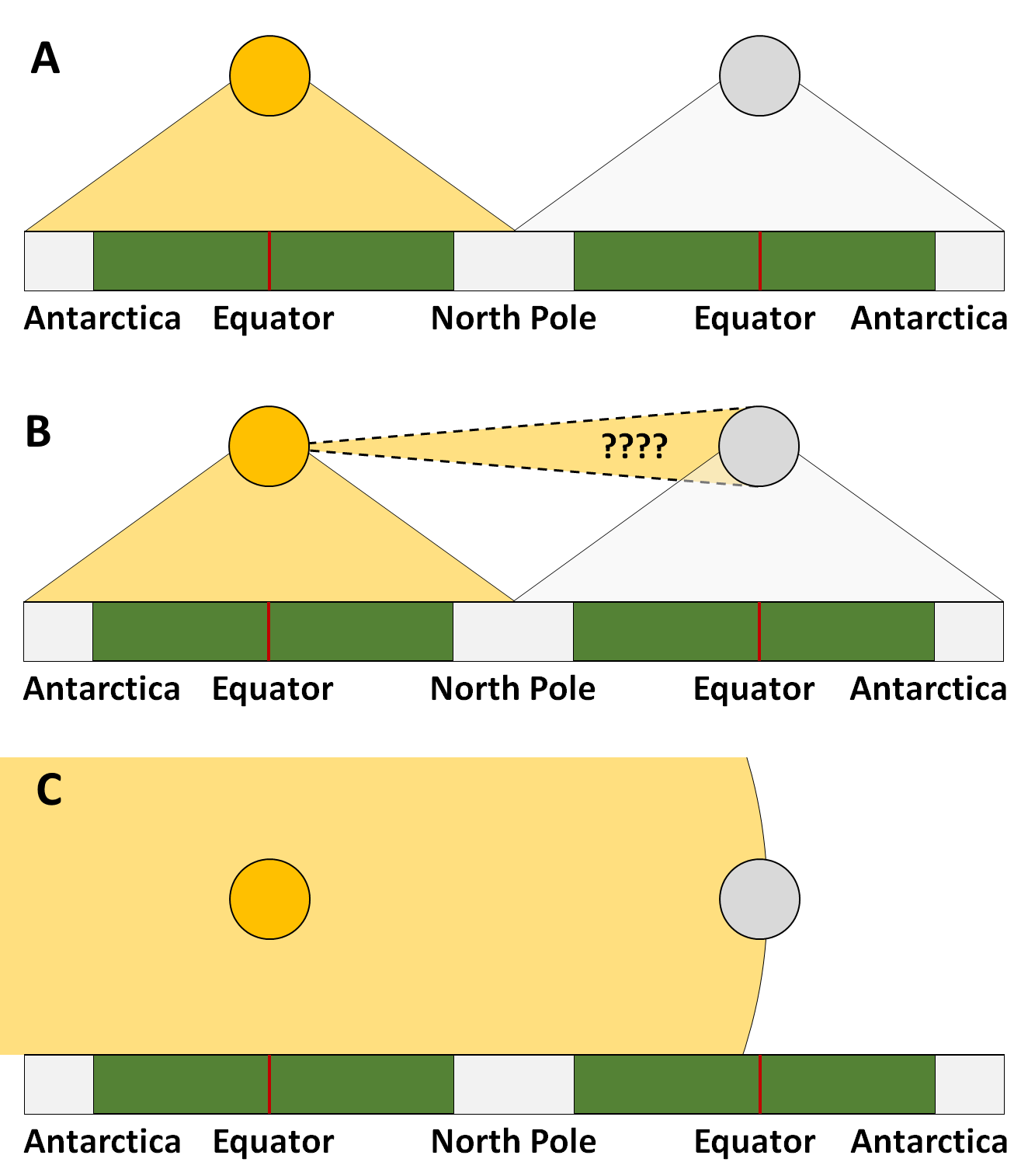
This diagram (viewing a flat earth from the side) illustrates the absurdity of flat earther’s “spotlight” argument. Panel A shows how things would need to be for their model to be correct, but that is clearly not how light works. As panel B illustrates, if the sun acted as a spotlight, then no light would reach the moon. Panel C shows how light actually works. It radiates out from all points of a sphere. In reality, it would continue radiating out well past the moon, but for this figure I stopped it at the moon to illustrate that for light from the sun to reach the moon, it also has to, at the very least, constantly reach essentially the entire northern hemisphere (in reality it would constantly reach the entire earth).
1.3 Why can’t we see the sun all the time?
The next problem comes from the sun illuminating planet earth. If the sun is a mere 3,000 miles above the earth and is constantly hovering above the earth, we should see it all the time. There should never be a point in the day during which we cannot see it way off in the distance. To “solve” this, flat earthers propose that the sun acts like a spotlight that magically directs its light downward, rather than allowing the light to radiate outward. Thus, you only see it when it is close to overhead. This, of course, is pure madness (it’s also another ad hoc fallacy). That’s not how light works. A ball of light (such as a sun) radiates light in all directions, not just down. Further, if the sun was a spotlight, then it shouldn’t be able to illuminate the moon. I have sometimes seen flat earthers try to explain this away by proposing that the atmosphere (which they amusingly call the “atmoplane”) is so dense that the sun can’t pass through it at a shallow angle (i.e., when the sun is distant on the horizon, it has more atmosphere to pass through). That is, however, just more ad hoc speculation. Further, if it was true that our atmosphere was that thick and that good at blocking light, then how is it possible for us to see the stars? Surely their exceedingly dim light wouldn’t penetrate that atmosphere. Or, at the very least, they should only be visible from directly above, and we shouldn’t be able to see them on the horizon. The fact that we can see stars on the horizon, but not the sun clearly indicates that the thickness of the atmosphere is not the issue here.
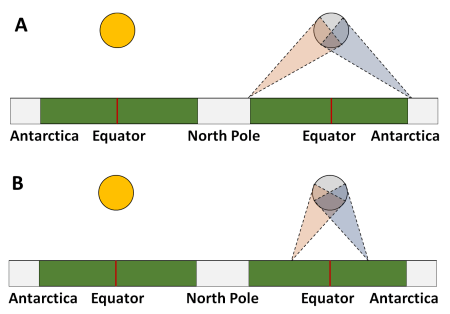
This diagram (viewing a flat earth from the side) illustrates the fact that, on a flat earth, people in the northern hemisphere would see a different side of the moon than people in the southern hemisphere (the pink and blue triangles show the angle of view form a person in each hemisphere. Panels A and B show the same problem, but they demonstrate that the problem becomes worse as you move away from the equator. The size of the sun and the moon is not to scale with the earth based on flat earther views (but that is irrelevant since we are talking about spheres, and making them large was necessary or else they wouldn’t be visible), but their position above the earth is approximately correct for flat earth views, and even if the scale was way, way off from their claims, the same problem would remain.
1.4 Why do both hemispheres see the same surface of the moon?
There are other issues with this view of the sun as well, but let’s move on to the moon, because it creates a whole new set of problems for flat earthers. First, if the moon was circling 3,000 miles above us, then people in the northern hemisphere and people in the southern hemisphere should see very different faces of the moon. In reality, however, everyone sees them same face, it is just flipped upside down in one hemisphere. That alone clearly demonstrates that the moon is not circling overhead, but wait, there’s more.

This diagram (viewing a flat earth from the side) illustrates the fact that, on a flat earth, people in the northern hemisphere and southern hemisphere would experience different lunar cycles. For simplicity, I showed the sun casting a single beam, but it obviously actually radiates out in all directions. The dotted triangles show the points of view from people in the northern and southern hemispheres. Panels A and B show the same problem, but they demonstrate that the problem becomes worse as you move away from the equator, with people in the far south rarely seeing more than a sliver of lit moon. Panel C shows that even if we drastically alter the altitudes of the sun and the moon (as some flat earthers propose) the problem still remains. The size of the sun and the moon is not to scale with the earth based on flat earther views (but that is irrelevant since we are talking about spheres, and making them large was necessary or else they wouldn’t be visible). Their position above the earth is approximately correct for flat earth views, and even the scale was way off from their claims, the same problem would remain.
1.5 Why does everyone experience the same lunar cycles at the same time?
The lunar cycles also present a huge problem for flat earthers. They generally explain them by saying that the moon circles at a different rate than the sun, thus the cycles are caused by the sun’s light hitting the moon at different angles. That’s highly problematic though. First, as stated above, it conflicts with their “the sun is a spotlight” claim. Further, if that were true, then the entire earth wouldn’t experience the same lunar cycles simultaneously. In fact, it’s worse than that. According to this model, people in the southern hemisphere should never have a full moon, or, at best, a full moon should only occur in the middle of the day. Some flat earthers have tried to get around this by saying that the moon is sometimes at a higher altitude than the sun, but this still would not let someone in New Zealand (for example) see a full moon, and people in New Zealand do see full moons. Ergo, this position must be bogus. Just to prove that I am not making things up, here is a video by flat earthers showing what the lunar phases would look like on a flat earth. Notice that according to this video, different parts of the world should experience different lunar cycles (in reality we all experience the same cycles) and the southern hemisphere only gets a full moon in the middle of the day (again, that’s not what we actually see).
1.6 Flat earther responses to moon problems
Flat earthers have some imaginative ways to try to solve these problems with the moon. One popular view is that the moon is actually a flat disk, like a Frisbee. This is, once again, an ad hoc fallacy. They are just making things up to solve problems with their world view. Also, we know the moon isn’t a disk, because if it was, it would start to look like an oval as it descended over the horizon, ultimately looking like a sliver before disappearing on the horizon. The type of circular moonrise and moonset we observe is simply not possible with a Frisbee (it would have to turn so that it was facing us, rather than being a disk that is parallel to us). Additionally, if you look at the moon with a telescope or high-powered camera, you’ll notice that its craters are round in the middle, and gradually become ovals towards the edges. That makes perfect sense if we are looking at a sphere, but makes no sense whatsoever if it is a disk.
Another popular view is that the moon is actually self-luminous. In other words, it produces its own light (I wish I was making this up, but I’m not). Can you spot the logical fallacy there? Now, how or why it lights up is a mystery that flat earthers can’t explain. Similarly, the phases of the moon are hard to explain with this view, but that doesn’t stop flat earthers from trying. I have seen some propose that it is bioluminescent (so there is life on the moon apparently), and for unknown reasons these organisms light themselves up in massive groups that vary on a predictable pattern thus creating the illusion of lunar phases. Others propose that parts of the moon are simply “turned off” at various times (one wonders by whom, how, and for what purpose). Regardless of the mechanism, a self-illuminous moon still doesn’t solve the problem that people in the north and south should see different faces of the moon. Also, we know that the moon is illuminated by the sun, not itself, because its craters cast shadows, and those shadows are always consistent with the position of the sun.
1. 7 Lunar eclipses are impossible on a flat earth
One final problem that I want to talk about is the lunar eclipse. This happens when the earth passes between the moon and the sun, thus blocking the sun’s light. This is 100% impossible in a flat earth model (they even admit that). Therefore, they have invented what they call the “shadow object.” This is an object that orbits the sun, and is usually so close to the sun that you can’t see it, but occasionally it passes between the sun and the moon causing the eclipse. That’s right, they just completely invented a celestial object for which we have 0 evidence, and the only reason to ever think that such an object exists is because doing so is necessary for a flat earth view. That is a textbook ad hoc fallacy. You can’t simply invent celestial objects to save your pet view. That violates fundamental principles of logical reasoning and maintaining an evidence-based view of reality.
1.8 Other forms of science denial commit the same logical blunders
Now, at this point, it would be easy to laugh at flat earthers for constantly inventing solutions that they have no evidence for, but the reality is that most (if not all) groups of science-deniers do this. Creationists, for example, do this all the time. Just to give two quick examples, they arbitrarily claim that the radiometric decay was faster in the past, and they invent magical mechanisms for sorting fossils during Noah’s flood. Similarly, when faced with the fact that we have carefully tested the natural drivers of climate change and found that they cannot explain the current warming, climate change deniers often insist that there must be some other driver that we don’t know about. That response is, however, ad hoc. Inventing and unknown driver of climate change is no different from a flat earther inventing a shadow object. Anti-vaccers and the anti-GMO crowd are no better. They invent fanciful mechanisms through which vaccines and GMOs supposedly cause harm and they invent conspiracies and conflicts of interest anytime that a paper disagrees with them. All of these groups (and many others) commit the exact same logical flaw: they make massive assumptions to solve problems in their views, and that is not logically valid. You must have evidence to support your claim. It’s that simple.
2). Gravity
Gravity is another huge thorn in the side of flat earthers. You see, gravity should preclude a flat earth, because gravity would pull the earth into a sphere (you know, like it actually does). Further, even if the earth was solid adamantium and could resist gravity’s pull, a big problem would still remain. Namely, anytime that you weren’t on the North Pole, gravity would pull you sideways as well as down, because there would be more mass to one side of you. This would become exaggerated the further you moved from the North Pole. Most flat earthers admit this and acknowledge that gravity is fatal to their view, but don’t worry, they have a solution.
According to flat earthers, gravity is an illusion, and actually the earth is accelerating upwards at a rate of 9.8m/s^2, thus creating the appearance of gravity. So, when you drop an object, it doesn’t fall, rather the earth accelerates up towards it. This is, of course, yet another ad hoc fallacy. Also, there is no explanation for why the earth is accelerating. Flat earthers usually just cop out with, “dark energy is causing it,” or some other claim for which there is clearly no evidence or logical reasoning.
Additionally, it is clearly not enough for the earth to be accelerating, because if it was just the earth, then we would crash into the sun and the moon and shoot past the stars. Therefore, according to flat earthers, the entire universe is accelerating via unknown mechanisms (because reasons). Somehow, though, the earth shields the objects close to it (thus they can still fall) but doesn’t shield the sun and the moon, even though they are only a few thousand miles directly above the earth. How this happens is anyone’s guess.
Having the universe accelerate at a constant rate of acceleration raises the obvious problem that the earth would soon be going faster than the speed of light, which is impossible. To get out of this one, flat earthers invoke special relativity and claim that it allows an object to accelerate infinitely at a constant rate of acceleration without ever reaching the speed of light because of differences in reference frames. Invoking special relativity and other complex physics concepts is a common and irritating tactic by science-deniers. It is irritating because these concepts are so complicated that it takes an immense level of knowledge before you can even assess them. Thus, someone with no real knowledge of relativity can invoke it, and even if they are dead wrong, their opponent can’t explain why they are wrong without first earning a PhD in theoretical physics (which I don’t have). The one thing I am sure of is that as you approach the speed of light, the energy needed for further acceleration increases to the point of infinity. So, they not only need a mechanism to explain the acceleration, but they need to explain how it is consistently infinitely increasing its energy output (good luck).
Note: originally I explained why I thought they might be wrong about relativity, but based on the comments, it seems that they may actually be correct that it can accelerate infinitely at a constant rate; it’s still hopelessly ad hoc though.
One final note about gravity is that their views on it are self-contradictory. As explained earlier, they invoke it to explain the movements of the sun and moon. They also need it for their mythical shadow object to orbit the sun. Further, we can very clearly see that celestial bodies move according to the laws of gravity, and we have used gravity to predict the existence of objects before they were directly observed (e.g., Neptune). Flat earthers seem to accept all of this. Thus, they have to argue that gravity is true, except for planet earth. Everything else produces gravity and acts according to the laws of gravity, but not earth (makes perfect sense, right?).
3). Coriolis effect
Flat earthers also struggle to explain the movement patterns of storm systems in the northern hemisphere vs the southern. You see, the spinning of the earth results in a phenomenon known as the Coriolis effect, and that causes storm systems in the northern hemisphere to spin counter-clockwise, while storm systems in the southern hemisphere spin clockwise (this video illustrates and explains why this happens). This is a huge problem for flat earthers, because they have no way to explain why storm systems spin in opposite directions in the north compared to the south.
I have yet to see a flat earther give a well-reasoned response to this problem, but here are the three responses that I have encountered on various videos, forums, and blogs. The first is to simply cop out by saying, “because of wind patterns.” That is clearly a non-answer, however. What causes the wind patterns? Yes, the storms circulate because of the wind patterns, but those wind patterns only move that way because the earth is spinning. There is no reason for them to move that way on a flat earth, that’s the point.
The second response is to attribute it to gravitational pull from the “celestial gears.” This is another baffling concept that flat earthers have invented. It proposes that different star systems form “celestial gears” and their rotation somehow has an impact on earth. This is, once again, ad hoc, but it is also inconsistent with their other views. Remember again that flat earthers reject gravity, yet here they are invoking it. Further, how could the stars (which according to them are tiny) create that type of gravitational pull? It just doesn’t make sense.
The final option is to simply claim that the Coriolis effect isn’t a real thing. On several forums, I have seen flat earthers assert that the differential movement of storm systems is just a myth invented as part of the “round earth conspiracy.” Thus, all those photos of storm systems are fake, and all the people (like me) who have experience both hurricanes in the northern hemisphere and cyclones in the southern hemisphere are liars. That is, of course, patently absurd, but the there is an entire section is on conspiracy theories, so I’ll simply direct you there.
Note: it is a myth that toilets in the southern hemisphere flush in a different direction than ones in the north. The Coriolis effect is not powerful enough to act on such a small scale. The direction of flush for toilets is determined by their plumbing, not the Coriolis effect.
4). Impossible flights
Flat earthers also struggle to explain many airline flights. You see, if you look at a flat earth map, continents in the southern hemisphere are very far apart, whereas ones in the northern hemisphere are quite close. This should cause impossibly long flights in the southern hemisphere, but very short flights in the northern hemisphere. Reality, however, is quite different.

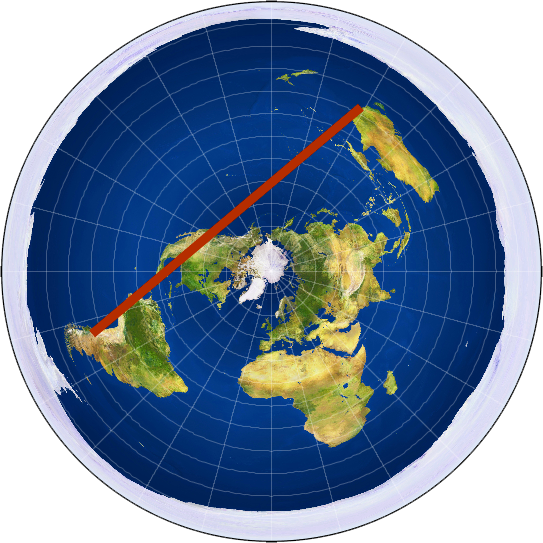
This is the path that Flight 28 would have to take on a flat earth. It is impossibly long. There is no way to make this flight with a 747 on a flat earth.
Let’s take Qantas Flight 28 that goes between Sydney Australia and Santiago Chile as an example (there are multiple others that could be used, and you can find plenty of other websites that have worked out this math for other flights). This is a non-stop flight that travels over 11,000 km and takes 14 hours and 20 minutes. That is all well and good on a round earth, but if you look at a flat earth map, the distance becomes substantially larger. In fact, it should be around 25,000 km. This is a huge problem because 747s simply cannot fly fast enough to make that flight in that time. In fact, given that 747s fly at 920 km per hour, it would take over 27 hours to make the flight!
As you might expect, flat earthers have some entertaining ways to “solve” this problem. My favorite is probably the argument that people on the plane get drunk or fall asleep and lose track of time (yes, they do make this claim). I have seen others claim that airlines drug their passengers. These are clearly absurd suggestions. Obviously not everyone on the plane is drunk. Further, many people watch movies the whole time, and they’d notice if their flight took 10 hours longer than advertised. Further, many people (including me) don’t reset their watches until they land. So even if I got waisted, I’d know something was up when I looked at my watch and it was 10 hours off of what it should be, not to mention that most people coordinate pick up times at their destination, which will be seriously off if the airline lied by a full 10 hours.
Others, perhaps slightly more logically, propose that airlines have simply upgraded the engines on the planes so they go much faster than the airlines report. This is also insane. For one thing, why wouldn’t they use these fast engines on all their planes. Why keep it a secret? Further, the planes would have to go ludicrously faster than their reported speeds to make flights like this. A 747 would need to go over 1,700 km per hour to make that flight. That’s nearly twice its actual speed, and is 1.4 times the speed of sound. A 747 is not a supersonic plane. I shouldn’t have to say that.
Oh, and one other thing I failed to mention, 747s only have a range of 13,450 km. So, on a 25,000 km flight, they’d make it about half way before running out of fuel and crashing.
Given all these problems, many (possibly most) flat earthers take yet another route: they deny the existence of these flights. According to them, these flights only show up on the websites to further the “round earth illusion,” but they can’t actually be booked and no one has ever actually flown on one. Everyone who claims to have been on one of these flights is either lying or (according to some flat earthers) actually got off in a different country than the one advertised (you’d think they would have noticed that when going through immigrations).
Regardless of which answer you choose, the end result is that you have to believe in ludicrously impossible physics and a vast conspiracy involving every airline in the world. There is absolutely no way that commercial airline pilots wouldn’t know if the earth was flat. Their routes would make no sense if they were flying round earth routes on a flat earth. Further, although I used a long-distance flight as an illustration, these problems exist on a smaller scale for shorter flights as well, and pilots would notice the discrepancies. This conspiracy would be on an utterly absurd scale. Tons of people at Boeing would have to know about it, every airline company would know about, numerous officials at every airport would know about, every airline pilot would know about it, military pilots would know about it, etc. Also, the same problems would occur for sea travel. So, we have to add cruise companies, international shipping companies, every navy in the world, etc. to that list. It is a completely ludicrous conspiracy.
Note 1: Some flat earthers try to get out of problems like this by arguing that the actual flat earth map is unknown, thus the miles reported by the airlines (and seen on real maps) may actually be correct. The problem is that constructing a flat map where those miles are correct is utterly impossible. The geometry simply doesn’t work on a flat map. To put that another way, no flat earth map can explain these discrepancies in airline times/routes.
Note 2: Some flat earthers try to counter this by presenting multi-flight trips that seem unintuitive for a round earth (for example, a flight from Africa landing in Europe before going to South America). These flights are, however, completely possible on a round earth, they just aren’t the straightest routes (as opposed to the flight I presented which is impossible on a flat earth). Further, the reason for these non-direct routes is pretty obvious: demand. If airlines have very little demand for flights from A to C but plenty of demand for A to B and B to C, then they simply won’t run a direct flight from A to C and will route passengers through B instead.

A screen shot of Flight 28 on a booking site.
5). Impossible coordinates
GPS coordinates provide another proof that we are not on a flat earth. I’ll use the decimal degree system to illustrate, but you can do the same thing with any coordinate system. This system splits the earth up into a grid with 360 degrees running east-west (longitude) and 360 degrees running north-south (latitude). The system can seem a bit confusing at first, because longitude is scored as 0 to +/- 180 degrees, whereas latitude is scored from 0 to +/- 90 degrees, but if you look at the figures below, it should make sense. You’ll notice on the lower image (which is a projection of a globe onto 2-dimensional space) that the distance between the longitude lines (i.e., the lines running north and south) decreases as you move away from the equator, but the decrease is consistent both north and south of the equator. In other words, the distance covered by 1 degree of longitude changes as you move away from the equator (i.e., change in latitude). This should make sense if you think about a ball. Any line around a ball can be broken into 360 degrees, with each degree comprising the same distance along that line. Where you draw the line determines what that distance is, however. If you draw it around the center of the ball, it will be a long line that runs along the circumference with each degree measuring 1/360th of the circumference; whereas, if you draw the circle near the top of the ball, the line will be small, as will the distance contained in each degree.
This is really important because it indicates two things. First, a formula to calculate distances between two points on this coordinate system must take the curvature of the earth into account, or else the distance will be wrong. Second, for each degree of change in latitude, the change in the distance covered by a degree of longitude must be consistent when moving north or south from the equator. In other words, 1 degree of longitude (i.e., distance east to west) at a latitude of 15 (i.e., 15 degrees north of the equator) must cover the same distance as 1 degree of longitude at a latitude of -15 (i.e., 15 degrees south of the equator).
A flat earth model inherently requires a different relationship. The distance covered by a degree of longitude has to decrease above the equator and increase below it. In other words, on a flat earth, 1 degree of longitude at a latitude of 15 would cover far less distance than 1 degree of longitude at a latitude of -15.

As you can see, our coordinates systems shouldn’t work on a flat earth. On a flat earth, the distance between two points of longitude would decrease as you moved away from the equator heading north, and increase as you moved south. In reality, they decrease both north and south of the equator. That can only happen on a round earth (see the text for details).
You can clearly see how this plays out if you look at the dots on the maps I drew. The purple dots are at the following positions: lat 30 long 15, lat 30 long 30, lat -30 long 15, lat -30, long 30. The red dots are at: lat 75 long -60, lat 75 long -75, lat -75 long -60, lat -75 long -75. Now, we have a simple test of the shape of the earth. If it is round, then when we calculate the distances (east to west) of those points, we should find that both sets of purple dots have the same distance, and both sets of red dots have the same distance, but the distance between the red dots is smaller than the distance between the purple dots, even though all four sets of dots are separated by 15 degrees of longitude. In contrast, on a flat earth, that distance must be different for each set of points, with the distance decreasing as you move north.
So, which prediction is correct? You guessed it, we’re on a globe. At both 30 and -30 degrees latitude, 15 degrees longitude equals 1,442 km, and at both 75 and -75 degrees latitude, 15 degrees of longitude is only 430 km. That result is 100% impossible on a flat earth.
Think about it. These coordinate positions really are where things are. There’s no way to fake it. Every map, every GPS, every smart phone, etc. agrees. Further, we know that the distances between those points are correct. Just watch your odometer as you drive on a straight line and you can easily test this. In other words, we know that the calculations work. They have been ground-tested countless thousands of times, and you can easily test them yourself. Field biologists like me use them constantly, and if they didn’t work, we’d constantly be getting lost in the field, because nothing would be where we had calculated that it should be. The fact that the trigonometry accounts for the earth’s curvature and produces accurate results is proof that the earth is round. The math simply could not work on a flat earth.
If you are tempted by the flat earth position, then really think about this. Think about degrees around a circle, then try explain how it is possible that degrees of longitude have matching distances in the northern and southern hemispheres (as I have illustrated). Coordinates and distances that we know are correct simply cannot fit on a flat earth map. It is not mathematically possible. The math that people like me use daily cannot work on a flat earth.
6). We’ve been to space/everything is a conspiracy
I’ve talked briefly about the insane conspiracy theory that must accompany flat earth views at several points in this post, but I want to really focus on it here, because it is far more ridiculous than I had previously stated. You see, we have been to space. We have seen that the earth is round. Astronauts are orbiting it right now. We have countless hours of video and tens of thousands of photos. According to flat earthers, however, those are all fake. Every last one of them. According to them, we have never been to space (according to some of them, space doesn’t even exist). Thus, every single space agency in the world is conspiring together to fake space programs and create the illusion of a round earth. Also, the International Space Station doesn’t exist (even though you can see it with a telescope and photograph it with about $2,000 worth of camera gear). Additionally, satellites aren’t real either. Every company that claims to be using them is actually using a complex series of weather balloons. If all of this sounds insane, good, because it is. NASA alone employs thousands of people every year. That’s an awful lot of people to be keeping quiet, not to mention everyone who works with satellites, other countries’ space agencies, etc.
Now, you may be wondering why so many countries would do this. What benefit do they get from fooling all of us? Why, for example, during the Cold War would the Soviet Union and the USA both conspire together while simultaneously competing with each other? These are good questions, and flat earthers don’t have good answers.
Often, they make some claim about how these programs actually just exist for the militarization of space, and so they just fake their own accomplishments as propaganda to keep the public interested and keep the money flowing in. That explanation makes no sense though. For one thing, how are they militarizing space if we have never even been to space!? Further, why would all of today’s space agencies conspire together. Do you honestly expect me to believe the US and Russia are in a joint conspiracy to help each other build their militaries?
Additionally, the military argument makes utterly no sense when you start looking at the numbers. NASA gets around 20 billion dollars annually. In contrast, the US military gets around 600 billion a year. Further, funding for the US military is one thing that is never in question. Why on earth does the military need to invent this utterly insane conspiracy theory just to get an extra 20 billion!? That’s only 3.3% of their annual budget. It’s nothing for them. Further, by the time that you buy off everyone involved (thousands of NASA employees, thousands of airline pilots, thousands of ship captains, etc.), launch rockets into the ocean (which is where flat earthers think the rockets go), and fake all the videos and photos (which would involve hiring actors, building sets, special effects, tons of computer animation, etc.), there is hardly going to be anything left. Honestly, 20 billion a year is probably not enough to even attempt a conspiracy like this. Nothing about this makes any sense.
Nevertheless, regardless of the sheer lunacy of this conspiracy theory, it presents a more fundamental problem. Namely, conspiratorial thinking like this is inherently irrational because it makes it possible to explain away any evidence against the conspiracy theory. In other words, no matter what evidence anyone presents that the earth is round, flat earthers will simply write it off as part of the conspiracy. The airline situation is a perfect example of this. Rather than accepting that these long-distance flights discredit their view, flat earthers simply write them off as part of the conspiracy. That type of reasoning is inherently illogical, and if you care about rational thought, then that alone should be enough to make you reject the flat earth movement (to be clear, that isn’t a fallacy fallacy, because the flat earth position requires this conspiracy, but the conspiracy itself has no evidence to support it and is irrational).
Here again, I want to pause and point out that lots of people are quick to laugh at flat earthers for this type of thing, then immediately make identical arguments themselves. Anti-vaccers, for example, propose that there is a vast conspiracy involving all of the world’s medical agencies, governments, and the vast majority of the world’s scientists and doctors. Similarly, both anti-GMO activists and climate change deniers imagine a conspiracy involving numerous governments, every major scientific body, and thousands of scientists. All of these conspiracies theories are irrational for the same reasons. Namely, they don’t have any solid evidence to support them (i.e., they are ad hoc assumptions), and are used to blindly write off any contrary evidence.
Summary
In short, to believe in a flat earth, you have to believe that the sun and moon both defy physics to run in continuous circles overhead, and you have to overlook the fact that this would prevent people in the southern hemisphere from ever seeing a full moon, and you have to overlook the fact that this would result in people in different hemispheres seeing different faces of the moon, and you have to ignore the fact that this would result in different lunar cycles in different parts of the world. You also have to believe that the sun somehow acts as a spotlight (which makes no sense). You also have to either believe that this spotlight somehow also illuminates the moon even though the moon should not be in the direction of the spotlight or you have to believe that the moon is self-illuminating. You also have to believe in a “shadow object” for which there is zero evidence, but the existence of which is required to explain a lunar eclipse on a flat earth. Further, you have to ignore the fact that a flat earth model can’t explain the fact that storm systems spin in different directions in different hemispheres. You also have to believe that gravity is a myth and via unknown means, the entire universe is accelerating upward at a constant rate of acceleration of 9.8m/s^2, but the earth somehow shields objects on it from the force causing this acceleration, yet somehow the sun and moon aren’t shielded. Also, you have to simultaneously believe that gravity does exist for every celestial body other than earth. Additionally, you have to either believe that certain airline flights don’t exist and everyone who claims to have been on them is lying, or you have to invent fictional technology that lets 747s fly faster than the speed of sound and greatly exceed their fuel limitations. On top of all of this, you have to ignore the fact that it is impossible to consistently plot known geographic coordinates onto a flat earth map. The math simply doesn’t work. Finally, you have to invent an insanely massive conspiracy involving every government, every space agency, every airline company (and their pilots), every international shipping company (and their ships’ crews), every company that is involved with satellites, etc. None of this makes any sense whatsoever.
As absurd as all of this may seem (and, indeed, as absurd as it actually is), flat-earthers are not alone in constructing this type of lunacy. The logical fallacies, conspiracy theories, etc. that pervade the flat earth movement are also prevalent among anti-vaccers, climate change deniers, etc. Indeed, essentially all forms of science denial suffer the same suite of logical blunders. So, before you mock flat earthers, take a good look at your own views, and make sure that you aren’t suffering the same errors in reasoning.


 That line of reasoning is specious. The fact that science isn’t infallible doesn’t mean you can ignore its results anytime that you want, and the fact that science isn’t the only source of knowledge doesn’t automatically mean that other sources of knowledge are equal in all contexts. When it comes to establishing causation in the physical universe, science is the best and most reliable method, and you can’t reject it anytime that you want. Further, I’ll reiterate my previous point that asking questions in the absence of evidence is fine, but refusing to accept the results of numerous studies is not.