Creationists often argue that scientists’ lack of knowledge about how the first cell arose is evidence that life could not have arisen “spontaneously from nonliving matter.” There are numerous problems with this argument, some of which I have dealt with before. For example, it is entirely an argument from ignorance fallacy (details here). Further, although it is often used as an argument “against evolution” it is actually an entirely separate concept from the theory of evolution, and the two theories do not rely on each other (details here). In this post, however, I want to focus on a different aspect of this argument. Namely, the fact that it isn’t actually true. Life arises spontaneously from “nonliving matter” all the time. Creationists simply frame the argument in a deceptive way that ignores the chemical nature of living organisms. Every time an organism reproduces, life is arising from nonliving matter. Now, creationists will, of course, object to that claim because that new life came from the reproduction of another living organism, but that is actually entirely irrelevant. As I will explain in detail, life itself is simply a product of highly complex chemistry, and the process of reproduction consists entirely of chemical reactions among nonliving atoms. The living organism simply provides the environment in which that chemistry can take place.
Definition of “spontaneous”
The first thing that we need to talk about in this discussion is the definition of “spontaneous.” In chemistry, spontaneous has a specific meaning. It gets a bit technical with concepts like entropy, but the easiest way to understand it is that a spontaneous reaction is exothermic (meaning that it releases energy into the environment), whereas a nonspontaneous reaction is endothermic (meaning that it requires energy from the environment). This is an oversimplification, but that is not really important for this post.
The definition used by chemists is not, however, generally what creationists mean when they talk about a “spontaneous” formation of life. Rather, they seem to mean simply an event that could happen naturally without conscious intervention. Although not technical, we can use this definition, but I think we need to carefully clarify it at the outset. By this definition, given the right environmental conditions (including temperature, enzymes, etc.) any chemical reaction is spontaneous. Imagine, for example, that I take a small salt crystal, and drop it into water. The salt will dissolve because the positive sodium ions will be attracted to the negative part of water molecules, while the negative chloride ions will be attracted to the positive part of water molecules (water is a polar molecule). That reaction is (by creationists’ definition) spontaneous. It is an inevitable outcome of the chemistry. No one has to sit there and will the molecules to interact with each other. They just do so automatically because of the way that charges, electrons, etc. behave. You might try to quibble over this example because it involved me (a conscious entity) dropping the salt into the water, but we can easily think of situations where the chemicals would meet without intervention (e.g., a cliff eroding into a lake).
This may seem straightforward so far, but it is critical to clarify that this definition of spontaneous must still apply even when we are talking about reactions that occur inside a living organism. Take photosynthesis, for example. Plants take in water (H2O) and carbon dioxide (CO2) and through a complex series of chemical reactions, they produce oxygen (O2) and glucose (C6H12O6). Various enzymes are involved, and the reaction is endothermic and requires energy from the sun. Thus, it is not spontaneous by the technical chemical definition, but it is spontaneous by the definition that creationists use when they say things like, “life can’t spontaneously arise.” In other words, it is an inevitable outcome of the chemistry in that environment. When you have those chemicals (including the various enzymes, etc.) plus an input of energy from the sun, the reaction will happen. No one has to force the individual atoms to interact.
Note: I will use this definition of spontaneous throughout.
Everything is nonliving matter
There is no such thing as living matter. The dichotomy between “living’ and “nonliving” matter is a completely false one that is perpetuated by the way that all of us (including scientists) talk, but it is a critical topic when it comes to abiogenesis, because creationists entire argument hinges on this false distinction between living and nonliving matter.
The problem here is that matter is never alive, but when it is arranged in certain ways, it results in chemical reactions that produce the property known as life. In other words, living organism are composed entirely of nonliving matter. You are, for example, predominantly composed of the elements oxygen, carbon, hydrogen, nitrogen, calcium, and phosphorus. These are nonliving atoms that come together to form nonliving molecules. When those molecules are arranged in a certain way, they chemically react and produce a living cell, and those living cells collectively form a living organism (you). You are alive, and your cells are alive, but the matter that makes those cells is not alive. It’s just a specific arrangement of nonliving atoms.
This may seem like an entirely pointless semantic quibble, but it is actual vital for this discussion, because, since matter itself is not alive, all life, by definition, arises from nonliving matter. When you make a sperm or an egg cell, for example, nonliving matter is simply being arranged into a living cell. Yes, that arrangement is being performed by living cells, but they are themselves just arrangements of nonliving matter, and they are simply providing the chemicals (aka nonliving matter) and environment necessary for spontaneous chemical reactions to arrange the chemicals into a living cell. The matter is never alive at any point in the process.
Now, I can already hear the objection that a living cell is required for that to happen. In other words, this argument states that even though the matter itself is not alive, a living organism is required to arrange the nonliving matter into a living cell. As I will explain in subsequent sections, however, there is absolutely no reason to think that assertion is true.
This is about chemistry, not consciousness
Before I go any further, I need to make a brief comment about consciousness, because someone will inevitably respond to my assertion that life is simply a product of complex chemistry by arguing that “chemistry can’t explain consciousness.”
I want to respond to that in several ways. First, prove it. You are a biochemical machine. You breathe in oxygen, which is transported to your cells thanks to haemoglobin in your blood. That oxygen, as well as glucose from your food, is then used for a complex chemical reaction known as cellular respiration. This produces the molecule ATP which can be reduced to ADP, resulting in a release of energy. That degradation of ATP to ADP powers your body. Every function of your body is controlled by chemistry and reducible to chemistry. Even when you are thinking, that is a result of chemistry in your brain (neurotransmitters, sodium ion channels, etc.). Given all of that, there is no good reason to think that consciousness is not also just a product of complex chemistry.
Having said that, however, this topic is actually completely irrelevant to the argument about abiogenesis, and I would really rather just drop it altogether. So, to that end, I will focus on bacteria from here on out. I don’t know anyone who thinks that bacteria are conscious, so we can talk about them from an entirely chemical perspective, even if you think that consciousness is more than chemistry. Further, the first cell is thought to have been something similar to a cyanobacteria, so talking about bacteria is rational path.
Bacterial reproduction
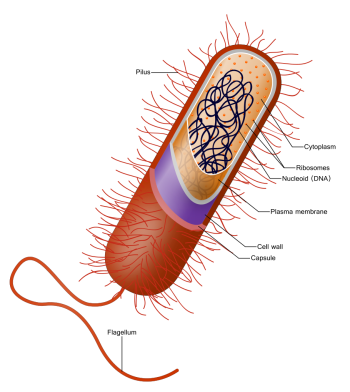
Diagram of a bacterium. Image credit: Ali Zifan via Wikimedia
Now that we have agreed to focus on bacteria, let’s talk about how bacteria reproduce. Bacteria are very simple organisms and really only consist of a few major parts: a cell wall (made of the chemical peptidoglycan), DNA, proteins known as ribosomes, cytoplasm (the gooey fluid inside), and a few other bits and pieces. Again, all of those parts are made of nonliving matter, and are themselves nonliving, but when they are arranged correctly, and the correct chemical reactions occur, the cell as a whole exhibits the properties that we use to define life. In other words, ribosomes are not alive, the cell wall is not alive, DNA is not alive, etc., but when all of those things are put together and the correct chemical reactions occur, we describe the entire cell as being alive. Further, we would describe it as “dead” only if those chemical reactions ceased. Thus, biological life is defined by the occurrence of specific chemical reactions.
When a bacterium detects that the environment and resources are good for reproducing, a series of chemical reactions are triggered. Most importantly, the contents of the cell (DNA, ribosomes, enzymes, etc.) are duplicated. The DNA duplication involves a series of enzymes and chemical reactions that read the DNA strands and make identical copies. Again, this is a spontaneous chemical reaction that will occur anytime that the right chemicals are supplied under the right conditions.
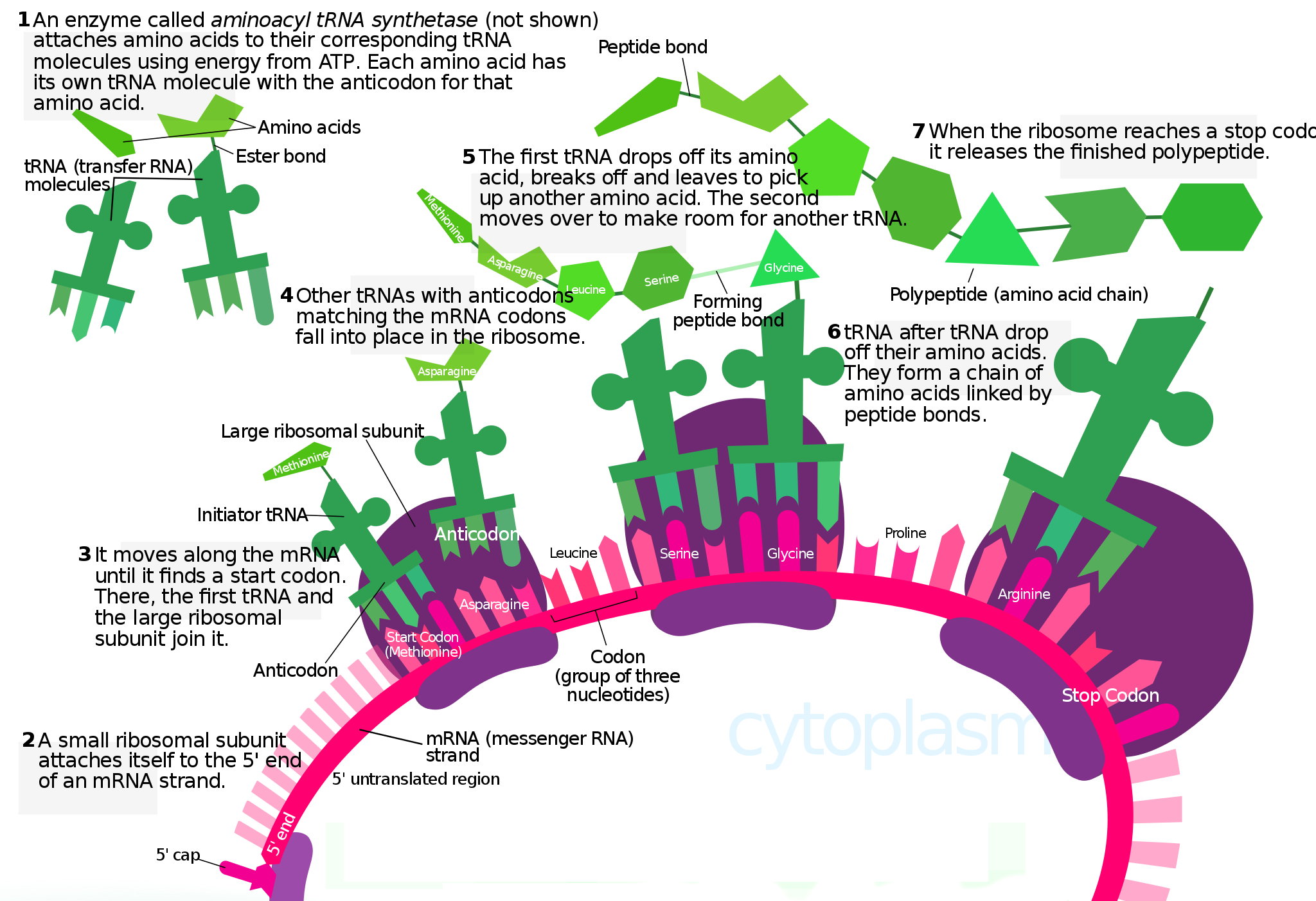
Unlike the DNA, the proteins are duplicated by the ribosomes (which are themselves made of proteins). The ribosomes are protein factories. They receive blueprints from the DNA (in the form of mRNA) and building materials from the rest of the cell (in the form of tRNA), and they arrange those building materials according to the blue prints. Here again, this all happens because of inevitable chemical reactions (given the reactants and environment; see note at the end for more details on how proteins are made).
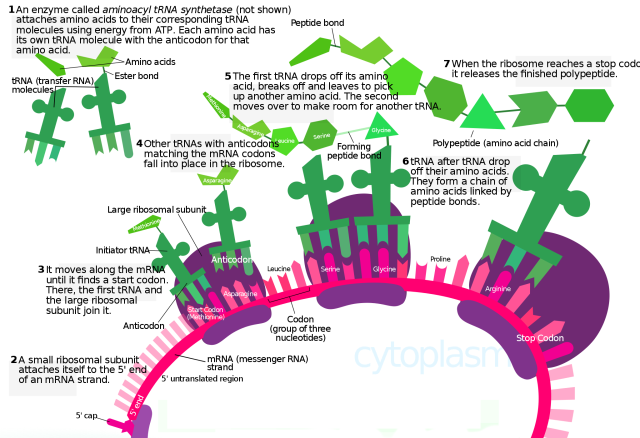
Diagram of protein synthesis. Image credit: Kelvinsong via Wikimedia
Hopefully at this point the picture is becoming clear. The entire process of forming a new cell is just a long string of chemical reactions. It is true that in nature, we have only observed this entire chain of reactions occurring in living cells, but that is just because the cell provides the right environment, conditions, and reactants for those reactions to take place. If the right conditions occurred outside of a cell those reactions would still happen. Imagine, for example, that we figured out how to artificially produce ribosomes, then put them in a beaker with the correct reactants, mRNA templates, enzymes, tRNA, energy input, etc. Would they form proteins? Yes. In fact, we have done essentially that. We have developed methods known as cell-free protein synthesis that allow you to produce the proteins for a given strand of DNA in a test tube without needing a living cell!
The significance of PCR
For most of the history of life on planet earth, DNA replication only happened in one place: a living cell. During human history, DNA didn’t spontaneously replicate in nonliving environments. Just like the production of proteins and the other steps involved in making a new cell, DNA replication required a living cell. DNA replication is, however, just chemistry (just like the other steps of making a new cell), and scientists saw no reason why it shouldn’t be possible to replicate DNA if the right conditions were created outside of a cell. So, they began studying the chemistry, and after years of work, they figured it out, ultimately resulting in the polymerase change reaction (PCR).
If you ever take even an introductory course on genetics, you’ll almost certainly have to do a PCR reaction, because it is one of the most common tools in laboratories around the world (a substantial amount of my life has been spent running these reactions). To do PCR, you take a strand of DNA that you want to replicate, add the necessary chemicals (enzymes, bases, primers, etc.), put the mixture into a thermocycler that creates the correct temperature profile for the reaction to occur (i.e., the environment), and lo and behold, you replicate DNA without needing a living cell.
Why is that possible? Why is it possible to take a process that, in nature, requires a living cell, and do it without a living cell? Because the process is entirely chemical! Again, the cell just provides the environment necessary for that reaction to occur, but if you can replicate a suitable environment outside of a cell, then you can do the same reaction. Further, there is absolutely no reason to think that this only applies to DNA replication. Every step involved in making a cell is just a series of chemical reactions, and there is absolutely no reason why a living cell should be the only environment in which those reactions are possible.
Additionally, it is important to remember that the series of reactions that occur in living cells today are more complicated than would be necessary to form a rudimentary cell. Indeed, scientists are actively studying chemical reactions that can produce primitive versions of various cellular components without requiring a living cell.
Bringing it all together
Let’s recap, shall we? Matter itself is not living. Rather, when nonliving chemicals are arranged together and react in certain ways, they produce living organisms that consist of nonliving matter. Further, the processes and actions of these living organisms are simply the result of complex chemical reactions. Additionally, these chemical reactions occur “spontaneously” in that they will occur on their own given the right chemicals in the right environment. Indeed, all living organisms are accurately described as biochemical machines, with these “spontaneous” reactions driving their functions.
As a result of all of this, it is completely fair to say that life constantly arises from nonliving matter, because each new cell is formed by arranging nonliving matter into a configuration that will result in the chemical reactions that produce the properties that we describe as life. It is true that currently these reactions do not occur in nature outside of a cell. In other words, each new cell is formed by existing cells; however, because that formation process is entirely chemical, there is no reason to think that those chemical reactions could not occur elsewhere. To put that another way, living cells simply provide the right environment and resources for those reactions to occur, but if the right environment occurred outside of a cell, those reactions would still occur even in the absence of a cell. Indeed, we have clearly demonstrated this by replicating a key component of cellular reproduction (i.e., DNA replication) in the lab. Further, it is likely that the environment on planet earth billions of years ago would have also been conducive to these types of reactions.
In short, there is absolutely no reason to think that life couldn’t form “spontaneously from nonliving matter,” because matter is never alive, and the formation of life is nothing more than a complex series of chemical reactions.
Note: Someone is probably getting ready to point out that although PCR replicates DNA, it is not exactly the same reaction used by living cells. That is true, but completely irrelevant. There are lots of different variants of the DNA replication process found in nature, and it is entirely possible the first cells used mechanisms that were different from those of current cells. So, all that matters is that we were able to replicate DNA in the lab. In other words, the point is simply that a living cell is not required for that task to be accomplished. The end product is what matters, not the mechanism through which it happened.
More details on protein synthesis: The process here is complicated, but the simplest way to explain it is like this. DNA is a chemical molecule, and the four bases of DNA (ATCG) are four different chemical molecules. When the cell sends blue prints to the ribosome, it translates the DNA into mRNA, which also consists of four bases (AUCG; mRNA is a single-stranded complimentary copy of the DNA strand with T replaced with U). The bases on mRNA are arranged into sets of three, known as codons, and each codon codes for a specific amino acid. Once this strand of mRNA is in the ribosome, it will react with tRNA, which consists of anticodons attached to an amino acid. The anticodon is the compliment of the codon, and, because of the chemistry, anticodons (and, as a result, the amino acids they carry) are specific to specific codons. Thus, each anticodon reacts with a specific codon, ultimately resulting in its amino acid getting added to the amino acid from the previous anticodon. In other words, the ribosome matches the codons with the correct amino acid, resulting in reactions that bind the amino acids together into chains, and those chains fold to form proteins. I realize that may sound like the ribosome is a conscious entity that is consciously deciding how to do this, but it is not. All of this is 100% chemistry. In the presence of the right enzymes, chemical reactions will occur with the codons, anticodons, ribosome, amino acids, etc., ultimately causing the amino acids to string together in a certain order that is dictated by the chemistry of the RNA, which is in turn dictated by the chemistry of the DNA.
Related post
Abiogenesis: An unsolved mystery is not evidence of a creator

 I have increasingly seen anti-vaccers citing the fact that vaccines are considered “unavoidably unsafe,” as proof that vaccines are dangerous and should be avoided. In reality, however, the term “unavoidably unsafe” is just legal jargon that does not mean what anti-vaccers think it means. So let’s talk about what it actually means

 The Logic of Science