
Some of the most persistent myths and misconceptions around COVID19 vaccines concern the risk of myocarditis and pericarditis, particularly in young people. A massive new study has obliterated these myths using a very clever study design, and it’s worth diving into it.
First, as critical background information, numerous massive studies have confirmed that COVID vaccines are enormously beneficial and reduce the spread of COVID, reduce the risk of catching COVID, reduce the severity of COVID if you catch it, reduce hospitalization rates, and reduce mortality (Huang and Kuan 2022; Rahmani et al. 2022; Zheng et al. 2022; Wu et al. 2023). This has been studied over and over again with very consistent results. Indeed, COVID vaccines have been examined with some of the largest studies I have ever seen, such as this meta-analysis of over 24 million people (Ikeokwu et al. 2023). Anyone who says that COVID vaccines haven’t been well-studied or aren’t beneficial is simply wrong. The reality is that COVID vaccines have been extensively studied and have saved millions of lives (Watson et al. 2022; Mesle et al. 2024).
Nevertheless, nothing is risk free, and COVID vaccines (like all medications) do have risks and side effects. Most of those side effects are, however, very mild, and serious side effects are rare (Amanzio et al. 2022; Haas et al. 2022; Kouhpaye and Ansari 2022; Bello et al. 2023). This is true even when looking at subgroups like children (Piechotta et al. 2023). There is absolutely no evidence whatsoever of widespread deaths from COVID vaccines (Lamptey 2021; Abdel-Qadir et al. 2026).
With that said, there are occasional serious side effects, particularly in some subgroups. Heart issues (especially myocarditis and pericarditis) have received the most attention. These are anti-vaxxers’ go-to excuse for why the vaccines are actually dangerous. What vaccine opponents ignore is the fact that these side effects are very rare and are also caused by COVID itself. Indeed, multiple studies have shown that while your risk of myocarditis does increase after COVID vaccination, your total risk is still incredibly small (Juan Gao et al. 2023) and your risk is substantially higher from actually catching COVID (Patone et al. 2022; Voleti et al. 2022).
Despite this evidence, concerns have persisted, and there are countless myths out there like the notion that elite athletes are suddenly dropping dead, and people have continued to focus on the low risk of the vaccine while downplaying the higher risk from COVID itself. The new study I want to discuss address those concerns with a brilliant design.
Study design
The study is titled, “Cardiac outcomes following SARS-CoV-2 infection versus BNT162b2 vaccination in adolescents and young adults: a cohort study of 4 million individuals” and was published in the journal Vaccine by Toraih et al. (2026).
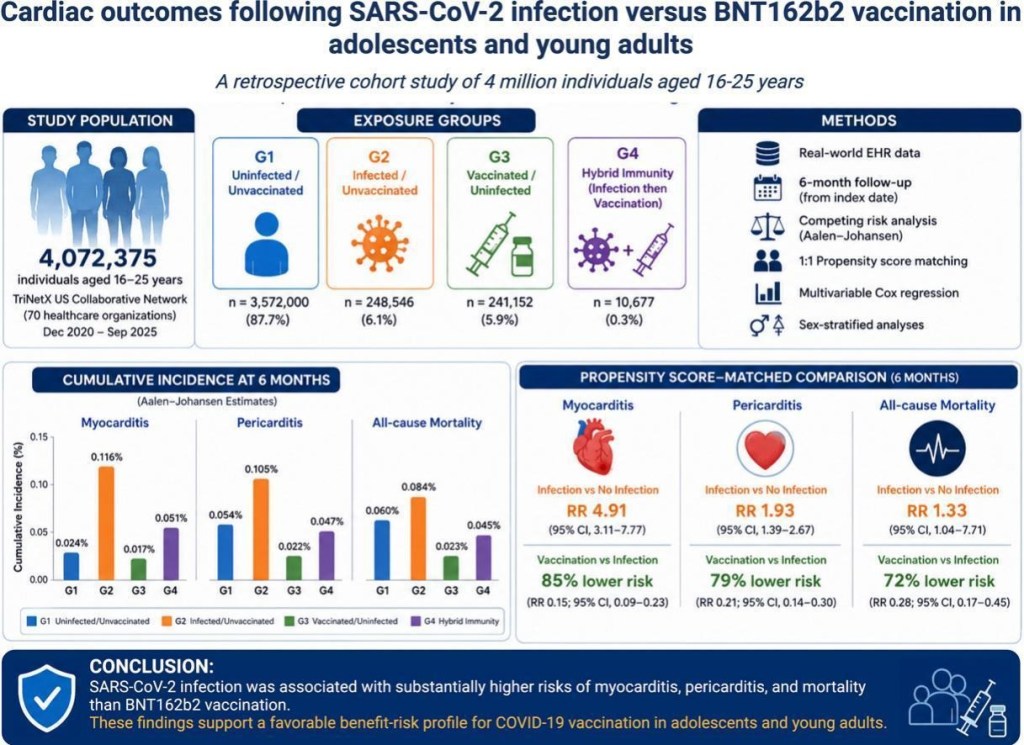
The authors took an enormous group of over 4 million people, split them into the following groups, and compared the risk of myocarditis, pericarditis, and all-cause mortality (i.e., any deaths):
- People who were never vaccinated for COVID or infected with COVID
- People who were never vaccinated but were infected
- People who were vaccinated and never became infected
- People who were vaccinated and became infected.
This study has a lot of strengths. First, it only included 16-25 year-olds. This is really important, because this is the age group with the highest risk of myocarditis from COVID vaccines, and it is a group that anti-vaccers routinely insist don’t need to be vaccinated. It is very common for them to claim that young adults simply don’t need the vaccine. Therefore, restricting the study to this age group creates something of a “worst-case scenario” for vaccines. It is a group with lower risk of COVID complications and higher risk of vaccine complications. So, if we were ever going to see a situation where the vaccines did more harm than good, this would be it.
Second, the study had a truly massive sample size. As I’ve written about before, cohort studies like this one are often better tools than placebo-controlled trials for studying vaccines, because they allow researchers to have massive sample sizes that are better at detecting relatively rare events. So, this is actually a really powerful design for comparing risk.
Third, the four-group design of the study is brilliant. It directly compares the risk under each of the four potential scenarios. Often, studies only look at groups like unvaccinated vs. vaccinated and suffer from confounding factors like COVID infection history. This study eliminates that problem.
Fourth, this study followed people for a full 6 months. Because of how the vaccines work (and how COVID causes heart issues), we really wouldn’t expect these issues beyond that period, so this is a good window and, importantly, it is a longer window than many previous studies have used.
Fifth, the authors used three different analytical approaches, and all three gave the same results. The statistical details are beyond what I want to get into here, but this agreement among approaches is good evidence that the results aren’t simply statistical flukes or the result of authors cherry-picking a biased approach (note that one of these approaches included stratifying by sex).
But what about conflicts of interest? One of the great things about cohort studies is that they are often retrospective and therefore require little or no funding. In this case, there was no funding for this study. It was not paid for by “big pharma.” That said, one of the four authors has previously worked on COVID vaccine trials and various safety monitoring boards. This is, in my assessment, not a very serious conflict of interest. This author is simply an expert in this area. Further, this author was not the project leader and was not the one leading the analyses (see the “author contribution statement”).
Results
So, what did the study actually find? In short, vaccines passed with flying colors. In every comparison, risk was lower with vaccination than without vaccination. When comparing those who were vaccinated and uninfected to those who were unvaccinated and infected, the vaccinated had:
- 85% lower risk of myocarditis
- 79% lower risk of pericarditis
- 72% lower mortality
It is inescapably clear that infection from COVID is substantially more dangerous than COVID vaccination. Also, it is worth noting that many people simultaneously claim that COVID is a very mild disease and claim that the vaccines are extremely dangerous. That claim is clearly self-contradictory nonsense.
So being vaccinated and never catching COVID is clearly much better than being unvaccinated and never catching COVID. However, while vaccines do reduce your risk of catching COVID, some people who are unvaccinated will get lucky and never catch COVID. So what about them? In all cases, there was no increase in risk among the vaccinated compared to the unvaccinated. In fact, the vaccinated/uninfected had slightly lower risk than the unvaccinated/never infected. I’m a bit cautious about that result, because other studies have shown slight increases in rates of myocarditis and pericarditis (but not death) following vaccination, but what is clear is that the risk is not substantially higher following vaccination. In other words, I’m not going to hang my hat on this result as showing that the vaccines reduce your risk even if you don’t catch COVID, but they are compelling that any risk from the vaccines must be extremely low.
Nevertheless, no vaccine is 100% effective, and some people who were vaccinated still caught COVID. So, what happens if you are vaccinated but still catch COVID? In this case, the risk goes up compared to never catching COVID (either vaccinated or unvaccinated), but the risk is still lower from catching COVID without being vaccinated. This makes perfect sense since so many previous studies have shown that COVID vaccines reduce the severity of COVID infections.
Conclusions
This study gives extremely clear and compelling results. No matter how you slice the data, the worst-case scenario is being unvaccinated and catching COVID. That scenario has the highest risk of myocarditis, pericarditis, and death. Conversely, the best-case scenario is being vaccinated and never catching COVID. This had the lowest risk across the board, even when compared with people who were never vaccinated and never caught COVID. Being vaccinated and developing COVID resulted in a mid-level of risk, with higher risk than never catching COVID (either with or without vaccination) but lower risk than catching COVID without being vaccinated.
These results could not be more clear: COVID vaccines are very safe (with low risk) and provide a substantial level of protection. The risks from COVID itself far outweigh the risks from vaccines, and you are safer with the vaccine than you are without it. There is no evidence whatsoever to support the claims of widespread harm from COVID vaccines.
Literature cited
- Amanzio et al. 2022. Adverse events of active and placebo groups in SARS-CoV-2 vaccine randomized trials: A systematic review. The Lancet Regional Health 12:100253
- Abdel-Qadir, et al. 2026. Association between COVID-19 vaccination and sudden death in apparently healthy younger individuals: A population-based case-control study. PLOS Medicine
- Bello et al. 2023. Adverse Events Related to SARS-Cov-2 Vaccination: A Systematic Review and Meta-Analysis. Journal of Epidemiology and Public Health 8:284-297
- Haas et al. 2022. Frequency of Adverse Events in the Placebo Arms of COVID-19 Vaccine Trials: A Systematic Review and Meta-analysis. JAMA Network Open 5:e2143955
- Huang and Kuan 2022. Vaccination to reduce severe COVID-19 and mortality in COVID-19 patients: a systematic review and meta-analysis. European Review for Medical and Pharmacological Sciences 26: 1770-1776.
- Ikeokwu et al. 2023. A Meta-Analysis To Ascertain the Effectiveness of COVID-19 Vaccines on Clinical Outcomes in Patients With COVID-19 Infection in North America. Cureus 15:e41053
- Juan Gao et al. 2023. A Systematic Review and Meta-analysis of the Association Between SARS-CoV-2 Vaccination and Myocarditis or Pericarditis. American Journal of Preventative Medicine 64:275-284.
- Kouhpaye and Ansari 2022. Adverse events following COVID-19 vaccination: A systematic review and meta-analysis. Int. Immunopharmacol. 109:108906
- Lamptey 2021. Post-vaccination COVID-19 deaths: a review of available evidence and recommendations for the global population. Clin. Exp. Vaccine Res. 10:254-275
- Mesle et al. 2024. Estimated number of lives directly saved by COVID-19 vaccination programmes in the WHO European Region from December, 2020, to March, 2023: a retrospective surveillance study. Lancet Respir. Med. 12:714-727
- Patone et al. 2022. Risks of myocarditis, pericarditis, and cardiac arrhythmias associated with COVID-19 vaccination or SARS-CoV-2 infection. Nature Medicine 28: 410-422
- Piechotta et al. 2023. Safety and effectiveness of vaccines against COVID-19 in children aged 5–11 years: a systematic review and meta-analysis. Lancet Child Adolsc. Health 7:379-91.
- Rahmani et al. 2022. The effectiveness of COVID-19 vaccines in reducing the incidence, hospitalization, and mortality from COVID-19: A systematic review and meta-analysis. Frontiers in Public Health
- Toraih, et al. 2026. Cardiac outcomes following SARS-CoV-2 infection versus BNT162b2 vaccination in adolescents and young adults: a cohort study of 4 million individuals. Vaccine 91: 129001
- Voleti et al. 2022. Myocarditis in SARS-CoV-2 infection vs. COVID-19 vaccination: A systematic review and meta-analysis. Frontiers Cardiovascular Medicine 9
- Watson et al. 2022. Global impact of the first year of COVID-19 vaccination: a mathematical modelling study. Lancet 22:1293-1302
- Wu et al. 2023. Long-term effectiveness of COVID-19 vaccines against infections, hospitalisations, and mortality in adults: findings from a rapid living systematic evidence synthesis and meta-analysis up to December, 2022. The Lancet Respir. Med. 11:439-452
- Zheng et al. 2022. Real-world effectiveness of COVID-19 vaccines: a literature review and meta-analysis. International Journal of Infectious Diseases 114:252-260.


This was excellent!
LikeLike