
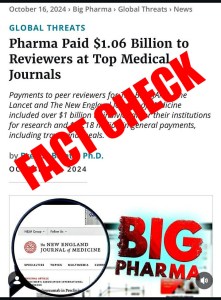
 Science-deniers have a long history of blindly assuming that any research they don’t like must have been corrupted by “big whatever,” and I constantly see people assume a study had conflicts of interest rather than actually checking for conflicts. Lately, a new strategy has emerged, with many people claiming that we shouldn’t trust peer-reviewed studies because “big pharma” is not only paying the authors, but also buying favorable reviews. This claim is based on a gross misreading of a short paper titled, “Payments by drug and medical device manufacturers to US peer reviewers of major medical journals” (Nguyen et al. 2024).
According to many of the commenters on my Facebook page (particularly anti-vaccers), this study proves that medical science is hopelessly corrupt and “big pharma” is just paying reviewers to get their papers through peer-review. When you actually read the study, however, it did not document anything even close to widespread corruption and, as always, science-deniers are simply revealing their own lack of scientific literacy. Indeed, if you understand the peer-review system at all, the claims being made are absurd on their face.
So, let’s quickly dig into how peer-review actually works, what this study actually found, and why the claims being made by science-deniers are completely bogus.
How peer review works in a nutshell
Before looking at this specific paper, we need to understand some basic concepts of how peer-review works. I have previously written several detailed posts about how peer-review works, who reviews papers, and how funding works in science more generally, so I’ll only hit the key points here.
First, peer-reviewers are active scientists with relevant expertise on the topic being studied in a give paper. Journals don’t have a staff of peer-reviewers. Rather, when a paper is submitted to a journal, the editor reaches out to relevant experts (i.e., other scientists) and asks them if they would be willing to review the paper. This process is generally completely voluntary, with reviewers getting, at most, free access to the journal for a limited period. For the vast majority of journals, scientists do not get paid for reviewing a paper. Rather, they volunteer their time.
The voluntary nature of peer-review already puts the claims of corruption on shaky ground, but let’s look further. Not only are the reviewers volunteers, but the authors of the paper have no way of knowing who the reviewers are going to be ahead of time, and for most journals, they are never told who the reviewers were even after review. For some journals authors can suggest potential reviewers, but it is entirely up to the editor which researchers they invite to review a paper, and authors have no way of knowing if their suggestions were followed. This is a devastating problem for the claim that “big pharma is buying reviews,” because there is no way for them to know who the reviewers are going to be. You can’t bribe someone if you don’t know whom to bribe.
Additionally, in most cases, there is another layer of removal between funding agencies (such as pharmaceutical companies) and the review process. Generally speaking, when a scientist receives funding for research, the funding agency has no input or control over the subsequent publications. If a researcher at a university receives a million-dollar grant from Pfizer to do a clinical trial, in most cases, Pfizer doesn’t get to control the resulting publication. Pfizer’s input into the study ends with approving the proposed research and sending the grant money. The scientist submits the paper for publication, not Pfizer.
Admittedly, that is painting with a broad brush as there are countless funding arrangements, and there are situations where companies have more control, particularly when we are talking about researchers working directly for the companies during the initial development phases of a drug, but once it gets to the later stages of clinical testing and, especially, studies after a drug is on the market, funders usually have little direct control over the output.
The paper
With that background now in place, let’s look at what Nguyen et al. (2024) actually found. Their methods were really simple and took a very crude, broad approach. First, they obtained lists of the names of all US-based researchers who served as peer-reviewers in 2022 for four major medical journals (The BMJ, JAMA, The Lancet, and The New England Journal of Medicine). Second, they looked at any industry payments those reviewers had received between 2020‒2022 and determined that 54% of reviewers had received some form of industry payment (1.07 billion dollars total).
To be 100%, crystal clear, these were not payments for peer-review; rather, these were payments made for any reason. So, as was sometimes the case, if a researcher was paid for a speaking engagement, then volunteered as a reviewer for one of these journals, that counted as a payment to a reviewer. Likewise, if someone did a study that was funded by a pharmaceutical company, then voluntarily reviewed a totally unrelated paper, that counted as a payment to a reviewer.
Thus, one of the key problems with the discussion around this paper is that it is often framed as if the payments were for review rather than being for totally separate reasons. Titles like, “Pharma paid $1.06 billion to reviewers at top medical journals” grab attention, but they are wildly misleading. A far more accurate title would be, “Reviewers at top medical journals also received $1.06 billion in unrelated funding.” (actually 1.07 billion)
As a brief aside, I know $1.07 billion sounds like a lot, but most of that (over 1 billion) was funding for research, the vast majority of which was paid to the researcher’s institution. When a scientist gets a 1 million dollar grant, a million bucks doesn’t show up in their bank account. Rather, it goes into a university/institution account, the university/institution takes a huge chunk as overhead, and the rest goes to buying equipment, paying research assistants, etc. (research is expensive). Very little if any goes to the researcher who received the grant (depending on whether they are responsible for funding their own salary). So, when you see those numbers, please remember that the money is generally not going directly to the scientists, and framing this paper as “payments to scientists” is actually highly misleading.
Getting back to the paper itself, an additional issue arises from the fact that “big pharma” is not a single entity. There are lots of different, competing pharmaceutical companies, but the study did not examine who was funding which study. In other words, this paper simply documented any reviewers that had received any industry funding regardless of whether the specific paper being reviewed was funded by the same company that provided the other funding.
As I have written about before (e.g., here and here), there are many studies that have no conflicts of interest and aren’t funded by pharmaceutical companies, but this paper in no way distinguished those studies. So, if a researcher received a grant from a pharmaceutical company, then reviewed a paper that did not receive funding from a pharmaceutical company, the payment to the researcher was still included, even though they were reviewing a non-industry paper. Similarly, a researcher who received research funding from Moderna then reviewed a paper that was funded by Pfizer was still included as an industry payment.
So even beyond the fact that these payments were not actually for peer-review, the level of existing conflicts of interest is not at all clear. The potential conflicts would only exist when a reviewer had received funding from the same company that had funded the paper, but those data aren’t presented, and by the time you consider all of the papers without and conflicts of interest and all of the different pharmaceutical companies out there, that number is going to be a very small portion of that 54%. In other words, the percent of reviewers who reviewed a paper that was funded by the same company that had previously paid them for something is going to by much, much smaller than 54%.
Note as well that this paper only documented the existence of unrelated payments to reviewers. It in no way assessed whether those payments biased reviewers, and even in the subset of cases where a reviewer’s funding and a study’s funding overlap, the idea that an anonymous, volunteer, peer-reviewer is going to be substantially biased in favor of a study because it was funded by a company that had previously given them funding is unlikely on its own. That’s just not how review usually goes.
Finally, even IF nothing else that I had said was true and pharmaceutical companies really were directly paying for favorable reviews (they aren’t), that would still only apply to 54% of reviewers (based on this study). So, if, for example, vaccines actually were dangerous, that would mean that the other 46% of reviewers should be shooting down pro-vaccine papers. The same is true more generally for conflicts of interest. If scientists only supported vaccines because of funding from big pharma, then there should be a clear schism with papers with and without industry funding coming to wildly different conclusions, and that’s just not the case.
In summary, this paper did not show that big pharma is buying favorable reviews, and it did not show that industry funding is biasing review results. It simply showed that reviewers often have work that receives industry funding (no duh).
Don’t misunderstand me, conflicts of interest can bias authors and should be taken seriously, but the crude level of analysis used in this paper doesn’t really add much of anything to the discussion and absolutely does not support the wild claims being made by the good people on the internet.


I think there’s a useful distinction missing in this discussion.Yes, the paper being discussed doesn’t show that peer review is “bought” by pharma, and it’s fair to push back on overstated claims.
But that doesn’t address a broader issue many people experience in healthcare: the strong tendency toward medication-first solutions, especially in primary care.In my experience, lifestyle factors like diet, sleep, stress, and exercise often feel secondary in consultations, even though they are central to long-term health.
Medications can absolutely be necessary and sometimes life-saving, but they can also act as symptom management rather than addressing underlying causes, and they can introduce side effects that create new problems.
So the real question isn’t whether peer review is corrupt—it’s whether our healthcare system consistently prioritises prevention and lifestyle change as strongly as it does pharmacological intervention, especially for chronic conditions.It would be more helpful if the discussion moved in that direction rather than becoming a binary argument of “trust science completely” vs “the system is rigged.”
The reality is more nuanced, and improving health outcomes likely depends on integrating both approaches more effectively.
LikeLiked by 1 person
I was IT support for a Clinical Research Organization (CRO). Aside from being required to attend seminars describing our clinical work, I was responsible for ensuring the data we collected from Phase III trials was properly blinded not only from the field researchers but the study sponsor and our own internal staff. As I sometimes find myself explaining, “Big Pharma” negotiates a study protocol with a CRO. The CRO recruits clinics to recruit patients collect results from treatments according to the study protocol. When the study concludes the data may or may not be unblinded for an in-house statistician, but the formal data analysis is contracted to a third-party. At each stage there are arms-length relationships between sponsor, CRO, and data analysis. As it happens, Big Pharma refused to do business with the CRO because one study results showed the drug had no treatment efficacy. But eventually they came back for subsequent studies because the CRO knew its business and what it was good at.
LikeLike