Evolution is, in my opinion, the most fascinating topic in all of science. It provides elegant, compelling, and enthralling answers for everything we observe in biology. It really is true that nothing in biology makes sense without evolution. Unfortunately, not everyone shares my passion for this topic, and evolution is often poorly taught and badly misunderstood.

Some examples of the comments people were making
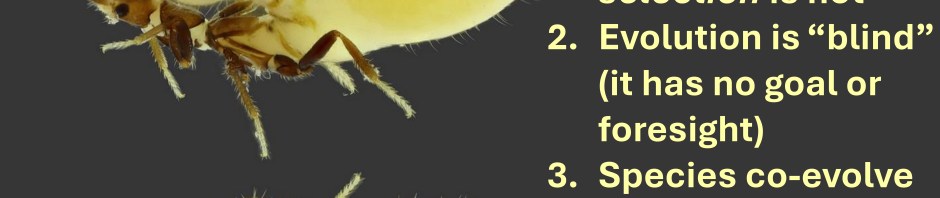
As an illustration of this, I was recently wasting time on Twitter (I refuse to call it X) when I came across someone sharing an article from a few years ago about the discovery of a new species of rove beetle (Austrospirachtha carrijoi) that had evolved a specialized abdomen that made it look like the beetle was carrying a termite larvae “puppet” on its back. The puppet provided a disguise for the beetle and allowed the beetle to live inside termite tunnels and even be fed by the termites!
It’s a very cool discovery, and a fascinating example of the crazy stuff evolution can produce. However, the person sharing the article had a different take, commenting, “random mutation is a retarded explanation for this btw.” Many others chimed in agreeing with him and committing one straw man argument after another. As if that wasn’t bad enough, even many of the people who were commenting in defense of evolution were also badly misrepresented evolution. These comments predominantly followed two paths, either erroneously claiming that mutations are not random or doubling down and asserting that random mutations could create this given enough time.
The reality is more complex and fascinating, and both the original poster and many of the commenters* were missing three critical aspects of how evolution works:
- While mutations are random, natural selection is, by definition, non-random
- Evolution is “blind,” meaning that it has no direction or goal that it is trying to achieve
- Evolution doesn’t happen in isolation. Species co-evolve together.
In the post, I want to walk through each of these using the rove beetle as an example and try to give you a better understanding of how evolution by natural selection actually operates. To any young earth creationists who might be reading, as always, I ask simply that you hear me out and try to actually understand these evolutionary mechanisms. As I’ve written about before, I used to be a young earth creationist, and although I thought I understood evolution, essentially all of my objections to it were actually straw men. Put another way, in this post, I am not trying to convince you that evolution is the explanation for this rove beetle, rather I am simply trying to demonstrate that when properly understood, evolution does, in fact, offer a compelling and rational explanation (see my other posts for evidence that evolution is correct, e.g., here, here, and here).
*Note: some commenters did get it correct by pointing out that mutations alone are a bad explanation but mutations plus natural selection is a very good explanation.
Mutations and selection
First, to be completely clear, genetic mutations are random. Drop any notions you have about mutations being guided, or consciousness affecting mutations, or mutations being biased towards beneficial ones. Mutation is a random process that happens during reproduction, and it (accompanied by genetic crossing over and the independent assortment) results in enormous genetic variation. Most mutations are neutral, a few are harmful, and a few are beneficial (see this post for more details on mutations).
Second, I completely agree that mutations alone would be a very poor explanation for the diversity of life that we see. Even with millions of years and millions of individuals mutating and reproducing, the odds of the exact right set of mutations occurring in the exact right order to create something like a rove beetle (all while avoiding harmful mutations) are astronomical, and when you apply that math to all of nature, it becomes wildly implausible. That’s why natural selection is so important.
This is one of the single biggest misunderstandings about evolution by natural selection: it is not random. Any time you hear a creationist scoff about something evolving “just by chance,” they are committing a straw man fallacy. Mutations are random, but that’s just step 1. The next absolutely critical step is natural selection, which is, by definition, not random.
In each generation, numerous mutations occur, most of which are neutral (those do evolve randomly via genetic drift), but every once in a while, one of them is beneficial. The individuals with that beneficial mutation survive/reproduce just slightly better than the ones who lack that mutation. As a result, they produce more offspring than the other individuals, and that inherently means that the beneficial mutation becomes more common in the next generation (more offspring = more copies of the mutation). Those offspring carry that mutation with them, and, just like for their parents, the mutation gives them an advantage allowing them to produce more offspring, which means even more copies of that mutation in the next generation. Each generation, that mutation becomes more and more common in the population all thanks to simple math. That’s it. That’s how natural selection works. There’s nothing mystical or atheistic about it: it’s just simple math.
Note that I am glossing over some complexities of inheritance that are irrelevant for the core argument, but in many cases it would take two copies of the mutation to have a benefit.
When a negative mutation arises, the process is the reverse. Individuals with that mutation produce fewer offspring, which means that the mutation becomes less common each generation (i.e., nature selects against it).
Note that this process is not random. Which mutations stay and which mutations go is determined by the effects they have, and they are “selected” for or against simply by causing the production of more or fewer offspring. This is critical, because it means species can accumulate beneficial mutations rather than accumulating mutations randomly.
Let’s use dice as an example. Let’s say you have 10 regular, 6-sided dice, and you want to get all 10 on the number 1. We’ll think of each throw as a generation reproducing, and each number as a mutation. The odds of tossing the 10 dice and getting all 10 to land on 1 (i.e., random mutations) are extremely low. In fact, they are 6^10 or 1 in 60,466,176. You could sit there throwing the dice for days and never get it. That’s the random mutation model, and I agree that it is absurd; so now let’s add selection into the mix.
Suppose instead, that every time you get a beneficial mutation (i.e., a 1) it is kept (in the same way that nature selects the beneficial mutations). So now, each time you throw the dice, you keep any 1s, then throw the remainder for the next generation. In this scenario, you’d actually get to a set of ten 1’s very quickly (go try it yourself if you don’t believe me).
Out of curious (and because I’m something of a nerd), I programmed a quick commuter simulation to try this and see how long it would actually take to get ten 1s, and on average, it only took 16.5 throws. We went from odds of 1 in over 60 million to averaging 16.5! That’s the incredible power of selection.
This is why the mathematical arguments against evolution fail: they are focused on mutations while ignoring the selection component. Once you add selection into the equation, it becomes entirely plausible to evolve something like a rove beetle with a termite puppet. The math works.
Evolution is blind
Now that we have cleared up the math, let’s look at the “blindness” of evolution. I really like the dice example I used above except for one important caveat: it gives the false impression that evolution is working towards some ultimate goal (like us trying to get all 1s). In reality, nature is not trying to accomplish anything. There’s no goal in mind. Each generation, the genes that result in the production of more offspring inherently get passed on to the next generation in higher numbers, while the genes that result in fewer offspring inherently are less common in the next generation. In other words, evolution is working one generation at a time.
Species evolve based on their current environment, which means that a trait that was beneficial in one generation can become detrimental in the next generation if the environment changes. Likewise, a trait that was being selected for one reason can get repurposed for something else if the environment changes or the right mutation comes along. Take the wings of a penguin, for example. For the penguins great, great, great, etc. ancestor, the wings were selected for flight, and evolution evolved them accordingly. Then, conditions arose that made being a strong swimmer more important than being able to fly, so evolution repurposed the wings into paddles for swimming. Again, there was no conscious process, it was simply that each generation, the individuals who had slightly better wings for swimming were able to do a better job escaping predators and/or catching food, which resulted in more offspring and more of the genes for improved swimming in the next generation.
Turning back to our rove beetle friend, there is a huge spectrum of insects (including many other types of rove beetle) that have evolved to raid termite and ant colonies, and they range widely from very ordinary beetles (and other insects) that get attacked constantly by the ants/termites to critters like the one in question that are so highly specialized that the termites accept them rather than attacking.
Many rove beetle species have an enlarged abdomen that sticks up over top them and looks something like a halfway point between a regular rove beetle and our termite puppeteer. What good is that blob? Glad you asked. Termites perceive the world largely through touch and chemical pheromones, and in some cases, that swollen abdomen seems to produce pheromones that help the rove beetle go unnoticed in the termite colony. So, selection has been acting on the abdomens to turn them into enlarged hormone factories.
Now we can easily imagine a scenario in which these pheromone-producing rove beetles do great when the termites sniff them, but once the termites start touching, they run into issues, because the beetles don’t feel like a termite (thus blowing their cover). Then along comes a mutation that makes their swollen abdomen slightly more termite-like. Perhaps it constricts at one point like a body segment or has a tiny protrusion like a leg. This makes it slightly less likely that the rove beetle will be detected, which lets it produce slightly more offspring, which results in that mutation becoming more common in the next generation. Then, just like with our dice example, beneficial mutations start to accumulate as each of them is selected and all negative ones are selected against, until eventually, we end up with this stunning example of mimicry. Keep in mind that the mutation doesn’t need to provide an enormous advantage. Any slight increase in survival/reproduction will be enough to shift the math in its favor**.
In that scenario, the swollen abdomen might not have been a very good mimic at first, but that was fine because it was being selected for pheromone production, not tactile mimicry. Then, later on, with the right mutation, evolution shifted course and started evolving a tactile mimic.
To be clear, I don’t know for sure that what I described is that path evolution took, and you can no doubt think of other equally plausible paths. My point is simply that these plausible paths exist, and it is entirely possible to get to this “final” stage of a highly complex mimic one simple step at a time.
For some more examples and discussions of this type of mimicry I recommend Parmentier 2000. Guests of social insects. In Encyclopedia of Social Insects. Springer.
For more details on evolution being blind see this post.
**Note: there technically are cases where other factors do override mutations that are only minorly beneficial. These include things like large amounts of gene flow from other populations and small population sizes, which allow genetic drift to override selection. However, for most large populations, even a tiny benefit gets selected because that is how math works (more offspring = more copies of the mutation).
Species co-evolve
Finally, you may still be thinking that everything I have said is all well and good, except that there is no way for the process to get started because a half-formed mimic would surely be detected. Put another way, if evolution was the cause of this superb mimic, then it is inherently true that even a slightly less superb mimic would not do as well. So how could my hypothetical example of a mutation that causes a rove beetle with a swollen abdomen to get a slight constriction possibly be advantages? Wouldn’t the termites detect that right away?
The answer is simply that we are seeing the late stage of an evolutionary arms race that has been going on for a very long time. It’s like looking at a modern fighter jet and asking how a biplane could ever have been useful. The answer, of course, is that when biplanes were in use, they were going up against other biplanes, and we only got to modern fighter jets by different militaries constantly trying to outdo each other (here again, evolution is not consciously trying to do anything, but the same sort of arms race still occurs due to the math).
So, let’s back the clock up several million years and return to my example of a rove beetle who has a swollen abdomen for pheromone production, then gets a mutation for a constriction on the abdomen. At that stage, the termites would be naïve to that sort of trickery. They would not have the ability to distinguish even a poor mimic because they’ve never faced that problem. This would give our rove beetle a slight advantage, but it would also create a selection pressure on the termites to do a better job identifying mimics. So, termite colonies that have genes that make them slightly less trusting of the rove beetles with constrictions will do better, produce more offspring, which means more genes, etc. This puts the evolutionary pressure back on the beetles, resulting in a selection pressure for any further mutations to make them more termite-like, but every time the beetle adapts, the pressure flips back to the termites. Every time the beetles evolves better mimicry, the termites evolves better mimicry detection, and every time the termites evolves better mimicry detection, the beetles evolves better mimicry. Back and forth the two go for millions of years, each evolving in response to the other’s adaptations.
Isn’t that neat? I find it absolutely fascinating, and I have very distinct memories of learning about these arms races for the first time as an undergraduate (bats and moths were the key example there). Learning about this topic really opened my eyes and helped me to understand the true power and flexibility of evolution. I hope it has helped you as well.
Conclusion
I hope you can now see that evolution provides a rational, internally consistent, and compelling explanation for how something like a rove beetle that mimics termites could come into existence. Creationism, in contrast, lacks a compelling explanation. All creationists can do is shrug their shoulders and say, “God wanted it that way,” but that’s a cop-out, not an explanation. To those of us who want to understand the natural world, it is completely unsatisfactory (further it runs into all sorts of issues if you believe in things like Noah’s flood: how did that beetle and its termite host survive the flood, then find each other afterwards and make it all the way to Australia?). Evolution by natural selection is the only reasonable explanation, and you simply cannot understand biology without it.
The paper in question is: Zilberman and Pires-Silva. 2023. A new species and morphological notes on the remarkable termitophilous genus Austrospirachtha Watson from Australia (Coleoptera: Staphylinidae: Aleocharinae). Zootaxa 5336
Related posts
- Evolutionary mechanisms part 1: What is evolution?
- Evolutionary mechanisms part 2: Simulating evolution
- Evolutionary mechanisms part 3: The benefits of mutations
- Evolutionary mechanisms part 4: Natural selection
- Evolutionary mechanisms part 5: Sexual selection
- Evolutionary mechanisms part 6: Genetic drift
- Evolutionary mechanisms part 7: Gene flow
 The Logic of Science
Nicely done!
Ken Gerow Professor Emeritus of Statistics University of Wyoming
LikeLike