
 Yesterday, I posted the fairly innocuous image above on the TLoS Facebook page, and the results were both fascinating and horrifying. Numerous people took time out of their day to embarrass themselves by doubling down and attacking fact-checkers, often with truly deranged comments that were totally detached from reality and clearly illustrated why fact checking is so important. Further, multiple people (all on one side of the political aisle) incorrectly interpreted this as a political post, a response which is delightfully revealing. Given the responses that this post engendered, I think it will be instructive to clarify several points and discuss some of the comments. This is hardly the first time that I have written about fact-checking, and you can read a much longer post on it here.
 First, I want to deal with the strawman that I was suggesting that people should blindly believe fact-checkers (see a selection of such comments to the right). I have never said anything of the sort, and, in fact, the original post wasn’t about professional fact-checkers at all. Rather it was about individuals checking facts before believing something.
That said, professional fact-checking organizations like Snopes, Politifact, and FactCheck.org are extremely valuable (as are science and skepticism websites that often play the role of fact-checker); however, these sources are valuable not because they are authoritative, but rather precisely because they are transparent and cite their sources. I’d never suggest that someone should blindly believe a source like Snopes, but the break-down of why and how they came to their conclusion and what sources they used is incredibly useful. You don’t have to blindly believe fact-checkers because you can look at their sources and verify what they are saying! You can also cross-check multiple fact-checkers to see if they are in agreement or if one has uncovered information that the others missed.
Fact-checking doesn’t mean finding a source you like and blindly believing it. Rather, it means checking multiple sources, verifying the claims they make, and tracing things back to their origin as much as possible.
Other comments went a step further and asserted that fact-checkers are unreliable, biased, and often wrong. When pressed for data to back up those claims, however, no one managed to cite actual evidence, and the attempts were often hilariously flawed.
 Let’s look at one case that I found particularly amusing. After a general statement against Snopes, the person in red doubled down with the claim that Snopes had testified before Congress that their fact checks were actually opinions (note that they did not specify Snopes, but that was the subject being discussed, and the “the” appears to be a typo for “they”). This would have been a great place for red to fact-check before posting, because Google failed to reveal any such testimony, and when pressed for evidence that such a confession had taken place, red posted a NY Post article about Facebook (not Snopes) testifying in a trail (not before Congress), and the NY Post article took things wildly out of context (as it often does). When this was pointed out to red, rather than admitting his mistakes, he doubled down and accused everyone else of being the blind, biased ones.
This exchange is very typical of my experience talking to people who ridicule fact-checkers. Their disdain of fact-checkers is not actually based on evidence or facts. Rather, it is based on their preconceptions about fact-checkers (because fact-checkers often say they are wrong) and their view is propped up by erroneous claims that they have never bothered to fact-check! Further, when caught in an error like this, it is also typical (in my experience) to try to claim that everyone else is the problem rather than just admitting the error.
Don’t be that person. Don’t be the person in red. Fact check before you form your opinions, and if you are caught in an error, just admit it! There’s nothing wrong with being wrong. We’re all humans; we all make mistakes. Mistakes are only a problem when you refuse to acknowledge and correct them.
More broadly, the point here is that while fact-checkers are not infallible, and you absolutely should verify what they are saying, they are really useful, and these claims that they are horribly biased and unreliable have no basis in reality. Having said that, let’s talk about the claim that Facebook admitted that their fact-checks are just opinions for a second, because this one comes up a lot.
First, let me state for the record that Facebook’s fact-checking is admittedly not always the best. It’s not one that I would usually recommend, and it is highly variable with different organizations responsible for the fact-checks in different countries. Most of us science bloggers have had stuff incorrectly flagged by Facebook. Nevertheless, let’s look closer.
Without getting too into the legal weeds, the case was 5:21-cv-07385-VKD, in which John Stossel asserted that Facebook had defamed him in how they rated the factualness of some of his posts. Facebook then made the legal argument that their fact-checkers were simply stating their opinion based on the claims made in his posts. This word, “opinion” was then picked up and taken out of context to assert that fact-checks are just “opinions.”
I really hate semantic arguments, but we need to get into one here. The word “opinion” has different meanings in different contexts. If I say, “in my opinion, bananas are the best fruit,” that is an entirely subjective statement that is based on nothing more than my personal preferences. That is, however, extremely different from something like a doctor saying, “having reviewed your case, in my professional opinion, your best option is surgery.” The latter is a statement based on data and years of experience. See how they are different even though they both use the word “opinion”?
Now, let’s imagine a fact-checker has been carefully reviewing an article. They have looked at the claims made in the article, they have checked them with good sources to the best of their ability, and now they need to make a judgement: is the article completely false, mostly false, misleading, mostly true, totally true, missing context, etc. At the end of the day, that is a judgement call they have to make, and especially in a legal context, we could call that an “opinion.” Again, fact-checkers are not infallible, divine arbiters of absolute truth. They can and do make mistakes, but an “opinion” about how an article should be rated based on a very careful consideration of the evidence is a very different thing from the type of “opinion” that I have about bananas. Despite what outlets like the NY Post would like you to think, the fact-checkers aren’t sitting around going, “well in my opinion Trump sucks, therefore this claim he made is false.” That’s not how this works, and these attacks based on the word “opinion” are highly misleading.
Also, note that some things are very clearly, objectively true or false (in which case an opinion is not being expressed), whereas others (such as the ones in the court case in question) contain a mixture of true and false information or information that is presented in a potentially misleading way. Those situations are much harder to judge (and require more of a subjective call) than something like someone saying “the unemployment rate is X” when it is actually Y.
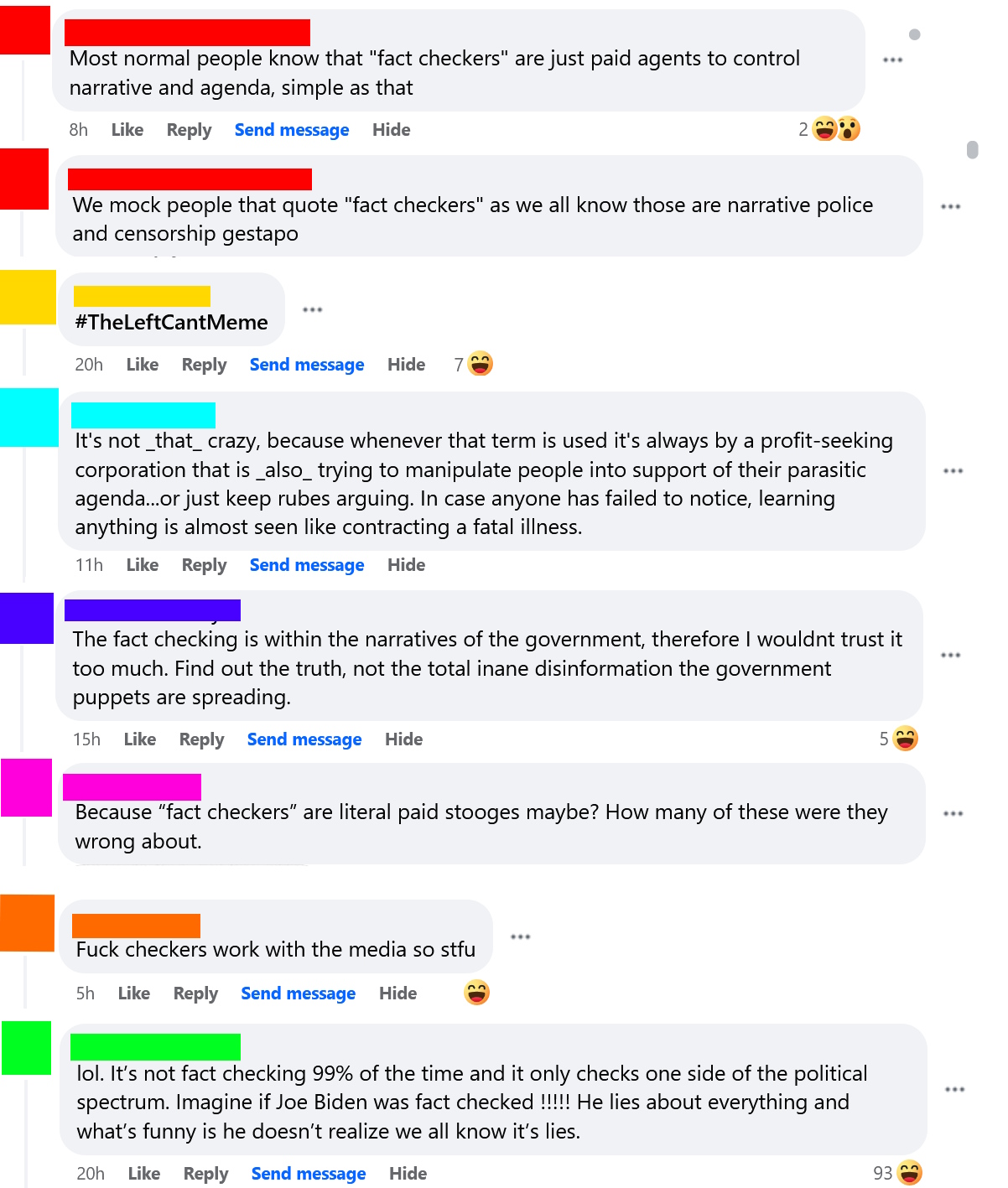 Finally, let’s briefly turn to politics for a second, because when I made my initial post something fascinating happened. The post was not even remotely political. Nevertheless, a bunch of people came crawling out of the woodwork to claim that it (or fact-checking more generally) was part of some leftist agenda. That is, in my opinion, a fascinating and hilarious self-own. It is fundamentally an admission by these people on the right that the facts are not on their side.
I don’t want to dwell on left vs right politics, however, and instead want to look at the claims being made and apparent mindset of the people making them, because they are instructive and illustrate, once again, that people are making claims based on their preconceptions, not facts.
Take, for example, one person who boldly asserted that fact checkers only check the right and don’t fact check people like Biden. This is, of course, completely untrue, and if the person making the claim had spent just a few seconds on Google, they quickly would have found Joe Biden’s Politifact file and tons of other outlets fact-checking him and other liberals (Politifact literally gave Obama one of their “lie of the year” awards). This person didn’t do that fact-checking, however, because they have a world view that is not based on facts and is incompatible with the facts. That is the problem here, and it extends to far more than just politics. People become so entrenched in their world views that they no longer bother to verify what is and is not true and become allergic to anything that opposes their world view.
This problematic mindset was on full display in all the comments baselessly asserting that all fact-checking organizations are paid shills secretly working for the liberals. This is fundamentally the same conspiracy theorist thinking used by anti-vaccers, climate change deniers, flat earthers, etc.: if the facts and experts disagree with me, it must be a conspiracy. This is a very easy trap to fall into, but it is deeply problematic.
I’ve written a lot about this sort of conspiracy thinking before, and I’m tired and just don’t feel like going into it right now, so let me instead simply say this: when all the evidence is against you, whether that be scientific studies or the facts presented by fact-checkers, you can either stick your fingers in your ears and shut your eyes and claim it is all a conspiracy, or you can do the rational thing and stop and ask yourself, “am I wrong?” You have nothing to lose by fact checking and everything to gain.
Be humble, accept that there are others who know more than you, be willing to be wrong, and fact-check before you believe something and, especially, before you make a fool of yourself by posting it online for everyone to gawk at.
Related posts
- Don’t mistake an assumption for a fact
- Facts aren’t political (or religious)
- Facts: Why they matter and how to check them
- Occam’s razor is about assumptions, notsimplicity
- The Rules of Logic Part 5: Occam’s Razor and the Burden of Proof
- The Rules of Logic Part 6: Appealing to Authority vs. Deferring to Experts
- What would it take to convince you that you were wrong?
 The Logic of Science