Evolutionary mechanisms part 1: What is evolution?

theodosius dobzhansky quote nothing in biology makes sense except in the light of evolutionI am utterly enamored with evolution. To me, it is not only the central concept of biology, but it is the single most interesting topic in all of science. Nothing fascinates me as much as evolution. Unfortunately, when I tell people about evolution, I am usually debating creationists rather than simply teaching. This irritates me because I really prefer to think of myself as a science educator rather than a debater, and I would prefer to spend my time explaining the marvelous intricacies of evolution, rather than wasting it trying to convince someone that dinosaurs and humans never coexisted. Therefore, I have decided to briefly forgo the argumentative topics that characterize this blog, and instead write a series simply explaining evolution and why it is so freaking cool. My experience has been that even most people who accept evolution don’t really understand it, and most creationists reject it largely because they don’t understand it. So I hope that this series will be of wide interest regardless of whether or not you accept evolution as the fantastic scientific fact that it is. In this first post, I will simply lay the basic groundwork, and in future posts, I will explain the details of the different evolutionary mechanisms (selection, gene flow, genetic drift, and mutation). Throughout this series, I will use a simulator to illustrate how these mechanism operate.


What is evolution?

If you ask a group of people to define evolution, you will get a wide range of answers, almost all of which will be wrong or at least incomplete or inaccurate. Part of the problem stems from the fact that the term “evolution” can mean several different things. At the most basic level, we have the process of evolution. This is simply the change in the genetic makeup of a population over time. At a higher level, we have the fact of evolution. This is the scientific fact that life on earth has evolved over billions of years (despite what creationists will tell you, this fact has been repeatedly confirmed by genetics, the fossil record, biogeography, etc., and it is settled science). Finally, at the highest level, we have the theory of evolution by natural selection. This is the theory that natural selection has been the dominant mechanism that has caused evolutionary change.

Let me describe the relationship among these three uses of the term “evolution” another way. The process of evolution can happen through a number of different mechanisms (genetic drift, selection, gene flow, and mutation). All of these cause the genetic makeup of a population to change from one generation to the next. These small changes (what are often called microevolution) accumulate over time, ultimately resulting in large changes which are often referred to as “macroevoltuion.” There is no difference in the mechanisms of micro and macroevolution. Rather, macroevolution is just an accumulation of microevolutionary steps, and it is a fact that those changes have been slowly accumulating over billions of years, ultimately resulting in the evolution of all of the living things that we see today. Nevertheless, the question remains, what caused the evolution? This is where the theory of evolution comes in. Remember, theories always explain facts, and the theory of evolution by natural selection explains the fact of evolution by proposing that natural selection is the primary mechanism that has driven the process of evolution throughout the history of life on earth.


The process of evolution: simple genetics

Throughout this series, my focus is going to be on the process of evolution, and I want to specifically look at the various mechanisms of evolutionary change, but first we need to get several terms and definitions straightened out. The best way to define the process of evolution is, “a change in the allele frequencies of a population over time.” The two important parts of that definition are “allele frequencies” and “population” so let’s look at each of them.

Allele frequencies
Hopefully everyone reading this realizes that most of your traits are controlled (at least partially) by your DNA, and those traits can be passed onto your offspring. If I asked you, for example, why your eyes are the color that they are, you would probably say, “because I got the genes for that eye color from my parents.” That response would, however, not actually be correct. You see, most people say “gene” when they really mean “allele.” A gene is just a section of DNA that codes for a specific type of trait. So, for example, you have a gene for eye color (actually several, but more on that later), but the gene doesn’t actually determine what color your eyes will be, the alleles do that. For most genes, there are multiple alleles and the alleles determine the expression of the gene. Thus, you don’t get the gene for blue eyes. Rather, you get the gene for eye color and the alleles for blue eyes.

A common example of this is the pea plant. Pod color in pea plants is inherited through complete dominance, and is typically illustrated using a dominant green allele (G) and recessive yellow allele (g). Hopefully you all remember high school biology, but I will briefly review just to be sure. For each gene, an individual has two alleles (one from each parent), but which allele will get passed onto their offspring is random. Thus, if a pea plant was Gg, on average, 50% of its offspring would receive the dominant allele (G) and 50%would receive the recessive allele (this randomness is going to become very important in later posts on genetic drift). Further, which alleles an individual receives determines how the gene will be expressed. In complete dominance, the dominant allele completely masks the recessive allele, so both Gg and GG individuals will be green. Thus, green is their phenotype (the expression of the alleles) whereas Gg and GG are the genotypes (the actual alleles that they possess). The only way to get a yellow phenotype is to receive two recessive alleles (gg).

Now, let’s tie all of this back into evolution. Remember, the process of evolution is simply the change in the allele frequencies of a population over time. So, for example, let’s say that a population of pea plants had 50% G alleles and 50% g alleles. Those would be the population’s allele frequencies (i.e., 50% G, 50% g). Now, let’s say that for some reason, being yellow was disadvantageous. In other words, gg individuals produced fewer offspring than GG and Gg individuals. This would result in fewer g alleles getting passed to the next generation. Thus, the allele frequencies for the next generation would be shifted towards G alleles (e.g., they might be 60% G and 40% g). In that case, we would say that the population had evolved because the allele frequencies had changed. Specifically, that population would have evolved by natural selection, but the other evolutionary mechanism all also work by manipulating the allele frequencies. Some of these mechanisms (such as genetic drift and gene flow) can even be harmful to the population (yes, evolution can actually be a bad thing), but I’ll explain that in future posts.

Finally, it’s important to realize that most traits are polygenic (i.e., influenced by multiple genes), and most genes have many different alleles. Thus, while we often use simple examples that involve only one gene with two alleles, most traits are considerably more complicated than that. In fact, even most of our text book examples are actually very complex and are not nearly as simple as we are led to believe in introductory courses (you can find good explanations of many of them here). This is extremely important because these polygenic, mutli-allele traits provide extraordinary variation for evolution to work with, and, as I will explain more in future posts, most evolutionary mechanisms require variation.

Populations evolve
This should be obvious from the discussion above, but I’ll explicitly state it anyway: populations evolve not individuals. Because evolution deals with allele frequencies, it is inherently impossible for an individual to evolve. Whenever we talk about evolution, we are talking about changes that are taking place within populations, not individuals.


Introducing the mechanisms

I have mentioned the various evolutionary mechanisms several times now, and each of them will get their own post later on, but for right now, I want to give a brief definition of each of them. I also want to note that even young earth creationists accept these mechanisms (with the possible exception of mutations). They simply make the absurd and ad hoc claim that accumulating small changes somehow doesn’t lead to a large change.

Natural selection
This is the most well known mechanism. The concept is really quite simple: individuals with the best alleles will survive better and produce more offspring than individuals with alleles that are not as useful. Thus, by virtue of the fact that individuals with good alleles produce the most offspring, there will be proportionately more good alleles in the next generation. In other words, the allele frequencies shift from one generation to the next, with the beneficial alleles gradually becoming more common.

Genetic drift
This is a random change in allele frequencies, and it can happen several different ways. For example, a catastrophe may randomly kill off a large number of individuals, and if the group that died had different allele frequencies than the population as a whole, then the allele frequencies of the surviving population will be different from the allele frequencies of the original population. Thus, the population will have evolved. Another way that this happens is through the random chance involved in which alleles get passed. Remember, each individual has two alleles for a give gene, but which allele they pass to their offspring is random. So if just by chance, the g allele gets passed more than the G allele, that will cause the population to evolve, because the allele frequencies will change. Regardless of the details, the key here is that genetic drift is always random.

Gene flow
Gene flow is simply the exchange of genes among two or more populations. Imagine for a minute that one population has only the G allele, while a neighboring population has only the g allele. Then for some reason, individuals from one population end up moving into the neighboring population and breeding with its individuals. This would result in Gg individuals. Thus, the population would have evolved because, once again, the allele frequencies would have changed (i.e., the frequencies were 100% G and 0% g, but now there are some g).

Mutation
Mutations are random changes in the genetic code. They are usually neutral, but a small subset are beneficial and a small subset are harmful. Mutations are extremely, extremely important for evolution because they are the only way to generate new genetic information. Both selection and genetic drift actually remove variation from a population. Conversely, gene flow can add variation to a population, but it doesn’t actually create new genetic material. Rather, it simply moves it between populations. Thus, without mutations, species would slowly loose genetic variation until eventually, all individuals would be genetically identical.

Concluding remarks

At this point, I have covered the essential basics of what evolution is, and how it works. Because I was just trying to go over the fundamentals, this post has probably been fairly dry and boring, but I expect future posts to be far more interesting as we delve into the details of the evolutionary mechanisms. So stay with me, and by the end of this, I think that you will agree that evolution really is the most glorious and fascinating process imaginable.

Other posts on evolutionary mechanisms:


Posted in Science of Evolution, Uncategorized | Tagged , , , , , | 5 Comments

Supporting science isn’t the same as supporting big business

Hardly a day goes by without someone accusing me of being a “shill.” You see, I have the audacity to say that we should be getting scientific information from reputable scientific sources (i.e., the peer-reviewed literature), rather than trusting blogs, conspiracy theorist websites, etc. In the minds of science deniers, however, that can only mean one thing: I have sold my soul to Monsatan/Big Pharma and am now a hired gun who roams the internet spreading propaganda. Even those who don’t go quite to that extreme often claim that I am “in love with Monsanto” or am a big supporter of pharmaceutical companies, but nothing could be further from the truth. I have never received any money from a corporation, nor do I particularly like big business. In fact, I am pretty left-leaning on most economic issues.

So if I don’t like big business, why would I spend so much time and effort promoting GMOs, vaccines, etc.? It’s really quite simple: a veritable mountain of evidence says that GMOs are safe, vaccines don’t cause autism, vaccines save lives, etc. I support the science not the companies who benefit from the science. It is entirely possible to loath a company’s business policies and still think that their scientific claims are correct.

If, for example, it was announced that Monsanto had gone bankrupt and was shutting down, I wouldn’t care (provided that their research would be picked up and carried forward by other parties). That stipulation is, however, extremely important. You will, at times, see me “defend” Monsanto/Big Pharma, but that’s not because of any particular love that I have for those companies. Rather, it is because they research, design, and produce marvelous technological and medical wonders. Whether you like it or not, it is a fact that vaccines save lives, GMOs increase crop yields (especially in developing countries), some GMOs provide vitamins that aren’t in traditional crops, etc. So, I become irritated when people attack these companies, because they invariably use their assaults on the companies as arguments against the companies’ products, and that’s not logically valid. I don’t necessarily support the business models of major companies, but I do stand by the science, and I refuse to allow economic ideology to interfere with scientific advances.

Now, at this point, someone will inevitably start dredging up examples of companies behaving unethically, and they will use those examples as evidence that we can’t trust the companies. More often than not, the examples are inaccurate or downright lies, but a handful of them will actually be true, to which I say, “so what?” Again, I support the science not the companies. Big corporations are undeniably concerned primarily with their own bottom line, and they will behave unethically to protect it. I’m not denying that, but that fact doesn’t automatically make their products dangerous. For example, Toyota is primarily concerned with its profits (as are all major companies), and if you do some digging, I’m sure that you can find evidence of situations where its CEOs behaved unethically, but that doesn’t mean that they falsified their safety tests or that Toyotas are actually death traps. Even so, the fact that pharmaceutical companies are primarily concerned with profits and at times behave unethically does not automatically mean that their products are dangerous. That’s a simple application of consistent reasoning.

It’s also important to note that there are numerous independent scientists, institutions, non-profits, and small private companies involved in the research and testing of GMOs, vaccines, etc. Anti-scientists often pretend that those people/organizations don’t exist, and they have a tendency to assume that all studies are biased (just as they assume that I am a shill), but that’s not reality. For example, in this post, I discussed several vaccine safety trials that were not in anyway affiliated with pharmaceutical companies.

Finally, let’s not forget that the anti-science position is also often associated with major companies. As I have previously pointed out, Whole Foods (a massive organic food chain) makes almost as much money as Monsanto. In fact, the Organic Trade Association reported that in 2014, people spent over 39 billion dollars on organic products in the US alone! So if supporting GMOs makes me a shill for Monsanto, why doesn’t supporting organic food make you a shill for Whole Foods? Please explain to me how that isn’t a big bushiness. Similarly, Americans spend 34 billion dollars annually on “natural treatments” and “alternatives” to pharmaceuticals.  So don’t accuse me of supporting big business while you defend extremely profitable nonsense like acupuncture, natural remedies, and magic water (i.e., homeopathy).

In conclusion, supporting science and supporting big business aren’t the same thing, though at times they do overlap. If you don’t trust major companies, that’s fine, neither do I, but I do trust the scientific method, and I stand by results that have been constantly replicated by numerous scientists from around the world. I agree that companies should be tightly regulated, and I agree that we should demand transparency and independent verification of their claims, but once that verification has been achieved, we should accept their results, and we absolutely cannot misconstrue attacks against a company as arguments against their science. In short, I support science, regardless of whether or not it agrees with the positions of major companies (you’ll notice that I don’t side with oil companies, which are, btw, among the largest corporations on the plant).

Literature cited (none of which had ties to corporations, btw)


Posted in GMO, Vaccines/Alternative Medicine | Tagged , , , , , | 8 Comments

No one thought that Galileo was crazy, and everyone in Columbus’s day knew that the earth was round

A portrate of Galileo Galilei

Galileo Galilei

It’s a common situation that I run into frequently: two people are debating about some scientific concept, and one of them is arguing for the mainstream view and supporting their arguments with the relevant literature. Meanwhile, the other one is “supporting” their arguments with blogs, personal anecdotes, and discredited papers. The debate eventually reaches a point where the anti-scientist realizes that a mountain of evidence and a strong scientific consensus opposes them, but rather than admitting the problems with their view, they instead invoke either Galileo or Columbus with arguments like, “well everyone thought that Galileo was crazy, but he turned out to be right” or “in Columbus’s day, every ‘knew’ that the earth was flat, but they were wrong, so why should I trust what scientists ‘know’ today?” Politicians have also been known to use these faulty arguments to support their non-sense. For example, in an attempt to defend the fact that he denies the science of climate change, presidential hopeful Ted Cruz said,

“Today, the global warming alarmists are the equivalent of the flat-Earthers. It used to be [that] it is accepted scientific wisdom the Earth is flat, and this heretic named Galileo was branded a denier.”

At their core, these arguments are just a variation of the fundamentally flawed argument that scientists shouldn’t be trusted because they have been wrong in the past (debunked here). Nevertheless, I want to look more closely at these examples, because not only do they not work, but they actually strongly oppose anti-science positions.


Columbus challenged the size of the earth, not it’s shape
Let’s start with Columbus. The common trope which we are all familiar with is that everyone in Columbus’s day thought that the earth was flat and Columbus would simply fall off of the edge if he tried to sail around it, but he thought that the earth was round and you could sail from one side to the other. That story is, however, nothing more than a wonderful fairly tale. No one in Columbus’s day thought that the earth was flat. The idea that the earth is round dates all the way back to the Greek philosophers, and it was nearly universally accepted well before Columbus set sail. So the debate in Columbus’s day was over the size of the earth, not its shape. You see, the most widely accepted estimate of earth’s circumference in Columbus’s time was 40,250 to 45,900 kilometers (25,000 to 28,500 miles), but Columbus thought that it was much smaller, only about 30,200 kilometers (18765 miles). So the debate was not about whether or not Columbus would fall off the edge of the earth. Rather, the debate was about whether or not he could survive such a long voyage. The ships of that day could not carry enough supplies to make it all the way to the other side of the planet if it was actually 40,250 kilometers in circumference. So people thought that his voyage was fool-hardy because they thought that he would run out of supplies part way.

Now, here is the really important part: Columbus was wrong! The actual circumference of the earth is 40,074 kilometers (24,901 miles), which is remarkably close to the well-accepted estimate in Columbus’s day, and way off from the number that Columbus had calculated. If it hadn’t been for the existence of North America and the Caribbean islands (which were previously unknown to most Europeans), Columbus and his crews would most likely have died.

In short, yes, Columbus was ridiculed, and people did think that he was crazy, but their derision was completely justified! Just like the modern anti-scientists, he ignored the well-established science and plowed forward, blindly following his own ignorance with reckless abandon. So, to any science deniers reading this, by all means compare yourself to Columbus, because you actually have a lot in common with him. You both have “done your own research,” you both defiantly ignore experts and the scientific consensus, you both allow your biases to cloud your judgment and drive you to make dangerous decisions, and you are both dead wrong.


No one thought that Galileo was crazy
Let’s get a couple of things straight about Galileo. First, he got in trouble for claiming that the earth moved around the sun, not that the earth was round. As explained above, everyone knew that the earth was round long before Galileo.

Second, no one accused him of being crazy. There were people who thought he was wrong, but he was never viewed as a raving lunatic. Further, he had support from many of his fellow astronomers. A large number of his colleagues thought that he was right. The people who disagreed with him were, in many cases, disagreeing because of religious reasons, not scientific reasons. In other words, they did not like the implication that the literal interpretations of certain Biblical passages (such as Joshua) were wrong; therefore, they insisted that Galileo must be incorrect. Let me describe this another way. One one side, you had Galileo with hard facts, careful observations, and rigorous calculations. On the other side, you had religious fanatics who were blindly rejecting Galileo’s facts because those facts didn’t agree with their preconceived biases. To be clear, there were also astronomers who disagreed with him, but it was the religious implications that really got him in trouble. Also, the astronomers who disagreed with him weren’t doing so because they had strong evidence that said he was wrong. Rather, they were disagreeing with him because he was proposing a fundamental shift in how we view the world (i.e., a rejection of Aristotle’s views of matter and motion). In other words, they were disagreeing with him because he was arguing against their biases and preconceptions, not because they had opposing evidence.

Now, let’s apply that to the modern anti-science movement. If you are arguing against climate change, vaccines, evolution, etc. you do not get to invoke Galileo because in any accurate analogy, you are the religious fanatics (or the astronomers who blindly clung to Aristotle). For example, when it comes to climate change, on one side we have scientists who have collected an enormous mountain of data and published thousands of studies, and on the other side, we have the deniers who have no data and rely instead on personal biases and logically invalid arguments like, “well it changed naturally in the past, so it must be a natural change now.” Similarly, we have thousands of studies which show that vaccines are safe and effective, yet those studies are opposed with anecdotes, “mommy instincts,” and fear-mongering.

In short, the idea that Galileo was a ridiculed rogue who dared to defy the consensus and turned out to be right is completely inaccurate. He certainly challenged the views of his day, but he did so with actual evidence, and many scientists realized that he was right. That is completely and totally different from claiming that the studies showing that vaccines don’t cause autism must be wrong because you know someone who was vaccinated and got autism, or that some “miracle cure” must work because you’ve done “thousands of hours of research” and the internet has assured you that it is legitimate. If you have numerous properly conducted, carefully controlled, peer-reviewed studies, with large sample sizes that have been replicated by other independent scientists and show that homeopathy works, GMOs are dangerous, acupuncture is effective, evolution isn’t true, etc. then you get to be Galileo. Until then, you are the religious fanatics who are opposing progress because of your own biases and misconceptions.

Posted in Uncategorized | Tagged | 18 Comments

The Rules of Logic Part 7: Using Consistent Reasoning to Compare Apples and Oranges

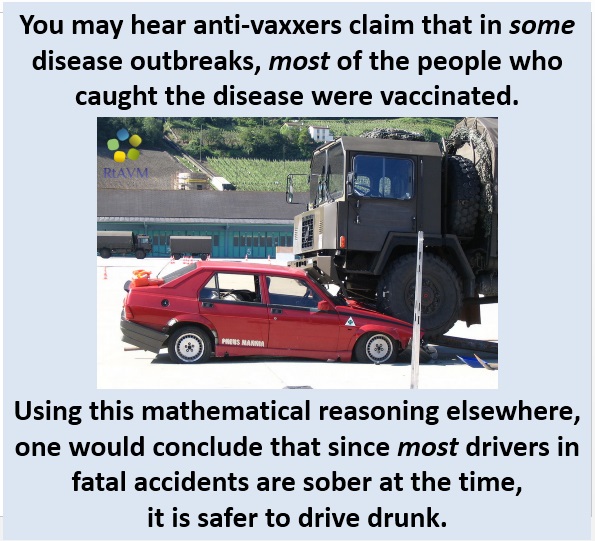
drunk driving analogy, vaccines, anti-vaccers

An example of inconsistent reasoning among anti-vaccers. Image via Refutations to Anti-Vaccine Memes

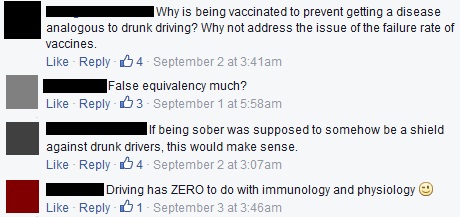
Using consistent reasoning simply means that you use the same type of thinking or the same logical structure across your various views and arguments. In other words, the arguments that you use to support one position cannot conflict with the arguments that you use for another position. This is a fundamental requirement of the law of non-contradiction. It is, therefore, vital to make sure that your views are internally consistent, and pointing out inconsistent arguments can be an extremely powerful debate tool (it’s actually among my favorites). Nevertheless, many people struggle to spot conflicts among their views, and when those inconsistencies are revealed to them, they often have trouble processing the problem. For example, on my blog’s Facebook page, I recently shared the image above, and I got all sorts of bizarre responses, such as the ones below.inconsistent reasoning All of these responses represent a fundamental misunderstanding of the argument being made in the meme. The argument is about the reasoning behind anti-vaccer’s claims, not the facts. In other words, when you make analogous arguments, it is the logic which must be analogous, not the topics of the arguments. Given that so many people seem to struggle with this, I am going to explain why consistent reasoning is so important, and explain an easy method for both testing for consistent reasoning as well as pointing out inconsistencies in people’s arguments. I will begin with some neutral examples, then move on to some real life examples (including the aforementioned meme).


The structure of an argument

Before I can explain what is meant by “consistent reasoning,” I have to review the basic structure of an argument. All arguments consist of premises and a conclusion. The premises are the known facts. They are the evidence that you are bringing into the debate, and the conclusion is the point that you are attempting to prove. If the argument is a good argument, then the conclusion will follow necessarily from those premises. In other words, the structure of the argument will lead from one premise to the next in a way that makes the conclusion inevitable (i.e., if the premises are true, then the conclusion must be true). So when we talk about reasoning, we are talking about the structure of the argument, not the actual facts used in the argument. This is very, very important. The facts are irrelevant to the reasoning, so you can point out inconsistencies in reasoning by using totally unrelated topics (e.g., driving and vaccines) or even by using hypothetical situations (more on that later). To put it another way, it’s fine to compare an argument about apples with an argument about oranges, just so long as the structure of the two arguments is identical.

Let me use a simple example to illustrate what I mean. Suppose that Bill is taller than Bob, and Bob is taller than Sue. This means that Bill must be taller than Sue. If you put that into a formal structure known as a syllogism, we get the following:

  • Premise 1: Bill is taller than Bob
  • Premise 2: Bob is taller than Sue
  • Conclusion: Therefore Bill is taller than Sue

In order to examine the structure or reasoning of this argument, we need to remove the actual facts and look at the skeleton that remains. In other words, we need to remove the people. This gives us the following:

  • X is taller than Y
  • Y is taller than Z
  • Therefore X is taller than Z

That is the structure or reasoning of the argument, and if it is a good structure, then it should apply any time that we have an item (X) that is taller than a second item (Y), and the second item is taller than a third item (Z). I could, for example, say:

  • A giraffe is taller than a cow
  • A cow is taller than a tick
  • Therefore a giraffe is taller than a tick

Notice, the facts being used in the argument are now totally different, but the reasoning or the structure of the argument is identical (note: this particular example is an illustration of a logical rule known as the law of transitive properties).


Testing for consistent reasoning

The best way to test for consistent reasoning is to do what I did above. Namely, write the argument as a syllogism, then remove the actual topic of interest and see if the structure of the argument still works for other situations (specifically, other views held by you or your opponent). Setting up analogous situations like this is extremely useful because it eliminates the biases surrounding the actual topic being debated. When you do this, if you can find even one situation in which the structure results in an incorrect conclusion (or a conclusion that you or your opponent disagrees with), then you have just shown that inconsistent reasoning is being used, and the logical structure must be flawed. Remember, an argument with a good structure and true premises will always produce the correct conclusion (more on that here). So if you can find a single example where the premises are true but the structure produces a faulty conclusion, then you know that the structure is bad.

Let me illustrate this with a silly example that I have used before. Suppose that I said, “Indiana Jones and the Last Crusade is one of the best movies ever made because Harrison Ford is in it.” This argument claims that Ford’s presence alone is enough to make a movie one of the greatest ever, which seems like a faulty claim, so let’s examine it further. First, let’s put the argument into a syllogism.

  • Harrison Ford is in Indiana Jones and the Last Crusade
  • Therefore Indiana Jones and the Last Crusade is one of the best movies ever made

Now, let’s remove the actual topic of interest.

  • Harrison Ford is in X
  • Therefore X is one of the best movies ever made

Now the reasoning behind the argument is easy to test. It should be obvious that this argument inherently claims that any move with Harrison Ford will be one of the best movies ever made. In other words, if this was a good argument, then we could replace X with any Harrison Ford movie, and syllogism would still work, but that clearly isn’t the case. For example, I would not agree with the following:

  • Harrison Ford is in Indiana Jones and the Kingdom of the Crystal Skull
  • Therefore Indiana Jones and the Kingdom of the Crystal Skull is one of the best movies ever made

The fact that I do not agree with the argument above means that my reasoning is inconsistent. In other words, I cannot claim that a movie is great just because Ford is in it, because there are movies with Ford in them which I do not think are great. This also illustrates a very important point: arguments like this one make universal claims. In other words, they make claims that must be true all of the time (e.g., all Harrison Ford movies must be great). So anytime that someone makes a universal claim, you only need one example where that claim clearly isn’t true in order to defeat the claim.

I want to use one more slightly more realistic example to illustrate how to do this. Consider the following argument.

  • Hitler promoted gun control
  • Hitler was evil
  • Therefore gun control is evil

This who are familiar with logic will instantly realize that this argument is a guilt by association fallacy, but simply stating that an argument commits a logical fallacy is, unfortunately, often not enough for people. So pointing out the fact that this argument is inconsistent with other views may be a more useful approach. Again, let’s begin by removing the actual object of debate (i.e., gun control) so that we can see the structure of the argument.

  • Hitler promoted X
  • Hitler was evil
  • Therefore X is evil

As with the previous example, all we need is one X that is not evil and this argument will be defeated. For example:

  • Hitler promoted hard work
  • Hitler was evil
  • Therefore hard work is evil

Indeed, no matter who you are, you can almost certainly find something that you and Hitler would agree on; therefore, it is completely inconsistent to use Hitler as an argument that something is bad.

Also, remember that when an argument is bad, you reject the argument, not the conclusion. In other words, the fact that my gun control example is a bad argument does not mean that gun control is good, because bad arguments tell you absolutely nothing about the conclusion. Indeed, saying that a conclusion is false because the argument is bad is a logical fallacy known comically as a fallacy fallacy.

I want to make one final point with the Hitler argument before moving on. You can often make slight modifications to the syllogism while still keeping it analogous to the original. For example, if everything that Hitler supported was evil, then it stands to reason that everything that he fought against was good. That is the inescapable extension of the argument (i.e., if everything that Hitler did was evil, then anytime that he opposed something, his opposition must have been evil, which means that anything that he opposed must have been good). For example, we could say:

  • Hitler opposed communism
  • Hitler was evil
  • Therefore communism is good

As a general rule, you should try to avoid making modifications like that because it is very easy to accidentally modify it to the point that your example is no longer parallel with the original, but there are situations where it can be useful.


False equivalence fallacy

When you try to point out inconsistencies in people’s logic, you may receive accusations that you are committing a false equivalence fallacy, so I want to briefly explain what that is and how to avoid it.

False equivalence occurs when you assert that two things are the same, when, in fact there is a difference that was overlooked. This generally deals with the facts of an argument, not the structure. In other words, you are saying that two objects are similar rather than two arguments are similar. A common illustration of this is to assert that both cats and dogs are the same because they are both furry. Clearly the fact that they have a few traits in common does not mean that they are the same, because there are differences that were overlooked. Another example would be, “canoes and cruise ships both travel on the water, therefore they are the same.” Does that makes sense? False equivalence generally deals with the objects, not the logic. So if you follow the steps that I have outlined and ensure that the your syllogisms are identical, then you don’t have to worry about committing a false equivalence fallacy.

Note 1: False equivalency can also occur if the arguments are not actually analogous but this is less common, at least in my experience, and it can easily be tested for by breaking arguments down to their syllogisms to ensure that they match.

Note 2: This fallacy also occurs when you change the meaning of a word part way through the argument. You can find a good explanation of this form of the fallacy here.

Example 1: Parental Instincts

Now that you see how to test for consistent reasoning, let’s apply the method to some arguments that are commonly used by anti-scientists.

Anti-vaccers are very fond of arguing that parents know what is best for their children, and since they are parents, they must be correct that vaccines are bad for their children. To test that argument, let’s run through the steps that I just explained. First, let’s write the argument as a syllogism.

  • Parents know what is best for their children
  • I am a parent
  • I think that vaccines are bad for my children
  • Therefore vaccines are bad for my children

Premise one is clearly absurd, but you’re going to have a hard time convincing an anti-vaccer of that. Your only real hope is to show that they don’t use this argument consistently (even if it doesn’t convince them, it will make the absurdity of their argument obvious to anyone else reading the thread). So, let’s remove vaccines from the argument.

  • Parents know what is best for their children
  • Y is a parent
  • Y thinks that X is bad for their children
  • Therefore X is bad for their children

This is another universal claim. In other words, for this argument to work, all parents must always know what is best for their children all the time. Premise 1 relies on parents always being right. So all that we need is one example where a parent didn’t know what was best for their children, and we will have defeated this argument. Doing so is, of course, very easy. For example, we have all seen parents who feed their children nothing but junk food and think that those foods are good for them. When we plug that into the syllogism, we get the following:

  • Parents know what is best for their children
  • Bob is a parent
  • Bob thinks that eating nothing but McDonalds is good for his children
  • Therefore eating nothing but McDonalds is good for his children

Notice, as with my Hitler example before, I changed the syllogism slightly, but the structure of the argument is still exactly the same. In other words, the argument revolves around the notion that parents know what is best for their children, and knowing what is best for your children inherently means that you know both what is good for them and what is not good for them. So the structures of the arguments are identical, and if you are going to argue that being a parent automatically means that you know what is best for your child, then you must also argue that Bob knows what is best for his children, even though getting all your meals from McDonalds is clearly a bad idea.

Finally, note that in order to point out inconsistencies in reasoning, you don’t even need an argument with a faulty conclusion. Rather, you only need an argument with a conclusion that your opponent disagrees with. For anti-vaccers, there is an obvious example which I have written about before. Namely, if you are a pro-vaccine parent, you can respond with the following:

  • Parents know what is best for their children
  • I am a parent
  • I think that not vaccinating is bad for my children
  • Therefore not vaccinating is bad for my children

Is the problem obvious now? Do you see what I mean by inconsistent reasoning? If being a parent automatically makes you right, then pro-vaccine parents must be right, but anti-vaccers think that pro-vaccine parents are wrong; therefore, anti-vaccers are using inconsistent logic. You cannot say that only parents know what is best for their children while simultaneously saying that pro-vaccine parents don’t know what is best for their children.


Example 2: “Man can’t change the climate”

My religious friends often write off all of the evidence for anthropocentric climate change by simply saying, “Man isn’t powerful enough to change the climate. Only God can do that.” This argument commits a rather blatant ad hoc fallacy, but it also suffers from inconsistent reasoning. I usually point this out with a hypothetical example by asking, “True or false, if man fired every single nuclear weapon that we have, we would create a massive nuclear winter and change the climate?” This invariably gets a knee-jerk response of, “Well I don’t have to answer hypothetical situations” or “CO2 and nuclear bombs aren’t analogous,” but both of those responses are red herring fallacies. Remember, when you are testing for consistent logic, the facts are irrelevant and only the reasoning matters. So if your opponent would disagree with their current reasoning in some hypothetical situation, then their reasoning is inconsistent. Again, let’s walk through the syllogisms to see how this works.

  • Man is not powerful enough to change the climate
  • Therefore man cannot change the climate via greenhouse gasses

This reduces to:

  • Man is not powerful enough to change the climate
  • Therefore man cannot change the climate via X

This is another universal claim, so if it was true, then the following argument must also be true.

  • Man is not powerful enough to change the climate
  • Therefore man cannot change the climate via nuclear weapons

Do you see the problem? The structure of the arguments is completely identical. Therefore, if one works, they must both work. You cannot accept one and reject the other. The fact that the situation is hypothetical is irrelevant because the logic is identical.


Example 3: “Getting the disease protects you from getting it again.”

This is another anti-vaccine trope that I have written about at length (also more briefly here), but let’s take a close look at its logic. This argument claims that if you get a disease like measles, you’ll be protected against it for your whole life, therefore it is better to get the disease rather than getting vaccinated. This breaks down into the following syllogism:

  • If you get measles then you’ll never get measles again
  • Therefore, you should get measles to avoid getting measles in the future

After removing measles, we get the following structure:

  • If you get X then you’ll never get X again
  • Therefore, you should get X to avoid getting X in the future

This argument is clearly nuts, and it’s easy to demonstrate that by replacing X with things other than measles. Here are a few fun examples.

  • If you get your arms cut off then you’ll never get your arms cut off again
  • Therefore, you should get  your arms cut off to avoid getting  your arms cut off in the future
  • If you quit your job then you’ll never get fired
  • Therefore, you should quit your job to avoid getting  fired in the future
  • If you get cavities that rot your teeth out then you’ll never get cavities again
  • Therefore, you should get cavities that rot your teeth out to avoid getting  cavities in the future
  • If you get sentenced to a life in prison then you’ll never get sent to prison again
  • Therefore, you should get sentenced to a life in prison to avoid getting  sent to prison in the future

In each of these cases, you are choosing to get something harmful/undesirable in order to avoid getting that harmful/undesirable thing again, when, in reality, you could just avoid getting it in the first place. As other people have pointed out, getting measles to avoid getting measles is like using pregnancy as a contraceptive.


Example 4: “The Bible says that evolution is wrong”

Creationism is, of course, based on the claims that evolution and the Bible conflict, and the Bible must be trusted as the ultimate source of truth (i.e., you can’t use science to interpret the Bible). Even if you believe the Bible, however, that argument is untrue and it is easy to show that creationists are being inconsistent.

  • The Bible is completely true and we cannot use science to interpret it
  • The Bible says that creationism is true
  • Therefore creationism is true

This argument is inconsistent because of the following argument.

  • The Bible is completely true and we cannot use science to interpret it
  • The Bible says that geocentrism is true
  • Therefore geocentrism is true

The Bible very clearly says that the sun moves around the earth, so you cannot simultaneously claim that creationism is true because the Bible says so while rejecting the idea the the sun moves around the earth, even though the Bible says so (more details on that here).


Example 5: “Most people who get the disease are vaccinated against it”

I want to end this post with the meme that started it. Let’s take a good look at the comparison between vaccines and drunk driving. The anti-vaccine argument goes like this:

  • Most people who get infectious diseases were vaccinated against them
  • Therefore it is safer not to get vaccinated

This breaks down to:

  • Most people who X were Y
  • Therefore it is safer not to Y

Now, let’s insert the variables from the driving example.

  • Most people who cause fatal car accidents were sober
  • Therefore it is safer not to drive sober

As should now be obvious, these two arguments are completely parallel. Either they both work, or neither of them works. Again, the fact that one is about driving and one is about vaccines is irrelevant because it is the structure of the argument that we are interested in, and the structure is identical.

On a side note, in some (but not all) disease outbreaks, most of the people who get the disease were vaccinated against it, but that is just because most people are vaccinated. When you look at the ratios, however, the infection rates are far lower among the vaccinated. Similarly, most fatal car accidents involve sober drivers because most people are sober when they drive. When you look at the ratios, however, the accident rates are far lower among sober drivers than drunk drivers (more details here).


Conclusion

You must always be sure that you are using logic consistently. When two situations are completely analogous, you must use the same reasoning in both situations. Although it is obviously necessary for all of the facts in your arguments to be true, the topics and facts are irrelevant to the structure of the argument. In other words, two arguments can be completely parallel even if they are about completely different topics. So, when someone points out that your reasoning is inconsistent, don’t immediately reply with a well worn response like, “you’re comparing apples and oranges” because it’s fine to compare an argument about apples with an argument about oranges, just so long as the structure of both arguments is the same.

Other posts on the rules of logic:


Posted in Rules of Logic, Vaccines/Alternative Medicine | Tagged , , , , | 2 Comments

Yes, there is a strong consensus on climate change

Even if you have never paid any real attention to the climate change “debate,” you have probably seen someone say that, “97% of climatologists agree that we are causing climate change.” This is a number that I have personally cited on numerous occasions, and it is a number that is highly contested by the climate change deniers. Indeed, I rarely mention the consensus without people responding by adamantly proclaiming that the 97% number is a myth, and the study that produced it (Cook et al. 2013) has been debunked. Therefore, in this post, I want to deal with the consensus on climate change from several angles. First, I want to focus on the prominent Cook et al. study and explain what the authors actually did, what they found, and why their study was robust. I also want to deal with some of the common criticisms of their study. Finally, I want to look at several other lines of evidence that show that there is a strong consensus on global climate change.


How was the Cook et al. study conducted?

The key study in question is Cook et al. 2013 “Quantifying the consensus on anthropogenic global warming in the scientific literature,” so I want to quickly run through what the authors actually did. They accessed the ISI Web of Science database (this is a database for scientific publications), and searched it for any articles on “global warming” or “global climate change” that were published between 1991 and May 2012. This returned 12,465 papers, but 186 were not peer-reviewed, and 288 were not actually on climate change, so those papers were eliminated. This left them with 11,944 papers, written by 29,083 authors, and published in 1980 journals (that’s a pretty large data set).

The abstracts of these papers were anonymously rated by two reviewers who could only see the titles and abstracts of each paper. A total of 24 people reviewed the abstracts, but 12 people were responsible for 97.4% of the ratings. Each paper was assigned one of seven categories which were later lumped into three broad categories: explicit or implicit agreement that humans are causing the climate to change, no statement or uncertainty about humans changing the climate, and explicit or implicit rejection of the notion that humans are changing the climate. Thirty-three percent of papers had disagreeing endorsement ratings (based on the initial  seven level system), so those papers were sent back to the reviewers to be re-assessed. After re-assessment, only 16% disagreed, and those papers were then rated by a third party. Finally, they emailed 8,547 authors (they used the emails provided in the publications), and asked them to rate their own papers (these self-rated papers are going to be very important later).


What did Cook et al. find?

Out of the 11,944 papers that they examined, 32.6% endorsed the idea that humans are changing the climate, 0.7% rejected it, and 66.7% were uncertain or made no statement. They randomly selected 1,000 of the uncertain/no statement papers and carefully examined their abstracts to determine if they actually expressed uncertainty (e.g., “While the extent of human-induced global warming is inconclusive. . .”) or simply did not make any statement about whether or not humans were at fault. This revealed that only a tiny percentage (0.3% of the papers) were truly uncertain, with the majority simply not making any statements. From that, they found that of the papers that expressed an opinion on climate change (accept, uncertain, or reject), 97% agreed that we are causing the climate to change. When they looked at authorship of those papers, they found that 98.4% of all authors endorsed anthropogenic climate change. They also found that the percent of abstracts rejecting human induced climate change stayed the same overtime, but the percentage accepting it decreased, and the percent not making a statement increased (that is actually a really important point that I will return to later).

A comparison of reviewer ratings and the self ratings provided by 1,200 authors. Data are from Cook et al. 2013.

A comparison of reviewer ratings and the self ratings provided by 1,200 authors. Data are from Cook et al. 2013.

For the self-rated papers, they received replies from 1,200 authors, and the responses were really interesting. Among the papers that received a self-rating, 62.7% were self-rated as endorsing anthropogenic global warming (i.e., the authors rated their own papers as endorsing it), whereas Cook et al. had only rated 36.9% of those abstracts as endorsing it. Similarly, 35.5% of abstracts were self rated as having no position or being undecided, whereas Cook et al. had assigned 62.5% of the papers to that category. Finally, authors self-rated 1.8% of abstracts as rejecting human induced climate change, and Cook et al. rated 0.6% as rejecting it. So, even among the abstracts that were self-rated as having an opinion on climate change,  97% endorsed human-caused climate change (note: this number was originally reported as 99.7 due to an error on my part, I apologize for the mistake).


Why the results of Cook et al. are robust/responses to critics

Large sample size
In statistics, the larger your sample size, the more accurate your results will be. Cook et al. examined roughly 12,000 abstracts, which is a very large sample and should yield solid results. Nevertheless, it clearly does not include all of the publications on global climate change, and many critics have been quick to jump on this. Richard Tol is one of the most outspoken examples of this. He argued that Cook et al. should have used the search term, “climate change” rather than “global climate change,” because the former returns more hits. The problem with this argument is that there is no good reason to think that using different search terms would have yielded substantially different results. For example, when Tol compared the search results from both search terms, he found that using “global climate change” under-represented meteorology (by 0.7%), geosciences (2.9%), physical geography (1.9%), and oceanography (0.4%). These differences are, however, fairly minor, and there is no a priori reason to think that those small differences would result in a large difference in the results of Cook et al. Indeed, Tol even admits that those differences, “likely introduce a bias against endorsement.” In other words, the level of agreement could be even higher among the larger sample.

Tol also argues that Cook et al. should have used the Scopus database, rather than the Web of Science. His argument is that the Web of Science is more exclusive than Scopus, and would thus bias against articles published in fairly minor journals, which are often more likely to publish papers opposing climate change. He is technically correct, but here is the important catch: papers in minor journals tend to be of lower quality than papers in large journals. If we want to see whether or not there is any real, significant debate on climate change, we should be focusing on the high impact journals, so using the Web of Science would likely give a more accurate representation of whether or not there is any serious debate. As with the different search terms, however, I would be very surprised if using a different database gave substantially different results. In other words, you might get 95% or 99% rather than 97%, but any of those values still represents an overwhelming consensus.

There are several other things to note about Tol’s paper. First, there are several mathematical mistakes and irregularities which you can find explanations of here and here (the latter is a published response by Cook et al.). Second, realize that Tol does not disagree with the notion that there is a scientific consensus, he simply disagrees with the methods used in Cook et al. To quote Tol’s paper,

“There is no doubt in my mind that the literature on climate change overwhelmingly supports the hypothesis that climate change is caused by humans.”

So even if you want to blindly side with Tol, that still doesn’t give you support for the notion that there isn’t a consensus.


The use of self-ratings strongly supports the consensus
The single most common criticism that I hear about Cook et al. is that their review system may have been biased. In other words, the people rating the abstracts were biased towards climate change, and therefore rated the papers in a way that favored their bias. Also, there is admittedly some evidence that the authors were setting out to prove that there was a consensus, which is a huge taboo in science and gave me some personal reservations when I first stated looking into this paper; however, the argument that the authors biased the results ignores one of the most important components of the Cook et al. study. Namely, they received self-ratings from 1,200 authors, and the self ratings showed a stronger consensus than the Cook et al. ratings! There was very little difference among papers that disagreed with climate change (0.6% by Cook et al., 1.8% by self rating), but there was a huge difference in the number of papers that were rated as agreeing that humans were causing climate change. Cook et al. only rated 36.9% of the papers as agreeing that humans are at fault, but among the self ratings, 62.7% agreed. In other words, the reviewers who rated the papers for Cook et al., were conservative and actually classified many papers as “no opinion” when they should have been listed as “endorses anthropogenic climate change.”

This brings me back to my central point: I’m not arguing that Cook et al. is utterly infallible. I have no doubt that slightly different methods would have yielded slightly different results, but there is no reason to think that different methodology would have produced substantially different results, and the results of the self-ratings show that the assessment ratings being used by Cook et al. did not bias things in the favor of anthropogenic climate change.


It is valid to calculate agreement only among papers that expressed a view
We need to talk for a minute about the large number of papers that neither endorsed nor rejected anthropogenic climate change. First, I often encounter people who think that Cook et al. simply threw those papers out because they didn’t agree with them, but that argument is clearly untrue. Those papers were included in the analyses of publications over time (see the next point), and a subset of them were re-analyzed, which revealed that only a tiny portion of them (0.3% of papers) actually expressed uncertainty (i.e., the authors stated that they were unsure about climate change), and the vast majority of them simply made no statement about whether or not climate change was caused be humans.

The next argument that I often encounter is that Cook et al. didn’t actually find a 97% consensus, but rather they found that 97% of papers that expressed a view agreed with anthropogenic climate change. In other words, 7,930 papers made no statement on anthropogenic climate change, so those papers were excluded when calculating the percent agreement.  Although this argument is technically true, it is extremely shoddy and ignores basic math. First, it’s important to stress that not stating an opinion and not having an opinion are two very different things. If the abstract didn’t state an opinion, then you cannot conclude anything about those authors’ views, and, as a result, you cannot include them when trying to calculate the level of agreement. That should be intuitively obvious, but I’ll use an example to try to illustrate this. Suppose that I surveyed 12,000 people and asked them if the earth was round, and 33% of them agreed (3960 people), 1% disagreed (120 people), and 66% of them did not reply (7920 people). How would I calculate the level of agreement? Would I only use the people that responded, and say that 97.1% agreed, or would I use all of the people (even those who didn’t respond) and say that 33% agreed? Obviously I would do the former. It would be absurd to include people who didn’t even express an opinion, but that situation is no different from what Cook et al. did. They “surveyed” roughly 12,000 abstracts, and roughly 66% of them “didn’t respond” (i.e., didn’t express an opinion), therefore they only included those that did express an opinion in their calculations. This is standard practice for surveys.


The percentage of papers that didn’t express an opinion increased over time
This may seem counter intuitive at first, but the large percentage of papers that didn’t express a view, and the fact that the percentage increased over time actually provides support for a consensus. I say that because when something is well established, there is no need to state your position or argue for it; whereas when something is highly contested, it is important to state where you stand and defend your position. For example, I have written several papers on evolution (or that discuss the evolution of a trait), but if you were to assess their abstracts using the criteria of Cook et al. (modified for acceptance of evolution), they would get put into the “no opinion” category because I did not affirm that I accepted the theory of evolution by natural selection. Importantly, I didn’t affirm that simply because the theory is accepted by virtually all scientists. There is no debate on it, and, therefore, there is no need for me to affirm that it is correct. In contrast, if I am writing a paper on a controversial position, I am going to state my view and defend it. So a large number of papers that neither endorse nor reject climate change is actually what you would expect from a strong consensus, and the increase in those papers over time suggests that the consensus is growing.


The results are important and useful
A final criticism that I frequently encounter is that Cook et al. is worthless because the disagreement among scientists is about the extent of climate change, not whether or not humans are having some impact on it, and Cook et al. only showed agreement that we are influencing climate change, without clarifying the extent of the influence. Bloggers and authors such as Montford and Legates et al. ramble on endlessly about this as if it is a significant critique of the paper (you can find a response to Legates here); however, arguing that Cook et al. are wrong because they didn’t document agreement about the extent of climate change is a strawman fallacy, because Cook et al. made no claims of having documented such an agreement. Rather, Cook et al. simply claimed to (and indeed succeed at) documenting widespread agreement that humans are causing the climate to change. Despite the many strawman fallacies, this is actually an important result because there are still many people in the general public who deny any suggestion that humans are causing the climate to change.

Addendum 13-11-15: Several people have been critical of both Cook et al. and my assessment of that paper because Cook et al. only found 65 papers which explicitly stated that humans are causing 50% or more of the warming. There are two problems with this criticism. First, the Cook et al. paper made no pretense about having document agreement on the amount of warming being caused by humans, it only stated that there is agreement that we are having an impact. Second, the fact that only 65 abstracts specified that humans are causing at least 50% of the warming does not mean that only the authors of those particular studies support that position. In science, anytime that you give a quantification, you have to back it up. In other words, for any paper to include an estimate of the amount of warming being caused by humans, it would have to include a rigorous analysis of that question in the paper, but such an analysis is well beyond the scope of most climate change papers. Most papers on climate change deal with one particular aspect of the problem, not the overarching picture. Therefore, we would expect very few papers to give an actual estimate of the total amount of warming being caused by humans. So you cannot misconstrue those 65 papers as evidence that there is little agreement on the extent of the warming. To be clear, you also can’t use it as evidence of agreement. In other words, the data provided in this paper simply cannot be used to address the question of whether or not there is agreement about the extent of the warming that is being caused by humans. That is a very real limitation of the paper, but it doesn’t make the paper a fraud.


Other lines of evidence
Beyond the Cook et al. paper, there are multiple other lines of evidence which show that there is a strong scientific consensus on climate change, and I will briefly discuss several of them (there are others which all have essentially the same results, but these are the most prominent ones).


Anderegg et al. 2010 “Expert Credibility in Climate Change.”
In this study (which was published in PNAS, a very prestigious journal), the authors identified 908 expert climatologists (defined as those that have published at least 20 papers on climate change) and rated them as agreeing or disagreeing with the idea that the climate is changing and humans are “very likely” responsible for “most” of the warming (ratings were based on signed statements about climate change). They then subset the data to look at the consensus among different levels of expertise (again, expertise was defined based on the number of relevant publications). They found that agreement with anthropocentric climate change increased as expertise increased, and among the the highest levels of expertise, 97-98% of scientists agreed that humans were the largest factor causing the climate to change.

This study is admittedly dependent on the authors’ use of publications as a proxy for expertise, and its results have to be presented very carefully to avoid a strawman. It would not, for example, be fair to use this paper as evidence that 97% of all scientists agree on climate change. Indeed, when looking at a broader data set, the authors found that roughly 80% of all the scientists that disagreed with climate change had fewer than 20 publications and were thus eliminated from the analysis. So all that this paper shows is that there is strong agreement among the most well published climatologists. In my opinion, that is a really useful result, because publication record is one of the most common metrics against which researchers are judged, and if there is significant debate on an issue, you would surely expect it to be represented among the top researchers, rather than just among minor players who rarely publish.

In the interest of openness, Bodenstein published an article criticizing Anderegg’s use of publication records as a proxy of expertise, and Anderegg et al. wrote a response to that response. You can read Bodenstein’s argument here, and Anderegg’s response here.


scientific consensus on global climate change, global warming

Image via James L. Powell

James Lawrence Powell’s literature searches
Powell combed through the scientific literature from 1991-2012 looking for any papers that rejected the idea that humans are changing the climate. Out of 13,950 papers on climate change, he only found 24 that rejected anthropogenic climate change. Later, he followed up that survey by looking at papers from November 2012 to December 2013, and out of 2,258 articles on climate change, only one rejected the idea that humans are causing it. To be clear, his survey was not peer-reviewed, but you are welcome to repeat his methods yourself (you’ll get the same result).


American Association for the Advancement of Science (AAAS) survey
A recent survey of AAAS scientists found that 87% of them thought that “climate change is mostly due to human activity.” This number is clearly lower than the one calculated by Cook et al., but it still represents a significant consensus. Also there are two things that should be noted about it. First, it is asking a different (and more specific) question than Cook et al. asked. Second, this survey was conducted across all AAAS scientists, not just climatologists, whereas Cook et al. looked at actual publications on climate change. It is not at all uncommon to have a lower consensus among non-experts than among those who are actively conducting research in a given field.


Doran and Zimmerman 2009 “
Examining the Scientific Consensus on Climate Change”
This survey polled 10,257 “Earth scientists” and asked them two questions:

1. When compared with pre-1800s levels, do you think that mean global temperatures have generally risen, fallen, or remained relatively constant?
2. Do you think human activity is a significant contributing factor in changing mean global temperatures?

The authors received 3,146 responses. As with the AAAS survey, this survey was not specific to climatologists, and only 79 individuals both listed climatology as their area of expertise and had strong publication records in climate change (i.e., at least 50% of their recent publications were on climate change).

Among the general body of scientists, 90% answered “risen” for question 1, and 82% answered “yes” for question two. Among the climatologists, 96.2% answered “risen” for question 1, and 97.4% answered “yes” for question 2.

The biggest criticism of this survey is obviously sample size. Seventy-nine climatologists is obviously a very small sample, and it is admittedly difficult to get a meaningful representation from such a small sample size. So in isolation, this paper can’t tell us much about the views of climatologists, but when included as part of the larger body of literature, it has some value. It is also informative about the views of scientists more generally.


Fansworth and Lichter 2011 The Structure of Scientific Opinion on Climate Change”
This study polled 998 members of the American Geophysical Union and American Meteorological Society and received 489 replies. 97% agreed that global temperatures have risen during the past century, and 84% agreed that humans are currently causing the climate to change via greenhouse gases. When asked to rate what they expected the future impacts of climate change to be, 44% thought that they would be moderated, and 41% thought that they would be server/catastrophic.

This study admittedly had a small sample size and wasn’t truly representative of climatologists more generally, but among those sampled, there was still a large consensus that we are causing the climate to change. There was, however, disagreement over the extent of the change, which is something that I have never denied.


Conclusions

In conclusion, the majority of the arguments presented against the Cook et al. paper misrepresent what the authors did or what they found. The reality is that they surveyed a massive body of literature, controlled for their personal biases by getting authors to rate their own papers, and found a roughly 97% agreement that humans are changing the climate. Is Cook et al. a perfect study? No. If I was conducting it, there are certainly things that I would have done differently, but none of the problems with the study are serious enough to expect the true level of consensus to be far from 97%.

Further, numerous other studies and surveys have looked at the same basic question from several angles, and all of them paint the same picture: there is a strong consensus that humans are causing the climate to change. Among the general scientific community, the consensus is generally reported in the 80s, and among actively publishing climatologists, it’s probably in the high 90s. Granted, some of these studies were small, and some of them used very specific, focused criteria, but others were quite extensive (such as Powell’s), and they all found the same thing. So when taken together, we have numerous lines of evidence which all point towards a strong consensus that humans are changing the climate. Indeed, the only study to find a noticeably different result (at least to my knowledge), was one that specifically surveyed scientists who worked for the petroleum industry (most of whom weren’t climatologists), and it’s hardly a surprise that they often rejected the idea that we are responsible for climate change.

Inevitably, there is going to be someone who is very unhappy with this article, so I want to make several things clear. First, if you want to say that there isn’t a consensus on climate change, then you must completely defeat all of these lines of evidence. Second, simply showing that these studies are invalid would not automatically show that there isn’t a consensus (that would be a fallacy fallacy [yes, that’s its name, not a typo]). In other words, showing that these studies were conducted incorrect would only mean that these studies could not be trusted. It would not mean that there isn’t a consensus. So if you want to argue that there isn’t a consensus, you must provide evidence for that position. In other words, you must find or conduct your own survey, literature review, etc. and show that there is strong disagreement on the issue. Nothing else will suffice.

In short, there is extremely strong agreement among experts that we are in fact causing the climate to change. Based on the available evidence, the agreement is roughly 97% among climatologists, but it may be slightly higher or slightly lower. Regardless of exactly what it is, however, it is clear that a strong consensus exists. The amount of change that we will cause is still debated, but the simple idea that we are causing the climate to change is “settled.”


Note: there have been numerous accusations of fraudulent behavior among the authors of the Cook et al. study, but none of those arguments stand up against the facts and basic logic, so I haven’t bothered to go through them here (you can’t say that someone committed fraud just because you don’t like what they have to say). The authors of the study have, however, written numerous posts explaining the study in more detail and responding to critics. You can find examples of them here, here, here, here, and here. Please give the authors a chance to defend themselves before you believe conspiracy theorist websites (ever heard of innocent until proven guilty?).


Posted in Global Warming | Tagged , , , , | 22 Comments