
“Clean coal” has once again become a hot topic, but most people don’t seem to know what it actually is or if it is even a real solution rather than just a marketing gimmick. Therefore, I want to talk about what it is, whether it delivers on its promises, and whether it is economically viable. This is often a politically charged topic, so let me make it clear upfront that I am not going to be discussing politics. I will not talk about policies, specific politicians, etc. I am just going to talk about the facts regarding coal power plants and the concept of “clean coal.” You can use facts to make a political argument, but the facts themselves are not political. They are just statements of reality.
The problems with coal
Before I can talk about what “clean coal” is it is important to understand the problems with our current use of coal. Otherwise, you don’t have the context or frame of reference to evaluate “clean coal.”Probably the most well-known problem with burning coal for energy is that it releases carbon dioxide (CO2), which is a major contributor to anthropogenic climate change (a.k.a. global warming). For the sake of this post, I am not going to debate climate change (and would ask you to refrain from doing so in the comments), but I will briefly state that is in fact occurring, it has not paused, and we are very confident that we are causing it, because we have tested all of the natural drivers of climate change and they cannot explain the current warming by themselves, but including our greenhouse gas emissions in the analyses does explain the warming (more details and sources here). Additionally, it is a myth that volcanoes produce more CO2 than us, and although it is technically true that all natural sources combined produce more CO2 than us, prior to us nature was in balance, with equal amounts of CO2 being produced and removed; whereas, now we produce excess CO2 that accumulates rather than being removed (more details and sources here).
Nevertheless, many people reading this probably don’t accept anthropogenic climate change, but even if you don’t there are plenty of other issues with coal that you should be concerned about. For example, burning coal also releases mercury, nitrous oxides, sulfur oxides, and various other potentially harmful gases. These pollutants cause smog, acid rain, respiratory problems, and a host of other issues. Indeed, several studies have found that living close to coal power plants greatly increases your risk for asthma, lung cancer, laryngeal cancer, etc. (Garcia-Perez et al. 2008; Liu et al. 2012). Further, in countries with really dense populations, coal power plants cause a significant number of mortalities annually. For example, in India, it is estimated that between 2010–2011 there were 80,000–115,000 deaths as well as 20 million cases of asthma because of the pollution from coal power plants (Guttikunda and Jawahar. 2014). To be fair, that is an extreme example, but it nevertheless illustrates just how much of a problem this can be, and mortalities do occur in first-world countries as well (Garcia-Perez et al. 2008).
To be fair, I should point out that in the USA this situation has gotten better. Several pieces of legislation forced many power plants to install things like scrubbers to help curb their emissions (specifically emissions of nitrogen and sulfur). Nevertheless, these technologies have not been implemented in all coal power plants, and even in the ones that use them, they only remove up to 90% of the nitrous and sulfur oxides. To be clear, removing 90% of those emissions is certainly better than allowing them all to enter the environment, but that 10% that still gets released adds up to a lot of emissions when you multiply it across all of the coal power plants in the USA.
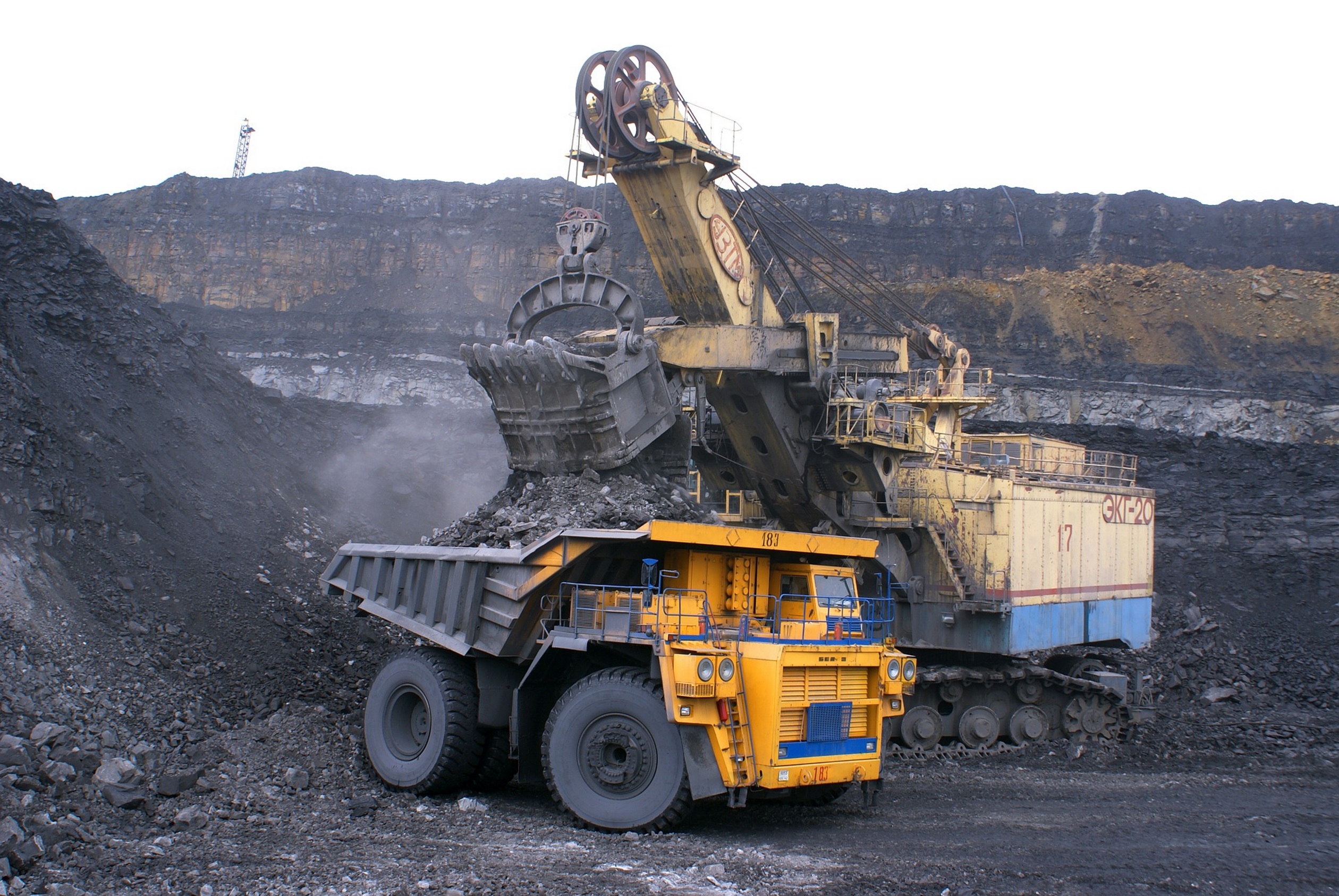
Additionally, burning the coal is only half the story. You see, the process of getting the coal is also fraught with problems. Many reviews and books have been written on this topic, so I will just briefly hit the highlights. First, all mining practices result in some level of deforestation and habitat loss. This is particularly pronounced for the practice of “mountain top removal” where very large sections of land are clear-cut and dug up (thus literally removing the tops of mountains). Anytime that you have deforestation, you have a loss of habitat for plants and animals, increased soil erosion, an increase in pollutants entering water ways, and often flash floods (trees slow water, hold the soil in place, and help to filter potentially harmful chemicals), but mining processes exacerbate that, because mining can make the land itself unstable, resulting in landslides (Younger. 2004). In a particularly devastating example known as the Aberfan disaster, 144 people were killed by a landslide that resulted from coal mining (Younger. 2004). Once again, that is admittedly an extreme case, and, fortunately, modern legislation has greatly improved conditions in most first-world countries, but fatal accidents still happen occassionally, and are still common in third-world countries.
In addition to landslides, coal mines discharge large amounts of sulfuric acid, copper, lead, and mercury, which often enter the water supply (Mishra et al. 2008; Zhengfu et al. 2010). Indeed, in the USA, it is estimated that 9,000 miles of our waterways have been polluted by coal mining. That is a huge problem for the plants and animals that live in those streams or get their water from them, but it is also a problem economically. Ecotourism and fishing are both huge industries, and they both benefit from clean water. Further, even if you don’t care about wildlife, fishing, or the economy, you still need to drink clean water, so it is a topic that affects everyone.
In addition to all of that, it is not uncommon for fires to occur at coal mines. This causes all of the aforementioned problems with burning coal, but there obviously aren’t any sulfur or nitrogen scrubbers controlling the emissions, so large amounts of those gases get pumped into the atmosphere (Zhengfu et al. 2010). Also, even without fires, coal mines release a number of air pollutants, and lung and cardiovascular diseases are disproportionately high among people living near coal mines (Hendry and Ahern 2008).
When you sum all of this up, there is a high cost to mining and burning coal, even if you don’t care about the environment. Indeed, one study estimated that when you combine all of these problems, using coal costs America around 345.3 billion dollars annually (the range for that estimate is 175–523.3 billion; Epstein et al. 2011). So even if all that you care about is money, there are serious problems associated with coal.
Environmental impacts of “clean coal”
Now that you understand the problems with coal, let’s talk about “clean coal.” There is, unfortunately, no one exact definition of this term. Sometimes, it is used very broadly to refer to things that are now fairly standard practices in modern power plants, such as washing coal to remove dirt and chemical impurities, as well as scrubbers like the nitrogen and sulfur scrubbers that I talked about earlier. By that definition, however, “clean coal” is anything but clean, because it still has the environmental problems that I talked about earlier. Yes, the emissions of some (but not all) potentially dangerous gases are reduced, but those emissions aren’t fully eliminated, all of the harmful mining practices are still in place, and massive amounts of CO2 are still released. So, that usage of the term is really just a scam by politicians and companies to make their product sound benign when it is actually still quite harmful. Yes, those plants are better than ones that don’t use any scrubbers, but they are still a far cry from anything worthy of the title “clean.”
That broad definition is, however, probably not the most common modern usage of the term “clean coal.” The more common and technical usage generally refers to “carbon capture and storage” (CCS) methods. There are a variety of CCS methods used, and I won’t bore you with the details, but the basic concept is simply that you trap the carbon dioxide from the coal, and you store it somewhere (usually buried deep in the ground) rather than allowing it to be released into the atmosphere. This sounds great, but as you have probably guessed, there are a lot of problems with it.
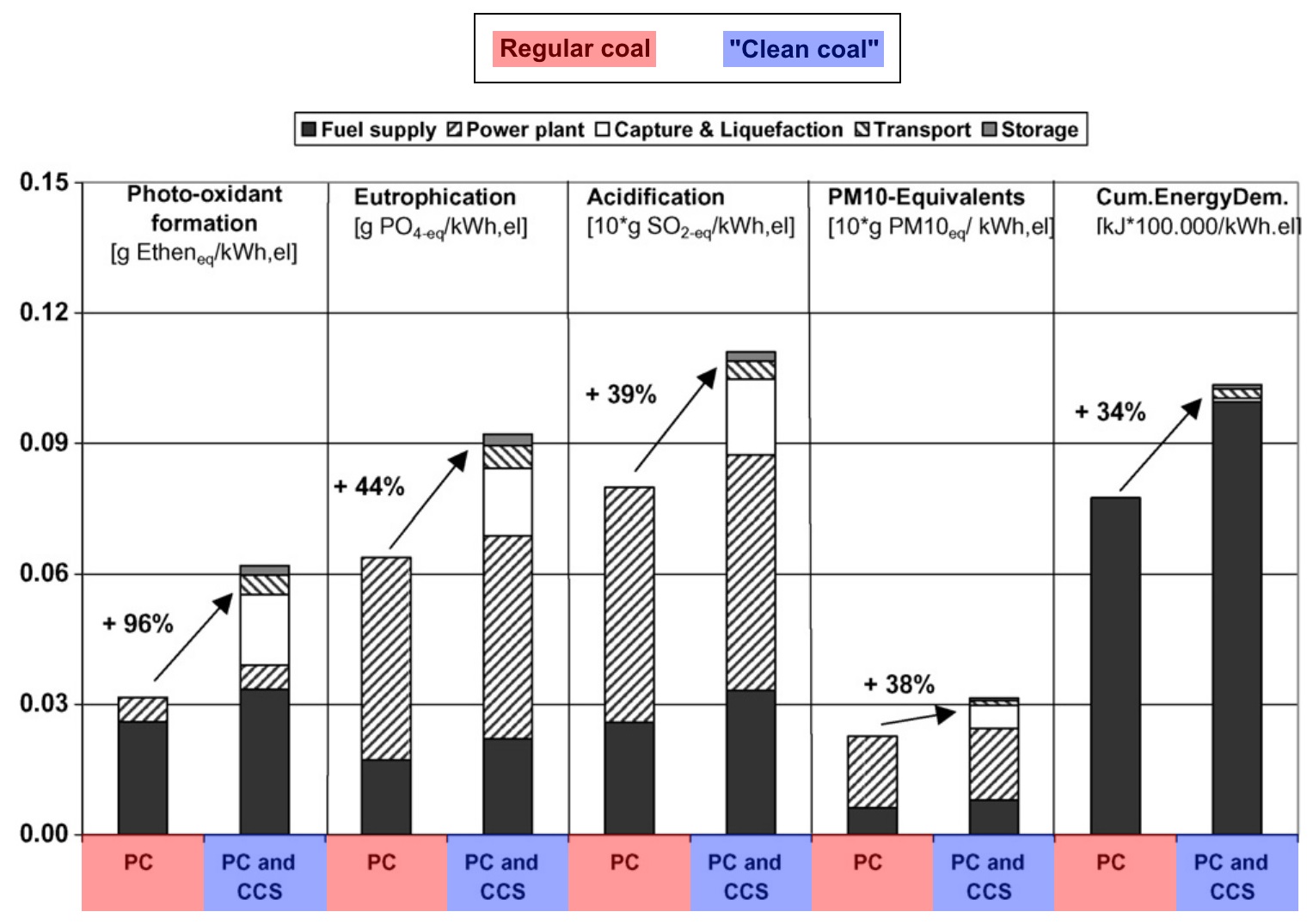
This shows the increase in environmental problems other than CO2 when CSS (aka “clean coal”) is implemented. It shows several different coal technologies. This figure is a copy of Figure 5 from Viebahn et al. 2007 (I added the colored boxes).
First, it only deals with the carbon dioxide that is produced by burning the coal. So, all of those other problems that I talked about still exist. All the erosion, stream pollution, lung cancer, etc., is still there. In fact, those problems become even worse! You see, CCS methods are not energy efficient. As a result, using them requires anywhere from 16–41% more fuel (depending on the type of CCS) than a regular coal plant uses to produce the same amount of power (Rubin et al. 2007; Rubin et al. 2015). That means more mining, as well as more emissions for gases other than CO2. As a result, environmental issues other than CO2 are worse with CCS than with regular coal power plants (Viebahn et al. 2007; Cuellar-Franca and Azapagic. 2015).

This shows the greenhouse gas emissions of CCS (aka “clean coal”) compared to regular coal, solar, and wind power. It shows several different coal technologies. This figure is a copy of Figure 4 from Viebahn et al. 2007 (I added the colored boxes).
In addition to all of that, CCS technology only removes 90% of the carbon (Rubin et al. 2007). Much like the nitrogen and carbon scrubbers I mentioned earlier, that’s good, but that 10% is still a lot of CO2, and, just to be clear, it is a lot more CO2 than we produce from renewable energy sources like solar or wind (i.e., it’s more than the carbon footprints from things like constructing renewable energy sources; Viebahn et al. 2007). Further, once the carbon has been trapped, it has to be transported to wherever it is going to be stored, which also uses energy and releases CO2. Plus, extra fossil fuels are required to mine the extra coal that we need since CCS plants are less efficient. So the net reduction in CO2 drops from 90% to 86–88% (Rubin et al. 2015). Additionally, although the extra CO2 is buried underground, some of it still slowly leaches out of the ground and enters the atmosphere (Viebahn et al. 2007). So, when it’s all said and done, CCS plants produce less CO2 than regular coal plants, but they still don’t even approach being truly clean, they still have a much bigger carbon footprint than renewable energy sources, and there are still tons of other environmental and safety problems. Indeed, “clean coal” makes those problems worse, not better.
Economics of “clean coal”
Beyond the environmental issues, there is another massive problem with “clean coal.” It’s freaking expensive. In addition to the cost of installing the CCS technology, you need more coal to produce the same amount of energy, and, once you’ve trapped the CO2, you have to pay to transport and store it. As a result, CCS plants are 39–78% more expensive than traditional coal power plants (depending on the type of CSS). Indeed, “clean coal” is so expensive that there are currently only 21 operating CCS power plants in the entire world, even though we have had this technology for decades (to be fair, several other plants are currently under development).
In the interest of fairness, I should make two caveats here. First, some people are experimenting with carbon capture and utilization (CCU) systems, where the carbon is used, rather than stored. This does reduce the cost, but probably not by enough to be meaningful because production of CO2 is expected to far exceed demand (Dowell et al. 2017). Second, like with any technology, the cost will come down with more research and widespread use. However, it needs to come down a lot for it to be economical, and the price tag for that research and development is quite high. Indeed, it’s estimated that we would need to invest $100 billion annually to get this technology where it needs to be.
“Cleaner coal”
Before ending this post, I do need to acknowledge one other group of technologies that are sometimes referred to as “clean coal.” These are technologies that focus on burning coal in more efficient ways that reduce the amount of emissions that are produced, rather than technologies that capture the CO2 after it has been released (for example, the DICE project in Australia). These projects still aren’t really “clean coal” though. “Cleaner” perhaps, but not clean. They still produce lots of CO2, and they still have all the issues with mining that I already talked about, as well as issues with emissions other than CO2.
Conclusion
A recent issue of Popular Mechanics may have said it best when it refereed to “clean coal” as, “a political pipe dream.” It is far more expensive than regular coal, and it’s not even clean! It does reduce the amount of CO2 that is released into the atmosphere, but it does not eliminate the release of CO2, and it is less efficient than regular coal plants. As a result, it requires more coal to produce the same amount of energy, which means that we have to mine even more coal, and coal mining causes a wide range of environmental and health problems including water pollution, deforestation, lung cancer, etc. So when you add all of that up, “clean coal” is an expensive misnomer, not a viable solution. It’s not clean, and it’s not economically practical.
I promised that I wouldn’t get political, but I do want to leave you with a question to ponder. Namely, if we are going to invest money into cleaner energy technologies (as we need to do), then wouldn’t it make sense to invest that money into the technologies with the fewest impacts on the environment and human health?
Note: Invariably, someone is going to respond with a host of supposed problems with renewable energy, so let me pre-emptively say a few things. First, that doesn’t change the truth of anything that I said about coal. Second, many of the arguments against renewables are myths or, at the very least, gross exaggerations. So please fact check carefully. Third, having said that, renewable energies certainly aren’t without their problems, and they do have an impact on the environment. However, when you add up all of the environmental costs (as well as costs to human health and the economy), the impact is much lower than fossil fuels.
Literature Cited
- Cuellar-Franca and Azapagic. 2015. Carbon capture, storage and utilisation technologies: A critical analysis and comparison of their life cycle environmental impacts. Journal of CO2 Utilization 9:82–102.
- Dowell et al. 2017. The role of CO2 capture and utilization in mitigating climate change. Nature Climate Change 7:243–249.
- Epstein et al. 2011. Full cost accounting for the life cycle of a coal. Annals of the New York Academy of Sciences 219:73–98.
- Garcia-Perez et al. 2008. Mortality due to lung, laryngeal and bladder cancer in towns lying in the vicinity of combustion installations. Science of the Total Environment 407:2593–2602.
- Guttikunda and Jawahar. 2014. Atmospheric emissions and pollution from the coal-
- fired thermal power plants in India. Atmospheric Environment 92:449–460.
- Hendry and Ahern. 2008. Relations between health indicators and residential proximity to coal mining in West Virginia. American Journal of Public Health 98:669–671.
Liu et al. 2012. Association between residential proximity to fuel-fired power plants and hospitalization rate for respiratory diseases. Environmental Health Perspectives 120:807–810. - Mishra et al. 2008. Concentrations of heavy metals and aquatic macrophytes of Govind Ballabh Pant Sagar an anthropogenic lake affected by coal mining effluent. Environmental Monitoring and Assessment 141:49–58.
- Rubin et al. 2015. The cost of CO2 capture and storage. International Journal of Greenhouse Gas Control 40:378–400.
- Viebahn et al. 2007. Comparison of carbon capture and storage with renewable energy technologies regarding structural, economic, and ecological aspects in Germany. International Journal of Greenhouse Gas Control 1:121–133.
- Younger. 2004. Environmental impacts of coal mining and associated wastes: a geochemical perspective. Energy, Waste, and the Environment: A Geochemical Perspective 236:169–209.
- Zhengfu et al. 2010. Environmental issues from coal mining and their solutions. Mining Science and Technology 20:0215–0223.




 The Logic of Science