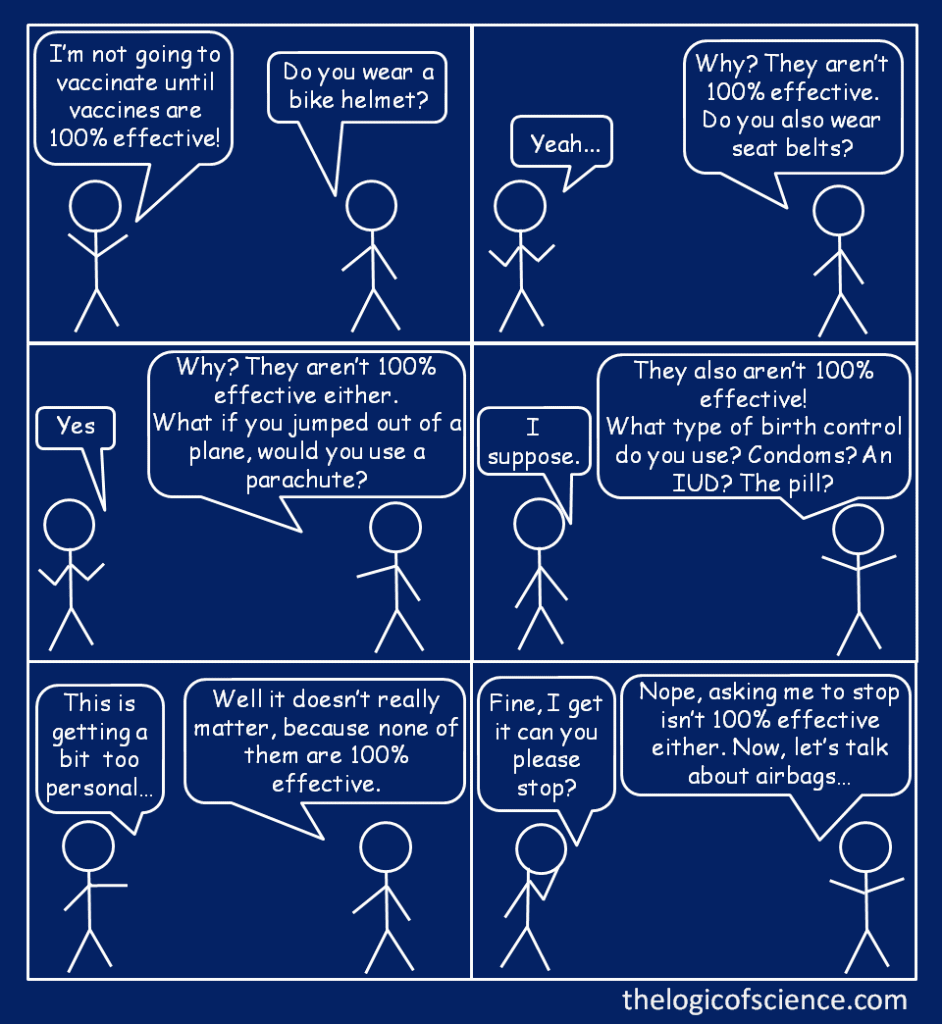
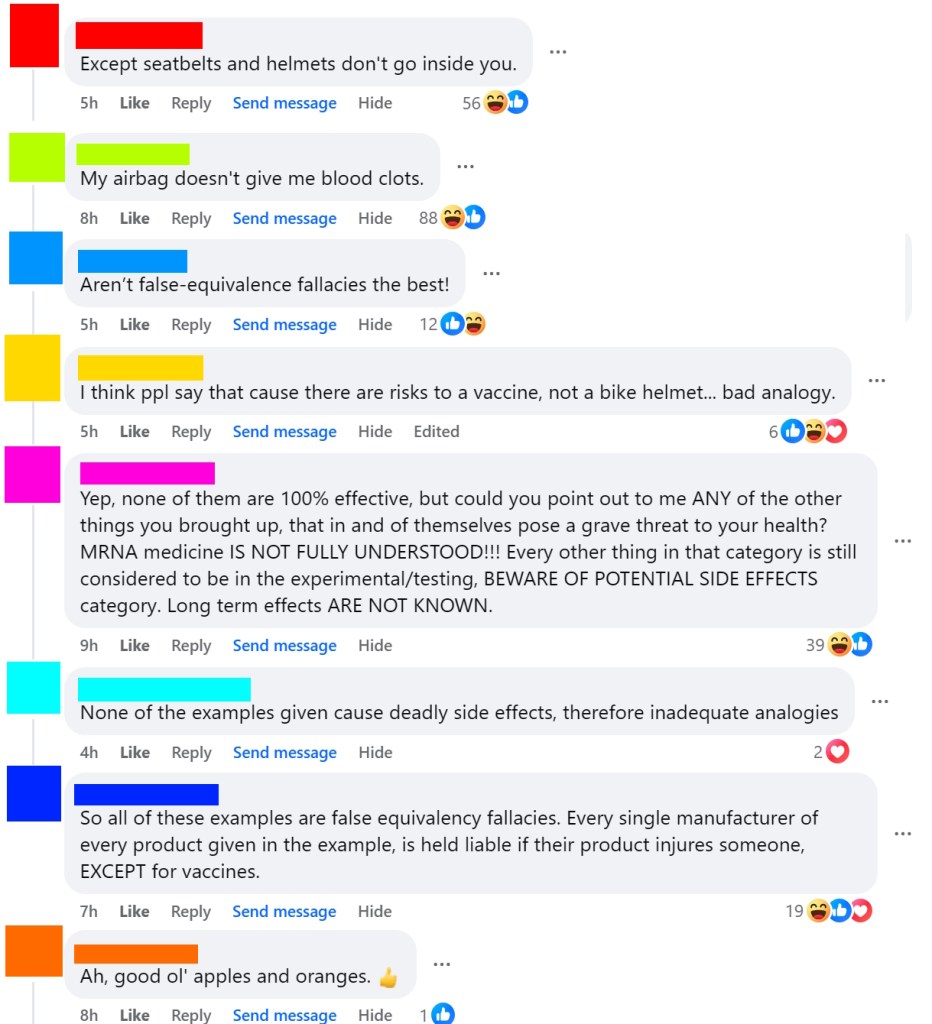
Yesterday, on this blog’s Facebook page, I posted the stick figure comic on the right, lightly making fun of anti-vaccers and using analogies to demonstrate why they are wrong that 100% effectiveness is needed for vaccines to be useful. I love analogies. They are a great way to get people past their biases and show underlying flaws in their reasoning, but apparently many people don’t understand how analogies work, and the comments quickly filled with people saying that these were bad analogies/false equivalencies because (according to them) unlike seat belts, helmets, birth control, or air bags, vaccines cause serious injury, go inside you, and are protected from lawsuits (see examples below).
There is a lot wrong with these responses (e.g., serious side effects from vaccines are extremely rare, serious injuries can occur from the other things mentioned, etc.), but I want to focus on the big one. Namely, these responses totally misunderstand the nature of analogies and how to evaluate arguments.
This comic was about one specific argument: the argument that vaccines aren’t useful because they aren’t 100% effective. That’s it. Effectiveness is the only thing being discussed. As such, all other considerations are 100% irrelevant. Even if vaccines were horribly dangerous (they aren’t) that would not make this comic a bad analogy or a false equivalency because it is not about safety. It is about the effectiveness argument. The purpose of a good analogy is to get at the underlying logical structure of an argument, and nothing outside of that structure matters.
To illustrate this, let’s break the argument down into its syllogism:
- Premise 1: Vaccines aren’t 100% effective
- Conclusion: Therefore, vaccines should not be used.
Stated like that, it is clear that the conclusion does not follow necessarily from the premises, which is why there is actually a second, unstated premise.
- Premise 1: Vaccines aren’t 100% effective.
- Premise 2 (unstated): Things that aren’t 100% effective should not be used.
- Conclusion: Therefore, vaccines should not be used.
That is the argument being addressed by the comic, and we can show that the argument clearly does not work by replacing vaccines with literally anything else that is useful despite not being 100% effective. For example:
- Premise 1: Seat belts aren’t 100% effective.
- Premise 2: Things that aren’t 100% effective should not be used.
- Conclusion: Therefore, seat belts should not be used.
Do you see how that works? All of those other considerations (like safety) are totally irrelevant for this analogy, because they don’t matter for this one particular argument.
To be completely clear, things like safety are certainly important in a broader discussion of vaccines. If I had said that this comic proves that we should be using vaccines, then commenters would have been absolutely correct to point out that it doesn’t address safety, but no one ever claimed that this comic encompasses all considerations or proves that we should vaccinate. It was about one specific argument about one specific aspect of vaccines, and the examples used are completely analogous for that specific aspect. Thus, it is in no way a false equivalency.
Understanding this is really important, because our brains are very resistant to information that is contrary to our beliefs, and one of the tricks they play on us is to ignore an argument we are being presented with and shift to a different argument. That is exactly what happened here. Rather than take the time to consider this one particular defect in anti-vaccer reasoning, people ignored the argument at hand and jumped to a different argument. We all tend to do this frequently, and it is a cognitive trap that we need to be aware of and train ourselves to avoid.
When presented with an argument, train yourself to avoid the tendency to jump to “what about…” Stop, take a deep breath, and carefully consider the argument currently in front of you. Don’t let your brain jump to other topics. Force yourself to focus on the specific argument you have been presented and thoroughly analyze it before moving on to other considerations.
My point with all of this is two-fold. First, try to understand what analogies are actually intended to do in logical arguments. Analogies are used to illustrate underlying defects in the structure of an argument. As such, only the factors relevant to that structure matter and all other considerations are irrelevant to the argument at hand. Even if two things being compared are wildly different in every respect except for the one thing being discussed in the argument at hand, it can still be a good analogy as long as the specific thing being addressed by the argument is the same. Second, train yourself to take each argument seriously and carefully on its own terms. Avoid the mental trap of jumping to other considerations that are irrelevant for the specific argument being discussed.
SIDE NOTE ON STRAW MEN: Another common response was to accuse me of committing a strawman. This comic is not a strawman, however, because on countless occasions I have seen people make this exact argument. Indeed, many years ago, one of my first popular blog posts was debunking a popular article called “One hundred arguments against vaccines.” The second argument in that list was “NO vaccine is 100% effective.” In the years since, I have seen people comment with this argument more times than I can count, though admittedly it is often stated less bluntly. For example, when you hear someone say something like, “being vaccinated doesn’t even guarantee that you won’t get infected!” They are making this argument. If you break that down into a syllogism, it’s the same logical structure, and we can use the same analogies, such as “wearing a helmet doesn’t even guarantee you won’t get a head injury!”
Further, in situations like this, many people make the strawman response simply because it is not their personal reason for holding a position. I see this all the time on topics like GMOs where, for example, I’ll post about pesticides and someone will say, “that’s a strawman because the real issue is corporate control of food.” Just because it isn’t the issue that you personally care about doesn’t mean it’s not an issue that others care about, and that doesn’t make it a strawman.
Related posts


NOTE: If you are going to comment on this post, stay on topic (as per the comment rules). This post is about analogies, not vaccines, and is not the place for a broader discussion about vaccines.
I have written many posts on the scientific evidence for the safety and effectiveness of vaccines, which you can read here https://thelogicofscience.com/vaccinesalternative-medicines/
And for studies specifically on COVID vaccines, see this post https://thelogicofscience.com/2025/02/27/masks-and-covid-vaccines-were-huge-successes-ivermectin-and-hydroxychloroquine-were-not/
LikeLiked by 1 person