Evolution, Natural Selection, and the Theory of Evolution by Natural Selection

It is very common for people to use the terms “evolution,” “natural selection,” and “theory of evolution” interchangeably, but, in reality, all three of these terms refer to different things and it is important to keep them straight. In this post, I will explain the differences between and give a brief primer on what evolution actually is and how it actually works.

Evolution

In technical terms, evolution is the change in a population’s allele frequencies over time. In other words, evolution is simply a change in the genetic makeup of a population. It is very important to point out that populations evolve, not individuals. Because evolution deals with changes in the gene frequencies, it is impossible for an individual to evolve. There are, however, a great many ways for populations to evolve.

For example, suppose that a population of 1,000 frogs is living at the base of a volcano. Nine hundred of the frogs (90%) have genes for being green, and 100 (10%) have the genes for being brown (to keep the math simple, let’s assume complete dominance and that all individuals are homozygous). Now, imagine that the volcano erupts and kills off 500 frogs, but, just by chance the eruption missed all of the brown frogs and only killed green frogs. Now, the remaining population has 400 green frogs (80%) and 100 brown frogs (20%). Evolution has occurred because the genetic makeup of the population has changed (brown genes went from 10% to 20%). This is an example of an evolutionary mechanism known as genetic drift.

To keep running with the frog example, let us now suppose that 100 additional individuals immigrate into the population from a neighboring population, and let’s suppose that they are all brown. Now, we have 400 green frogs (66.667%) and 200 brown frogs (33.333%). Our fictional population has once again evolved because the frequency of genes has again changed (i.e., the brown gene became more frequent or abundant). This example illustrates an evolutionary mechanism known as gene flow. There are several other mechanism that can cause populations to evolve, but I am only going to talk about one of them: natural selection.

Natural selection

Hopefully at this point it is obvious that natural selection and evolution do not mean the same thing. Rather, natural selection is one of the mechanisms that causes evolution. Natural selection is a fairly simple concept that requires only three things:

  1. Variability for a trait within a population (i.e., not all individuals are the same)
  2. Heritability for that trait (i.e., parents can pass the trait to their offspring)
  3. Selection for that trait

We know from countless studies that all three of these criteria are almost always met. Also, anytime that those three criteria are met, natural selection will occur and will cause evolution. This is a mathematical certainty. In fact, we can actually calculate the amount of evolutionary change that will take place, but I won’t go into the details of the math here.

Let me give an example to illustrate how this works. Suppose we have a population of lizards. Obviously, different individuals are going to have different body sizes (variation), and body size is heritable. So large individuals should produce offspring that are, on average, larger than the average size of the population, and small individuals should produce offspring that are, on average, smaller than the average body size of the population. Now, let’s propose the very realistic scenario that large individuals are able to escape predators more frequently than smaller individuals. This results in larger individuals living longer than smaller individuals which means that they produce more offspring than smaller individuals, which results in them passing on more genes to the next generation. In other words, the genes for being large will be slightly more common in the second generation than they were in the first, and the second generation will be, on average, slightly larger than the first. The second generation will then go through the same process of selection: larger individuals will live longer and produce more offspring, therefore they will pass on more genes. So, large genes will be slightly more common in the third generation and, on average, individuals will be slightly larger than they were in the second generation. This process will keep occurring until either the population reaches an optimal body size (this is an equilibrium state at which being any larger is no longer advantageous) or the environment changes such that being larger is no longer beneficial. That, in a nutshell is natural selection. It is an amazing process that can result in almost anything you can imagine.

Mutations

Mutations in some ways are actually the opposite of natural selection. Natural selection, if left to itself, actually decreases genetic diversity. In other words, if allowed to run without interference, natural selection would eventually reach a stopping point at which there would be no variation for a trait. Mutations counteract this by generating new genetic information (note: it is a common myth that scientists have never documented a mechanism for creating new genetic material, in reality, we know of a great many mutations that can add genetic information). So natural selection and mutations are, in many ways, opposing forces. Natural selection reduces variability, and mutations increase it. Ultimately, this is a good thing, because natural selection can act on the new genetic information provided by mutations, resulting in the evolution of new traits that were not possible prior to those mutations. So mutations are necessary for natural selection to continue, because without them, populations would eventually consist entirely of “clones,” and natural selection would grind to a halt (fun fact, lab mice are actually genetically identical “clones” that were created by carefully inbreeding them until there was no variation left).

It is common to hear people argue that evolution can’t be true because mutations are usually harmful, but this is a misnomer. In fact, most mutations are neutral, a few are harmful, and a few are beneficial. The neutral ones are irrelevant, but the harmful ones are selected against, and the beneficial ones are selected for (in other words, harmful mutations becomes less common in a population and beneficial mutations become more common). So there is no reason why the nature of mutations would prevent natural selection from working.

The theory of evolution by natural selection

Before I explain the theory, I want to point out that even ardent young earth creationist organizations like Answers in Genesis agree with everything that I have said thus far. It is obviously undeniable that both evolution and natural selection occur. Creationists simply take issue with the scope of evolution. In other words, they place arbitrary limits on it and say, for example, that it is possible that all species of finch evolved from a common ancestor, but it is not possible that all birds evolved from a common ancestor. This division has no scientific support and is completely arbitrary and logically invalid, but I will deal with it in detail in a later post. For now, I simply want to point out that the concept that all life on this planet evolved from a common ancestor is considered a scientific fact (despite creationists vain arguments). So, the theory of evolution by natural selection simply states that natural selection has been the primary driver of the evolution of life on this planet. Recall that there are multiple mechanisms that can cause evolution. So this theory proposes that natural selection has been the most important of those mechanisms.

In a previous post, I stated that theories explain facts. That is exactly what is happening here. The theory of evolution explains the fact that life on this planet has evolved for billions of years. Also, please note that the theory of evolution has absolutely nothing to do with the origins of life (that’s the theory of abiogenesis) or the origins of the universe (that’s the big bang theory). It only deals with what happened after life formed. So even if you could disprove the big bang or abiogenesis, you would have done nothing to the theory of evolution.

So to briefly summarize, evolution is simply a change in the genetic makeup of a population over time, natural selection is one among several mechanisms that cause evolution, and the theory of evolution by natural selection states that natural selection has been the primary driver of evolution on this planet.
Posted in Science of Evolution | Tagged , , | Comments Off on Evolution, Natural Selection, and the Theory of Evolution by Natural Selection

Basics of Global Climate Change: A Logical Proof That it is Our Fault

There are few topics with a wider disconnect between what scientists know to be true and what the general public thinks than global warming. Based on the most recent Gallup poll numbers (which were from 2013 when this post was written), only 54% of Americans think that climate change is already happening, 39% think that its natural rather than anthropogenic, and only 62% think that there is a scientific consensus about it. In reality, roughly 97% of climatologists agree that the planet is currently warming and we are causing it. This disparity is largely attributable to a great deal of misinformation about climate change. The internet is full of nauseatingly horrible arguments like, “well it changed naturally in the past, so it must be natural now” or the erroneous claim that “in the 70s all the scientists were predicting global cooling” and the misconception that “climate change has paused during the past 15 years.” Therefore, I am going to try to briefly explain how climate change actually works, and present a logical proof that we are causing it. According to the rules of logic, the inane dribble of the internet will then be meaningless, as we have no choice but to accept the conclusion of a logical proof.

Premise 1: CO2 traps heat and is largely responsible for the earth’s climate.

This is a simple scientific fact. Not even the 3% of scientists who disagree with climate change disagree with this premise. CO2 traps IR radiation, preventing it from leaving the earth. Without it, earth would be much colder. That is an irrefutable scientific fact.

Premise 2: We have greatly increased the CO2 in the atmosphere.


Again, this is an irrefutable scientific fact. We can measure past CO2 levels in the environment using ice cores. In certain parts of the world, ice forms annual layers, and air bubbles containing CO2 get trapped as those layers form. So we can drill into those bubbles Jurassic Park style and measure the past CO2 levels. Further, we can confirm that ice layers form annually by checking them against known volcanic events (ash from the volcanoes gets trapped in the ice layers, so we can check the date based on counting layers to the known dates of eruptions like Pompeii, and see that the dating method does work). So, using these data, we can tell that there is more CO2 in the atmosphere now than at any point in roughly the past 800,000 years.

Further, we know that this increase is from us because of the Carbon-13/Carbon-12 ratio. Carbon exists in three different isotopes (i.e., they have different numbers of neutrons), but Carbon-13 and Carbon-12 are the most abundant (Carbon-14 is unstable). The Carbon-13/Carbon-12 ratio that is naturally in the atmosphere is different from the ratio in our fossil fuels. So, if the in the increase in CO2 is from our fossil fuels, we expect the Carbon-13/Carbon-12 ratio in the atmosphere to shift to be closer the ratio in fossil fuels. Guess what, the ratio has shifted significantly, clearly demonstrating that we have altered the atmosphere and increased the CO2 concentrations (Bohm et al. 2002; Ghosh and Brand 2003;Wei et al. 2009). These isotope data are unambiguous. They are like fingerprints, and they trace back to us.

These data come from Wei et al. 2009, but the legend of this figure was modified for readability by skepticalscience.com (the data themselves were in no way manipulated as you can see in Figure 4 of Wei et al.)

These data come from Wei et al. 2009, but the legend of this figure was modified for readability by skepticalscience.com (the data themselves were in no way manipulated as you can see in Figure 4 of Wei et al 2009.)

Premise 3: When you increase something that traps heat, you trap more heat.

This is thermodynamics 101 and should be intuitively obvious to everyone. If you didn’t accept this premise, you wouldn’t wear a thicker coat in January than you wear in April. Further, we have demonstrated many times in the laboratory that if you increase the CO2 concentrations, you will trap more heat.

Conclusion: Therefore, we are causing the climate to change.

This conclusion follows necessarily from the premises. CO2 traps heat, more CO2 traps more heat, we have greatly increased the CO2 in the atmosphere, therefore the earth is trapping more heat. This is irrefutable. It’s not opinion, it’s fact. Unless you can discredit one of these premises or show that a logical fallacy has been committed, you MUST accept the conclusion.

Finally, just in case someone isn’t convinced, I will offer one more piece of evidence. Energy from the sun enters the earth as high energy, short wavelength light. It leaves the earth as longer wavelength IR radiation, some of which gets trapped by CO2. So, if our increase in CO2 levels is causing the planet to warm, we would expect the input from the sun to remain constant, but the amount of IR leaving the earth should decrease. Note: this is an exclusive prediction. In other words, the ONLY way that you would get constant input but decreasing output is if greenhouse gasses like CO2 are trapping more heat. So, in the 70s we launched satellites to measure energy going in and leaving, and, lo and behold, the input from the sun has remained essentially unchanged, but the IR leaving the earth has decreased significantly (Harries et al. 2001Chen et al. 2007; Griggs and Harries. 2007). Importantly, this decrease has been at the wavelength that CO2 absorbs, and the decrease correlates nicely with increasing CO2 levels. The only reasonable explanation for those data is that our CO2 is trapping more energy. This is a close to proving something as science ever comes. It is an incontrovertible fact that we are causing this planet to warm.

Posted in Global Warming | Tagged , | 10 Comments

The Value of Carefully Controlled Studies: A Thought Experiment

Amusingly, anti-scientists (such as anti-vaccers) always claim to have the upper hand on scientific knowledge. I have yet to meet one who hasn’t claimed to be “well-informed” or to have “done their research.” Yet when you ask anti-vaccers for their sources, you invariably get links to blogs and websites like Whale.to and NaturalNews.com, and those of us who dare to assert that we should be getting our information from carefully controlled studies, not blogs, are generally accused of having been “brainwashed,” “misinformed,” or “indoctrinated.” I almost never see an anti-scientist produce a legitimate source in support of their position. Therefore, in this post, I am going to use an analogy to demonstrate why there is one and only one way to know whether or not something works and is safe.

Suppose that someone came out with a product (product X) that you apply to multiple areas of your car and, according to the manufacturers, in 95% of vehicles it will make them last 100,000 miles longer than they would without it. This product is inexpensive, but, according to the manufactures, in 0.03% of vehicles, there will be a very slight reduction in fuel mileage, and in 0.000003% of vehicles, it will either cause a problem that will need to be repaired or, in extremely rare cases, it will destroy your vehicle. Now, you want to know with a high degree of certainty whether or not the manufacturer’s claims are true (after all, the life of your vehicle is at stake). How do to you test their claims? Please actually answer this question for yourself before reading any further, how would you determine with a high degree of certainty whether or not they are correct?

One of the most convenient options is to ask your friends and see what their experiences with the product have been, but this is obviously problematic. Suppose you have a friend who didn’t use it and has had his car for 300,000 miles, does that mean the product isn’t necessary because his car is just fine without it? No, it could just be dumb “luck” that his car is still running. Also, what? if you have another friend who used product X and has driven her car 300,000 miles. Does that mean that the product works and is safe? No, because her experience also could be due to chance or any number of other factors. Finally, you have a third friend who used it and their car died within 1,000 miles. Does that prove that it is bad for your car and the company lied? No, maybe they were just one of the ones who were unfortunate enough to be in the 0.000003%. For that matter, we can’t even be certain that product X caused the problem. Assuming that product X caused the problem is a post hoc ergo propter hoc fallacy (i.e., A preceded B, therefore A cause B). This could be one of the 5% of cases where product X simply didn’t work, and the car just happened to die after using X for reasons that were totally unrelated to X. The point is that polling your friends obviously doesn’t work because it is all anecdotal. There is no way to go from scattered personal accounts to a definite answer.

Because your friends can’t help, you then decide you use the internet. Surely by expanding your sample to encompass people’s comments on the internet you can find the answer. On the internet, however, you find the same problems that you had with polling your friends. You find lots of people giving their personal experiences and opinions, but, once again, there is no way to say that their experiences weren’t from chance. Also, the internet is notoriously untrustworthy. Anyone can write a blog about this product even if they know nothing about it. Further, for every blog in favor of product X, you find another one against it. There are multiple blogs and forums where people rant against the product and claim either that it is a conspiracy by the government to kill older vehicles and get them off the road, or it is just a scam by the manufacturer to make money. The same people also refer to themselves with appealing terms like “thinkers,” and they claim that everyone else has been brainwashed or indoctrinated to believe what the manufacture has told them. This all sounds legitimate, but how do you actually know that this group of people is correct? Further, you find plenty of other blogs that say the exact opposite, and both sets of blogs claim to have the facts and evidence. How do you tell which ones to trust? You obviously need to fact check both sides, but this becomes problematic because the “facts” all seem to be coming either from anecdotal evidence like what your friends gave you, or are just made up and are really no more than opinions. Once again, getting a definitive answer is impossible.

Finally, in frustration over the lack of good information online, you turn to your local mechanics and ask them what they think. Most of them say it works, but a few have reservations about it. A mechanic is obviously a better source of information than your non-mechanic friends or the error-prone internet, but still you cannot accept a mechanics word as proof (that would be an appeal to authority fallacy). Sure, they know cars very well, and they have actually used product X, but ultimately, they are giving their opinions about anecdotal evidence, and their opinions can be biased by any number of factors. Humans are notoriously bad at accurately seeing trends without the aid of statistics. Our minds are wired to look for patterns, but that often causes us to see patterns that don’t exist. So, some subtle bias that your mechanic has may cause him to inadvertently think that the product is working more often than it is or, inversely, that it is damaging vehicles more often than it is. Further, there may be a bias in the shops clientele. Perhaps most of the customers at this shop drive high end vehicles that generally have a long life span, so to the mechanics at this shop it seems like the product works because most vehicles that they see have high millage. A different shop, however, attracts customers who drive their vehicles very hard, so most of the vehicles that the mechanics there see have low millage and are falling apart, making them conclude that product X doesn’t work. Finally, you have the issue of which mechanics to believe. Do you just blindly accept the majority? Do you go with the ones that you personally like more? Do you toss a coin? None of those options result in a definitive answer.

At this point, I think that we can all agree that there is one and only one way to tell with a high degree of certainty whether or not the manufacturer’s claims about product X are true. We take an extremely large number of vehicles and carefully control for make, model, year, driving conditions, etc. Then we randomly choose half of them and apply product X. Meanwhile, the other half receives an inert dummy product. We then track the state of these cars over many years, and we record how many of the cars with product X need repairs and compare that with the repair rates on the control cars. Similarly, were compare the total life spans of cars with and without product X. Ideally, multiple different people would do this test multiple times so that we have several very large data sets. Then, we look at the data. If the product works and is safe for cars, then in all of the data sets, we should see that on average, cars with product X last longer than cars without it, and the damages that product X supposedly causes occur just as frequently in both groups. On the other hand, if product X is actually dangerous, we should see that vehicles that used it needed repaired more frequently than vehicles that didn’t use it. Only then, after doing a carefully controlled, randomized study can you conclude with a high degree of certainty that product X does or does not work. This is, of course, not simply my opinion. It should be intuitively obvious that an actual experiment is the only way to know, and any statistics book or professor will tell you that the only way to infer causation is to control all of the confounding variables so that only the experimental variables remain.

So what is my point in all of this? This situation is completely analogous to vaccines, alternative medicines, etc. If you agreed with me that the controlled study was the only reliable source of information (as any reasonable person would) then you must agree that carefully controlled studies are the only way to know with a high degree of certainty whether or not vaccines work and are safe as well as whether or not alternative medicines actually work. This means that if you are going to actually be well-informed about these you cannot trust blogs and personal stories. You must read the actual, original peer-reviewed papers where the results of the research are reported. Blogs are inherently second hand information. Even when they claim to be discussing scientific results, they often insert their own biases and distort the results. You must read the original literature because it is the only legitimate source of scientific information. You cannot trust anecdotes, and you cannot trust the internet. If you are getting your information from HealthNews and similar sites, you are not well-informed, it’s that simple.

In conclusion, lets apply this logic to vaccines:

  1. If vaccines cause autism (or cancer or auto-immune diseases or any of the other problems that they are accused of), then people who get vaccinated should have those side effects more often than people who don’t get vaccinated.
  2. Multiple studies have shown that unvaccinated people have these problems just as frequently as vaccinated people
  3. Therefore, vaccines do not cause these problems

It doesn’t matter how many people claim that vaccines gave them autism or some other deformity, the carefully controlled studies clearly show that they are wrong.

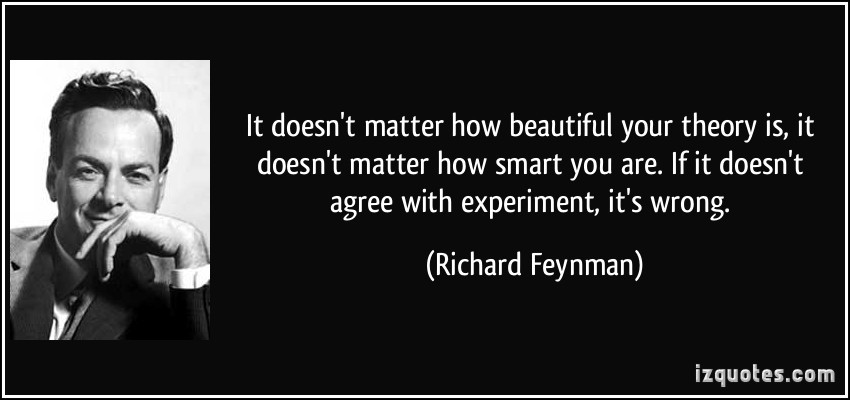
Richard Feynman quote

Posted in Nature of Science, Vaccines/Alternative Medicine | Tagged , , , , , | 6 Comments

Can Science Tell Us What Happened in the Past? Historical vs. Observational Science

It is fairly common knowledge that science requires observations and repeatability, but at a quick glance, many fields of science seem to lack those criteria. For example, forensic science, archaeology, and paleontology all deal entirely with past events that can’t be repeated and were not observed. This has led to the widespread misconception that science cannot tell us what happened in the past. Creationists such as Ken Ham have championed this notion as evidence that evolution does not meet the standards of science. He has famously argued that there are two forms of science: observational and historic. According to him, observational science is what we do when we examine current phenomena. So chemistry, physics, most of biology, etc. all count as observational science where we can directly observe what is happening and repeat our observations in laboratory experiments. In contrast, he argues that historical science deals with past events that were not directly observed, and observational science is true science and can be trusted, whereas historical science is, at best, weak and highly unreliable. As I shall demonstrate, however, this distinction is a totally fictitious one that creationists created to support their position. In reality, all science relies both on observations and logical deductions.

I want to begin this post with an example. Consider the following hypothetical situation:

Mary Smith is murdered, and her body is found with stab marks that indicate an unusually curved knife. Fortunately, there is an eye witness who quickly pegs Mark Williams in a lineup. The witness swears that he saw Mark murder Mary, then load her into the trunk of a very dark green car. There is, however, a problem. Mark has an alibi. Credit card receipts confirm that he was several hours away when the crime was committed. Further, Mark didn’t know either Mary or anyone in her family and he has no priors and no motive. Additionally, during the investigation, police discover that Mary’s husband (John) drives a very dark blue car and his trunk has Mary’s hair and blood in it. Further, in John’s laundry, they find a shirt soaked in Mary’s blood, and in his trash they find an unusual knife that is covered in Mary’s blood and John’s fingerprints. Also, the curvature of the knife matches the wounds on Mary’s body. Finally, John has no alibi and he will receive a substantial amount of money from Mary’s life insurance. Who murdered Mary?

If you said John (as any reasonable person would), then you have just affirmed that not only can science answer questions about the past, but evidence based deductions about past events are actually superior to direct observations of those events. This really shouldn’t surprise anyone. Eyewitnesses are notoriously unreliable. To be clear, they aren’t lying. They are describing what happened to the best of their ability, but the reality is that both our perception and memory of what happened can be easily influenced and biased by numerous factors which ultimately render our observations unreliable.

With that example in place, let’s return directly to the topic of observational vs. historical science. First, I need to explain what scientists mean when they say that something is observable and repeatable. In science, we do not use these terms to mean that an event itself was observable and repeatable, rather, we mean that the event left behind observable clues and the methods that we used to examine those clues are repeatable. In other words, if someone else did the same experiment/analysis that you did, they should get the same results. So, in my crime example, the investigators who solved the case did not repeat the murder, nor did any of them directly observe it. Rather, they observed the clues left behind by the murder, and any other investigator who questioned them could have looked at the same evidence and repeated what they did.

This is the same way that we tell what happened millions of years ago. We observe the clues left behind and use those to draw logical conclusions. Usually, we also accompany these observations with exclusive, falsifiable predictions that we can test. In other words, we might make a hypothesis that, “if and only if X happened, we will find Y.” We can then test that hypothesis by seeing whether or not we find Y. The more exclusive predictions that X gets right, the more likely it is to be true. Further, all it needs is one exclusive prediction to fail for X to be rejected. So, in the case of evolution, the theory makes numerous exclusive predictions about genetics, the fossil record, biogeography, etc. We have then tested those predictions by looking at the clues that were left behind, and we have very consistently found that its predictions are true. Also, this process is repeatable, because any other scientist can do the same tests that we did and look at the same evidence that we looked at. So contrary to what Ken Ham would have you believe, we can use science to tell what happened in the past.

The final thing that I want to do in this post is demonstrate that even sciences that Ken Ham considers to be “observational” actually work exactly the same way as his “historical” sciences. For example, no one has ever observed how the inside of the sun works, nor has anyone replicated it in the lab, but we have a very good understanding of how it works, and astrophysics should, by any reasonable standard, be considered observational. So how do we know how the sun works? It’s really quite simple, we made hypotheses about how it works, then we made testable predictions about what should be true if those hypotheses were correct (e.g., what its emissions should be like). Finally, we carefully tested those predictions and used the data from those tests to draw a conclusion about our hypotheses. This is the same exact procedure that we use for fossils.

So maybe astrophysics isn’t an “observational” science, but surely the rest of physics is fine, right? Actually not so much. Take gravity for example. No one has ever observed or replicated gravity. Rather, what we observe and replicate are the effects of gravity. When you watch an object fall, you aren’t seeing gravity, you are seeing its effect. From that effect, we infer the nature and existence of gravity, but we cannot actually observe gravity itself. So according to Ken Ham’s definition, the theory of gravity should not be trusted because it came from the weak, non-observational type of science (gravity is of course also supported by rigorous mathematics).

Chemistry presents a similar problem. No one has ever seen two atoms combine to form a molecule. It has never been observed, but we understand how it works by conducting experiments, measuring the things which can be observed, and using those measurements to deduce how the atoms are behaving. So it is entirely possible to be very certain about how something functions without directly observing.

Finally, what about biology? I’m a zoologist. I study living animals, that has to be observational right? Not really. My studies often rely on logical inferences rather than direct observations. For example, I have published several diet studies in which I collected wild animals, forced them to regurgitate or defecate, then examined what came out and used that information to determine what they had eaten. So, for example, on several occasions I have documented novel prey items for snakes (i.e., they regurgitated a prey item that had never before been documented for that snake species). I did not directly observe the snake eating that prey, but I can infer that it did based on the fact that the prey item was in its stomach. Further, it would be absurd for someone to say, “you can’t actually know that the snake ate that item because you didn’t see it happen.”

So you see, all science is a combination of direct observation and logical deduction. There is no difference between observational science and historical science because we use the exact same methods for each. Science works simply by making and testing predictions. As long as past events left clues behind, we can make predictions about those clues, and test those predictions in order to determine what happened in the past. So the idea that science cannot tell us about past events is absurd and, once again, illustrates just how little creationist groups like Answers in Genesis actually understand about science.

Posted in Nature of Science, Science of Evolution | Tagged , , | 1 Comment

“But scientists have been wrong in the past…”

I’m sure that we have all seen it happen at one point or another. Two people are debating about some scientific topic and the person who is opposed to the mainstream scientific view gets backed into a corner by an opponent who is wielding numerous peer-reviewed studies. So, how does he get out of it? Simple, he merely utters the words, “well scientists have been wrong in the past, so they might wrong now,” and having spoken those irrefutable words, the debate ends, and the anti-scientist leaves, thinking himself victorious. In reality, all he did was use a logically invalid cop-out that does nothing other than demonstrate how truly weak and indefensible his position is.

The first problem with this argument is simply that it is a guilt by association fallacy (or ad hominem depending on exactly how it is used). Just because scientists have been wrong in that past does not mean that you can blindly reject all evidence and arbitrarily assume that they are wrong now. So right off the bat, the rules of logic tell us that this argument is no good.

The second problem is one of the most important. Of course scientists have been wrong in the past, because science is inherently a process of proving other scientists wrong. That’s how science works. It would be a terrible thing if scientists were never wrong because that would mean that science had come to a standstill and was no longer advancing. Here’s the important thing though, scientists are always proved wrong by other scientists! Major scientific principles aren’t overthrown by people with no scientific training sitting on their couch and speculating! New scientific discoveries are made by scientists, not bloggers, not people who have never set foot in a lab. There is no universe in which someone’s uneducated opinion is just as valid as the results of countless peer-reviewed studies.

Next, we arrive at a core problem with the fundamental claim of this argument. More often than not, I hear this argument accompanied by a claim like, “scientists used to think that the earth was flat,” but did scientists really think that? You see, the term “science” is relatively new. Virtually all of the examples that I hear of flawed views that scientists supposedly held are from a time period that predates science as we know it. Science today is very careful, systematic process that allows us to be highly confident in our results. The statistical analyses that allow us to quantitatively test our hypotheses, for example, have only existed for the past 100 years or so. There is simply no comparison between the “scientists” who thought the earth was flat and the scientists today. The “scientists” back then were no different from alchemists. They were not employing the rigorous scientific methodologies that we use now.

So if we are going to make the claim “that scientists have been wrong in the past, therefore they shouldn’t be trusted today” we have to limit ourselves to roughly the past 100 years. Now let’s ask the question, “have scientists been wrong about anything in the past 100 years?” Well yes, of course they have been wrong about a lot of things. The past 100 years have seen great advancements in almost every field of science as new discoveries have replaced outdated hypotheses, but keep in mind that this argument is used against scientific theories and concepts that have an overwhelming amount of evidence behind them. It isn’t used against a particular cladogram showing the evolutionary relationships between turtles, rather it is used against the entire theory of evolution. It isn’t used against a particular model of climate change, rather it is used against the very idea that man could change the climate. So the question is really, “in the past 100 years, have scientists been really wrong about something very important that they were extremely confident on (something on the level of the theory of evolution or the usefulness of vaccines)?” The answer is…not really. The modifications that Einstein’s theory of relativity made to Newtonian physics is really about the closest example, but even then, Newton wasn’t wrong so much as incomplete, and relativity was proposed at the very beginning of the 100 year period we are talking about. So when you actually stop to think about it, the core claim of this argument isn’t even correct.

The next objection to this argument is perhaps the easiest for most people to grasp. If this argument worked, than we could use it in absolutely any situation. “You think the earth moves around the sun? Well I think the sun moves around the earth, and scientists were wrong about the shape of the earth, so why should I trust them about its movement?” You see the problem here? If we allow this argument, then we can’t ever trust science about anything!

This leads to the final problem with this argument. It actually creates a logical paradox that destroys itself. Consider, the argument posits that we can’t trust scientists because they’ve been wrong in the past, but the only reason why we think those scientists were wrong was because other scientists discredited them, but we’ve just established that we can’t trust scientists, which means that we can’t trust the scientists who discredited the original scientists. By way of example, why should I trust the scientists who say that the earth is round instead of the ones who say its flat? This argument (if it worked) would make all science invalid and we would have no reason to accept anything that any scientist has ever discovered (which is clearly absurd).

In conclusion, despite being one of the most common anti-science arguments, this claim has a logical fallacy as its core, it is based on a faulty understanding of science, and it unravels everything into a chaotic mess in which science can never tell us anything. All of which clearly shows that this argument is entirely invalid and should never be used.

Posted in Global Warming, Nature of Science | Tagged , | 7 Comments