In this post, I will address fifteen of the most commonly used arguments against vaccines. Throughout this post, you should notice that none of these arguments require a great deal of scientific knowledge or logical ability to defeat, and anyone with an unbiased mind and internet capable computer can find the flaws in them in minutes. I realize that this post is lengthy, but its broken up in sections so you can read only the parts that you care about.
#1 We shouldn’t trust the doctors/scientists that support vaccines because they are paid by pharmaceutical companies/the government
#2 Many doctors/scientists are coming forward against vaccines
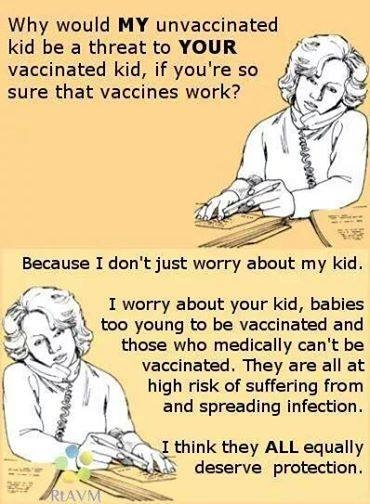
#3 If vaccines work then why do you care if my child is vaccinated?
#4 No vaccine is 100% safe
#5 Vaccines contain many TOXIC chemicals that aren’t safe at ANY dosage!
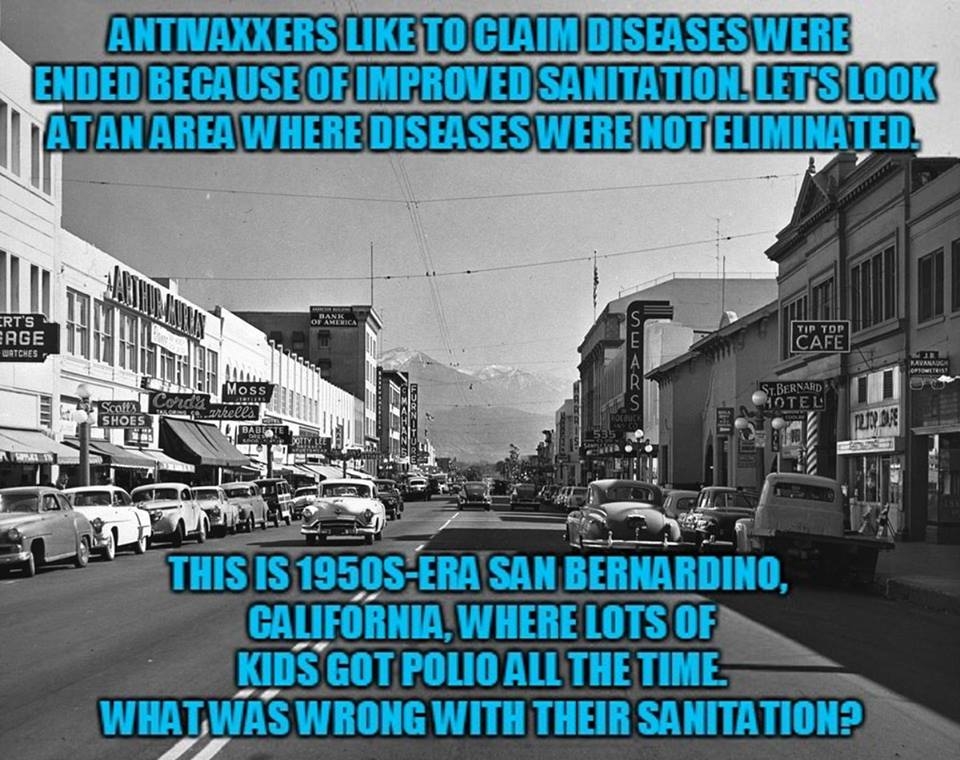
#6 Vaccines did not eliminate diseases, they were declining before vaccines were introduced
#7 There have been no scientific studies that…
#8 Vaccines can overwhelm a child’s immune system
#9 Vaccines cause autism
#10 The majority of people who got the disease were vaccinated for it
#11 Disease outbreaks occur among vaccinated populations
#12 Vaccines contain chicken proteins, monkey cells, calf serum, etc.
#13 Natural immunity is better than the immunity from vaccines
#14 No vaccine is 100% effective
#15 Vaccines contain aborted fetus cells
#1 We shouldn’t trust the doctors/scientists that support vaccines because they are paid by pharmaceutical companies/the government
This argument is total nonsense. Beyond the fact that it’s an ad hominen fallacy, it’s premise is blatantly untrue. Only a small portion of vaccine researchers are paid by pharmaceutical companies or the government. The a huge portion of vaccine research comes from independent scientists who are working out of universities and are funded by grants that they apply for. Further, this argument represents a fundamental paradox in the thinking of the anti-vaccine movement. This argument arises in almost every conversation I have with them, yet in those same conversations, they inevitably claim to have unbiasedly considered the evidence. These two claims are incompatible. If you are blindly writing off every scientist that disagrees with you, then you have not actually considered the evidence. Finally, this argument overlooks that fact that many of the anti-vaccine advocates that they blindly believe make quite a bit of money off of books and alternative “medicines.” Go to the website of almost every anti-vaccine advocate and you will find a store selling their products. So the few scientists and doctors who oppose vaccines have a monetary incentive for holding their position as well. So this argument is completely logically inconsistent.
#2 Many doctors/scientists are coming forward against vaccines
First, realize that this “many” is an exceedingly small portion of professionals, so this entire argument is an inflation of conflict fallacy. Further, this argument is also a blatant appeal to authority fallacy. It doesn’t matter what crackpot position you believe in, you can find someone with an advanced degree that agrees with you. You can find Ph.D.s in physics that argue that gravity isn’t true, and M.D.s that argue that smoking doesn’t cause cancer, but it would be absurd of me to say, “Many doctors are coming out and saying that smoking doesn’t cause cancer, therefore smoking is safe.” Also, notice the inconsistency in the anti-vaccer’s logic. Any time that I bring up a paper the shows that vaccines work/are safe, they instantly respond with, “those researchers were paid by pharmaceutical companies and shouldn’t be trusted” (which is rarely true), but any time that someone agrees with them, they instantly believe that source. This is classic cherry-picking of data (i.e., its a sharpshooter fallacy).
#3 If vaccines work then why do you care if my child is vaccinated?
Anyone who uses this argument (which is almost every anti-vaccer I have ever talked to) has just demonstrated beyond a shadow of a doubt that they don’t have the foggiest clue what they are talking about, because the answer comes from the most basic facts about vaccines.
In brief, non-scientific terms, this is how the immune system works. A germ enters your body and an immune cell finds it, memorizes it, returns to the central command, and cells are generated specifically to combat that germ. All of this takes time, however, and often by the time that your immune system has the troops ready to go, the germ has already replicated and taken hold. At this point, it’s all out war and you are going to be sick for a while. What a vaccine does is teach your body to recognize the germ before you actually encounter it. Your body then keeps low levels of antibodies around that are specific for that germ. These act as a first line of defense. That way, when the germ is detected, it can be taken out before it becomes a problem. Here’s the catch though, your body doesn’t keep a full regiment on alert at all times. It only keeps low levels of the antibody circulating. So, for a normal exposure to a germ, a vaccinated person’s immune system can take care of it, but, if you get a large exposure, it can overwhelm that first line of defense and you still have a full blown war. This is one of the reasons why vaccines sometimes fail. To put it another way, if someone with H1N1 sneezes in your face, you’re probably going to get the flu even if you’re vaccinated.
So, how does this relate to the original argument? Vaccines lead to herd immunity. When a large number of individuals are vaccinated, very few people get exposed to a large dose of the disease, and therefore very few people get it. When there are unvaccinated people around, however, you are much more likely to get a large dose of the disease and actually get sick. So even though I am vaccinated, my risk of getting the disease is higher than it would be if you were also vaccinated. Further, there are many elderly people and immunocompromised people who cannot receive vaccines, but are protected by herd immunity. Additionally, for various reasons vaccines don’t always take hold. In a very small number of cases (usually between 1 and 5% depending on the vaccine), the vaccine doesn’t work, leaving the person completely vulnerable. So by not vaccinating, you are putting all of those people at risk. In short, vaccines work and reduce disease even if you don’t vaccinate, but they work much more effectively when everyone is vaccinated.
This video does a nice job of visualizing what I just said (skip to 1:45 if you just want to see the simulation). You can also check out this really cool simulation showing how vaccine levels effect disease rates.
Also, here are two recent studies that shows a very strong association between low levels of vaccines and disease outbreaks. It’s herd immunity at work.

Please carefully note how the measles outbreaks are centered around the communities with low vaccination rates. Image from Knol et al. 2013
#4 No vaccine is 100% safe
True, but you know what else isn’t 100% safe, not getting vaccinated! The anti-vaccine crowd loves to list the potential side effects of vaccines while totally ignoring the dangerous side effects of not getting vaccinated. Side effects like, measles, polio, hepatitis, deafness, death, etc. The truth is, most vaccines have extremely low levels of dangerous side effects, so it comes down to a basic risk assessment. The risk associated with getting the vaccine is lower than the risk associated with not getting the vaccine, therefore you are safer with the vaccines. Also, thanks to herd immunity, the risk associated with not getting the vaccine goes up as the number of people who aren’t vaccinated increases (see #3). So every additional person that you convince not to get vaccinate increases your risk of getting sick. Don’t believe me? get on Google Scholar and look at the literature. There have been tons of studies that have looked at side effect rates and/or disease rates, and they paint a clear picture: vaccines work and have low risks of side effects.
Here are a few studies to get you started, Madison et al. 2002; Obonyo and Lau 2006; Low et al. 2008; Lu et al. 2011; Schmitz et al. 2011)
#5 Vaccines contain many TOXIC chemicals that aren’t safe at ANY dosage!
I put “toxic” and “any” in caps because that is generally how I see anti-vaccine nuts put it. The first half of this is true, vaccines do contain “toxic” chemicals, but the second half is total crap. Almost everything is toxic at high enough levels and safe at low enough levels, and the levels in vaccines are extremely low. Further, this argument ignores that fact that chemicals are everywhere. You and I are made of chemicals. Your organically grown fruit is made of chemicals. Everything is made of chemicals, and most things (you and your organic fruit included) contain “toxic” chemicals. Here are a few examples of the most commonly attacked chemicals in vaccines.
- Formaldehyde – As anti-vaccers point out, formaldehyde is known to be extremely carcinogenic. What they fail to point out is that your body requires small amounts of it to function properly. Also, it is present in many fruits and vegetables. In fact, the amount of formaldehyde in an organically grown pear is typically greater than the amount in a vaccine, yet no one fears the toxic pear.
- Aluminum – Is aluminum toxic? yes. Is it in vaccines? yes. Is it in breast milk? also yes. That’s right, mommy’s goodness contains toxic aluminum. In fact, there is more aluminum in breast milk than in vaccines. During the first six months, on a regular vaccine schedule, an infant gets roughly 4 milligrams of aluminum from vaccines (a very tiny amount). During those same six months, an infant would get roughly 10 milligrams (also a low level) from breastfeeding, or 40 milligrams (still a low level) from baby formula. So, no matter what you do, if you feed your child during its first 6 months of life, you will be giving it more aluminum than it would receive from a vaccine. So if you aren’t worried about the aluminum in its milk, then please shut up about the aluminum in vaccines.
- Mercury – Probably no chemical gets more press from anti-vaccine nuts than mercury, and the funny thing is, vaccines don’t really contain mercury, they contain thimerosal, which is a mercury-containing preservative. Now, you may say, “wait a minute, if vaccines contain thimerosal, and thimerosal contains mercury, than vaccines contain mercury.” Technically you are correct, but apparently you didn’t pay attention in chemistry class. You see, how chemicals behave depends on what other chemicals they are bound to. The highly toxic mercury is methyl mercury. Thimerosal is ethyl mercury, which is not toxic unless its in extremely high doses. You may think that mercury is mercury and I’m just playing semantic games, but as I will demonstrate, you’re dead wrong.
Let me use an illustration to try to demonstrate that chemicals properties change when they are bound to different substances. Sodium and chlorine are both highly toxic. If you were to sprinkle either one across your food on a regular basis, you would be in big trouble. Yet when they are combined into sodium chloride, wet get table salt (sea salt is also mostly sodium chloride), which is totally safe unless eaten in excess. You don’t get the symptoms of chlorine poisoning from salt, even though salt is a chlorine-containing preservative. Even so, you don’t get the symptoms of mercury poisoning from thimerosal even though thimerosal is a mercury-containing preservative. This is high school chemistry.Finally, as of 2001, technological advances had provided alternatives to thimerosal that don’t contain any mercury of any kind. So to both appease the public and err on the side of caution (there is no evidence that the amount of thimerosal in vaccines was toxic), thimerosal was removed from all vaccines except a few forms of flu shot. So really this whole section was a waste because almost all modern vaccines contain no mercury of any form, yet this is the number 1 chemical that the anti-vaccine crowd cites as being harmful. Once again, they are clearly not fact checking their memes and blogs.
#6 Vaccines did not eliminate diseases, they were declining before vaccines were introduced
This argument contains a grain of truth, but it is distorted and inaccurate. It is true, that disease rates had decline prior to vaccines, but that does not mean that vaccines were not the final weapon that ended them all together. By way of analogy, we were winning WWII before dropping the atomic bomb, but it would be absurd to say that the atomic bomb didn’t end the war. Similarly, diseases had decline prior to vaccines, but it is absurd to say that vaccines didn’t play a pivotal role in eliminating them.
Further, the fact that vaccines were responsible is clearly demonstrated by the incidences of these diseases popping back up when vaccine rates are lowered, and from developing countries which haven’t had all of our other medical improvements but still show greatly reduced disease rates when given vaccines. Why is it that disease rates plummet when we introduce vaccines to developing countries that don’t have clean water or good sanitation? Also, if you look at the dates at which diseases disappeared, they are scattered over a wide range, but are always associated with the introduction of vaccines. If these diseases were eliminated by clean water and sanitation (as the anti-vax crowd suggests) then why weren’t all the diseases eliminated together?
#7 There have been no scientific studies that…
I have seen countless variations of this: “there have been no scientific studies that compare safety between the vaccinated and unvaccinated,” “there have been no scientific studies that have looked at long term effects,” etc. Obviously, I can’t make the blanket statement that every single permutation of this argument is false, but what I can say is that every single one of these that I have ever heard has been false. For goodness sake people, get on Google Scholar and do your homework! It’s really not that hard to fact check these claims. The problem is that anti-vaccers have no interest in fact checking. They would rather blindly believe their favorite blog or pithy meme. In debates, I have frequently responded to these claims by posting articles that tested exactly what the anti-vaccer just claimed had never been tested, at which point they invariably either pretend that I didn’t just debunk their crap (red herring fallacy) and move on to some other nonsense, or they respond with argument #1 (ad hominem and ad hoc fallacies) and write off the article as biased and untrustworthy (hardly the response of someone who is interested in truth). Finally, this form of argument is what is known as a argument from ignorance fallacy. It basically says, “we don’t know that vaccines are safe, therefore they are dangerous.” That type of thinking is obviously not logically valid.
By way of example, there is a very common article passed around by anti-vaccine nuts called “9 Questions That Stump Every Pro-Vaccine Advocate and Their Claims.” Most of these questions revolve around scientific articles that supposedly don’t exist, but a few seconds on the internet quickly brings up this refutation that shows just how easy it is to find these “non-existent” science articles. All that the anti-vaccers have to do was enter these claims into Google Scholar and they could have debunked them in seconds. Instead, they choose to blindly believe that these articles don’t exist and continue to repost this blog. Notice, this is not something that is in anyway ambiguous. These articles either exist or they don’t, and the fact that anti-vaccers continue to claim that the research has never been done despite the fact that the papers are readily available on Pub Med and Google Scholar should cause a huge red flag to go up, because it proves that anti-vaccers have utterly no interest in facts and are not doing even rudimentary background checks on their arguments.
#8 Vaccines can overwhelm a child’s immune system
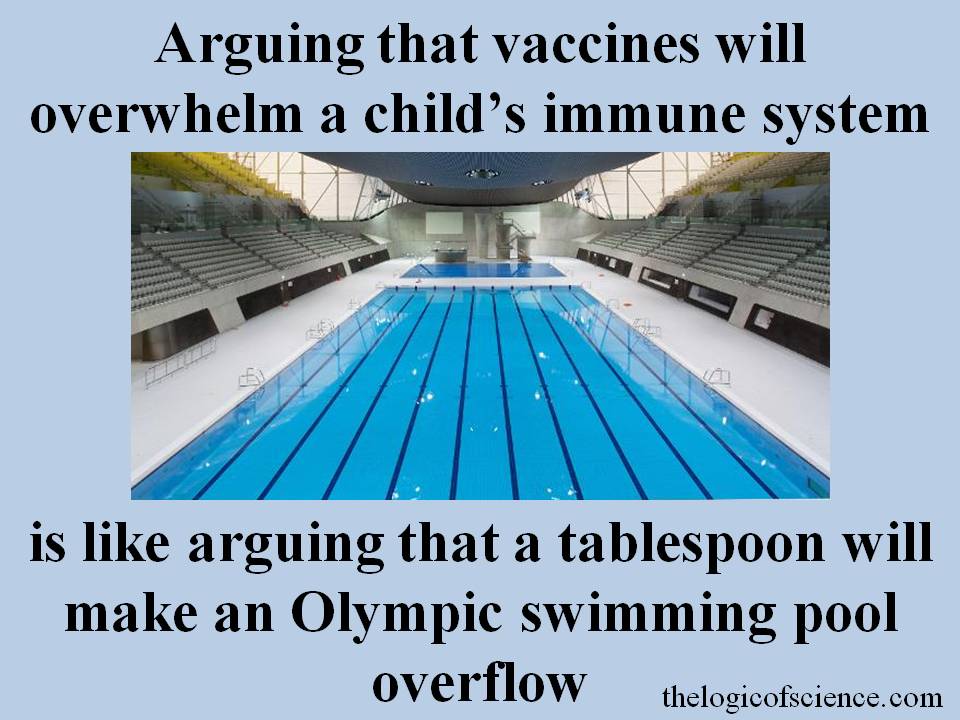
This argument is just downright silly. It goes something like this, “A newborns’ immune system isn’t fully formed yet, so by giving it multiple vaccines right away you can overload its immune system and make it sick (or even immunocompromised).” The reality is that this argument is utter nonsense. Vaccines expose children to a very small number of antigens (antigens are the proteins on the surface of a cell that the immune system uses to recognize and respond to it, each type of virus, bacteria, and cell in your body has its own unique antigen). In contrast, the environment around them exposes them to hundreds, even thousands of antigens daily. Do you know what happens when your kid worms its way through the birth canal? It gets covered in all manner of nasty germs. Do you know what happens when you cuddle the thing and breathe on it? It gets covered in all manner of nasty germs. Do you know what happens when you pass it off to the next person who then breathes on it? It gets covered in a whole new set of nasty germs. Unless you have a C section in a clean room, and instantly stick your kid into a incubation chamber, it will be exposed to far more antigens in its first few hours of life outside the womb then it will ever get from vaccines. Arguing that vaccines will overwhelm a child’s immune system is like arguing that a teaspoon will make an Olympic swimming pool overflow.
#9 Vaccines cause autism
In short, no, they don’t. This argument has done more damage than any other anti-vaccine argument, and it is soooooo easy to debunk, yet anti-vacciners refuse to accept the contrary evidence. In brief, here’s what happened. In 1998 Dr. Wakefield published a paper which suggested that vaccines were causing autism, and the media and general public went nuts with it. So scientists responded by doing what scientists do with an extraordinary claim like this: they tested it over and over again, but what they consistently found was that vaccines were not causing autism. So, in 2010 an official investigation into Wakefield’s claims was made by the British General Medical Counsel. In brief, it found that he was a dishonest, unethical scumbag who had falsified his results and was being paid by parents who thought their kids had been harmed by vaccines (odd, I thought it was supposed to be the scientists who are supporting vaccines that were being paid off). The journal that published his paper has now retracted it, multiple of his other papers have been retracted from various journals, and Wakefield is no longer allowed to practice medicine.
Further, thimerosal is generally the chemical in vaccines that gets accused of causing autism, but it was removed from vaccines in 2001 (see #5). So, if it had been causing autism, then autism rates should have lowered, or at least slowed down, after 2001, but guess what, they didn’t. So in summary, the article proposing that vaccines cause autism was a fraud invented by an unethical doctor, countless papers since that one have failed to find a link between vaccines and autism, and autism rates continue to climb even though that chemical that supposedly causes autism is no longer in vaccines. All around, this argument is one big, steamy, pile of crap.
Here is the one really important question that people who use this argument need to answer, and are completely incapable of answering: if vaccines cause autism, then why has study after study found that autism rates are the same between vaccinated and unvaccinated children? If vaccines cause autism, then the autism rates must be higher among the vaccinated, but they aren’t. A recent study with a sample size of over 1.2 million children very convincingly demonstrated this. Vaccines do not cause autism, it’s that simple.
#10 The majority of people who got the disease were vaccinated for it
In some cases this is true, but ultimately, it is irrelevant. Let me use an example to illustrate (I’m going to use fictional numbers to make the math easy to follow, but this is generally speaking how it works in real outbreaks). Suppose that I told you that 150 out of 200 people (75%) who got disease X had been vaccinated for it? Anti-vaccers hop all over numbers like this and say, “see, clearly vaccines don’t work if the majority of people who get the disease were vaccinated for it.” The problem is that, as any mathematician will tell you, it is the relative percentages, not the raw numbers that matter. So, you also have to look at the total percentage of people who were vaccinated for that disease. Let’s suppose that 95% of the population had been vaccinated, and there were 100,000 people in the population (95,000 vaccinated, 5,000 unvaccinated). That means that the disease rate was 1 in 633 among the vaccinated, and 1 in 100 among the unvaccinated. So yes, of course the majority of people who got the disease were vaccinated against it. That is a simple and irrelevant result of the fact that the majority of people were vaccinated. What’s important is the relative percentages, not the raw numbers. Even though the majority of people who got disease X had been vaccinated, the actual disease rate was over 6 times lower among the vaccinated. Further, in many cases (such as whooping cough), even when the vaccine fails, the severity of the disease is still lessened. So it’s not as simple as whether or not they got it, severity also has to be included.

Notice, most of the people who got the disease were vaccinated, but that is only because the vast majority of people in the study were vaccinated. When we look at percentages, the disease rates were much higher among the unvaccinated. Figure from Schmitz et al. 2011.
#11 Disease outbreaks occur among vaccinated populations
This is another classic example of a sharpshooter fallacy. Anti-vaccers like to point out specific examples where disease outbreaks have occurred in a vaccinated population. The problem is that these examples totally ignore both the many unvaccinated communities that also had outbreaks, and the thousands of vaccinated communities that didn’t have outbreaks. As previously explained (see #3), like all medicines, vaccines do not work 100% of the time, but they do work most of the time. So, of course, outbreaks will still occur in vaccinated communities, but when we zoom out and look at the big picture, we see that outbreaks occur less often among vaccinated communities than unvaccinated communities (see #10). So this argument is another example of cherry-picking data.
Further, this argument ignores several key features of these outbreaks. First, they usually occur in college dorms and other situations where close proximity increases the chances of the vaccine failing (see #3). Also, they are usually easily contained. That is, outbreaks are confined to a specific university or community. This containment is because of herd immunity. When outbreaks occur in areas where very few people are vaccinated, they tend to be much harder to control (see the video in #3). Also, these outbreaks are very often triggered by travel to other countries where vaccines aren’t prevalent. For example, in 2011 there were 222 cases of measles in the US. Two-hundred of those were linked to travel to other countries. So, in fact, these outbreaks provide strong support FOR the effectiveness of vaccines, because they are usually caused by contact with unvaccinated populations. To put this another way, 90% of measles cases in 2011 were CAUSED by people who had not been vaccinated. This is extremely strong evidence that herd immunity works, and opposing vaccines is dangerous. (Note: I did not cherry pick these data, this is an extremely common trend among disease outbreaks).
Related to this argument, is the argument that, “I was vaccinated and still got sick.” This is once again, a sharpshooter fallacy. You have to look at the big picture, not an isolated datum.
#12 Vaccines contain chicken proteins, monkey cells, calf serum, etc.
Yes, vaccines do contain some of these things (though anti-vaccers often list items which aren’t actually in vaccines), but who cares? I often hear anti-vaccers make this claim as it if obviously follows that containing these things is bad and unsafe, but nothing could be further from the truth. Modern medical practices use animal tissues, cells, serum, etc. all the time. A great many lives have been saved by using animal parts. This argument is what is known as an appeal to emotion fallacy. It sounds bad, so people respond to it as if it is bad, and never stop to actually consider the issue. It evokes an emotional response that blocks logical thought. Unless you can provide evidence that these things are bad for you, then you don’t have an argument.
To be fair, if you’re a hard core animal rights advocate, then this argument is probably compelling for you, but most people who I hear using this argument are concerned about human health, not the treatment of animals.
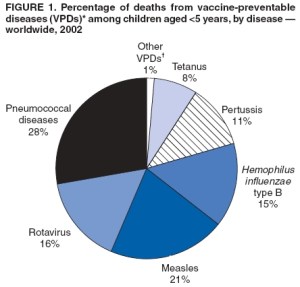
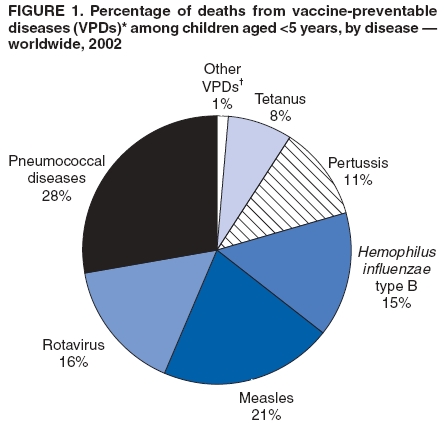
These data came from the deaths of over 2.5 million children under the age of 5 in 2002. Despite what antivaccers want you to believe, these diseases are deadly, and it is clearly better to vaccinate them than it is to let them risk death in the name of acquiring natural immunity. Data via the CDC.
#13 Natural immunity is better than the immunity from vaccines
For sake of argument, let’s assume that this statement is true. My response would then be, so what!? You generally get natural immunity from actually getting the disease! Are you honestly saying that it would be better for your kid to get polio then it would be for him to get vaccinated for polio, because after getting polio he will be better protected from polio in the future (if he survives of course)? That’s just nuts! How can anyone possible say that it would be better for kids to go through these horrible, often life threatening diseases than it would be for them to be protected from them in the first place? This is possibly the stupidest anti-vaccine argument I have ever heard (and that’s saying something).
#14 No vaccine is 100% effective
The fact that anti-vaccers use this argument should be a big clue about the worthlessness of their claims. Just think about this argument for a minute, “they don’t work 100% of the time, therefore we shouldn’t use them.” That’s downright idiotic. Virtually nothing works 100% of the time. Here are just a few examples of other things that don’t work 100% of the time: seat belts, air bags, cancer treatments, condoms, safety harnesses, helmets, parking brakes, air filters, etc. Clearly, the fact that a safety mechanism isn’t 100% effective DOES NOT mean that we shouldn’t use it. Also, the reasons why vaccines sometimes fail have already been discussed in several other sections (see #3, 10, 11, and 12).
Closely related to this argument is the claim that vaccines don’t work/shouldn’t be used because some of them require periodic boosters. Again, this is just silly. Its about like saying that changing the oil in your car won’t help it last longer because you will have to change it again in a few months. Yes, some vaccines require boosters, but that doesn’t mean that they don’t work, it just means that they have limits.
#15 Vaccines contain aborted fetus cells
No, they most certainly do not. Here’s the deal, back in the 60s, cells were taken from a few aborted fetuses, and those cells were used to generate cell lines that are used in the production of vaccines. So the current cells are the great, great, great….great decedents of the original cells, and are not themselves from an aborted fetus. Also, no portion of the cells themselves enter the vaccine. They are used as a growth medium to help develop the virus which will ultimately be deactivated and included in the vaccine. I have sometimes heard anti-vaccers claim that “if they are grown on aborted cells, then some of the aborted cells must be in the vaccine,” but this, once again, just illustrates how little these people understand about science. This claim is really, really easy to debunk. Fruit trees grow from the ground, does that mean that apples contain dirt? Of course not. Even so, just because the virus used to make vaccines are grown using fetal cells does not mean that the vaccines contain fetal cells.
So it basically comes down to this, in the 60s a few fetuses were aborted, and scientists took advantage of those abortions to create a life saving medicine. How does any of that lead to the conclusion that using vaccines is immoral? No new fetuses are being aborted in the name of vaccines, and no fetal cells are in the vaccines. What’s done is done, we can’t change it. So, all that we can do is make the most moral choice out of the choices available to us, and the most moral choice is obviously the one that saves lives (i.e., vaccines). To put this another way, suppose that I made a cure for cancer, but in the process I used aborted fetus cells (no additional fetuses need to be aborted now that I have a cell line). Would you honestly tell the millions of people who are dying from cancer that they shouldn’t use my medicine? I sure hope not.
Conclusion
The obvious conclusion of all of this is quite simple, the anti-vaccine movement consists of biased, paranoid, conspiracy theorists who would rather accept the information on blogs than the information provided by professional scientists. They put the health of themselves, their children, and the entire public at risk simply because they refuse to actually consider the evidence. Their arguments are childish and easy to defeat. Anyone with a computer and access to the internet can shoot holes in their nonsense with a few minutes of honest searching. So please do everyone a favor and VACCINATE!








 The Logic of Science