Are creationists and scientists both interpreting the evidence?

I continually hear creationists make the following claim: “Evolutionists and creationists both have the same amount of evidence, they just interpret the evidence differently.” The argument is basically that evolution and creation are on equal grounds scientifically, and the facts that scientists present are actually just interpretations of the data, and the scientists’ interpretation is no more valid than the creationists’ interpretation. As I will demonstrate, however, this argument is complete nonsense. It, once again, demonstrates that creationists don’t understand how science actually works.

First, this argument inherently assumes that all interpretations are equally valid, but that is obviously ridiculous. Just because there are two interpretations doesn’t mean that they are both rational. More importantly, the way that scientists use the word “interpret” is very different from how most people use it. Personally, I don’t like the term “interpretation” because I don’t think that it accurately represents what scientists do. The term “interpret” implies that the process is subjective, but science relies on objectivity. So, we don’t “interpret” the evidence, rather, we examine the evidence and draw logical conclusions from it. The term “deduce” more accurately illustrates what scientists do.

Allow me to demonstrate this with a court room example. Suppose that John Smith is on trial for murder. We know that he had motive, he has no alibi, we found his DNA at the crime scene, we found the murder weapon in his home, and we found the victims blood in his trunk. The defense, however, has decided ahead of time that Mark Williams is guilty, even though none of the evidence actually points to Mark (there is no motive, no DNA, no weapon, and also no association to John Smith). Now, suppose that the defense gets up in court and says,

“Both sides have the same amount of evidence, we are just interpreting it differently. The prosecution started with the notion that John Smith is guilty, therefore they have interpreted the evidence to indicate that he committed the crime, but if we start with the notion that Mark Williams is guilty, then we can easily interpret the evidence to be consistent with that view. You see, Mark had a secret motive that no one knows about, and after committing the crime, he placed John’s DNA at the scene without leaving any of his own DNA, and he broke into John’s house and car to plant evidence, again without leaving any indication that either had been broken into.”

Obviously, the defense’s “interpretation” is nothing more than baseless speculation, and it would be completely inadmissible in court. It is not an interpretation of the evidence, rather, it is a manipulation of the evidence to try to make it fit a preconceived idea (in technical terms, it’s an ad hoc fallacy). The prosecution’s interpretation, however, is a simple exercise in logic. They started with the evidence, then arrived at the most logical conclusion. This is a key difference between scientists and creationists. Scientists start with the evidence, then draw a logical conclusion; whereas, creationists start with the conclusion that Genesis is literal, then they try to make the evidence fit that conclusion.

Creationists will of course object to this because they claim that scientists are starting with the “naturalistic” viewpoint, then using that viewpoint to interpret the evidence in favor of evolution/an old earth, but this is pure nonsense. We arrived at the conclusion that evolution is correct and the earth is old, because of the evidence, not the other way around. I’ll illustrate this using varves.

Varves are alternating layers of light/fine and dark/course sediment that accumulate in lakes as a result of seasonal changes (light/fine layers = winter; dark/course layers = summer). We can verify that these correlate with seasons because we see varves form today, and at some lakes, we find algae in the dark layers, but not the light layers (algae only blooms in summer). While varves around the edges of lakes can occasionally accumulate more than one layer a year from storms, varves in the center of the lakes only accumulate one layer each year. In the center of some lakes, we have millions of sets of alternating layers. So, how should we interpret the data? The answer is obvious: these lakes are millions of years old. Consider:

  1. A set of two layers (varves) forms every year in these lakes
  2. The fact that these layers represent distinct seasons is confirmed by the algae
  3. Some lakes contain millions of varves
  4. Therefore these lakes are millions of years old.

Notice, this is not an interpretation in the normal sense of the word, rather this is a logical deduction that follows necessarily from the premises. Further, we did not need a “naturalistic” starting point to arrive at the conclusion.

Now, let’s consider the creationists’ “interpretation” of the varves. The most common one goes like this: “actually, these were formed during the flood, through an unknown mechanism. Somehow, the flood managed to sort these particles into alternating layers of sediment, and it managed to sort the algae, and these layers managed to form only over lake beds, and they formed at a rate of over 10 sets of layers per minute.”

This is in no way shape or form an interpretation of the data. It is a complete and total rejection of the data. This is not science, it is pseudoscience. The scientists’ interpretation is a logical conclusion that follows from all known facts. The creationists’ “interpretation” is an illogical ad hoc fallacy that completely ignores the facts, and proposes an unknown and completely absurd mechanism. Even if these layers aren’t precisely one per year, the rate that you would need for creationists’ “interpretation” to be correct is outrageous (roughly one varve every 30 seconds). One of these interpretations is science, the other is not.

Further, if we grant creationists the ability to create unknown mechanisms in order to derive interpretations that match their pre-existing biases, then an infinite number of interpretations become possible. This is the problem with ad hoc fallacies: it is always possible to generate an ad hoc argument. This is also why Occam’s razor is important. It tells us that the solution that makes the fewest assumptions is usually the correct one. In other words, the more unfounded assumptions there are, the less likely something is to be true. The creationists’ “interpretation” consists of multiple assumptions staked on top of each other and is, therefore, logically invalid.

Fortunately, there is an easy way to test whether or not your interpretation is at least potentially valid. Ask yourself the following question, “what if I showed the data to someone who had absolutely no knowledge or biases about the topic, what would they conclude?” In the case of varves, if we showed them to someone who had no knowledge or biases about the age of the earth, they would never conclude that some unknown mechanism caused them to form in roughly one year. Rather, they would conclude that those lakes are several million years old. This clearly demonstrates that scientists are not “starting with a naturalistic explanation” then interpreting the data to fit that conclusion. Rather, we are starting with the evidence, and the naturalistic explanation happens to be the only logical conclusion given those data. To put it simply, if you have to start with the assumption that your conclusion is correct before the interpretation makes sense, then the interpretation is wrong.

Finally, I need to make an important point that usually goes unmentioned in this discussion. Science works best by making a priori predictions. In other words, scientists generally try to make predictions about what the data should look like before examining the evidence. So, for example, the theory of evolution predicted the existence of intermediate fossils, and today we have hundreds of intermediates between reptiles and birds, reptiles and mammals, amphibians and reptiles, fish and amphibians, etc. Creationists look at those fossils and try to interpret them as part of God’s design for creation, but there is a clear difference between what scientists are doing and what creationists are doing. Evolution predicted the existence of the fossils before they were found. In other words, it was proactive. In contrast, creationists are acting entirely retroactively. They predicted that intermediate fossils should not exist, therefore every time that one is found, they try to “interpret” it as a specially created species that just happens to have half the features of a bird and half the features of a dinosaur (for example). The problem, again, is that their “interpretation” is completely ad hoc. You wouldn’t accept it unless you were already convinced that creationism was true.

In summary, scientists are not starting with the assumptions that evolution is true and the earth is old, then interpreting the evidence to fit those assumptions. Rather, we are making and testing predictions about what the evidence should look like if evolution is true and the earth is old, and we are drawing the only logical conclusions from that evidence. In contrast, creationists are starting with the assumptions that evolution is false and the earth is young, then they are manipulating the data to fit those assumptions. So the idea that scientists and creationists both have the same evidence and are just interpreting it differently is completely and totally incorrect. Science always goes from evidence to a conclusion, and anytime that you start with a conclusion, you are, by definition, doing pseudoscience.

NOTE: it is true that scientists do not always agree on interpretations (particularly with phylogentics), but that is because in some complex situations, there are multiple valid deductions and it is difficult or even impossible to determine which one is the best, but these disagreements are generally resolved as more data are collected. Also, a young earth “interpretation” never shows up among the list of logical possibilities. There is no evidence anywhere that leads to the conclusion that the earth is young.

Posted in Nature of Science, Science of Evolution | Tagged , , , , | 14 Comments

The Rules of Logic Part 5: Occam’s Razor and the Burden of Proof

Carl Sagan quote extraordinary evidence claimsOccam’s razor, also known as the principle of maximum parsimony, is one of the fundamental guiding principles in both logic and science. It is commonly explained as, “the simplest solution is usually the correct one.” More accurately, it states that, “all else being equal, the solution that makes the fewest assumptions is usually the correct one.” In other words, when you have multiple competing hypotheses you should default to the one that requires you to make the fewest assumptions, unless there is some compelling, evidence-based reason to think that one of the other solutions is correct. This is closely related to concept of the burden of proof, which states that the person or view making an assertion is the one who is required to provide evidence, not the person who is defending the position that the claim is being made against. As I will illustrate, both of these concepts are essentially just affirmations that ad hoc fallacies are not logically valid.

Before dealing with scientific examples, I want to use some examples from everyday life to illustrate how this works. Suppose you try to start your car in the morning, and it won’t start. There is no indication that anything is mechanically wrong with your car or that anyone has tampered with it, but you notice that you had left the interior lights on the night before. Now answer the question, “why won’t the car start?” The obvious answer is that your battery was drained, but there are multiple other possible explanations for what is wrong with your car. For example, I could posit that a group of teenagers played a prank on you and sabotaged your car. I could also propose that that aliens are experimenting on how humans respond to difficulties; therefore, they sabotaged your car. In fact, there are an infinite number of increasingly absurd ad hoc possibilities (that’s why ad hoc arguments are fallacious), but obviously the battery explanation is the most rational. Why is that? What is it about the battery explanation that makes it more rational than believing that aliens sabotaged your car? Quite simply, it makes the fewest assumptions. In scientific terms, it is the most parsimonious hypothesis. That explanation really doesn’t make any unfounded assumptions, whereas the others become increasingly implausible as the number of assumptions increases. For example, the teenage miscreant hypothesis assumes that there was a group of teenage pranksters near your car last night, they had the motivation and means to sabotage your car, and they actually acted on those motivations and means without leaving any evidence behind. The alien hypothesis is even less plausible, because in addition to slight modifications of the basic assumptions required for the prankster hypothesis, you also have to assume that aliens exist, visit earth, and are interested in seeing how humans solve trivial problems. This is a basic application of Occam’s razor. The hypothesis that your battery died makes the fewest assumptions; therefore, it is the most likely hypothesis.

So where does the burden of proof come into this? It arises when there is contention about which hypothesis to accept. Suppose, for example, that I was with you when your car failed to start, and you asserted that it was the battery, while I claimed that it was aliens. In this case, the burden of proof would be on me to support my hypothesis, rather than being on you to refute my hypothesis. In other words, I am the one making the unparsimonious claim; therefore, I have to support my claim, and you are not required to refute it. So, if you said, “prove that it was aliens” I could not fire back with the well-worn internet response, “well prove that it wasn’t aliens.” The burden of proof is on me, not you. This is very important to understand because people try to shift the burden of proof all the time, and it is not logically valid. The burden of proof is always on the person making the claim.

To further illustrate this, consider a courtroom example. Suppose that an expert forensic witness is brought in to testify in a homicide case, and she carefully explains why the forensic evidence clearly indicates the accused person is guilty. The defense then responds by claiming that the witness is lying. At which point, the judge and prosecutor will invariably demand proof that she is lying. The defense attorney clearly cannot simply respond by saying, “well, prove that she isn’t.” He is the one making the claim; therefore, he bears the burden of proof and must provide evidence to support his claim. The prosecution doesn’t need to provide evidence that the witness is honest because the burden of proof isn’t on them.

That example illustrates a very important point: it’s not just the number of assumptions that matters, the quality of the assumptions is also important. This is part of what is meant by the, “all else being equal” clause in Occam’s razor. Technically speaking, both the defense and the prosecution are making one assumption. The defense is assuming that the witness is lying, and the prosecution is assuming that she is telling the truth, but these two assumptions clearly are not equal. Unless the witness has a past history of lying or there is some evidence-based reason to think that she is lying at the moment, it is clearly more logical to assume that she is telling the truth because her entire job relies on the concept that she will report truthfully on the witness stand. In order for the claim that she is lying to be logically valid, you have to have evidence to support it. That’s how the burden of proof works.

Now let’s apply this to science. When comparing hypotheses and attempting to understand the results of experiments, Occam’s razor tells us that we should default to the answer that makes the fewest assumptions unless we have a compelling, evidence-based reason for doing otherwise. Let me start with a neutral example. I recently wrote a paper on a study of the diet of a particular species of turtle. To conduct this research, I captured turtles in the field, waited for them to defecate into a bucket, then I examined their feces. In their feces, I found a variety of plants, insects, and crawfish. What’s the logical conclusion? As with the battery example, there are an infinite number of possible conclusions. I could, for example posit that they only eat plants but happened to eat a lot of plants that had insect and crawfish molts on them. I could also posit that someone when out before me, captured the turtles, force fed them crawfish, then put the turtles back into the pond just to screw with me. Similarly, I could again invoke aliens as an explanation. Obviously, however, the most rational explanation is that these turtles eat a variety of plants, insects, and crawfish, because that explanation makes the fewest assumptions. In this particular example, the other hypotheses are technically committing question begging fallacies. In other words, they are starting with the conclusion that these turtles only eat plants, then they are making unsupported premises to try to argue for that conclusion. This approach is not logically valid and it is one of the hallmarks of pseudoscience.

Now, let me show how this works in a more contentious example. Young earth creationists argue that the entire world was destroyed in a flood roughly 4,500 years ago. As I plan on elaborating on more in a coming post, one of the big problems with this view is coral reefs. You see, corals are very sensitive, and even most creationists agree that reefs could not survive the flood. This means that all the corals we see today would have had to grow after the flood. The problem is that corals grow very slowly, and to get reefs the size that we see today, you would need a sustained growth rate that is many times faster than the fastest growth rates ever observed under ideal conditions (many reefs are estimated to be several hundred thousand years old). When faced with this problem, creationists generally respond by claiming that growth rates were much faster in the past than they are now. This is a perfect example of an ad hoc fallacy. Think about parsimony for a second, which explanation makes more unjustified assumptions?

  1. Corals do not grow nearly fast enough to form modern reefs in only 4,500 years, therefore there wasn’t a recent worldwide flood.
  2. Corals used to have a sustained growth rate that was many times faster than the fastest growth rate that we have ever observed even under ideal conditions, and for unknown reasons they no longer grow that fast.

Clearly the second explanation is the one making unfounded assumptions. The burden of proof is on creationists to provide evidence that corals used to be able to grow much, much faster than they can today; whereas scientists don’t have to prove that they didn’t grow faster, because there is no a priori reason to think that they did. In other words, the only reason that anyone would accept creationists’ claim is if they already thought that the flood occurred. This is why the argument is not logically or scientifically valid. It starts with the assumption that the flood occurred, then it tries to make the evidence fit that assumption, but science always goes from evidence to a conclusion, never the other way around.

Finally, I want to conclude this post by bringing Occam’s razor and the burden of proof to bear on the common conspiracy theorist claim that virtually all scientists are corrupt and are only in it for the money. For example, whenever I present anti-vaccers with the copious papers that show that vaccines do not cause autism, they invariably claim that all of the scientists involved in those papers were paid off by the pharmaceutical companies. Consider, which explanation makes more unfounded assumptions?

  1. Most of the scientists are doing honest research
  2. All of the hundreds of pro-vaccine researchers from countless institutions and companies from all around the world are being paid off to falsify data

burden of proofClearly the second one is the explanation that is making more unfounded assumptions. This is no different from the courtroom example. Just as the burden of proof was on the defense to prove that the expert witness was lying, even so, the burden of proof is on the anti-vaccers to prove that all of the scientists are paid off. Another way to think about this is to ask whether or not there is any reason to think that the scientists are corrupt other than simply the fact that you don’t like their conclusions. The answer is obviously that there is no a priori reason to think that all of them are corrupt. This same reasoning applies to people who claim that climate scientists are only in it for the money, that Monsanto has control over all the food scientists, etc. Anytime that you claim that a consensus is wrong, you have just placed the burden of proof on your shoulders. Carl Sagan said it best when he said that, “extraordinary claims require extraordinary evidence.” If you’re going to claim that the scientific consensus is wrong about climate change, vaccines, etc. you cannot get away with an unsupported cop out like, “warming is just a natural cycle” or “it’s a conspiracy.” The burden of proof is on you to provide clear and irrefutable evidence for your position. Until you can do that, logic and rational thought are not on your side.

Other posts on the rules of logic:


Posted in Nature of Science, Rules of Logic | Tagged , , , | 2 Comments

GMOs are “unnatural,” but so is everything else that you eat

Genetically modified organisms (GMOs) have become an extremely hot and controversial topic, but, as usual, much of the information about them is actually misinformation, and scare tactics and appeal to emotion fallacies abound. Later on, I plan on dealing at length with a number of specific arguments against GMOs, but in this post I want to simply reveal a fundamental problem with the anti-GMO movement. You see, many of the arguments against GMOs rely on the concept that they are novel or unnatural and, therefore, harmful. Beyond the blatant appeal to nature fallacy, these arguments represent a fundamental misunderstanding of the science behind our food. As I will demonstrate, virtually everything that we eat has been genetically modified, even if it isn’t technically considered a “GMO.”

natural corn teosinte

Even when it has been organically grown, the corn that we eat is not natural, and it is quite different from wild corn (teosinte). Our crops have been genetically modified via thousands of years of careful breeding, and the fruits, vegetables, and animals that we eat today contain novel genetic codes that are not found in nature. Image via rrunrrun.blogspot.com.

First, we have to talk about how we grew food prior to GMOs. Excluding seafood, almost none of the food that we eat is truly natural, even if it has been organically grown. The type of corn that we eat, for example, is not found in nature. Natural corn (teosinte), is tiny and pathetic. So where did our large, juicy ears of corn come from? Well, thousands of years ago someone discovered that you could eat the tiny, pathetic wild corn. So they began to grow it, but they were smart, and each year they planted the new crop using only the best plants from the previous year. In other words, each year they selected the biggest and best ones, and they planted those. As a result of this process (known as artificial selection), each year the ears of corn became a tiny bit bigger than they were the previous year. After several thousand years of this process, we finally have the corn that we enjoy today.

Obviously, no one objects to artificial selection. No one says that it is “unnatural” even though it is by very definition unnatural (i.e., “artificial” and “natural” are antonyms), but, the products of artificial selection are, in fact, genetically modified organisms. We don’t label them as GMOs because they weren’t made in a lab, but they are organisms whose genetics have been modified. They have genetic codes that simply are not found in nature. So, if your problem with GMOs is that you don’t like the idea of humans creating and consuming organisms that don’t exist in nature, then you had better live by foraging from the forest, because virtually all of our crops and livestock have been genetically modified by careful breeding.

Further, our genetic manipulations through careful breeding are not limited to making crops larger, we can also breed different populations to get two beneficial traits in a single crop. For example, suppose one field of corn is very drought resistant, but it doesn’t produce large ears. Meanwhile, a different field produces large ears, but doesn’t do well during droughts. We can cross breed those two populations, and the resulting generation will have genes from both groups of corn, resulting in crops that are large and drought resistant. Notice, by doing this we have made a novel combination of genes that is not found in nature. We have recombined the DNA of these plants to produce new gene sequences. The only difference between this and a GMO is that we used crossbreeding to combine the genes whereas GMOs rearrange the DNA in a lab. Either way, we are manipulating organisms’ genetic codes.

Even more spectacularly, we can hybridize two different species of plant! This doesn’t simply result in a plant that is larger than the ones found in nature, rather, it results in an entire fruit that is not found in nature. Think about this for a second, one of the biggest objections to GMOs is that people don’t like the concept of splicing the genes from two different species together, but that is exactly what fruits like plumcots are. Biologists took the genes of two different species and merged them. We don’t consider plumcots to be GMOs because their genes were spliced by breeding not by laboratory manipulation, but this distinction is completely artificial. It doesn’t matter whether this new organism was formed by splicing genes in a lab or by careful breeding, either way, it results in a novel genetic code that does not exist in nature.

With this realization in place, the majority of the arguments against GMOs fall apart because if they worked, they would also apply to our non-GMO foods. For example, you may have heard about concerns that GMOs will hybridize with wild plants, well guess what, our non-GMO crops can do that too, and they are just as unnatural as GMOs (i.e., they also contain a genetic code that is not found in nature). Similarly, you may have heard that bacteria in your gut will take up some novel strand of DNA and make a new and dangerous protein, but, since our hybrids and other non-GMO crops also contain novel strands of DNA, bacteria can, in concept, do that with regular crops as well (note: there are lots of other problems with that bacteria argument, but I won’t go into their details here).

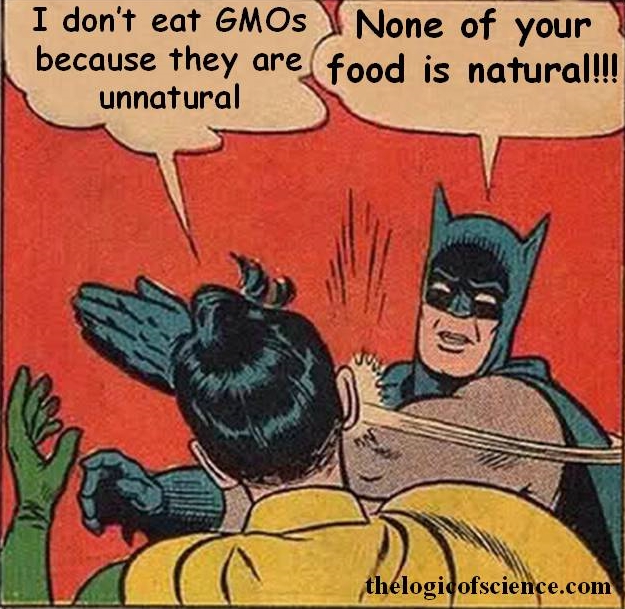
Batman and robin GMO meme

Almost nothing that we eat is truly natural (i.e., most of our foods are not found in nature)

My point here is quite simple: GMOs are not some novel freak of science. They are simply a natural extension of what farmers have been doing for thousands of years. Virtually all of our crops are unnatural, even if they are grown organically. Almost every bite of food that enters our mouths contains novel strands of DNA that are not found anywhere in nature. So if this concept of eating “unnatural” foods freaks you out, then I am afraid that you are in serious trouble, because nearly all of our crops and livestock have been genetically modified by careful breeding.

Posted in GMO | Tagged , , | 18 Comments

An Introduction to Theistic Evolution: Using Science to Interpret the Bible

When it comes to the theory of evolution, there is often an unnecessary clash between “men of faith” and “men of science.” I frequently see other scientifically minded people debate with creationists by either attacking the Bible or completely ignoring it and focusing entirely on the science. I think that both of these tactics are fundamentally flawed. There is no reason why you have to be either a man (or woman) of faith or a man of science, you can be both, and any attempt to persuade a believer to accept evolution without discussing theology is doomed to fail. Therefore, I am going to take a somewhat novel approach to this situation. For sake of discussion, I am going to ask that everyone reading this temporarily accept the premise that the Bible is the divinely inspired Word of God, and I am going to then demonstrate that even with that premise in place we still have to accept science, including the science of evolution. To be clear, I most decidedly am not trying to persuade anyone to become a Christian. In fact, I am not making any claims or arguments about whether or not Christianity is true, God exists, etc. Those are all outside of the realm of science. Therefore, I am simply trying to show that Christianity and evolution do not have to conflict with one another, and people with a Christian world view should still consider the scientific evidence for evolution. In other words, within the context of this blog, I am concerned only about science, but sometimes I find that it is necessary to discuss religion before people will listen to the science. So that is what I am going to do here, because I often find that this approach allows me to have conversations with Christians that I could not otherwise have.

Note: As I’ve written about at length here, I was raised as a young earth creationist and did not reject that view until I entered college and was taught how to think critically. After that, I began examining my views and beliefs and they began crumbling around me. Although I am no longer a theistic evolutionist, I went through a period where I considered myself one, and it was a helpful viewpoint for getting me to challenge my creationist views, which is why I advocate for using this line of argumentation (for me, you could almost consider it a transitional fossil between young earth creationism and the ultimate full degradation of my religious views)

It is entirely possible to be what is known as a “theistic evolutionist.” Most broadly defined, this is simply someone who both believes in God and accepts the science of evolution. There are many varieties of theistic evolution, but most theistic evolutionists hold the following:

  1. The Bible is the fully inspired and infallible Word of God.
  2. It is impossible to read the Bible without interpreting it.
  3. Any interpretation that conflicts with something that we know to be true must be rejected.
  4. There is overwhelming scientific evidence that the earth is ancient and life gradually evolved.
  5. Therefore, a literal interpretation of Genesis must be rejected.
  6. Therefore, Genesis must be a parable designed to teach spiritual truths rather than scientific facts.

Generally speaking, theistic evolutionists argue that God sparked the Big Bang, then allowed nature to run its course and did not intervene again until humans evolved sentience, at which point he established a personal relationship with humans. There are also theistic evolutionists who argue that God created the first cells, then let evolution run its course, and there are still others who say that God guided the process of mutations to ensure that humans would be the ultimate outcome. These views become increasingly unparsimonious, but none of them can technically be discredited using science (I won’t enter into philosophical arguments about God’s existence here).

Interestingly, most of the hostility towards theistic evolutionists comes not from scientists, but from young earth creationists. Organizations such as Answers in Genesis are adamant that theistic evolution is “dangerous,” and theistic evolutionists have “compromised” by rejecting the literal interpretation of the Bible. The vast majority of their arguments are, however, straw man fallacies. Creationists frequently claim that theistic evolutionists are, “trusting man’s wisdom instead of God’s,” “asserting that man is smarter than God,” or some other such nonsense. The reality is that all of the theistic evolutionists that I have met or whose writings I have read, have been extremely sincere about their faith. They are not claiming that God made a mistake or that man is smarter than God, rather, they are claiming that man’s interpretation of the Bible is flawed.

This is a very important point. Creationists continually assert that they have the spiritual high ground because they are simply accepting what the Bible says, whereas theistic evolutionists are making interpretive judgments. In reality, however, both creationists and evolutionists interpret the Bible. What creationists seem to forget is the fact that a literal interpretation is still an interpretation. Nothing in the Bible says that you have to interpret it literally, and, in fact, there are passages that virtually all Christians (including creationists) agree are figurative. So, ultimately, for any given passage, human beings are using “man’s logic” to decide which passages to interpret literally and which ones to interpret figuratively. There are many factors (such as the literary genre of a passage and its connections to other passages) that are used when determining how to interpret a passage of the Bible, and all that theistic evolutionists are proposing is that scientific evidence (i.e., things that we know to be correct) should be included as one of those factors. Creationists claim to ardently disagree with this proposition, but the reality is that they are extremely inconsistent about how they interpret the Bible, and in many passages they do in fact use scientific to make their interpretive judgments. I will prove this using the example of Galileo Galilei.

Galileo

Galileo Galilei

Galileo was not the first person to suggest that the earth moved around the sun (i.e., heliocentrism) rather than the sun moving around the earth (i.e., geocentrism), but he had something that his predecessors lacked: a telescope. With his telescope, he could make observations that were impossible for his predecessors, and he used those observations to demonstrate that heliocentrism was in fact correct. This got Galileo in trouble with the church (although the outcry against him was not as universal as some would have you believe). You see, several passages of the Bible clearly state that the sun moves around the earth. For example, 1 Chronicles 16:30, Psalms 93:1, Psalms 96:10, and Psalms 104:5 all very clearly say that the earth’s position is fixed and it cannot be moved. Most famously, there is a passage in the book of Joshua where the armies of Israel are in a battle and they need more time to win it so God performs a miracle and makes the sun and moon stand still, thus making the day last longer and giving Israel the time needed to win the battle. The Bible very clearly says that the sun stopped moving, “And the sun stood still, and the moon stopped” Joshua 10:13.

Prior to Galileo, everyone read those passages completely literally, and there was no good reason for them not to (anyone who spends a lot of time observing the night sky without the aid of a telescope will notice that it does in fact appear that the earth is stationary and everything else is moving around it). So, when Galileo said that in actuality it is the earth that is moving, not the sun, many members of the church took umbrage at this claim because it conflicted with a literal interpretation of the Bible. In fact, they made many of the same arguments that creationists make today. They claimed that we have to trust the authority of the Bible, not science and man’s wisdom. Galileo’s response was the same one that theistic evolutionists use today. He explained that he was not questioning the Bible itself, rather, he was questioning man’s interpretation of it. He was perfectly content to reinterpret passages such as the one in Joshua to accommodate new scientific discoveries.

Today, of course, virtually all Christians accept Galileo’s argument. The vast majority of Christians have no problems accepting that Joshua is being figurative when it says that the sun stood still, yet many of them are still adamant that we cannot use science to interpret Genesis, and have to rely on the literal interpretation of the Bible. This is, however, logically inconsistent. Consider the following two arguments:

Argument 1

  1. The Bible is the fully inspired word of God.
  2. The Bible clearly says that the sun moves around the earth.
  3. We cannot allow science to influence how we interpret the Bible. We have to trust what God said, not man’s flawed logic.
  4. Therefore, helicentrism must be wrong.

Argument 2

  1. The Bible is the fully inspired word of God.
  2. The Bible clearly says that all organisms were created less than 10,000 years ago.
  3. We cannot allow science to influence how we interpret the Bible. We have to trust what God said, not man’s flawed logic.
  4. Therefore, evolution must be wrong.

Argument #1 is the argument that was used by members of the church against Galileo, and it is clearly a flawed argument. Argument #2 is the argument that is used by creationists and it is identical to Argument #1. Therefore, according to the Law of Noncontradiction if argument #1 is a bad argument, then Argument #2 must also be a bad argument. In other words, you cannot simultaneously say that it is ok to use the science to interpret Joshua, but it’s not ok to use science to interpret Genesis.

At this point, creationists generally object to the second premise of Argument #1. They claim the Bible does not clearly say that the sun moves around the earth, because those passages are obviously being figurative, whereas Genesis does clearly say that all organisms were created less than 10,000 years ago. There are several problems with this. First, it’s a blatant question begging fallacy. The passage in Joshua does not of itself seem to be figurative, especially when everything else in that passage is clearly being literal. Further, everyone prior to Galileo interpreted that passage literally. So it was clearly not, “obviously figurative” to them. Further, the only reason that Christians interpret that passage figuratively today is because of science! If we had never discovered that the earth moved around the sun, then ipso facto we would still think that the sun moved around the earth, and ipso fact we would still interpret Joshua literally.

The second problem with the creationists’ response is that theistic evolutionists say the exact same thing about premise #2 of Argument #2. While to creationists it is obvious that the Bible clearly supports a young earth, it is not at all obvious to theistic evolutionists. This brings me back to me central point: theistic evolutionists aren’t questioning the Bible itself, rather they are questioning man’s interpretation of it. A literal interpretation is still an interpretation.

Finally, it is worth noting that geocentrists still exist today. There are groups of Christians who are adamant that we cannot use science to interpret the Bible, and therefore we must accept that the sun moves around the earth. Major creationist organizations deliberately distance themselves from these groups, but both groups use completely identical arguments.

This is a statement of faith from the geocentric group, the Tychonian Society:

“The only absolutely trustworthy information about the origin and purpose of all that exists and happens is given by God, our Creator and Redeemer, in his infallible, preserved word, the Holy Bible….All scientific endeavor which does not accept this revelation from on high without any reservations, literary, philosophical or whatever, we reject as already condemned in its unfounded first assumptions”

This is a statement of faith from the creationist group, Answers in Genesis:

“The Bible is divinely inspired and inerrant throughout. Its assertions are factually true in all the original autographs. It is the supreme authority in everything it teaches. Its authority is not limited to spiritual, religious, or redemptive themes but includes its assertions in such fields as history and science.”

Do they seem pretty similar to you? Both groups ardently claim that the Bible alone is to be trusted, and any scientific results that conflict with a literal interpretation of the Bible must be rejected. Both groups have lengthy pages of “technical documents” where they try to twist science to match a literal interpretation of the Bible, and both groups claim that anyone who uses science to interpret the Bible has compromised and given into man’s wisdom, which is where things get interesting. The geocentrists claim that groups like Answers in Genesis have compromised their faith by accepting the scientific interpretation of Joshua. All of those claims that creationists make about the dangers of theistic evolution are also claims that geocentrists make about the dangers of heliocentrism. Meanwhile, the creationists claim that the geocentrists are wrong to try to interpret Joshua literally, and they find it absurd to think that accepting heliocentrism somehow compromises their faith, even though they use identical arguments against theistic evolutionists. The genocentrists may be nuts, but at least they are logically consistent, which is more than I can say for the creationists.

To summarize, my point in all of this is that if you are a Christian who accepts that the earth moves around, then you have already accepted that science can be used to interpret the Bible. Therefore, you should carefully consider the evidence for evolution rather than blindly writing it off. At least according to legend, Galileo recounted a frustrating tale where he took one of his opponents onto a roof at night and offered him a telescope so that he could see the evidence for heliocentrism with his own eyes, but this man was so persuaded by his religious convictions that he refused to even look through the telescope. Today, we laugh at that man’s foolishness, but that is no different from what most creationists do. Most of them refuse to look at the evidence for evolution and groups like Answers in Genesis openly admit that they are starting with the assumption that the earth is young and then trying to make the data fit that assumption (which is not how science works). So, to any creationists reading this, please actually consider the scientific evidence. Accepting evolution does not require you to reject your faith. Just as Galileo interpreted Joshua figuratively in light of the science of heliocentrism, you can interpret Genesis figuratively in light of the science of evolution. Insisting that you cannot use science to interpret the Genesis is irrational and logically inconsistent.

“I do not feel obliged to believe that the same God who has endowed us with senses, reason, and intellect has intended us to forgo their use and by some other means to give us knowledge which we can attain by them.” – Galileo Galilei


Posted in Nature of Science, Science of Evolution | Tagged , , , | 41 Comments

Was Charles Darwin An Atheist?

Darwin

Charles Darwin

In honor of Darwin Day, I want to take a moment to dispel a very common misconception about one of the greatest figures in the history of science. I have frequently encountered Christians who adamantly proclaim that Darwin was, “an atheist setting out to disprove God,” and, therefore, we shouldn’t accept the theory of evolution. This is a rather bizarre claim that Darwin himself would have strongly disagreed with, so I want to briefly debunk it here.

First, it’s important to acknowledge that this is a guilt by association or ad hominem fallacy (depending on exactly how it is worded), so this argument is automatically invalid. Whether or not the theory of evolution is correct has to be determined by the evidence and scientific merits of the theory itself, not the beliefs of its most well known founder (Alfred Russell Wallace independently came developed the same theory).

HMS beagle

HMS Beagle

Further, the claim itself is blatantly false. Before becoming a naturalist, Darwin actually began training to become a clergyman, and when Darwin first set sail on the HMS Beagle (the voyage where he would make his earth-shattering discoveries), he still considered himself to be a Christian and believed much of the Bible. This is a quote from Darwin himself,

“Whilst on board the Beagle I was quite orthodox, and I remember being heartily laughed at by several of the officers (though themselves orthodox) for quoting the Bible as an unanswerable authority on some point of morality.”

Admittedly, Darwin’s views had begun to change by the time that he completed his voyage, but the notion that his goal was to disprove God is patently absurd.

Later in life, it seems clear that Darwin rejected his fundamentalist upbringing, but it also appears clear that he was never an ardent atheist whose goal was to discredit the Bible. In reality, his writings reveal a man who was very uncertain about the existence of God. I could give many quotes from Darwin that affirm this, but I think he said it best in a letter to James Fordyce:

“What my own views may be is a question of no consequence to anyone but myself. But, as you asked, I may state that my judgment often fluctuates. . . . In my most extreme fluctuations I have never been an Atheist in the sense of denying the existence of a God. I think that generally (and more and more as I grow older), but not always, that an Agnostic would be the more correct description of my state of mind.”

Similarly, in his autobiography, he said,

“I cannot pretend to throw the least light on such abstruse problems. The mystery of the beginning of all things is insoluble by us; and I for one must be content to remain an Agnostic.”

There you have it from Darwin himself, he was not an evil, sinister atheist setting out to destroy the notion of God.

Finally, I want to briefly dispel another common myth about Darwin. Namely, the claim that he had a deathbed conversion during which he denounced evolution. Nothing could be more untrue or insulting to the memory of a great man. All of Darwin’s numerous manuscripts, notebooks, and letters affirm that he was fully committed to his theory throughout his life, so this claim is incongruous with his written works. Further, it has been thoroughly debunked by historians (links to sources here). Finally, even IF this outlandish claim was true, it would have absolutely no bearing on the theory of evolution itself (i.e., this argument is an appeal to authority fallacy). Whether or not evolution is correct is determined by its own merits, not by the credentials of the people who accept or reject it.

So, in conclusion, whether you agree with his theory or not, Darwin was undeniably a phenomenal scientist, and he should be remembered and celebrated as a man of extraordinary intellect, not as a villain seeking to pollute the world with satanic lies.

Posted in Science of Evolution | Tagged , | 1 Comment