
Mission statement
- Teach critical thinking.
- Explain how science works and why it is reliable.
- Use critical thinking to defend science against the numerous logically flawed attacks that are hurled at it.
About this blog
We live in a fantastic world with countless technological marvels that were all brought to us courtesy of modern science. We understand more about our universe than people 100 years ago could ever have imagined. Nevertheless, there is a growing anti-science movement that is plaguing our planet and threatens to halt or even reverse scientific advancement. An increasing number of mostly well-intentioned people have launched an all out war against virtually every field of science. Anti-GMO advocates are attempting to halt genetics research. Climate change deniers are assaulting the entire field of climatology and spreading dangerous conspiracy theories and misconceptions. Anti-vaccers, homeopaths, alternative medicine practitioners, people who deny AIDs, and many others are all seeking to discredit the medical advances that have saved billions of lives, and, finally, we have young earth creationists whose arguments are so insidious that they pervade and seek to destroy biology, geology, physics, and chemistry. When I read the arguments of these groups, however, I do not find rational arguments that are grounded in facts. Rather, I find logical fallacies, conspiracy theorist musings, anecdotes, fear mongering, and a complete denial of the value of scientific research.
It would be easy to write these groups off as nothing more than a collection of idiots, but their numbers are large enough that they must be taken seriously. Further, in most cases I don’t think it is a matter of intelligence. In other words, I don’t think that most of the people in this anti-science movement are inherently unintelligent. Rather, I think that they have been misinformed and misguided. When I look closely at anti-science arguments, I generally find that they stem from a fundamental lack of scientific understanding and a poor knowledge of the rules of logic.
Therefore, one of the primary goals of this blog is to teach people how to think. It may sound silly, but most people do not intuitively know how to think critically. The average person needs to be taught how to think rationally, and I will fully admit that this was the case for me. I believed all manner of nonsense before being taught the rules of logic, and before I understood how to think critically, it was impossible for me to see the flaws in my arguments because I didn’t understand the difference between good arguments and bad arguments. I lacked the necessary tools for evaluating my vies. So, before I can convince anyone to accept science, I must first explain how to think.
An additional goal of this blog is to explain how science works and why we are so certain of the results it gives us. It is my intention to join the battle for the minds of the public, and to attempt to persuade my readers to rely on logic and carefully controlled scientific studies rather than fear tactics, misinformation, and anecdotes.
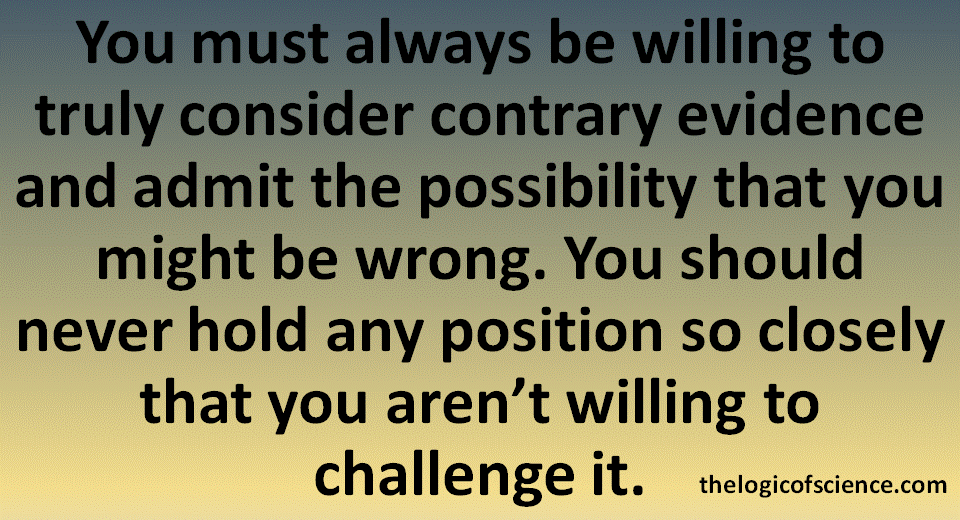 I ask only one thing of those who read my blog: that you accept the possibility that you might be wrong. The healthiest thing that anyone can do is to acknowledge that they might be mistaken, then go from that admission to a careful consideration of the facts. So I encourage everyone to lay aside your biases, apply the rules of logic, and carefully consider the issues at hand.
For the most part, it is my intention simply to inform people about science. Nevertheless, people often drag religion into debates that should be inherently scientific. Therefore, I will attempt to deal with some theological arguments as well (especially creationists’ claims that evolution and the Bible are inherently at odds). These posts will be geared specifically towards Christians who view science and religion as being incompatible, and it is my intention simply to show that the religion and science do not have to conflict with each other. I often find that this is a necessary prerequisite for discussing science with religious people. To put that another way, when I discuss topics like creationism, my goal is not to convince people to abandon their religion, but rather to show them the overwhelming evidence for evolution. For the sake of this blog, if someone wants to believe in god and accept the science of evolution, then I have no problems with them (that isn’t to say that discussions about whether or not god exists aren’t interesting and worth having, but simply that they are outside of the scope of this blog).
To facilitate easy learning, this blog is divided into several sections (some posts may appear in more than one section if they are highly relevant to both topics). I recommend that new readers start with the logic section. This section covers the basics of logical analysis and how to tell the difference between good arguments and bad arguments. Understanding logic is vital in order to properly comprehend any argument, so I strongly recommend that you familiarize yourself with its rules prior to reading my other posts.
The core of this blog is the section on the Nature of Science. This section contains general information about how science works, the logic of how and why we do science, and why we should trust science.
Finally, I have included sections with specific arguments pertaining to evolution, global warming, GMOs, and vaccines/alternative medicines. There is also a miscellaneous category (Misc.) that covers topics that did not fit neatly into the other pages.
About me
Because of the vitriol and ad hominem assaults that tend to get hurled at people who take a public stand on these issues, I am disinclined to post much in the way of person details. So I will simply summarize by stating that I have a B.S., M.S., and Ph.D. in biology, and I am currently a post-doctoral researcher at a university. I have over a decade of research experience, and I have published multiple peer-reviewed papers, served as a reviewer for many journals, and presented my research at national, professional conferences. Additionally, I have taught biology as an adjunct professor at a local college, as well as helping to teach multiple courses during my Ph.D. My research combines ecology and molecular tools (e.g., population genetics and microbiome sequencing) to address issues in wildlife conservation, particularly the conservation of reptiles and amphibians. Thus, depending on what level you were describing my research at, I could be accurately described as a herpetologist, zoologist, conservation biologist, ecologist, or population geneticist. Really though, all that you need to know about me is that I prize logical thought and a careful, rational understanding of the world around us above all else, and this blog is my attempt help people understand both logic and science.
Note: the pseudonym under which I am writing this blog (i.e., Fallacy Man) is a moniker that I adopted based on a character in the hilarious and educational online comic strip, Existential Comics.
 The Logic of Science