
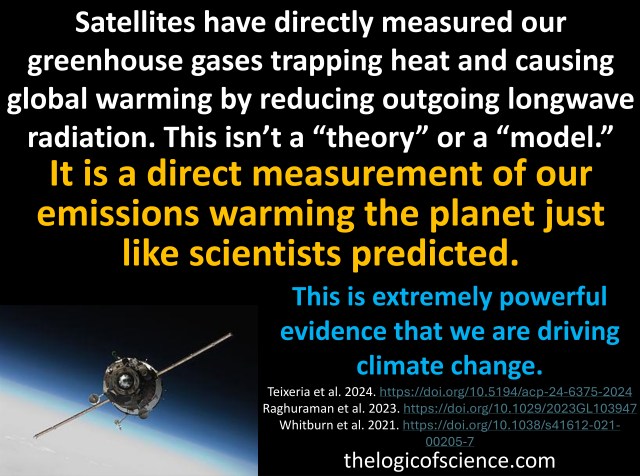
 The evidence for anthropogenic climate change is overwhelming, but the inherent complexity of the climate can make it difficult to communicate the science to the public. The basic concept is simple enough (CO2 traps heat, we have increased the CO2 in the atmosphere, therefore more heat is being trapped), but the details quickly get convoluted and conversations get bogged down in details of climate models, forcings, feedback loops, etc. So in the post, I want to talk about a really key piece of evidence that is, in my opinion, very straightforward and easy to understand and also extremely compelling. Namely, the results of satellites measuring heat leaving earth.
To set the stage for this, let’s quickly review the basic facts. Energy enters the earth as high energy (short wavelength) radiation from the sun. Some of that energy is lost as it passes through our atmosphere and reflects off the earth’s surface. That reflected radiation is then lower energy (long wavelength) heat that goes back into space. CO2, methane, and other greenhouse gases absorb some of that long wavelength energy, temporarily trapping it in our atmosphere, just as the glass of a car windows traps heat in your car. All of this is basic science that we have understood since the late 1800s. Everything so far is universally agreed on.
Changes in CO2 levels subsequently result in changes in the earth’s climate, and we can clearly see from studying past climates that CO2 increases result in increased temperatures (note: it is not true that the temperature increases lag behind the CO2; details and sources here).
We also know that we have greatly increased the levels of CO2 and some other greenhouse gases in the atmosphere. This led to the simple prediction that our greenhouse gases would cause the planet to warm (just as past natural increases in CO2 have), and, of course, our planet is warming. Scientists have studied this by carefully examining natural drivers of climate change, and none of them can explain the current warming (Foster and Rahmstorf 2011; Meehl, et al. 2004; Wild et al. 2007; Lockwood and Frohlich 2007, 2008; Lean and Rind 2008; Imbers et al. 2014). However, when we plug the known physical effects of our greenhouse gas emissions into the calculations, we get a very good fit between observations and what we expect based on the physics (Hansen et al. 2005; Santer et al. 2012; Stips et al. 2016; Stott et al. 2001; Meehl et al. 2004; Allen et al. 2006; Lean and Rind 2008; Imbers et al. 2014).
Note that we know the current CO2 increase is from us due to the isotope ratios. Details and sources here.
All of this is already very compelling, but modern satellites provide another line of evidence that is a metaphorical smoking gun. We have used them to measure the outgoing long wavelength radiation, and that radiation shows a clear and undeniable signature of our effects on the planet.
Science fundamentally works by making and testing predictions, and we judge the strength of an idea by how well it predicts observations and experimental outcomes. So let’s look at the predictions that were made prior to analyzing the satellite data and see how they hold up.
If our understanding of climate change is correct, then when we look at the satellite records we should see:
- Energy entering the earth remains relatively stable, while the outgoing long wavelength energy decreases (because it is being trapped by greenhouse gases)
- The decrease should be specifically at the wavelengths that our gases trap (thus indicating that it is our gases doing the trapping)
- The rate of decrease should match the models that are based on the physics of how greenhouse gases trap heat.
These are really strong, falsifiable predictions. If it turned out that outgoing radiation was not decreasing (prediction 1), that would sink climate change. That prediction has to come true for the notion of our gases causing climate change to be true. Likewise, if radiation decreased, but it wasn’t at the frequencies that greenhouse gases trap (prediction 2), that would show that our greenhouse gases weren’t the cause of the reduction in radiation. Finally, if predictions 1 and 2 came true, but the rates of decrease were way off, it would suggest that the fundamental concepts of anthropogenic climate change might be right, but our understanding of the physics is way off and, therefore, our predictions are unreliable.
In contrast, no other driver of climate change makes these three predictions. There is no other reason to expect outgoing radiation to decrease, and we certainly would expect a decrease to happen at exactly the frequencies trapped by greenhouse gases, nor would we expect the rate of decrease to match the modeled predictions based on our understanding of how greenhouse gases work.
Note that these measurements are typically taken on “clear sky” days to eliminate cloud cover as an explanation.
This is a great set of predictions because they make it possible to falsify climate change and they should only come true if our greenhouse gases are driving the current warming.
So what have we found? You probably guessed it: multiple studies tackling the problem from multiple angles have consistently found that all three predictions are true. When we use satellites to measure outgoing radiation we find a decrease specifically at the frequencies of our greenhouse gases, and those decreases match the models (Harries et al. 2001; Griggs and Harries. 2007; Kramer et al. 2021; Whitburn et al. 2021; Raghuraman et al. 2023; Teixeria et al. 2024). These results also match similar land-based research that directly measured the impact of CO2 (Feldman et al. 2015).
This is it. If there was ever any doubt, this settles it. Case closed. This a smoking gun, a clear fingerprint of our actions, and any other courtroom analogy you can think of. Really think about how extraordinary these predictions are and ask yourself, “why did they come true if our gases are not driving the change?”
We KNOW that our gases are trapping extra heat. We’ve measured it! This isn’t a “theory” or a “model.” It is a direct measurement of our gases trapping heat and warming the planet. This is the most conclusive evidence we could ever hope to have.
If you want to continue to deny that humans are causing climate change, then you have some really hard questions to answer like, where is the heat going? We know it’s not leaving earth, so what’s trapping it? Further, what is managing to trap it at the frequencies that we know our gases trap? And how is it doing it at exactly the rate we expect based on the increase in greenhouse gases?
Any alternative to anthropogenic climate change has to present compelling answers to those questions. Good luck.
Note: It is simply not true that climate change predictions have been wrong. Certainly there have been some sensational claims in the media as well as bad distortions of scientists’ predictions, and if you really try, you can cherry-pick off the cuff comments from individual scientists, but the core, consensus models scientists rely on have actually done a very good job of predicting trends. Details and sources here
Literature cited
- Allen et al. 2006. Quantifying anthropogenic influence on recent near-surface temperature change. Surveys in Geophysics 27:491–544.
- Feldman et al. 2015. Observational determination of surface radiative forcing by CO2 from 2000 to 2010. Nature 519:339-343
- Foster and Rahmstorf. 2011. Global temperature evolution 1979–2010. Environmental Research Letters 7:011002.
- Griggs and Harries. 2007. Comparison of spectrally resolved outgoing longwave radiation over the tropical Pacific between 1970 and 2003 Using IRIS, IMG, and AIRS. Journal of Climate 20:3982-4001.
- Hansen et al. 2005. Earth’s energy imbalance: confirmation and implications. 308:1431–1435.
- Harries et al. 2001. Increases in greenhouse forcing inferred from the outgoing longwave radiation spectra of the Earth in 1970 and 1997. Nature 410:355–357.
- Imbers et al. 2014. Sensitivity of climate change detection and attribution to the characterization of internal climate variability. Journal of Climate 27:3477–3491
- Kramer et al. 2021. Observational Evidence of Increasing Global Radiative Forcing. Geophysical Research Letters 48: e2020GL091585
- Lean and Rind. 2008. How natural and anthropogenic influences alter global and regional surface temperatures: 1889 to 2006. Geophysical Research Letters 35:L18701.
- Meehl, et al. 2004. Combinations of natural and anthropogenic forcings in the twentieth-century climate. Journal of Climate 17:3721–3727.
- Lockwood and Frohlich. 2007. Recently oppositely directed trends in solar climate forcings and the global mean surface air temperature. Proceedings of the National Academy of Sciences 463:2447–2460.
- Lockwood and Frohlich. 2008. Recently oppositely directed trends in solar climate forcings and the global mean surface air temperature. II. Different reconstructions of the total solar irradiance variation and dependence on response time scale. Proceedings of the National Academy of Sciences 464:1367–1385.
- Raghuraman et al. 2023. Greenhouse Gas Forcing and Climate Feedback Signatures Identified in Hyperspectral Infrared Satellite Observations. Geophysical Research Letters 50: e2023GL103947
- Santer et al. 2012. Identifying human influences on atmospheric temperature. PNAS 110: 26-33
- Stips et al. 2016. On the causal structure between CO2 and global temperature. Scientific Reports 6: 21691
- Stott et al. 2001. Attribution of twentieth century temperature change to natural and anthropogenic causes. Climate Dynamics17:1–21.
- Teixeria et al. 2024. Direct observational evidence from space of the effect of CO2 increase on longwave spectral radiances: the unique role of high-spectral-resolution measurements. Atmospheric Chemistry and Physics 24: 6375-6383
- Wild et al. 2007. Impact of global dimming and brightening on global warming. Geophysical Research Letters
- Whitburn et al. 2021. Trends in spectrally resolved outgoing longwave radiation from 10 years of satellite measurements. 4: 48


Typo in this sentence: “It is a direct measurement of our gases trapping head and warming the planet. This is the most conclusive evidence we could ever hope to have.” It should be “trapping heat” instead of “trapping head”.
LikeLike
Fixed
LikeLike
Is it not evident our planet is evolving. Are our scientists so egotistical as to assume they control our planet and weather.
The current level of volcanic activity has enormuous effect on greenhouse gas emmissions.
one would have thought, when everything was shutdown during covid our emmissions world wide would have reduced. From what I have found nothing changed.
Is the use of climate change a move by governments and scientists to have coercive control over the people.
LikeLike
You have just been shown direct evidence that we are causing our planet to warm. What specifically do you disagree with? You’re entire argument seems to be, “well I don’t think we can affect the planet.” That is what is known as an incredulity fallacy. Your lack of understanding is not a reflection of reality.
More details here https://thelogicofscience.com/2024/05/16/incredulity-fallacy-im-right-because-i-cant-believe-im-wrong/
and here https://thelogicofscience.com/2016/10/17/25-myths-and-bad-arguments-about-climate-change/#Bad%20Argument/Myth%20#25
The truly egoistical position is to blindly deny evidence.
As far as volcanoes, it is a total myth that they produce more CO2 than us (a few seconds on google will show you that). Further, scientists have carefully looked at the natural drivers of climate change (including volcanoes) and they cannot explain the current warming (see studies in the post).
Further, it is true that natural sources of CO2 in total (not just volcanoes) are greater than what we produce, but critically, before us, nature was in balance, and just as much CO2 was removed as produced. Now, excess is produced by us. https://thelogicofscience.com/2016/10/17/25-myths-and-bad-arguments-about-climate-change/
Also, emissions did, in fact, drop during COVID https://www.nature.com/articles/s41561-022-00965-8.pdf
In closing, I have a simple question for you: what evidence would convince you that you were wrong? If the data presented here are not enough, then what would be?
LikeLike
I realise that when you’re talking about the outgoing longwave energy decreasing, you’re probably referring to specific wavelengths, but one prediction of AGW is actually that overall outgoing longwave flux increases with emissions. This is essentially because the various feedbacks that respond to the warming (mostly clouds in this case) actually lead to an increase in absorbed solar radiation, which then leads to an increase in outgoing longwave flux as the system returns to energy balance.
I wrote a post about this, but there are also some links to papers at the end that also highlight this. The reason I thought I’d highlight this is because it has been used by some to suggest that this observation of increasing outgoing longwave flux somehow falsifies AGW, which mostly illustrates that they don’t really understand what AGW predicts.
LikeLike