
One of the most ludicrous things about the anti-science movement is the enormous number of arguments that are based on a lack of knowledge about high school level chemistry. These chemistry facts are so elementary and fundamental to science that the anti-scientists’ positions can only be described as willful ignorance, and these arguments once again demonstrate that despite all of the claims of being “informed free-thinkers,” anti-scientists are nothing more than uninformed (or misinformed) science deniers. Therefore, in this post I am going to explain five rudimentary facts about chemistry that you must grasp before you are even remotely qualified to make an informed decision about medicines, vaccines, food, etc.
1). Everything is made of chemicals
This seems like a simple concept, but many people seem to struggle greatly with it, so let’s get this straight: all matter is made of chemicals (excluding subatomic particles). You consist entirely of chemicals. All food (even organic food) consists entirely of chemicals. Herbal remedies consist entirely of chemicals, etc. So, when someone says something like, “I don’t vaccinate because I don’t want my child to be injected with chemicals,” they have just demonstrated how truly uninformed they are, and you can be absolutely certain that they don’t know what they are talking about because all matter is made of chemicals.
A “chemical-free lifestyle” is totally impossible. You can only survive without chemicals for 1-2 minutes, after that you will suffocate from a lack of oxygen. Right now, you are breathing in dioxide (aka oxygen) and your body is using that chemical as an electron acceptor for a process known as cellular respiration. This process takes carbohydrates such as glucose (which is a chemical) from your food, and breaks those carbohydrates down in order to release carbon dioxide (a chemical), water (also a chemical), and energy stored in adenosine triphosphate (ATP) molecules (still chemicals), and it is ATP which fuels your entire body. This process also involves numerous enzymes and electron acceptors such as acetyl coenzyme A and nicotine adenine dinucleotide (NADH), all of which are chemicals. Are you getting the picture here? You are a biochemical machine and every single thing that you do is driven by chemical reactions inside of your body. Even just reading this post is causing various chemical reactions inside your nervous system which are allowing you to process information. So there is no inherent reason to fear chemicals. You and everything else on this planet are made of chemicals and you would quickly die without them.
It’s also worth noting that the length of a chemical’s name does not indicate how toxic it is. The internet is full of scare tactics and fear-mongering over chemicals with long scary- sounding names. For example, Vani Hari (a.k.a. the Food Babe) is famous for proclaiming that you shouldn’t eat anything that you can’t pronounce or spell. This is patently absurd. For example, consider the following chemicals: retinal, cyanocobalamin, ascorbic acid, and cholecalciferol. Having taught college biology and listened to my students butcher scientific words, I am confident in saying that a large number of people would struggle to pronounce those, and many of them would likely freak out over things like ascorbic acid which sound like they should be bad for you. In reality, those are simply the chemical names for vitamins A, B, C, and D. Similarly, all living things contain DNA, and as a result, virtually all food contains DNA, but DNA stands for deoxyribonucleic acid. Again, its a long, difficult to pronounce name, and it sounds bad because it’s an acid, but it is essential for life and it is in nearly all foods. It is naive and childish to base your diet or medical practices on your pronunciation skills.
2). The dose makes the poison
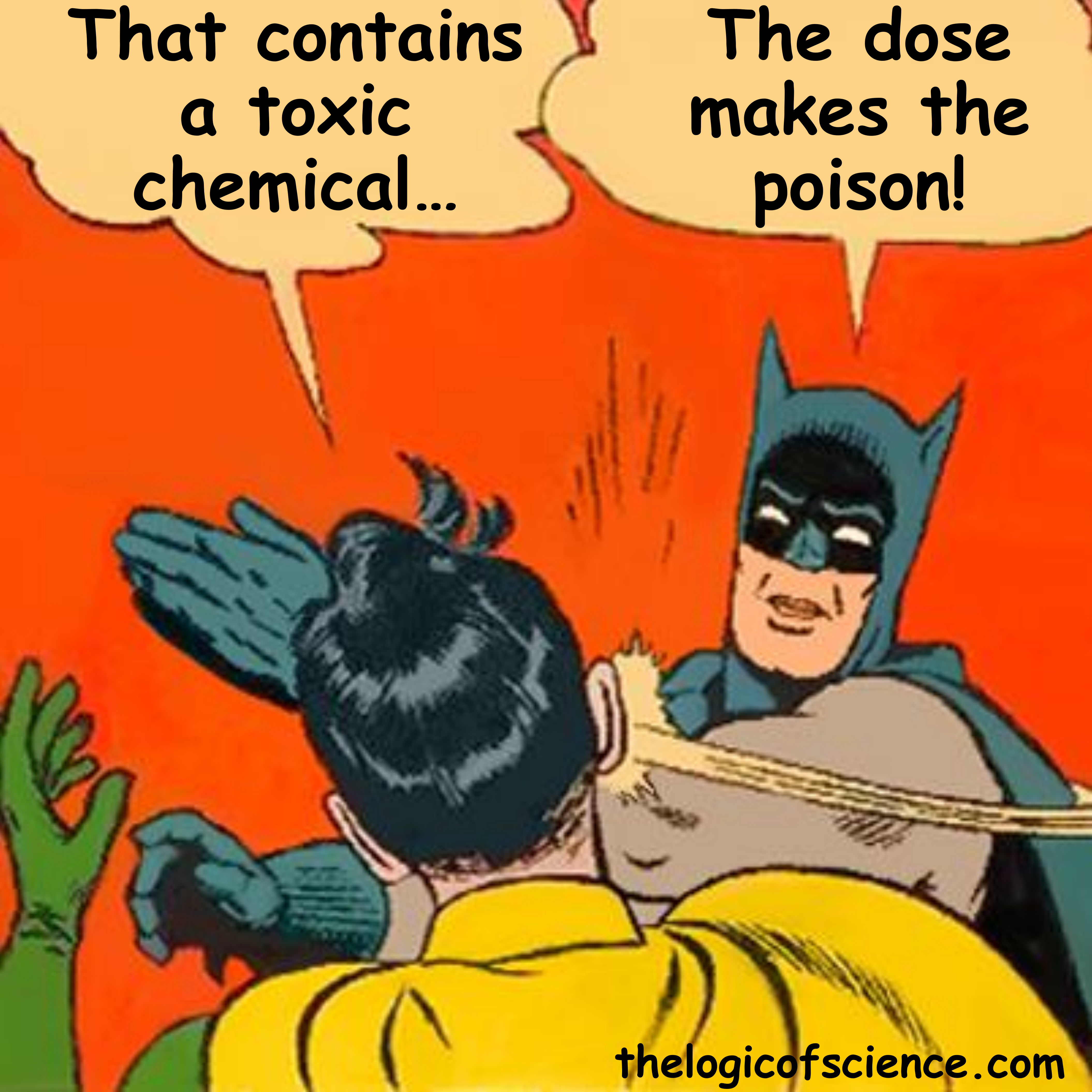 There is no such thing as a toxic chemical, there are only toxic doses. Let me say that again: essentially all chemicals are safe at a low enough dose, and essentially all chemicals are toxic at a high enough dose. This is a fundamental fact that people in the anti-science movement routinely ignore. Vani Hari is notorious for rejecting this fact by making claims such as, “there is just no acceptable level of any chemical to ingest, ever.” The reality is quite different. For example, everyone reading this currently has mercury, arsenic, cyanide, formaldehyde, aluminum, lead, and a host of other “toxic” chemicals in your body right now. Further, you would have those chemicals even if you had spent your entire life hundreds of miles from anyone else, ate only organic food that you grew yourself, never used pharmaceuticals or vaccines, etc. These are chemicals that are normally in our environment and we acquire them through our food, water, etc. Some of these (such as formaldehyde) are even produced by our bodies. Even radioactive chemicals like uranium are often present. So clearly there are safe levels of “toxic” chemicals since all of us normally have them in our bodies. Inversely, “safe” chemicals such as water are toxic in high enough doses. People have, in fact, overdosed on water. To be clear, they did not drown, they overdosed. Water is actually dangerous to your body at high enough levels.
The importance of this fact cannot be overstated. No chemical is inherently safe or inherently dangerous. So, the next time that someone tries to scare you about the “toxic chemicals” in your food, medicine, vaccines, detergents, etc. ask them for two pieces of information:
- What is the toxic dose in humans?
- What is the dose in the product in question?
Those two pieces of information are absolutely crucial for evaluating the safety of the product. You simply cannot know whether that chemical is dangerous without knowing the dose in the product and the dose at which it becomes toxic. So, if your friend, blogger, etc. cannot answer those two questions, then they have just unequivocally demonstrated that they haven’t done their homework and don’t know what they are talking about; therefore, you shouldn’t listen to them. Indeed, a great many anti-science arguments crumble under the realization that the dose makes the poison. For example, we have all no doubt heard people rant about the “toxins” in vaccines, but the reality is that the supposedly toxic chemicals in vaccines are present in completely safe doses and, therefore, are totally safe.
3). There is no difference between “natural” and “synthetic” versions of a chemical
I often hear people claim that “synthetic” chemicals (a.k.a. chemicals made in a lab) are not as good for you as their “natural” counterparts. The reality is that this represents a misunderstanding of literally the most fundamental concept of chemistry. The most basic unit of matter is the atom (again, excluding subatomic particles), and there are several different types of atoms known as elements. We combine these elements to make various molecules, and the combination of elements determines the molecule’s properties. The process by which those elements were combined is completely and totally irrelevant to how the final chemical behaves.
For example, water (a.k.a. dihydrogen monoxide) consists of three atoms: 2 hydrogens and 1 oxygen (hydrogen and oxygen are both elements). There are literally thousands of different chemical reactions that will produce water. In other words, we can make water thousands of different ways, but water always behaves in exactly the same way no matter how it was formed because it always consists of the same three atoms. Further, if given a vial of pure water, there isn’t a chemist anywhere in the world who could tell you how that water was produced because it would be completely identical to all of the other water everywhere on the planet. So, as long as the chemical structure is the same, it doesn’t matter if the chemical was extracted from a plant or synthesized in a lab.
4). “Natural” chemicals are not automatically good and “artificial” chemicals are not automatically bad
I often encounter people who will claim to agree with everything that I have said thus far, but they still insist that “artificial” chemicals (a.k.a. chemicals that simply are not found in nature) are bad for you and shouldn’t be consumed, injected, etc. There are several critical problems here. First, remember again that esentially all chemicals are dangerous at a high enough doses and safe at a low enough dose. That is just as true for artificial chemicals as it is for natural chemicals. Second, this claim is nothing more than an appeal to nature fallacy. Nature is full of chemicals such as cyanide and arsenic that are dangerous at anything but a very low dose, so there is no reason to think that the “naturalness” of a chemical is an indicator of its healthiness.
Further, remember that chemicals are nothing more than arrangements of elements. There is absolutely no reason to think that nature has produced all of the best arrangements or that we are incapable of making an arrangement that is safe or even better than what nature produced. I constantly hear people say that we cannot improve on nature, but that is an utterly ludicrous and unsupportable claim, and I would challenge anyone to give me a logical syllogism that backs it up. Really think about this for a minute, if you are of the opinion that artificial chemicals should be avoided, try to defend that position. Ask yourself why you think that. Can you give me any reason to think that they are bad other than simply that they aren’t natural (which we have just established is a fallacy)?
5). A chemical’s properties are determined by the other chemicals that it is bound to
Chemical compounds are made by combining different elements or even molecules, and the final product may not behave the same way as all of its individual parts. Sodium chloride is a classic example of this concept. Sodium is extremely reactive and will literally explode if it contacts water, and chlorine is very toxic at anything but an extremely low dose. Nevertheless, when we combine them we get sodium chloride, which is better known as table salt. Notice that table salt does not have the properties of either sodium or chlorine. It does not explode when it contacts water and you cannot get chlorine poisoning from it no matter how much of it you eat. The combination of those two elements changed their properties and it would be absurd to say that “salt is dangerous because it contains sodium.” The sodium in salt no longer behaves like sodium because it is bound to the chlorine. Therefore, when you hear a claim that something contains a dangerous chemical, make sure that the chemical isn’t bound to something that makes it safe.
Thimerosal in vaccines makes an excellent illustration of how little anti-scientists actually understand about chemistry. You have no doubt heard that vaccines are dangerous because they contain mercury, and mercury is toxic. Ignoring the fact that currently only certain types of flu vaccines contain mercury and the fact the mercury is present in very low doses, there is another serious problem here. The mercury in vaccines is in a form known as thimerosal. Thimerosal is mercury bound to an ethyl group, making it ethyl mercury. The mercury that causes poisoning (i.e., the form that accumulates in seafood) is mercury bound to a methyl group (a.k.a. methyl mercury). Ethyl and methyl mercury are not the same thing. They do not behave the same way. Just as the properties of the sodium were changed by the chlorine, the properties of the mercury are changed by the ethyl group. So, claiming that “mercury is dangerous and vaccines contain mercury, therefore vaccines are dangerous” is no different from claiming that “sodium is dangerous and salt contains sodium, therefore salt is dangerous.”
 The Logic of Science
Can we all just agree that Vani Hari is an idiot and a con-artist? Thank you.
LikeLiked by 2 people
I truly wish that we would, but sadly there are still hundreds of thousands of people who worship the ground that she walks on.
LikeLiked by 4 people
The only good news is that those people are completely ineffectual idiots. I read that someone did a study on the profiles of Food Babe followers and from the statistically significant sample size, over 90% were determined to have below average IQs based on several correlated dimensions like educational achievement, major, professional position, zip code, etc. Thus, those hundreds of thousands of people are just a subset of the millions of idiots in our country. And Vani is clearly the leader of idiots. What a legacy. Go Vani! Drive that short bus like a boss.
LikeLike
While I agree many people are complete idiots on topics they know nothing about and are too lazy to research, I call foul on this ‘study’. There is no way to accurately estimate the IQ of someone based on this criteria. If you find a stay at home mother or father who didn’t go to college, didn’t get on the honor role and lives in a certain zip, you can’t know if their IQ is high or low. And IQ has little to do with pretty much every point in that you quoted. High IQ doesn’t guarantee educational and career ambition.
Unless your comment is satire, in which case ignore me. ^_^
LikeLiked by 5 people
Actually, statistically it’s quite valid. The study most likely performed a multi-dimensional analysis of variance (aka ANOVA), which correlates changes in the studied variable (e.g. IQ) over a number of different factors (e.g. zip code, educational achievement, etc). While it is certainly important to understand that statistics are not the be-all and end-all facts, an analysis of variance does not lie provided the sample space is large enough because it provides rigourous mathematical evidence that the examined variable is changing alongside changes in other variables. Having said that, correlation doesn’t imply causation, but I re-iterate: it’s certainly a valid method for analysis.
LikeLike
Sorry, while I agree that it is highly likely that Foodbabe followers have below average IQs, the ‘study’ cited is about as scientifically legitimate as much of what the Foodbabe says. You cannot counter unscientific crap with more unscientific crap. In the case of that ‘study’, the studied variable (IQ) is not measurable with the inputs available, no matter which statistics are applied. Statistics are only revealing of any useful information if the inputs are sound. And before you automatically discount what I’ve written hear, I’ll mention that I am a biomedical researcher who has used a LOT of statistics for laboratory and clinical studies for over 30 years.
LikeLiked by 1 person
‘…written here,….’
LikeLike
absolute agreement, cliff notes, your ‘unscientific/unvalidated’ crap doen’t change a thing….
LikeLike
..and i’ll reiterate for the concession for classical physics and the quantafying excuse an attempt at unified theory is for that sustained blunder
LikeLike
Stila, can we assess someone’s IQ and education based on the fact that they are too stupid to know that it’s either “this criterion” or “these criteria”, and only completely ignorant idiots say “this criteria”?
LikeLike
No, we can only assess part of their education. Even at that, it might be that they are well educated and of a high IQ. It is very possible that when a person misused a word they were tired, distracted, rushed, sick, drunk, or in some other way impaired, or suffering from a combination of impairments.
I have no similar explanation for why some people insist on drawing conclusions about people they haven’t met, based on a small sample of that person’s writing style.
LikeLiked by 1 person
intelligence quotients are exactly that, and very few algorhythms have ever panned out for anything save grants and toys for jewish doctorals
LikeLike
yikes! dude, take a freakin’ chill pill.
(FYI: chill pills are all natural, so they’re safe.)
LikeLike
Only a completely arrogant jerk would call someone a “completely ignorant idiot” based on a minor grammar mistake.
LikeLike
and so i agree herbs don’t necessarily solve the arrogance/inferiority complex differentiation..
LikeLiked by 1 person
you just that moment did, moron..you need to call your 3rd grade teacher, she has a star for your forehead
LikeLiked by 1 person
I agree with a fair amount of your comment, however,,. Just because you cannot find the IQ of one person from those factors, (for that you would need absolutely every factor about them, an infinite list) this does not mean that you can correlate those facts to predict the average IQ of a person with those factors. If you take enough people with that same set of factors, statistically they will begin to conform to the prediction, if there are enough of them. This is what the study purports to have done.
LikeLike
just run down the nature and perspect of these comments, check out 2 or 3 other nasa posts and still arrivee at scientists (or wannabes) continueing to attempt validation with invalidated method= i like the ‘e’ and , no, i did not mean to say quantifying, i intended ‘ quantafying’..like indicated
LikeLike
“honor roll”
LikeLike
That’s not good news at all. Uninformed idiots vote in ignorant idiotic ways. There can be no rest for the informer!
LikeLike
You win today’s internet. Have a beer. 🙂
LikeLike
IQ as a psychometric is really, really flawed. Usually, this argument is a deeply classist one in disguise. Trying to figure out IQs based on correlated dimensions is infinitely more suspect. I’m not saying that you can’t determine anything from IQ, but the idea that it is a master indicator of someone’s intelligence and merit is offensive and ignorant.
LikeLiked by 1 person
You score an 85 I’m guessing?
LikeLiked by 1 person
Actually, he’s right, so rejoice at your room-temperature score.
LikeLike
160+ actually, but who gives a shit? This is ad hominem at its best. Yeah, I know you’re trying to troll, good job (shoulda gone for 60 though, that’s a nice sub-normal one). What I wonder is what makes you think being a dick somehow evinces superior intelligence.
LikeLike
Actually, it’s not that flawed. It correlates moderately with academic performance. The problem is when people reify the number. I used tests quite a bit, when needed. This is because they give a good standardised measure of how well someone can do in certain domains compared to a whole bunch of people. This allows the development of good support plans for the people concerned.
Of more interest clinically are the subtest scores. They are the things that allow someone like me to get a lot of information about a person’s difficulties … the least informative scores in the set of scores dervived from a test of intellectual ability are full-scale IQ scores. Even so, they are still useful.
LikeLiked by 1 person
Except that if it correlates moderately with academic performance, the moderate correlation may be due to all the other things that affect IQ, like nutrition, socioeconomic status, etc. So that’s pretty awful.
R.C. Lewontin has pointed out numerous flaws in the whole enterprise. For example: We say that I.Q. has some amount of heritability, as if that actually gave some kind of bounds on the amount that education can do. But the greatest Roman mathematician could be outcalculated by an eight year old with a calculator or a fifteen year old in algebra.
I’m not saying IQ should just be ignored. But when people use IQ, in the aggregate, to dismiss people’s humanity, like saying Republicans have lower IQs on average or religious people have lower IQs or people who listen to anti-vaccination pundits have lower IQs, they’re making a grotesque argument that is not supported by the evidence and is in any instance horrifically arrogant and dismissive. If I was working with an individual person in any context, sure, I’d want to know their IQ, amongst other pieces of information. But it’s just bankrupt to talk about it in the average in any population.
LikeLike
Still doing word salad?
Lewontin’s work on heritability of IQ I have no problem with; but – in a same-pace-for-everybody school setting – that IQ assessment will correlate well with achievement. If we take a Skinnerian approach, and only have ths student move on to the next part of the material to be learned, then IQ becomes a meaningless concept, since the whole IQ thing came into existence purely because of a same-pace-for-everybody type of mechanised schooling system in France.
So, yes – IQ will have an effect on achievement in school settings, whereas that effect will be largely negated in a system that allows a student to learn at the right pace for him/her.
LikeLike
peripheral blither
LikeLike
What the hell are you on about?
LikeLike
These do not correlate to current dialog( though its risky to call it that) a y rate the spaghetti western wannabe scientist ca ‘t decode ’cause he has no data.
LikeLike
And that’s a large part of my point. Psychometrics are a tool. They should not be used to dehumanize and debase. They should be used to identify people who need the most help, the most resources. We’re all different. Let’s try to celebrate that and help those of us who are struggling.
LikeLike
I definitely agree with you on the use of psychometric tests: if they’re not going to be used to help people, there’s no justification for using them at all.
“They should be used to identify people who need the most help, the most resources.”
Well, that’s the aim when I use tests. Which is in line with Binet’s own view when he developed the thing that became known as the Binet test. He was very worried about the misappropriation of psychometrics as a means to discriminate, though.
My own view is that, if we don’t have data on the extent to which a person has been handicapped by some issue, we cannot help; overall IQ – much as it moderately correlates with school achievement – is of limited value (as I said previously). I am more inclined to look into the meaning of the sub-test score profile, in terms of actual abilities and skills. Because that is where the issues are.
LikeLiked by 1 person
Again, I agree 100%. As David Simon has famously pointed out, any statistical metric can be juked or misused if you want to distort the data, and our politicians, bureaucrats, some NGOs and businesses have a vested interest in distorting data from crime statistics to health statistics in order to keep their jobs. We have to ask what a number MEANS, not just what it is, and what the best reaction to it is.
To me, that doesn’t mean denying science, like intellectually dishonest people like Food Babe want to do. It means embracing science alongside all of our other tools.
LikeLiked by 1 person
Actually… I’ll retract the remark about word salad. Seeing that ron whats-his-face idiot posting weird crap all over here … THAT’s word salad.
I may still disagree with you on much, but maybe the ‘word salad’ remark was a bit fast.
LikeLike
Thanks, I suppose? My concerns are social science and mental health based. I don’t want to see a model of human life presented that demeans us. I’d like to see the value of a conversation with a caring person ranked higher than giving someone a drug that will always have the risks of serious side effects.
LikeLike
“I’d like to see the value of a conversation with a caring person ranked higher than giving someone a drug that will always have the risks of serious side effects.”
Actually – not gonna argue against that.
FWIW, the psychologist’s aim is the teaching of skills for coping with things, and for becoming more observant about what is happening and being able to avoid unpleasant episodes, because of the adverse effects associated with many medications. Our view is that it needs to be a psycho-social intervention, supported by sub-therapeutic dosages of medications aimed at kickstarting, rather than taking over. If that makes any sense.
LikeLiked by 1 person
That’s 100% my view as well. Demonizing psychotropics out of hand is grotesque: Millions of people benefit from psychotropics. But the profit motive of corporations and a lack of political will (which comes from what I term #PeopleArentProblems, the way that we assume people need to be smashed into conformity by easy solutions like a pill) has led us to JUST use psychotropic efforts. With alcoholism, for example, we either due a group therapy approach like AA or think about it genetically, never both, never combining alcohol addiction work with actual underlying CBT work as a matter of social policy.
I want to see a continuum of mental health response as both a governmental and NGO approach.
LikeLiked by 1 person
as is ‘psychometric’ as indicative of that range of qualification for intelligence, ex celsor
LikeLike
Never underestimate the effect of idiots in large numbers, especially if they vote.
LikeLike
People don’t like being told that they are wrong and they don’t like being told that they’ve been conned. The natural reaction most people have when told they’ve been duped is to get defensive and attack their attacker. It doesn’t matter if that attacker has the best interests of the defender at heart and it doesn’t matter if the attacker is backed up with all manner of facts and figures and data. They’re still and attacker and defenders are going to get defensive.
LikeLike
you mean like all the decades of nobel laureates and phd’s who are evolutively dead wrong..?
LikeLike
Fucking hippies.
LikeLike
Bite your tongue! That woman is the salt of the earth…toxic, explosive salt.
LikeLike
I don’t think this was written by Hari…
LikeLike
Reblogged this on antifragilityblog and commented:
How true it is!
LikeLike
This article makes so many fantastic points. It could really use some proof-reading, though.
LikeLiked by 1 person
The author needs to correct the word brakes to breaks.
LikeLike
End of second paragraph, needs to correct “mater”
LikeLike
“mercury and the fact the the mercury” spotted this bad boy on the fourth line of the last paragraph
LikeLike
It seemed to follow what I have learned in AP chemistry, (the class was taught by a chemist). The only fault is that you cannot have a lone atom. Atoms together form elements, and elements form molecules. So point three needs revising. Also along those lines, there are protons, neutrons, and electrons that make up an atom.
LikeLike
I’m afraid you are mistaken. Most unbonded elements exist as singular atoms. In fact, the only that don’t are diatomic hydrogen, nitrogen, oxygen, fluorine and chlorine, which exist as pairs of atoms in their natural state. Perhaps you should have payed more attention in class.
LikeLike
As a chemistry teacher, I have issues with your comment. If you’re going to list the popular diatomic seven, list all seven (H, N, O, F, Cl, Br, I.) Second, I challenge you to to find elements that are not bonded in nature (besides nobles gases.) They don’t exist as singular atoms, because they strive to reach noble gas configuration. Third, diatomic elements are still bonded; they just happen to be covalently bonded to an atom of the same type.
LikeLiked by 1 person
A”s a chem teacher…..” When is ur lecture on metals. Quite a few manage as atoms
LikeLike
As a physicist, I know that there are untold numbers of single hydrogen atoms in the universe. It is easy to make single atoms in the lab. Many of our electronic devices are made by streaming beams of single atoms onto a substrate. This is why you chemists should take more physics courses.
LikeLike
I’m getting a Ph.D. in chemistry. I work in the physics department, doing condensed matter research. I’ve taken (and passed) grad level physics courses. Please don’t generalize. Give chemists some credit. Research gets more interdisciplinary every day, and random internet commenters don’t represent the entire field.
LikeLike
as do you not because you grasped your instructors concepts: einstein is nearly 100 % erroneous in mathematical algorhythm, he admitted that, doctorates and nobel laureates are scattering like so much detritus..classical physics will not reconvene, and quanta -fication, implementing the same elisions for validation, is failing ..what is this piddly arsed discussion without even any parameters supposed to be about..?..hydrogen 2 in rainbow spectres..?
LikeLike
Might I just mention that he DID state “in nature”? Your laboratory-created single atoms likely find a partner (or multiple) as soon as reasonably possible…
LikeLike
True, but that still leaves uncounted hydrogen atoms in a natural state. Single atoms are also present in atmospheres of stars. The fact that they combine soon doesn’t mean “they don’t exist”.
LikeLike
if this post and postors are launching from the prospect for intelligence in science, why are there no deliniations for hydrogen..?..1..2, etc. , in your statements :atomic or otherwise..?
LikeLike
What does a “delineation” for hydrogen mean? It’s perfectly clear what people mean by a single atom of hydrogen. Sure, it may exist in an excited state, but so what?
LikeLike
the hydrogen you believe you have a relationship to differring from all others and as differentiated , say, for atomic hydrogen in ultracold deep space which you will never experience, moron
LikeLike
At standard temperature and pressure, we breathe atoms of argon in and out all the time, as well as the occasional other noble gas atom. If I stroke a hunk of metal such as nickel, there is no reason I can’t pick up a few individual nickel atoms on my fingertips. At higher temperature and lower pressure, you can have all kinds of atoms at your disposal.
LikeLike
incorrect – single atoms have been ‘isolated’ : http://phys.org/news/2010-10-scientists-isolate-individual-rubidium-atom.html
LikeLike
Not true, All group 8 elements exist as lone atoms,
LikeLike
Helium begs to differ, and neon agrees.
LikeLike
It’s acetyl- CoA, not actyle-CoA
LikeLike
Many people have been criticizing my grammar (some quite harshly on various social media outlets). So I have gone back through and tried to correct the errors. I’m not really sure why two homophones and a handful of other minor mistakes in a four page post were worth a freak out, but they have been fixed.
LikeLiked by 1 person
you cannot get chlorine poisoning from it -now- matter how much of it you eat.
—
Don’t take it personally and fix it- your post is well informative and should be properly presented, we all have bias and some might just give up reading after seeing too many technical mistakes.
LikeLike
lol, and your usage of the word ‘informative’ in that sentence is incorrect, or ‘well’. either way it doesn’t make sense as written.
LikeLike
Sure, Too bad it’s not a post 🙂
LikeLike
because if it was I could edit and add ‘and’ between those words so people like you could make sense out of it- anyhow it’s okay. lol.
LikeLike
ok, thanks for the caveat. I didn’t understand what you meant after the first reply. I was merely pointing out the irony considering you were criticizing grammar, with poor grammar, and that is all. People like me… lol
LikeLike
The fact that you see I was criticizing his grammar alone kinda proves you were just being an ass who thought he had found a great irony.
Also let me clarify- I can’t edit my comment- or else I would have fixed it- anyhow it’s okay.
LikeLike
At least I didn’t call you an ass. But it’s OK. I guess. Sort of uncalled for. Could have just said, yeah, can’t edit the comments. I did see that you commended the article however, as do I.
LikeLike
I’m sorry if I hurt your feeling then.
LikeLike
Damn. I was hoping this pissing contest would go on for another 80 years. I love douche-off contests on the internet!
LikeLike
but i don’t, nigger
LikeLike
Hey Ron, Go away. You have exhausted your intellectual capacity on the forum. I don’t belong here either, but that’s just because I don’t have the scientific acumen to make it worth anyone’s while. But you seem to have all the interpersonal skills of a rabid wolverine. Have the good sense spew elsewhere. thanks…..
LikeLike
You should be thrown off this site forever for your nasty and racist BS. You don’t even have the brains to be ashamed.
LikeLike
you first, imbecile, your culture is dead, can’t be “thrown” far at all..at least not sos the stink diminishes
LikeLike
but i don’t concern myself with pidgin concepts at all..or your feelings, monkey
LikeLike
I don’t know why people *freak out* about that kinda stuff either, but to be completely taken seriously and be thought of as an authority on whatever topic you’re writing on – having correct spelling, grammar, and punctuation will always lend itself to giving you more cred 🙂
LikeLike
Creed 🙂
LikeLike
Cred abv – credibility. Creed – faith / belief. Right first time.
LikeLike
you have no concept for credulity, funny head, still believing your degree is sponsored per your 3rd grade sentence structure
LikeLike
Because it makes the article look unprofessional and when you want to use something as ammo in the “War Against Science”, it better look professional because those anti-Science idiots will latch on to anything to defend themselves and their stupid beliefs.
LikeLiked by 2 people
If you ever decide you want an editor to give anything a once-over, give me a yell. I’m serious about grammar. Your post was outstanding though, and something that needed to be said. Thank you.
LikeLiked by 2 people
wilson, and your dummy alliance, universal rhetoric did not evolve from dick and jane scrivenirs: in 7 to ten years you will hide, best you can, from these pinheaded proclamations
LikeLike
you can’t elaborate for simple chemical conclusions with no concept for how linguistics evolves with intelligence and universal evolution you’re really stupid here.
LikeLike
You might also want to fix this. “Right now, you are breathing in dioxide (aka oxygen)”. I believe you mean molecular oxygen.
LikeLiked by 1 person
yep, this is not right (at least, not how I’ve ever heard it). To be oxide, or dioxide, the oxygen has to be attached to something that it is an oxide or dioxide of. On its own, it’s just oxygen, whether atomic (never encountered other than in a hot place, like a mass spec) or diatomic.
LikeLike
He is correct as he wrote it. Dioxide IS molecular oxygen.
LikeLike
That is not true. To have an oxide, or a dioxide, you need some other element in addition to oxygen. The term you’re looking for would be dioxygen.
LikeLike
Retinol not retinal.
LikeLiked by 1 person
Not exactly. “Vitamin A” can be used imprecisely to refer to a suite of molecules. In food, it’s usually a retinol ester, like retinyl palmitate. In the short-term storage pool in your retina, it’s the alcohol, retinol. The biochemically-active form that binds to your opsin proteins and allows your eye to detect photons is the aldehyde, retinal.
In any case, (2E,4E,6E,8E)-3,7-dimethyl-9-(2,6,6-trimethylcyclohex-1-enyl)nona-2,4,6,8-tetraen-1-ol sound much, much scarier.
LikeLike
Some will “freak out” because, if English is your first – and probably only – language, you should be fluent and accurate with it, or refrain from publishing in the public space. Unlike science, English is a subject in which one should be an expert with only a high school education. Unfortunately, English, along with science and most other subjects, is suffering at the hands of our U.S. school system. Those of us coming at you with grammar corrections have a similar attitude as you do with those who are ignorant of science – it’s just something you should know.
LikeLike
When people freak out about grammar I just throw a lil theiy’re in der 👽
LikeLike
Don’t care about the spelling or grammar much, over all I really enjoy your post. Even if there are a few mistakes that I am not informed enough to see I really liked the article and the ideas it is trying to advocate.
LikeLike
I wish people paid as much attention to logic as they do to grammar. I would rather read an argument that was logical argued, but grammatically flawed, than a grammatically perfect essay that made no logical sense.
Unfortunately, I read far more grammatically correct essays than I read logical arguments.
I am quite sure the grammarians will be jumping all over what I just wrote. Lets hope they do so logically.
LikeLike
actually( that would be externally what you think is logical) universal rhetoric displaces doctoral blither in a perfectly grammatical latice, since there is no confluence (or difference) between the two structures you delineate
LikeLike
Did you write this article?
LikeLike
Rafts of basic gramattical, spelling, and usage errors in a posting you apparently intend to be an exposition of things “uneducated” people believe, make you look “uneducated” and thus unqualified to comment on that topic..
LikeLike
just not for content, simple-minded fuck
LikeLike
My father has a PHD in organic chemistry. I have heard so many rants just like this…
LikeLike
Hardly a rant.
LikeLike
Thank you so much for writing this. I have dyscalculia and NLVD so I had trouble with science in school but I still don’t believe in the homeopathy, anti-vaccine type bullshit.
LikeLiked by 2 people
http://m.huffpost.com/us/entry/814619
LikeLike
your affliction is not applicable( codiced) another ridiculous parameter for: i’m just not up for it right now
LikeLike
lol wut
LikeLike
Reblogged this on Black Metal Valkyrie: Reject male identified bullshit!.
LikeLike
I had this discussion with a hundred hippies and they just won’t understand, their brain shut when you talk about scientific facts…
LikeLike
It doesn’t help for arguments, but I’ve found the way to get through that is to have them come to you with a question. If you can get people to ask “why is that” they will listen to your answer.
LikeLike
Maybe the problem is that you’re calling them a word you clearly view as pejorative and aren’t actually explaining it to them in a language that they understand?
Science education in this country sucks. Combine that with a quite natural skepticism about corporate and government motives and you have a situation rife for abuse.
As time has gone on, I’ve come to agree with Socrates more and more: Bad behavior is caused by ignorance, and ignorance can be corrected. When someone is ignorant, they should be patiently explained to. This article did a pretty good job with the salt analogy, one I commonly use.
LikeLike
While a lot of bad behavior is caused by ignorance, I’m with Kurt Vonegut that a lot of it is due to ‘bad chemicals’. He wasn’t talking about environmental chemicals, or chemicals in your food. The fault, dear Brutus, is not in our stars, but in ourselves.
LikeLike
But when you castigate people for a problem based on ignorance, that’s not terribly helpful for curing that ignorance.
LikeLike
I’m not castigating people based on their ignorance; read the post if you can. I’m pointing out that much of the bad behavior we see is the result of ‘bad chemicals’, by which Vonnegut meant craziness based on things like neurotransmitter imbalances. Many if not most people are at least a little crazy, and really crazy people are easily influenced by hate propagnda, even if it’s in coded form (e.g, voter supression justified by fake appeals about non-existent fraud is code for ‘keep them minorites from voting’).
LikeLike
one of the most profuse forms of ignorance being the prepinderance of excoriating hate from what you know is just simple truth, moron..
LikeLike
You are insane, or in the grip of some serious pharmaceutical experience. Try posting in english rather than attempting to pump yourself up using words you don’t understand and can’t even spell.
LikeLike
thats your only objective abjectivity: google spell..?zzzz..that isn’t a question, you couldn’t survive my words, usage or otherwise..
LikeLike
I am a Biology Professor with a PhD in molecular and cell biology and I also have a nursing degree. I love the way you wrote the article! Very clear and understandable for people with different science background levels. Sometimes I don’t know what is going on in this country with the anti-science movement. And I think it is also alarming the scientific illiteracy that is dominating our society. Great job trying to fix that. A couple of minor grammar mistakes does not take away from the significance of such a great article!
LikeLiked by 3 people
ibid.: ” diffetent science background levels” = you couldn’t have been possibly less doctoral in your assessment for excellence in fact you speak like an uneducated child. no kudoes of belief from this doctor of nothing
LikeLike
This would be a great article if the word “literally” didn’t appear so often.
LikeLiked by 1 person
Good point. Over-use of the word ‘literally’ will give an article a rather serious ‘Food Babe’ feel, and that would be counter-productive. Otherwise, yes – good article.
LikeLike
He ment literally in a figurative way 😉
LikeLike
and you think this to be its singular failing…’ would that be figuratively or ‘ literally’, moron ?
LikeLike
This Article is awesome! Gained so much basic logic that I think I’m craving for some McDonalds. Here I come Dimethylpolysiloxane, Caminic Acid and Silicone Oil! I mean Bigmac and Fries!
LikeLike
were your options for the many categories of the constituents, before and afterwards( and then some) pointed, or merely to underimpress some delegate to this funny paper post..?
LikeLike
Most of it is perfectly true, except for one point in the “natural” versus “artificial” argument. All naturally-produced organic chemicals have a distinct “thread” taken from the helix of the DNA from which they were originally replicated. When those same molecules are synthesised in the lab, an equal number of molecules can be produced which have the opposite thread, and they can cause a number of unwanted side-effects. This is why drug companies prefer to bio-engineer organisms to brew the drugs they require; if the drug is produce naturally then all the molecules have the correct “thread”.
LikeLike
Are you arguing that the left and right-handed versions are not the same? This is true.
But there are ways around producing the wrong isomer, in the form of selective synthesis that produces mostly one of the isomers. These can sometimes be separated.
However here we are not arguing about artificial vs natural. The artificial molecule that has the same handedness as the natural molecule is not different. At all.
No question that the handedness matters. But they are not the same if they have different handedness.
LikeLike
I don’t know what are your sources for this, but chemical products do not contain DNA, nature or artificial. DNA is made from chemical substances (mostly carbon). Living cells contain DNA.
LikeLiked by 1 person
It sounds like you’re talking about chirality. However it actually is possible (though often a bit more difficult) to artificially synthesize molecules with a particular chirality (enantioselective synthesis). When pharmaceutical bio-engineer organisms to make drugs, they are usually molecules like proteins (e.g. insulin produced by bacteria with recombinant DNA), which are actually hard to produce through “regular” chemistry
LikeLiked by 3 people
You are apparently blissfully unaware that chemicals don’t have DNA. I applaud your efforts, though.
LikeLike
“All naturally-produced organic chemicals have a distinct ‘thread’ taken from the helix of the DNA from which they were originally replicated.”
Er…. what?!
Not all ‘naturally-produced’ organic chemicals are replicated from DNA! Where on earth did you get that idea? Chirality is not due to the helix structure of DNA: the helix structure of DNA is due to the chirality of the isomers of the chemicals involved in its construction.
LikeLike
Listen to Tony Sinlcair. I’d also point out that all molecules don’t have chiral centers, and hence don’t have handedness, and that it’s perfectly possible to do chiral synthesis using isolated enzymes, which can even be made synthetically. As Tony says, molecules of different chirality can be separated after synthesis. I have reagents in my lab of mixed chirality (cheap) or all one way (more expensive because of separation costs. The mixed stuff works fine for tasks like elution from a column. The people who want to bask in naturalness would hardly like to eat stuff produced by ‘bio-engineered organisms’ (it’s no longer a big deal to transfect or transform something to make a few proteins), which are also described as the dreaded GMOs.
LikeLike
once again, you discuss these parameters as if from an uneducated premise..!!” oh, well i just got a b+ in senior 102 chem..
LikeLike
Great post- I will be linking to this! It is like the idiots who tell me that I should not eat margarine because it is full of chemicals. In fact I have been told that it is “only a molecule away from plastic”. There are so many holes in this that it is untrue, I mean taking it literally, any single compound is only a molecule away from anything else. But if they mean an atom away (close enough) I like to explain the difference they would get from drinking H2O or H2O2. By the way, I eat butter. But not for those reasons. And as a health improvement specialist, I would add that there are some differences between naturally occurring vitamins and minerals and those produced in a lab. But these differences are more about the isolation found in vitamin tablets compared to the many synergistic compounds found alongside the “main” nutrients in food which aid (or hinder) absorption. And of course there are various sub-categories of compounds so whilst the exact same chemical formula will be the same no matter where it is produced, it is not always exactly the same substance.
LikeLiked by 1 person
*Clarification: i.e. it is not always the same substance that is being referred to under a single name
LikeLike
Clarification? Are we back to margarine again?
LikeLike
Heavily salted margarine!
LikeLike
Haha -no -I am talking about isomers, chirality and the various forms that vitamins can take
LikeLike
Margarine is terrible for you. My goodness man, read the science. Partially hydrogenated vegetable oils cause inflammation, atherosclerosis, and a whole host of health problems. Eat butter or olive oil or coconut oil.
LikeLike
So I guess you didn’t read my post?
LikeLike
It seemed like he did and made specific claims in the aggregate about margarine that I don’t see your post as replying to. A lot of health advocates are starting to swing away from margarine toward butter or oils (was hearing about this just today on Science Friday), though I’d probably agree that pretty much any fat is fine in moderation.
LikeLike
Am I missing something here? The OP said he does eat butter -not margarine. But just that this is for reasons other than it being “one molecule away from a plastic”. Isn’t the point of his post about pseudo-scientific claims being made about foods, rather than the relative merits of different spreads?
LikeLike
Depends on what you mean by margerine. I’d call all non-butter spreads margerine (if they’re pretending to be butter), but I’ve seen quite a few of them claim that they have no trans-fats, so I don’t see what’s wrong with eating them.
LikeLike
..chemical formula = varying substance..sheer genius..er, undertreatment..uh, er..kindergarten flopsies= when your attempt is to linguistically( lexiconically) embellish saying nothing and you don’t even have the mechanics for that ..it just sounds DUMB
LikeLike
“The sodium in salt no longer behaves like sodium because it is bound to the chlorine”
Even more: even if you dissolve sodium chloride in water, sodium and chlorine atoms will become separated. But they will be in their ionic forms, still behaving very differently and being much safer than non-ionic forms of sodium and chlorine.
LikeLiked by 2 people
I had this same quibble, actually. The sodium in salt is an ion, not an atom.
In the chemical reaction that generates NaCl, each original sodium atom donates an electron to each chlorine atom, generating chloride ions and sodium ions as a result. The sodium in salt, thus, no longer behaves like elemental sodium because it has lost an electron to chlorine, NOT because it is bound to chlorine.
The resultant sodium and chloride ions do associate together, with the attraction between the positive and negatively charged ions holding the ions together to form a crystalline lattice. This type of bond (ionic) is not a strong bond, and is easily broken, however, once broken, the particles that make it do not undergo an actual chemical change; they are still sodium and chloride ions, in this case, and do not behave like their predecessor atoms, even if they are not associated with each other any more.
Small point of clarification, but I think an important one.
LikeLiked by 1 person
this is kind of true, but a little meaningless. For one, neither you nor the original post defines what ‘behaviour’ is. Secondly, an ionic bond is one of the strongest ones, second only to a covalent bond. Thirdly, if electrons are transferred, they absolutely do undergo a chemical change – that is pretty much the definition of chemistry – it is only when nucleons move that atoms/ions change type (and of course, nucleons do not move in a normal thermodynamic frame of reference).
To be fair, you seem to be saying that a chemical change is one where the atoms/ions change elementally, which is an error of language. Any interaction which warrants the description ‘chemical’ is a transfer of electrons, and any transfer of electrons warrants the description ‘chemical’.
LikeLike
Here lies the rub. We do not know the “safe” levels of many of these chemicals. Especially after consuming them for years. Also, governmental and other experts change the publicized “safe” level many times. I have never even heard of Vani Hari. I guess I am out of the continuous loop of nonsense from both sides.
LikeLiked by 1 person
Sure, and this does mean that we should be very careful with new and unproven chemicals, but there is a skepticism that exceeds even that level of skepticism to become a kneejerk belief that anything a corporation sells must ipso facto be evil. I’ve personally seen people avoid taking the medication they need for depression or schizophrenia because of this cultural meme. There are chemicals out there that can change lives for the better.
LikeLike
On this point, I absolutely agree.
I’ve known people do that same. Outcomes are invariably poor.
LikeLike
that same thing*
*sigh*
Going to bed now. Finland was up much of last night getting bladdered.
LikeLike
You cannot avoid eating chemicals, Monte. The real rub is that chemicalsRus. Thanks for making Vani Hari equivalent to serious science. You are certainly out of the loop.
LikeLike
*whoosh*
LikeLike
From DDT to ALAR, to PCB’s to Dioxin to trace pesticides in our vegetables, mercury in our fillings, and asbestos in our break linings, the ignorance on display by the left is infinite in scope. But these are the white knights of the 21st century! For the left, these issues are so important to the survival of the planet that even the facts have can be sacrificed in preference to winning over the mob. One need only look at the profitability of Whole Foods to to understand this dynamic….
LikeLike
Nothing in this blog post mentions any sort of politics – especially any sort of simpleton politics that can easily be broken down into a left vs right argument.
Can you please share with us (and show your work) how you came to the conclusion that DDT, ALAR, PCBs etc were created by people that had left-leaning politics.
Also you forgot to hashtag your comment so I’ll do it for you now #ThanksObama
LikeLiked by 1 person
I did some research on dioxin and PCBs, simplistic research at that. Assigning political affiliation to this argument is a straw man fallacy, attacking “the left” rather than the topic of discussion. In reality, the reason dioxin and PCBs have been historically devastating is that the toxic dose levels, as well as proper protective measures, were concealed from public scrutiny in favor of massive profitability.
LikeLike
The products weren’t created by left leaning people; nor did I say they were. the efforts to get them banned were created, in some cases out of whole cloth by progressive left ideologues a means by which to slow down progress and gain power.
Relating this back to the article with the ALAR Scare. If you remember, The Environmental Defense fund had a whole segment on this chemical that was sprayed on apples to make them shiny. The thrust of their message was that it was highly Carcinogenic. The nex day saw millions of mothers pouring out the apple juice and campaigning it to have removed from school lunch programs. You had Meryl Streep in front of Congress weeping and asking “What are we doing to our children?” Of course it turns out the EDF put this study on the air without so much as allowing Laurent Munier to vet it. It had never been peer reviewed, and it turns out that one would have to eat about fifteen lbs of apples a day or drink five gallons of Juice a day over the course of about forty years to even get a fever blister, let alone cancer. It was no big deal to everyone except the Apple industry which lost about 300 million dollars for the season
Now how many conservatives work for the EDF? Greenpeace, the Sierra Club? Earth First? The list goes on. Sorry, I didn’t mean to change the subject, but my main point is that the people who whip up the kinds of panic over chemicals have a decidedly progressive left tilt to there axes……
LikeLiked by 1 person
No, you’re exactly right, but now we are having to put up with people insisting that water in plastic bottle left in a hot car will cause breast cancer. We are having to put up with the demand for banning of these chemicals which when used sensibly can be of great utility. As a chemist you must know for instance that Dioxin and Poly biphenyls are a bi-products of burning wood, and those bi-products occur in amounts much greater than occur outside the home. Shouldn’t we be banning Fireplaces and Plastic bottles? Bank on it! some progressive group in CA is looking into it as we speak…..
LikeLike
What’s you problem, Timmy? is it dirt dumb boot ignorance, or bad chemicals? You don’t know shit from shinola.
LikeLike
All quite true but’s it really is even worse that what is described. Deep sea divers can experience debilitating confusion and physical injury due to the effects of pressure on the air you breathe every day. Go too deep breathing air and you can experience nitrogen narcosis, the effect is similar to “laughing gas” used in some dental work. It can completely impair you in a matter of minutes. So, under the right conditions air is toxic due to it having a 70% concentration of the relatively inert gas nitrogen.
It gets worse. The United States Navy’s deep sea diving program experimented with having divers breathe only pure oxygen. The idea being that there would be none of the deleterious effects associated with the absorption of nitrogen under pressure. The aforementioned nitrogen narcosis and the “bends” which result from the body absorbing more nitrogen than usual, under pressure, and then having the pressure removed when the diver surfaces. Nitrogen that was in solution in the blood and tissues becomes a gas again and creates bubbles, of a sort, that can permanently injure or kill you.
Definitely worth trying to avoid, particularly since nitrogen doesn’t really do anything for us at normal atmospheric pressures experienced at surface altitudes and is harmful at the higher pressures experienced by divers.
The idea, get rid of the nitrogen, seems sound. After all how could breathing pure oxygen hurt you? Well, at a depth of about 60 feet below the sea’s surface breathing pure oxygen will kill you pretty quickly. The Navy actually lost some divers figuring that out. Oxygen becomes dangerously toxic to humans at a partial pressure (the pressure of the gas based on its total volume as part of a mixed gas atmosphere) achieved during diving operations. The higher the percentage of the particular gas the lower the overall pressure of that component of a mixture of gases has to be to reach its toxic partial pressure.
Pure oxygen (100% O2) can kill at a partial pressure found at depths below 60 feet. It’s like burning jet fuel in your car…it works, just not for long before it melts your engine. Essentially the same thing happens when oxygen is concentrated by depth and pressure…it becomes a lot better at oxidizing things…oxidation is, in essence, rusting or, at a greater rate, burning.
Not a fun way to go.
LikeLiked by 1 person
That’s right. It’s the “dose” of oxygen that is toxic.
LikeLike
Even breathing 100% oxygen at 1 atm is bad for you. You get enhanced superoxide production that does bad things all over, but esp to your lungs. Spending a lot of time in hyperbaric oxygen chambers is a bad idea.
LikeLike
Good points overall, though it should be noted that not all artificial versions of chemicals or nutrients are identical to their natural counterparts — for instance vitamin B12 derived from food is I believe hydroxycobalamin while supplements are cyanocobalamin. One will detoxify cyanide in your body, the other will contribute cyanide. Also, natural forms of some things will have the necessary fat, fiber, minerals, enzymes, etc, to make it bioavailable whereas synthetic additives probably don’t. So the idea of natural being better isn’t without validity.
LikeLiked by 1 person
In science around cannabis this is called the entourage effect.
LikeLike
Tom you missed the point. cyanocobalamin is not the synthetic version of hydroxycobalamin, it’s the synthetic substitute. The point is that a molecule of hydroxycobalamin made in my lab is indistinguishable from one made by nature. Hope that helps 🙂
LikeLike
indistinguishable by what parameter..to who, when..? moron
LikeLike
Reblogged this on Peddling and Scaling God and Darwin and commented:
I wish more actually accepted this, instead of the usual nonsense about “chemicals”
LikeLike
Although this is a nice critique of the terminology misapplied by these advocates (‘chemical’, ‘synthetic’, etc.), and I appreciate the intention behind the post, I worry that it is about as relevant to these peoples’ concerns as, say, it would be to criticize advocates of organic foods because diamonds are ‘organic’ too.
Most of us do not have a detailed understanding of chemistry and we do not know, given merely the name of a chemical compound, how much of what is good for us and how much of what is bad. Thus, we must rely on some kind of heuristic device. In the absence of further information, this is the best we are allowed to have. One heuristic is to accept that anything with a pretty label on it sold in a grocery store is good for us. But this heuristic is not always a good one for avoiding things which are bad for us, because some very bad things for us have been sold as food in grocery stores over the years.
So, instead, these advocates adopt the heuristic, “eat only that which you pronounce and recognize”, which is applied to the ingredients listed on the back of a container, which is their only source of information about what they are buying in the purchasing environment. Ascorbic acid is an essential nutrient, yes, but you’re likely to get plenty of ascorbic acid eating a normal diet without having to supplement it by eating boxes of things that say ‘ascorbic acid’. On the other hand, should you eat “Blue #N” or “Blue #M”? How would you know, when you’re given only a name, not a chemistry textbook? So, a useful strategy for avoiding the bad things in food (if that is their goal) is to avoid all of the things which you don’t recognize and understand, even if 95% of the things avoided are harmless. If the long term result of this consumer behavior is that food manufacturers give the good things names which people can pronounce (like “Vitamin C”) and educate them about it, that’s a good thing, isn’t it?
Again, when faced with something I don’t know or understand, is it wiser to eat a little of it, a lot of it, or none of it? The most conservative, safest strategy is to eat none of it. Suppose I gave you a box of unlabeled pill bottles. Would the smart strategy be to take only 1 of each pill, knowing that “everything is toxic in excess and nothing toxic in small quantities”? Unless you had a reason to trust me, the smart strategy would be to take none of the pills at all until you explained to me what they were. Normally I would expect a total stranger to explain to me what something is before I buy it from them and eat it. But in the grocery store environment, all I need is a pretty box and some upbeat background music.
Once again, suppose that I offer you two boxes to eat from. In the left box is something that I invented and which no one has eaten before. In the right box is something which your ancestors ate. It is possible that your ancestors ate many unhealthy compounds in proportions which were toxic for them, but not too probable — at least, they survived long enough to have you. On the other hand, how do you evaluate the probability that I have handed you something which is good for you in the proportions I have given you? All you have to go off of is the degree to which you trust me. Is this the fallacy of presuming that what is ‘natural’ is necessarily better than what is ‘synthetic’ or ‘artificial’? No, it’s simply accepting, in absence of further evidence (since none is made available to the non-expert), that something tested for many, many generations is more likely to be safe than something tested on a much smaller sample of people.
Thus, although your opponents are often called ‘anti-science’, in fact they’re simply ‘anti-authority’ — that is, they do not trust authority figures or experts. They do not assume that the pronouncement of an authority is true simply because it is given by an authority. This is good. It is legitimate when an authority’s public pronouncements, filtered as they are by the media, primarily serve commercial interests, are accompanied by a strong dose of elitism, and are supposed to be accepted on trust rather than careful explanation. Opposition to vaccines, for instance, is not really driven by concerns about thimerosal (since opponents do not understand thimerosal, as you correctly point out). It is driven by concerns about economics and human behavior. If pharmaceutical companies operated as non-profits with no financial incentives except for the improvement of human health, I suspect that concerns about thimerosal would quickly disappear and vaccination rates would return to a safe level.
The way to rectify this problem is for authorities to act in a trustworthy way (for instance, to be more scrupulous about whom they accept grants from, and perceived conflicts of interest), and to dedicate themselves to educating, rather than speaking down to, the interested public. (In my experience the ‘anti-science’ person is more likely, not less likely, to respond to real science when pitched at their level, in contrast to their expert-trusting counterparts). I know from your biography that you personally are involved in the task of educating students about these things, which is commendable. But I worry that this “anti-science” rhetoric serves less to improve public education, and more at the interests of a technocratic elite who profit from a situation in which most people see themselves as helplessly ignorant with no option but to defer to experts.
LikeLiked by 3 people
My older brother (who has a PhD in organic chemistry) worked for General Mills for a while. After that, he wouldn’t let any food that was artificially colored purple into his house. “Toxic,” he said.
LikeLiked by 1 person
I think this is incredibly insightful, and the way that I went in my response as well. People have to protect themselves with the limited information that they have. It’d be nice if people could each themselves all of the relevant basic sciences and social sciences, but they can’t, and our education system sure as hell isn’t doing it.
The problem is when people try to lead others with “heuristics” irresponsibly. Vani Hari is an irresponsible demagogue. And even the average person posting on Facebook should try to do their homework at least a little bit and see if the people who are against a particular chemical are, say, publishing in legitimate journals or newspapers, or can spell words correctly.
Skepticism about authority, corporations, government, etc. is healthy, and in my opinion in fact obligatory to think coherently in our society. But not every person that works in a corporation is evil and not every product that is made by a corporation is poison. There are good drugs and good food products out there.
LikeLike
Do you think the average human being is capable of such heuristic feats as Isaac Newton, who invented calculus? I did not invent on organic chemistry, yet I believe what my chemistry professor tells me about chemistry. Also, because something has been around for thousands of years, does not mean it is better somehow than a recent creation or discovery. Nothing against the Amish, but electricity and modern medicine is really whiz-bang! Is the allegorical context o overshadowed by my candor?
LikeLike
Calculus was invented by Leibniz, not by alchemist Newton.
LikeLike
Not true. Both contributed, but Newton clearly started it. It is true that Newton believed in alchemy and wasted years fooling with it. Most serious scientists and mathematicians credit both Newton and Leibnitz.
LikeLike
Okay, but that’s actually an appeal to authority, which is what we’re criticizing elsewhere. Yes, it’s important to trust, but it’s not credentials that lead someone to be trustworthy, it’s their intellectual work and their sincerity. So I’d probably on average accept your chemistry professors’ statement if I didn’t have time to do a little homework, but I’d want to do the homework if it mattered.
My issue is when people parrot what they’ve heard, angrily, when they haven’t done the work themselves. That’s the big problem with the anti-chemistry, anti-science, creationist, anti-vaccination, etc. types: They repeat bad arguments without doing some research to consider if those arguments might be laughable.
LikeLike
your argument is so self consuming, it is laughable..
LikeLike
BS. The way to rectify the problem is to stop attacking reputable ‘authority’ figures (the NAS, learned scientific societies, their members, and their refereed journals etc) and make some attempt to figure out who is taking you for a ride. Thanks, by the way, for your contribution to the Faux News and idiot america attempts to discredit science by making it equivalent to the ravings of assorted self-taught activists and politicians. The vast majority of people will always need to rely on the expertise of others. I bring my car to a mechanic who I trust. After forty years as scientist, incuding stints at some of the best med schools in the country, I rely on my family doctor and my oncologist. I isn’t that people are all stupid, but it would take me years to teach you what I do. Nobody can learn everything.
LikeLike
Your point is well made, and well articulated. I’m a Family Physician, in practice for 24 years. I have the vaccine discussions with caring, deluded parents. I try to convince folks that they should be more scared of another heart attack than the potential and reversible side-effects of a statin drug. The longer I’m at this, the more skeptical I’ve become of authorities, because we don’t know who is pulling the strings.
Case in point: This past year’s flu vaccine missed the mark, as happens when there is a late and large genetic shift in the prevalent strain. The director of the CDC promoted the “Take 3” campaign. 1. Get your shot. 2. Avoid sick people. 3. If you get the flu, run to your doctor and ask for Tamilfu. This advice flies in the face of the data on Tamilfu, data that Roche only grudgingly released after a protracted battle with the British NHS. Tamiflu only decreases the duration of symptoms by ~16 hours on average. It should only be used in patients with influenza who are sick enough to be hospitalized, or those with impaired immunity. I smelled a rat. Late in the flu season it was revealed that Roche, the manufacturer of Tamilfu, made a $950,000 “donation” to the CDC to fund promotion of the “Take 3” program.
I’ve seen this type of industry influence of medical education and policy over and over. There are entire classes of drugs on the market treating conditions that we only diagnose because the pharmaceutical industry supported the development of testing to be able to diagnose the “disease.”
I am not anti-science. it’s my passion. I grind my teeth weekly at some patient who’s being led down the primrose path of homeopathic, naturopathic quackery. But, I get where it comes from. I’m in a better position to skeptically ask questions when presented with the “new and better” drug. But, it takes time and effort. A lot of time and effort. Not all my colleagues are as passionate about practicing due diligence. Couple the reality of industry influence on science with a philosophical bent towards questioning authority, and you have a population of folks who cover their ears and sing “lalalalalalalalala” whenever we try to enlighten them.
I don’t have answers to the problem. I’m still seeking. Part of my strategy is to try to make my advice to patients as sound as possible, to not jump on the latest band wagon until I understand it, and to ask “who profits financially from this treatment guideline? When it comes to vaccines, I suspect we will need a truly major outbreak of a previously controlled disease, with hundreds of deaths, before the pendulum swings.
LikeLiked by 1 person
This is an excellent comment. Anti-vaxxers, though well-intentioned, have the power to break the whole shebang. Herd immunity is the ideal that vaccination is working towards, and it can be broken by just a few people ignorantly refusing to vaccinate their children. I know that making it compulsory speaks against the liberty that America is celebrated for, but the campaigns against it really ought to be considered as serious attacks on general health and prosecuted against as such.
LikeLike
you’ve been too umbillically attached to your college degree and too busy with the ‘then’ of that for 20+ years to learn the ‘now’..you more than probably are not a doctor, just a college graduate.
LikeLike
why don’t you rebegin and tutor us in heuristics: moron
LikeLike
As a food chemist, I love that you have spelt these things out so clearly. My one concern, and it is one based on lack of direct knowledge, is the Mercury example. Unlike sodium, Mercury is a cumulative toxin and I am uncertain as to whether form matters when we ingest it. But as you rightly point out dose is paramount and a fish & chip lunch probably contains more Mercury than a vaccination.
LikeLiked by 2 people
I was just about to post the same thing, and I’m not a food chemist 🙂 I’d also note that our body–if Wikipedia can be trusted–normally consists of 0.01 percent sodium, but only 0.000006 percent mercury. It doesn’t seem to me that sodium is dangerous in the same way as mercury is.
LikeLike
But what does that mean? Our bodies are about 70% oxygen. CO (60% oxygen) is still poisonous to us. CO2 (72% oxygen) is too. Using numbers to support what ‘seems’ to be correct is crazy without a broader viewpoint. Sodium may not be as dangerous as mercury (who knows) but the fact is we eat it every day, and we don’t eat mercury.
LikeLike
We eat both sodium ( but not elemental sodium) and mercury in small amounts every day, Joe, and we produce a whole lot of that posion, CO2, breathing it out and breathing O2 in. Eating elemental sodium would not exacty poison you. It would blow your head off.
LikeLike
I agree wholeheartedly. The point I was making (which I agree is not clear, reading it back) is that a simple argument based upon how much of something we are made, does not mean anything as to its toxicity. The actual comment (‘It doesn’t seem to me that sodium is dangerous in the same way as mercury is’), I agree with, just not the reasoning.
LikeLike
just saying ‘ probably’ discounts any further statement you will make..
LikeLike
Really? Funny, but that’s a word that gets used a lot in serious scientific papers when something is pretty much nailed down but a bit more work is needed. It even appears in papers that generate international awards. I myself tend to discount further statements from people who start posts with ‘just saying’.
LikeLike
too late, moron. you set the control..beside which, your reliance on who you pay to say your smart is too late also: classical physics is conceded
LikeLike
I’d like to address #4:
While I’m with you that it’s technically _possible_ that we can fabricate something that is perfectly safe and/or better than what nature creates, it seems you are thinking past the the fact that we, as living beings, have been shaped by the chemicals found in nature. That’s of course not saying that stuff in nature can’t be harmful to us; what I mainly mean is, when it comes to foodstuffs, we have had about a millon years or more to test what nature has to offer, and the point is, we’ve adapted to those foodstuffs.
You know as well as I, that we have virtually no idea of what we _actually_ are carrying in our gut, but it’s something along the lines of 100 times as much DNA as we are ourselves – about a kilogram of bacteroids and similar that we have a vague at best understanding on how they work.
These gut germs (and we ourselves) have, as said, adapted for the food and stuff we have around us for a very long time. It’s stood the test of time, and those who weren’t adaptable to whatever food we find in nature have darwinistically died off. We are tailor-made to what we find around us.
So I’d rather say that, when it comes for stuff that we insert in our bodies, hoping for a specific reaction, while it’s not impossible that we’ll come up with something that trumps natures chemicals, it’s probably highly unlikely. Just like a mutation – it can produce something that’s better, but mostly, it’s not. We can test something and sure, it might not kill us. But how do we know what kind of effet this will have after 10 generations? 100 generations? 1000 generations? We can’t. But we know that, for example, meat doesn’t kill us (in reasonable doses) because we’ve been eating that for a million years and we’re tailor-made to accept it.
So each time I hear that science has shown that a certain chemical will if eaten, do something good to our bodies, I remain sceptical. All I think is “have you REALLY seen what it does to my gut germs?” “It affects humans well, but how does it affect bacteroid C after 100 generations?” and “for how many generations has this been tested on human beings?” And I know the answer to the last one is zero.
LikeLiked by 2 people
I like you allusion to natural selection. What I will point out is that said “bacteriods” are also subject to natural selection. If said “gut germs'” environment and available food changed, they would adapt, that is, the most fit individuals would survive and reproduce. Primary and secondary endosymbiosis (in theory) is evidence of this process.
LikeLike
See how long your skepticism lasts after you have been diagnosed with cancer, Simon. I’d be dead right now without some of those chemicals, and instead I’m going to the gym. Gut germs are replaceable. How do you think babies get them? Hint: the womb is not connected to the intestines.
LikeLike
Awesome post! Thanks for shsaring the knowledge 🙂
LikeLike
All of this said, there are in fact good reasons to be suspicious of certain synthetics (even though, yes, sometimes the “naturally” derived version of a chemical is actually more dangerous than the “synthetic” one).
We still don’t understand a host of aspects about basic chemistry, let alone biochemistry. Just today, I was listening to Science Friday which was doing a wonderful analysis of oils. Suffice it to say that you can have two oils that have the same general fatty acid profile but behave very differently. Very minute differences can have huge effects.
No one is smarter than evolution. We’re capable of producing chemicals that just don’t exist in nature. Some are probably benign. Others probably aren’t. And we still don’t know about the effects of anything from GMOs to certain synthetic chemicals. Sure, a lot of GMOs may end up, again, being benign.
I think the natural skepticism that people have for something that comes out of a lab is appropriate. Like all skepticism, though, it needs to be dropped once there’s good evidence to the contrary. By this point, I think anyone who would be afraid of taking ibuprofen, acetaminophen, aspirin, etc. because it they were synthetic would be being quite silly. Similarly, that skepticism for what comes out of a lab should only go so far with psychotropics, which are often exactly what people need.
LikeLike
“We still don’t understand a host of aspects about basic chemistry, let alone biochemistry.”
Argument from ignorance ….
LikeLike
If the ignorance is in fact the case, then we’re done. Again, tell me what compound can cure cancer, or tell me definitely that no compound that exists could possibly do so. If you were correct about what you are implicitly arguing is our level of awareness, there would be no pharmaceutical industry. How do we test drugs? We basically make sure they’re not poison by testing in the aggregate.
Since Newton, we’ve come to accept that, in a lot of instances, either in practice or in principle we never fully understand underlying mechanisms, only outcomes.
LikeLike
1- ‘argument from ignorance’ means that you are committing a logical fallacy: arguing that we don’t know enough and using that as a menas to contractict something without making an effective rebuttal.
2- You’re still writing word-salad. Are you Jordan Pearce?
LikeLike
how explicitly correct you aren’t even as you make blithering argument: the entire oncoligical movement is reactivity to the ‘ chemical’ mutation which is, of course, perpetuated in pharmacology and that cash cow and also blithering st. jude/ danny thomas/ jerry lewis fiasco. there is no cure for continuum, only adaptation, or complete removal of the contaminant: NO CURE..a shot at prevention with radicalized extremist environmental disruption not possible !! so individualized patient case ‘life or organ function extention and or robotic prosthetic are best samples( not computer models) case studies and reality…..the hindi genius has an idea that could work in a white room, not this dirty filthy petrolium undustrialized planet
LikeLike
I worked in a mental health faculity. I dealt with people who couldn’t string two words together in English (they’re Finnish) … even they made more sense in english than you’re doing.
LikeLike
word salad, unlike ‘molecularized configurations’ will undoubtedly be the impetus for replacing ‘chemotherapy’ for end run maladies…universal rhetoric continues(is extant) regardless of misrepresented scientific( technological) phd -making / nobel prize winning/ aspirin concocting scape goats-C contin was ordered for terminally ill cancer patients in the not very distant past: that is prescribed for headaches currently.
LikeLike
There’s a meme somewhere that goes like this:
I could eat a can of alphabetti spaghetti and shit out a better- constructed piece of prose than the one you commented with.
LikeLike
You are a ‘meme’, somewhere.?..though we have no evidence for your claim: so, you’re just running your mouth, that it ?
LikeLike
Prefacing your avatar as psy..something or other..everyone has it..you’re just claiming especial relativity to brain works…isn’t working
LikeLike
“You are a ‘meme’, somewhere.?..though we have no evidence for your claim: so, you’re just running your mouth, that it ?”
“Prefacing your avatar as psy..something or other..everyone has it..you’re just claiming especial relativity to brain works…isn’t working”
Go back on your meds. You’re making word salads again.
LikeLike
Who is this ‘we’, Kimo Sabe? And what do you mean by ‘basic’? I feel quite capable of teaching ‘basic’ chemistry and biochemistry, ad have done so on occasion with nothing more than a blackboard and chalk. It’s not the mystery you seem to think.
LikeLike
Okay, then tell me how DNA emerged, tell me how to cure cancer…
We understand building blocks. That’s not that relevant when we’re talking about buildings.
LikeLike
You clearly aren’t a dope, arek, but you don’t bother to really read other people’s posts, do you? Suggest you go to Amazon and examine the table of contents of a first year basic biology (e.g. Cambell) or Chemistry (I’d probably order one of the Bauer texts, but you can see the TOC in Zumdah & DeCoste. The first 17 chapters are essential to any such course.)
The origins of life and the cure of cancer aren’t ‘basic’ biochemistry or chemistry, are they? In fact answering either of your questions would earn a Nobel Prize. Do you really not know that? Are you a very smart twelve year old or something?
Cancer isn’t a single disease like the measles, arek. Hodgkins doesn’t have much in common with adenocarcinoma because they are derived from completey different cell types. Hogkins is easily cured; to answer your question, 2-4 rounds of ABVD usually does the trick. There are now many curable cancers, and each one has a specific treatment. Adenocacinoma of the small intestine is treatable but not yet curable. In favorable cases, FOLFOX works well but the number of cases is very small so statistics are bad. I’m interested because as I type this I’m getting FOLFOX chemo. It worked on me; I’m in remission.
The origins of DNA will never be known in detail unless somebody develops a time machine that goes back two billion years or so; I’m not holding my breath. But we actually have a reasonable general idea: it came from RNA or a very similar polymer, which was the genetic material of the ancient ‘RNA world’. I can’t explain this here. but it is far from ‘basic.’ It is also irrelevant to the current situation, since the RNA word is gone for good.
LikeLiked by 1 person
Why wouldn’t they be “basic” biochemistry? My point is that we still don’t know enough about the rules of chemistry and biology to understand relatively pretty simple stuff like the origins of DNA. That to me says that we sure as hell don’t understand what any individual chemical will do to the human body, which is really, really complicated… Which was exactly my point and the point of many commentators. It’s that ignorance of the long-term effects of diets, chemicals, etc. that people like Food Gal take advantage of, but as useful as this article was, it ultimately is the case that we have a lot of ignorance about chemistry. We find out all the time these days that a chemical that was previously considered benign is in fact not: I’d point to the development of our understanding of tobacco and asbestos as examples. We also find out that certain drugs have nasty long term side-effects that no one anticipated. This isn’t to say that there’s NO knowledge, but that the lack of knowledge is enough to make some people quite understandably scared. When people come along and arrogantly act like other people are idiots (which, again, I think the article here avoided but many commentators did not), it does not help the issue, and it only serves to demand the question, “What the hell do you know? If you know everything about human biology and biochemistry, why aren’t you a billionaire?”
“It came from RNA or a very similar polymer” is actually not a good answer, because RNA is similarly very complicated. We still really do have a big gap between understanding how relatively simple amino acids spontaneously formed, which is very easy to demonstrate these days, and how you get to DNA and RNA, and from there how you get to even very simple uni-cellular life. So in trying to correct my point, you actually demonstrated it.
LikeLike
Do you mean to say that pronouncement upon pronouncement upon epigenerated industry upon patent upon patent upon rebuke upon dissolution of classic physics entirely is not being adhered to simply because all those nobels and grants have to be retracted..?
LikeLike
I had hoped, because many of your posts make good sense, that you were educable, but I see that isn’t going to happen because you cling to your mistaken ideas. Your very first sentence reveals not only your ignorance, but your unwillingness to even find out what basic biology and chemistry look like. BTW, basic biochem generally takes up about 1/2 of a typical intro to cell & molecular course, which in turn is 1/2 of Cambell.
To answer you one more time, cutting edge fields aren’t ever considered ‘basic’ when we talk about education. Cancer research is its own field, and is not biochemistry although you obviously need to know some biochem to be good at it. Origins of life research is its own weird little niche; most chemists and biochemists avoid it because it is impossible to do experimental research. I have turned down 50K a year funding to work on it because of this. I note that I answered both of your questions even though they had nothing to do with the material in basic courses in chem or biochem; your response was to ignore the cancer treatments, and to repose your irrelevant origins of life question. Frankly, I don’t give a flying furb about origins of life research (except that done by geologists; they can do experiments) and it’s completely irrelevant to understanding how things work NOW, two billion years later. Your statement that understanding the origins of life is ‘simple’ is ludicrous. You are squandering your credibility when you say things like that.
Your are overboard about the rationality of distrust. Most labs are honest, and you can’t fool the community for long. If you fake science, you get caught eventually and that’s the end of you for good. You ought to realize that the destruction of the public’s perception of vetted vs. unvetted information and the discrediting of expert opinion is not a rational and spontaneous phenomenon, but is being managed for the benefit of corporations (Tobacco, big agriculture, oil etc.) and right wing politicians, and has been for decades. They have fooled you into helping them by propagating this meme. Too bad, because you often make sense. Try reading some of my essays at cborgiasez for my take on this (ex. Defiining Idiocy Down).
BTW, we don’t know everything about what eating food does to the human body. Our concept of a healthy diet has changed radically in the last 50 years.
LikeLike
woohoo..turned down 50 big ones= not quite enough funding for an afternoon at propulsion labs
LikeLike
I kind of appreciate what you’re saying. But the mindset behind it seems to think that chemicals have some mysterious attributes beyond the atoms and bonds they’re made from, which is not only wrong, it’s harmful. Atoms are atoms, molecules are molecules, compounds are compounds. There may be contaminants, which differ between production processes, but these are not inherent in the compounds we wish to produce.
LikeLike
Yes, there’s no magical mystery, just regular ol’ human ignorance. Turns out that human bodies are really, really complicated. Human brains that much more so. Human societies that infinitely more so.
My point is that atoms are atoms and molecules are molecules, but we don’t understand very well what molecules do around other molecules. Human systems are biological, not merely chemical. There’s an aggregate complexity, just like molecules aren’t just atoms randomly assembled but have a structure.
In practice, that means that a lot of things that are natural and that aren’t obviously poison are going to have some advantages, on average. Not as a result of magic but as a result of those products themselves being biological instead of synthesized.
LikeLike
well, nice job of saying absolutely nothing..say it again..nah, don’t
LikeLike
A ‘mindset’ doesn’t’t ” seem to think ” at all Joe blown
LikeLike
Individuals who want to leave a more organic, natural lifestyle for the most part want to limit the number of chemicals in their life.
LikeLike
Do you mean pesticides? Or are you being ironic because your comment embodies the lack of chemistry understanding examined by this article?
LikeLike
But fail miserably because, as the article says, the whole world is composed of chemicals.
LikeLike
I am pretty sure everyone knows exactly what you mean when you say chemicals, and I think this is my issue with the article, it straw man’s the ‘chemical’ argument. Any intelligent person can infer that the use refers to things like pesticides, and to assume someone is referring to oxygen or water in that use is kind of douchey – even if the ‘chemical’ user is also at fault for not elaborating on his use of the word.
LikeLike
No. Seriously, No. We can’t allow people to coopt the word ‘chemical’ to mean “something undefined, but made in a lab”. That’s the whole point of the article, which you have clearly missed. Chemical is not a scary word. Chemical is the word you use to describe a substance, when a) you know what elements the substance is made of and b) you know how it was made. Nothing more, nothing less. Some chemicals are harmful, some are not. But the state of being a chemical does not make something harmful, it just makes it well-defined.
No straw men, no nothing. You can’t redefine what ‘chemical’ means to suit yourself. This is hardly necessary, but maybe it will help you: your interpretation is exactly what this article is targeting.
LikeLiked by 1 person
more snuffloch banter about nothing…well, this one really, really wants his degree to mean something and it doesn’t: sawwy chawwie
LikeLike
Point 2) The idea that the dose makes the poison has been around for more than 500 years, but science does not necessarily continue to support this idea. Levels that may not be “toxic” can still have health impacts. Synergistic effects are rarely studied.
http://www.actionbioscience.org/environment/trautmann.html
http://www.ncbi.nlm.nih.gov/pmc/articles/PMC1299203/
http://www.nature.com/news/toxicology-the-learning-curve-1.11644
http://pubs.acs.org/doi/pdfplus/10.1021/es505316f
Point 5) Ethylmercury has been shown (in scientific, peer-reviewed studies) has been shown to cause renal damage. It has also been shown to cross the blood brain barrier, where it is converted to inorganic mercury at a higher rate than methylmercury .
LikeLike
and your point is?
LikeLike
Stop using toxic incorrectly. Toxins are organicly derived chemicals that are harmfull. Botulism produces toxins, whereas radioactive waste is not.
LikeLike
“Toxic” and “toxin” are different (although related) terms. Toxic refers to any materials that are poisonous and can cause death, whereas a toxin is a poisonous substance specifically produced by a living organism. The author correctly uses the word toxic.
LikeLike
the lysis, the decay still being the product. regardless of your speciality
LikeLike
1). “Everything is made of chemicals.” Strawman Fallacy. This misrepresents the intent of the argument, which is not to be against all chemicals (or that that is even possible) but of course referring to synthetic chemicals, which are different (see below). And the “long and scary-sounding words” point is a fallacy fallacy, and a condescending one at that.
2). “The dose makes the poison.” Duh. The problem is the bio-accumulation of these toxins. So when fluoride, for instance, is set at a certain level that does not take into account all of the multiple sources of exposure (absorption through skin when bathing, ingestion through drinking water and toothpaste, dosage in pharmaceuticals, etc) and weight of person, the dosage becomes an uncontrolled variable. Lab science often lacks systems-thinking.
3). “There is no difference between ‘natural’ and .synthetic. versions of a chemical.” This is a false distortion resulting from a reductionist mechanical paradigm. Nature uses mixtures and ratios and synergistic combinations. Isolating one element or aspect of something changes it. And of course this is completely ignoring life force, or tachyon energy, which Western science doesn’t like to even acknowledge.
4). “‘Natural’ chemicals are not automatically good and ‘artificial’ chemicals are not automatically bad.” Ok, true. Appeal to Nature is a logical fallacy, but so is Appeal to Authority, as many pro-science worshippers seem to do. They also quickly forget how often scientific paradigms have shifted and completely disproven earlier scientific “facts” since they were dependent on the tools of measurement, limits of observation and even the politics of the day.
5). “A chemical’s properties are determined by the other chemicals that it is bound to.” Agreed, as stated in #3. But rest of argument ignores dosage issue stated in #2 and the exponentially increasing exposure to a multitude of environmental toxins from industrial waste, radiation, carcinogenic compounds, hormone disruptors, heavy metals (highly toxic to brain even in trace amounts), etc.
BTW I majored in biopsychology, minored in chemistry, edited a 300+ page manual on psychoneuroimmunology, got perfect SAT, ACT and GRE scores, am in Mensa and have an IQ significantly above 140 (since that seems to matter to some people, though not me since I realize it is an artificial and extremely limited attempt at measuring based on many assumptions and cultural bias) and I CHOSE not to vaccinate after experience and much research. I had to be revived after triple shot when I was twelve and sustained longterm effects, including severe allergies and undiagnosed extreme fatigue. My daughter got severely ill after one vaccination at age 1 and I exempted her from the rest. Do some research into what the BigPharma whistle-blowing scientists (who have not been silenced) say. Read the fine print on the inserts of vaccines about efficacy and side effects. Do some research into the re-naming of polio and the doctors who were forced to stop using that label. The divisiveness of this debate is a fallacy of black-and-white thinking.
LikeLike
Why am I having serious difficulties believing you?
LikeLike
Social conditioning?
LikeLike
I think it’s the cognitive dissonance produced by the supposed stellar credentials and the illogic in the post. It is true, however, that some very smart people get caught up in nonsense. A lot of people I went to MIT with in the late 60s wound up disciples of he Mahara JI, aka The Little Wise Guy.
LikeLiked by 1 person
Nah – I think it was the ‘Big Pharma’ thing that did it….
LikeLike
Thank you for your well-informed and well-reasoned comment! You seem to be the only person involved in the debate with a firm grasp on rhetoric and the logical fallacies. Both sides should take note!!!!! Logical fallacies do nothing but urge people to take up their proverbial torches and pitchforks. Come on, folks! Stop with the name-calling and posturing, and engage in real dialogue, which involves both listening and speaking!!!!
LikeLike
when did you plan to begin..?the lysis, the decay still being the product. regardless of your speciality
LikeLike
You’ve missed the most obvious fallacy – correlation does not equal causation. The vaccinations most likely did not cause the illnesses, and you also pulled the typical anti-vaccination move by making an outlandish claim about polio, then telling us to “do some research” rather than providing sources.
LikeLike
There is some evidence for causation http://www.politifact.com/punditfact/statements/2015/feb/03/bob-sears/what-cdc-statistics-say-about-vaccine-illnesses-in/
LikeLike
Actually, a direct mechanism of causation is often not proven in science or medicine without precluding use of practices (i.e. anesthesiology and certain vaccines) or acceptance of theories. Moreover, since it is impossible to identify every variable or measure every interaction of all possible variables or mimic all conditions outside the lab, a correlation of 0.8 is often accepted as indicating causation. It is still valid to look at patterns of co-incidence and timing of onset and acute increases in a population to determine causative or at the least contributing factors.
As far as resources, there are times I rather encourage others to do own research and evaluate the sources since this is a more effective way to learn. It is a teacher’s habit. My sources are personal family friends who were doctors who were given direct orders to stop using “polio” when they came across identical symptoms even when virus was present. After being told I did more investigation and came across valid corroboration. It was renamed aseptic meningitis and Guillain-Barre syndrome among other things.
“Dr. Bernard Greenberg, a biostatistics expert, was chairman of the Committee on Evaluation and Standards of the American Public Health Association during the 1950s. He testified at a panel discussion that was used as evidence for the congressional hearings on polio vaccine in 1962. During these hearings he elaborated on the problems associated with polio statistics and disputed claims for the vaccine’s effectiveness. He attributed the dramatic decline in polio cases to a change in reporting practices by physicians. Less cases were identified as polio after the vaccination for very specific reasons. “Prior to 1954 any physician who reported paralytic poliomyelitis was doing his patient a service by way of subsidizing the cost of hospitalization and was being community-minded in reporting a communicable disease. The criterion of diagnosis at that time in most health departments followed the World Health Organization definition: “Spinal paralytic poliomyelitis: signs and symptoms of nonparalytic poliomyelitis with the addition of partial or complete paralysis of one or more muscle groups, detected on two examinations at least 24 hours apart.” Note that “two examinations at least 24 hours apart” was all that was required. Laboratory confirmation and presence of residual paralysis was not required. In 1955 the criteria were changed to conform more closely to the definition used in the 1954 field trials: residual paralysis was determined 10 to 20 days after onset of illness and again 50 to 70 days after onset…. This change in definition meant that in 1955 we started reporting a new disease, namely, paralytic poliomyelitis with a longer-lasting paralysis. Furthermore, diagnostic procedures have continued to be refined. Coxsackie virus infections and aseptic meningitis have been distinguished from paralytic poliomyelitis. Prior to 1954 large numbers of these cases undoubtedly were mislabeled as paralytic poliomyelitis. Thus, simply by changes in diagnostic criteria, the number of paralytic cases was predetermined to decrease in 1955-1957, whether or not any vaccine was used.”
LikeLike
Bahahahaha. You’d be very amusing if idjits didn’t listen to ignorant people like you. Do you realize that you and those like you are killing people?
LikeLiked by 1 person
Your point overlooks the fact that the incidence of nut jobs NOT killing people is (MUCH) higher than the incidence of nut jobs ACTUALLY killing people.
LikeLike
Another example of your failure to use logic and information. Earlier I pointed out that very few people are crazy enough to drink enough water to overdose while billions are vaccinated, so that your statement that more people had side effects from vaccines than water overdose was meaningless; it is likely that anybody who drinks water to that extent will hurt themselves. Try thinking hard about that and maybe you’ll get it.
You, on the other hand, make a statement that ‘the incidence of nut jobs NOT killing people is (MUCH) higher than the incidence of nut jobs ACTUALLY killing people’. This is likely to be true of the population as a whole, which is rich in nut jobs. But I wasn’t making a statistical argument; I was referring to anti-vax people like you, who are demonstrably killing people all over the world. You will eventually have tho accept your own tiny sliver of responsibility for this or else wind up a old crazy person. Try reading the posts of people who actually understand science and medicine and step back from what is essentially occultism.
LikeLike
Tachyon energy? You may have great test scores, but not much common sense. Tachyons are particles (none of which have ever been observed) that travel faster than light. No one has ever demonstrated (as in published in a refereed journal) that “tachyon energy” exists.
LikeLike
of course tachyons exist! it’s what happens when the warp coils are out of alignment! don’t they teach you anything at Star Fleet Academ… I mean school?
LikeLike
Sarcasm aside, tachyon or chi or Qi or life force is present in living things, but since Western science must wait for tool of measurement to be invented, then of course these things are not acknowledged or discussed even though acknowledged for 1000s of years by Eastern medicine. So acupuncture works, but we don’t know how, so we say it doesn’t. Oh wait, a scientific study just recently showed how meridians are physically related to nervous system and circulatory routes….. Western medicine also relies heavily on study of cadavers, yet in acknowledging but not being able to measure or comprehend or find causation of the Placebo Effect, misses out on the mysterious healing energies of natural forces. So dismiss it all as woo-woo or SciFi if you want, but if you look at the Big Picture and study the history of scientific, rational Newtonian thought limited by isolation of observable and measurable variables and subsidized by academic or political or (currently) industrial entities, revolutions in paradigms, complete upheavals of former assumptions, you might notice the wisdom in seeing the limits of our programming. Besides, I always wonder if the allopathic paradigm is so all-encompassing, useful and consistent, and we certainly have more technological resources than most others, why is our health so comparatively awful? And the referred journals you so clearly assume are free of bias, are wholly owned by just 5 companies. I also understand the statistical manipulations used to indicate a study is valid. By throwing out outliers and any perceived anomalies, normalization of data (forcing into a bell curves) just serves to reinforce the prevailing explanation and preserve the status quo and does not allow for radical changes in perspective or novel approaches.
LikeLike
As you say, there have been papers in refereed journals on acupuncture, moxibustion, and so on, so your claim that refereed journals (not owned by only five “companies”) won’t publish quality research is false. In spite of being smart on tests, you have only a rudimentary understanding of how science works. You operate in a different plane and would do well to stay there.
LikeLiked by 1 person
It is not sci-fi, but woo-woo is a good description. Read Kuhn’s ‘The Structure of Scientific Revolutions ‘ for an interesting take on how science works and paradigms are overthrown. Your foolish dismissal of statistical analysis makes you look ridiculous.
LikeLike
“BTW I majored in biopsychology, minored in chemistry, edited a 300+ page manual on psychoneuroimmunology, got perfect SAT, ACT and GRE scores, am in Mensa and have an IQ significantly above 140 (since that seems to matter to some people, though not me since I realize it is an artificial and extremely limited attempt at measuring based on many assumptions and cultural bias) and I CHOSE not to vaccinate after experience and much research.”
OK. Seems like you think it is important that people give you credibility.
The rest of your post is, and I use this word reluctantly, insane.
LikeLike
I only mentioned that because many of the above comments referred to people as being idiots or ignoramuses or stupid just for having an opposing view. I hold much more stock in validity of argument and exchange of ideas than those credentials, as I said. I wanted to point out that my ideas shouldn’t be dismissed merely because they questioned the prevailing sentiment of this post. You labeled rest of post as insane without directly addressing a single idea.
LikeLike
Seriously, there’s no point in me addressing your individual arguments. They’re all floating on a rotten foundation which is your refusal to take .. life, I guess, or at least knowledge – seriously.
You fail to cite any sources. You say halfway reasonable things and then throw in life-force and Qi. These are not things that scientists do. However, to quote Tim Minchin: If perchance I have offended, think but this and all is mended, We’d as well be nine minutes back in time, for all the chance you’ll change your mind.
LikeLiked by 1 person
The article all of these comments refer to is simply excellent and could have been twice as long and still as effective. The only error that I noticed is that NADH is not an electron acceptor, it is an electron donor because its oxidized form (NAD+) received an electron in a metabolic pathway (most commonly respiration).
LikeLiked by 1 person
Just because an element doesn’t have much prevalence by itself doesn’t make it less important. Electron shells and ionic bonding necessities are irrelevant. One cannot exist without the other.
LikeLike
WTF? James, take my advice and don’t ever use your last name when you post. You are totally ignorant of chemistry and sound very foolish.
LikeLike
Reblogged this on Entertainment Escape and commented:
Thought this was something interesting. Use it to enlighten a guest at your next party, or to loosen up a hot nerd chick into talking to you.
LikeLike
I am not anti-science and I am not an anti-vaxxer (far from either – all up-to-date here thank you, including ones I’ve had to pay for because they aren’t on the schedule) – and if I get sick, I’ll take what my doctor recommends (though I’ll be careful in my choice of specialist if the occasion arises – and it will, sooner or later, however long I live). I even like a little NaCl in moderation, take my ascorbic acid et al – preferably in actual fruit and veg, and, regrettably, not quite enough (certainly not too much) H2O – like many, I really should drink a little more of that.
My choices in respect to providing food for my family and myself reflect much more what I do NOT believe rather than what I do believe – and that’s where I tackle the assumptions you might be implying. I do NOT believe the supermarket giants have my health at heart. I believe shelf-life means less waste and more profit and they know that years of eating preservatives will never be a successful court case against them. I know I feel better eating fresh food. I would rather spend my limited time slow-cooking for my family than bothering to decipher labels. If you are a marketing person, please note, don’t make it difficult because I don’t have the time and do not care enough about you to make it easy; use words – if they need explaining, do so – and I mean words findable in a dictionary or a recipe book whether or not I’ve previously heard of them (though I am university educated with a fairly extensive life experience so chances are I have – including most common chemical words). Your numbers might well be safe, I am not assuming they are not, I am only assuming that I cannot trust the supermarkets to put people above profit and I do not have time to bother working out what you are trying to do. Working out what the numbers mean is not the way I wish to spend my precious time so elimination is easier. If the business want to sell their product to me (and I assume they do) then don’t include numbers in the ingredient list; I do not and never will carry some ready reckoner – that’s not my job.
LikeLike
Kate, no one is saying you have to eat processed foods- the article is just explaining the science. The issue is when people use inaccurate reasoning to justify beliefs and attitudes and also pass those beliefs on to others. It sounds like you are following the dietary guidelines which are based on evidence- you don’t need to defend that.
LikeLike
Nothing in the article or in the comments of scientists here is against what you said. Some agricultural practices are indeed questionable; feeding chickens chicken parts, for example, invited a recapitulation of the British experience with mad cow disease a few decades ago.
LikeLike
Reblogged this on The Logical Place.
LikeLike
This is a great article. And you’ve also done a great job of breaking things down into simple chunks that anyone with even a modicum of intelligence should be able to understand.
That being said, the only people who will agree with this article are those of us who already knew it to be true, even before reading this article. 😀
“Trying to debate with an idiot is like playing chess with a pigeon. No matter how good you are at chess, the pigeon will strut all over the place, shit on the board, knock all the pieces over, and loudly proclaim itself the winner.”
LikeLike
The hyperlink about water overdose cites “a few” reports of “hyponatremia,” or water intoxication over a 15 year period. But statistics on adverse reactions to vaccines are much (MUC) higher than the “few” isolated water deaths. I acknowledge that vaccines prevent illness and death, but your red herring argument is misleading. http://www.politifact.com/punditfact/statements/2015/feb/03/bob-sears/what-cdc-statistics-say-about-vaccine-illnesses-in/
LikeLike
(MUCH)
LikeLike
Your point overlooks the fact that the incidence of vaccination is (MUCH) higher than the incidence of nut jobs who overdose on water.
LikeLike
It appears you do not understand the very item you linked to.
Anyone can report “adverse reactions to vaccines” to the VAERS, including parents.
If you were hit by a car after getting a vaccine, you could report that to the VAERS and it would be counted among the statistics. It would not mean that a vaccine caused you to be hit by a car.
Your citing the VAERS as a source that somehow demonstrates that the author’s article is a “red herring” is itself a red herring, and ample demonstration that you have little to no understanding of either statistics or basic science.
You are exactly the type of person that Food Babe counts on to bolster her ranks. People who basically know just enough to read the words, but not quite enough to understand them, and definitely not enough to draw logical, scientific conclusions from information presented.
The VAERS indicates absolutely nothing about the dangers – or lack thereof – of vaccines. It only indicates the amount of people who have reported what THEY think might be adverse effects. The next logical step is to prove (or disprove) that the reported adverse effect IS caused by the vaccine. Remember the no.1 rule: Correlation does not imply causation.
By anti-vaxxer logic, organic foods are the cause of autism. There is a direct correlation between the growth of the organic foods industry and the increase in (reported) cases of autism.
By anti-vaxxer logic, I said.
Remember: Correlation does not imply causation.
LikeLike
Sears’ reply at the conclusion of the article: “I would add, for completion, that I certainly do state the qualifier that not all reported reactions are due to the vaccine, when time allows. Dr. Karp (another guest on CNN) made that point clear, however, so I didn’t have too. In a long interview, and in what I write, I certainly do complete that qualifier.
“I would also add another angle, however, one that wasn’t considered in your article. These numbers are only the reaction events that are REPORTED. I read one study about 15 years ago that determined only about 10 percent of adverse vaccine or medication reactions are reported. Now, that was only one study, and we know that one study does not make science. BUT, it is likely true that at least SOME reactions aren’t reported. So, that may balance out the false reports. The two factors might also be a wash. Who knows? And that’s part of the point — we DON’T know.”
LikeLike
All true, but in the end your essay is just a definition of the word ‘chemical’. You’d be better to define ‘additives’.
LikeLike
Your point about thiomersal being safe is correct but your justification is slightly off. Ethyl mercury is also an incredibly toxic compound, as is methyl mercury as you correctly point out. The reason thiomersal is safe is because the mercury in the compound is bound to a sulfur atom. Sulfur atoms form very strong bonds with mercury atoms, many sulfur containing compounds are sometimes referred to as ‘mercaptans’ for this very reason. The strength of the S-Hg bond essentially ensures that no mercury in thiomersal can be released into the body by metabolic processes which renders the compound safe.
LikeLike
What this article fails to address are the valid concerns of the other side. My specific concern being that pharmaceutical companies prime motive is profit. Depo Provera is a prime example of this.
LikeLike
The Organic Foods industry’s prime motive is also profit. So?
Organic produce is considerably more expensive than non-organic. How does this translate into the organic food industry being benevolent and charitable?
All companies are in what they do largely for the profit, it is the nature of business.
But pharmaceutical companies make very little profit off things like vaccines, and yet they continue to make them and make sure that there are enough for those who need them, at an affordable cost.
Vaccines and various medications save lives.
Does organic produce save lives?
Tell me, which one is in it MORE for the profit? The one who is responsible for reductions in illness and death? or the one who sells you over-priced pears and tries to tell you that they don’t contain any formaldehyde?
LikeLike
Fully agreed. Many big companies that are buying organic businesses and selling out the organic ideals in favour of profits. General Mills buying Kashi is a good example.
Ideal food choices are local farmers who you develop a relationship with, people whose prime motive in business to create a great product, not a profit (which is often the result of a great product).
Anyone who’s worked in small and big business knows the difference in values between the two. Small biz can maintain integrity easier than giant companies can. It is tough to maintain values when focused on growth, because you end up hiring people who don’t have a passion for a product and are just there for the paycheque.
The root of all the terribleness in business though is our ponzi system of economics run by private banks who create almost all new money out of thin air.
LikeLike
I disagree with the natural vs. synthetic argument.
For decades, chemists have been trying to match the accuracy of natural compounds produced by biological processes. Any trained chemist knows synthetically produced compounds always have some level of impurity and some amount of isomers produced which may either be ineffective and just dross or could actually be toxic. It is well known that biology produces a higher rate of perfectly formed molecules and enzymes than a laboratory.
LikeLike
‘Well known”? Cite it then. You are employing the ‘argument from authority’, which is no argument at all.
LikeLike
Informative article. Ethyl and Methyl groups give alcohols. Ethyl gives Ethyl Alcohol and Methyl gives Methyl Alcohol. Whiskey, Brandy, Rum, Vodka like drinks contain Ethyl Alcohol while Methyl Alcohol containing drinks are high poison.
LikeLike
1 is incorrect. We are also made of energy. If we were simply a bundle of chemicals a dead person would be identical to the living.
2 True, this is why for example the practice of fluoridizing water is dangerous. Children (with a lower tolerance) get the same dose as adults, and both also receive unknown amounts from other sources, tea sea fish toothpaste etc. The same problem arises in the use of many chemicals commonly added to food, the dose in any individual case cannot be determined.
3 is easily contradicted by anyone who compares drinking fresh spring water to distilled water, even with chemicals removed.
4 veers dangerously close to hubris. Artificially produced chemicals are by definition an unknown quantity compared to those occurring naturally. We’ve been living with the latter for thousands of years, the long term effects of newly created chemicals are unknown, still less the effects of unknown combinations of these new chemicals. Furthermore we have evolved to recognise and handle naturally occurring substances to a great degree, not those which are produced in labs.
5 Quote: “claiming that “mercury is dangerous and vaccines contain mercury, therefore vaccines are dangerous” is no different from claiming that “sodium is dangerous and salt contains sodium, therefore salt is dangerous.” ”
In fact high levels of salt intake can result in high levels of sodium (http://www.betterhealth.vic.gov.au/bhcv2/bhcarticles.nsf/pages/salt?open) and it is for this reason that salt intake is recommended to be controlled. By your own logic then, we now know that vaccines are dangerous, as they contain mercury.
LikeLike
1. I think you missed the point, which was that “Everything is made of chemicals”. Not “Humans are ONLY made of chemcials”.
3. The author just explained the fundementals of chemistry to support his point. Like, basic science that we learn in middle school. Are you really refuting that? If so, can we at least see a study based in science to support your claim? A link to something?
4. The point was that artificial chemicals are not inherently bad. Each one should be taken on a case by case basis but not feared.
5. God. He just said that vaccines are not dangerous because of A) The dosage of mercury is low in the vaccine (not enough to harm a human) and B) the mercury in vaccines are bound to a group of elements that when bound the mercury is not poisoning to humans.
Your logic is misplaced. Unless you were stating that the author said that vaccines contained a large amount of mercury, in which case you’re wrong. Because he didn’t.
LikeLiked by 1 person
The only appropriate response is (wait for it) …. whoosh!
LikeLiked by 1 person
Another insecure person who works for the chemical industrial complex, who knows they are really a net negative to mankind, despite 8 or 10 years of college. It must suck to live this kind of lie. Bow down to your corporate masters.
LikeLike
He, uh, actually is a field biologist, who doesnt work for a chemical industrial complex. He works for universities.
Now, if you’re arguing that there’s a conspiaracy theory and no legitimate orginzation is truly legitimate, and that everyone is under ‘big corporations’ payroll then, I’m done here.
Also, trust me, this man is not insecure. He is a very confident, and morally sound person. I would bet alot of money that he’s alot more so then you. And I dont play the betting game.
LikeLike
As someone who has a basic grounding in chemistry, but does not work for the “chemical industry”, I can clearly say that the author is correct. Appealing to ignorance is not a solution. Getting edicated is. Now, since this article was correcting common fallacies, it does not go into details on what things are far and accurate in the natural movements. This is why being educated is important. And I am not talking a degree. I am talking being open to correct for thinking errors, taking what is good, and leaving the illogical and silly behind. You probably will just writing me off as another sellout, but you would be wrong. So my challenge to you is to research this deeper. Find out what is or isn’t true by applying understanding, logic, thinking beyond justifying past choices. Anyone can have a belief. Beliefs is as common as turds in a cowpen. But being able to support and prove a belief with evidence is worth something.
LikeLike
Apologies for typos. Typing and editing on a small screen is hard for me. I am normally much better.
LikeLike
In the argument of synthetic versus natural chemicals, I might play the Devil’s advocate and point out that lab methods are hardly ever 100% effective at making exactly one product, while nature, through the use of enzymes, can make 100% pure products. So the health difference between natural and synthetic chemicals can be as simple as the impurities present in each. I’m not saying that makes synthetic chemicals dangerous, but to say there are no differences isn’t exactly true either.
LikeLike
This is a fair point, as you are aware. However, appropriate controls are applied, as I’m sure you know, so you do indeed end up with no differences.
LikeLike
Actually nature never makes 100% pure products, you only think it does. A prime example is ribulose bis phosphate carboxylase, responsible for all the carbon fixation that makes life possible. Its side reactions produce nasty toxic and wasteful byproducts that have to be dealt with in another organelle and are a major source of inefficiency in photosynthesis.
Even if you had a 100% efficient enzyme (and some are very good), you could never get a 100%pure product because separation methods are not perfect.
LikeLike
This glosses over two things: some chemicals have a threshold of toxicity, and some have no known safe dose; often mentioned in the later category are botulism, dioxin, and even alcohol. The other is that millions of synthesized organic compounds have either never existed naturally or have existed in very small amounts, such that we have no basis for determining toxicology. This is one of the things that makes regulating new pesticides and chemicals so problematic, testing each and every one of them is extremely costly and we have vey little information about many of even those that are widely used.
LikeLike
It glosses over nothing – its sole purpose was to let people know that everything is a chemical. It does not presume to pass judgment on new chemicals that we make (which may be harmful, or not) it just seeks to reclaim the term ‘chemical’ as a non-scary scientific term.
LikeLike
Argument #5 is very weak in this context. Organomercury compounds are actually a lot more toxic than elementary mercury.
LikeLike
Except for those that are not toxic. Many are essentially harmless, Synthetic B12 is not dangerous unless you eat too much of it; you can overdose on ‘natural’ vitamins as well.
LikeLike
Natural and synthetic are no more the same than any synthetic copy of an original and natural material or object.
LikeLike
BS. If I split water to make oxygen, it produces EXACTLY the same O2 as photosynthesis. You are a credulous and superstitious dope.
LikeLike
We were not talking about water and those who feel a need to resort to name-calling and ad hominem merely demonstrate they can make no credible rebuttal. I was talking about a natural ingredient and a synthetic version concocted in a laboratory. Perhaps read more slowly next time.
LikeLike
you ow what..? it was the ”ad hominem’ that really threw me..i’ve only seen it used 20, 000 times this week..blithering moron..
LikeLike
Thanks Ron, keep up the good work of making followers of Scientism look so illiterate and incapable of intelligent, reasoned discussion.
LikeLike
what is that in your context, moron, ‘ overdose’..? is that like poisoning cancer patients w/ only the most expensive garbage
LikeLike
You are clearly an idiot, so I won’t post anything too deep for you. Most vitamins are enzyme cofactors. You need enough to fill up (saturate) the binding sites on enzymes to get full functionality. An overdose of vitamins typically saturates those sites and produces excess free cofactors that catalyze all sorts of chemical reactions with no specificity, that being provided by the proteins (enzymes) they bind to. Fat soluble vitamins are especially problematic because they are hard to excrete and bind to signal receptors on the surfaces of cells.
As cancer patient who has just had his life saved by those awful expensive garbage drugs, I can only advise you not to rely on alternative treatments if you are unfortunate enough to need help. If you foolishly cling to what you post here, you will die horribly.
You are among those who have been misled by fifty years of industry and right wing political propaganda into distrust of vetted (peer reviewed) information and scientific and medical expertise. Have fun doing their work for them while you imagine you are an activist.
LikeLike
John will try and give you a simple answer, that’s ’cause he’s a simpleton..
LikeLike
living with an end run case manager for the little rock (one of 3 globally) university/state hospital servicing (mostly celebtlrities , politicians/wealthy, etc. , terminal cancer patients i can tell you to your lying face there is no cure for cancer..only a more horrendous form of death..or three
LikeLike
Haha, wow! I have no idea why the statistically proven low IQ idiots are blind to those 5 crystal clear facts about chemicals, when people who have studied this area are so clearly on the same page and offer welcoming support to those with a differing opinion to there own. Reading these comments really made things simple to understand for an uneducated idiot like myself , not to mention made me study my old high school English notes just incase be was given the electric chair for spelling cemical wrong, which I know is also instant reasoning to have me labeled a serf and unworthy of the knowledgeable science gods of our community haha. If you ‘really’ want to educate us morons, maybe take a sales class, if you’re just looking to play game of thrones, biggest brain edition, then by all means continue to stone each other to death over details. You’re all cool in my book.
LikeLike
you aren’t worthy jack shit, flunky, and ‘there’ in your usage is ‘ their’
LikeLike
Another link in your chain of insulting and low information posts. You are a dope and a tool.
LikeLike
I completely agree with the things said, and I don’t claim to be a chemist, but isn’t it also prudent to also say that:
1. Chemicals don’t naturally occur in “pure” states. Like, drinking water is not just H2O, but also salt, etc.
2. We evolved, more or less, to handle chemicals as they occur in our habitat.
3. Labs are often not as clean they should be and due to a difference in processing chemicals created in a lab have different impurities from chemicals occurring naturally.
Again, I use chemicals created just like everyone else, but I would like to see those points addressed.
LikeLiked by 2 people
You requested a logical syllogism to explain why synthetic chemicals can never be “better” than natural chemicals. Ignoring the fact that “better” is completely undefined, and ignoring the fact that the argument you’ve made is impossible to prove (“who’s to say we can’t do better than nature? prove to me that we can’t!”), I’ll take a stab at fulfilling your request.
Humans, like all life on this planet, evolved in communion with and in response to the natural world surrounding us. When a random genetic mutation occurred that set one human at an advantage over another, the prism through which a judgment was made whether that adaptation was advantageous or not was the prism of the natural world.
When we introduce new, synthetic chemical compounds into the human body, it is the ecological equivalent of introducing a new species into an ecosystem that has never encountered it before. It may be that the new species gets crowded out immediately, its genetics finely tuned to thrive in a different environment than the one it now finds itself in. It may be that the new species becomes invasive, crowding out the life that once called the area home. No one can predict the outcome because no one knows the history of genetic mutations and trade-offs that were made to cause a species to thrive in its environment. That may very well be the next step in scientific knowledge, but it isn’t knowledge we currently have. So back to the analogy: introducing new species (chemicals) into ecosystems (bodies) that have never before encountered them may do harm, or they may not do harm; they may make things “better” or they may make things “worse”; whatever the outcome, *we have no idea*.
Man is safer using products devised by nature because he has evolved alongside and in response to them. As soon as he introduces new chemical components into his body and into his surrounding environment, it’s anybody’s guess as to how it’ll all sort itself out. So for this lady right here, I’ll trust the billions of years of evolution over the last 100 or so years of scientific discovery. Call me crazy.
LikeLike
The bad news is that our plant foods contain carcinogens. Carrots,
celery, parsley, parsnips, mushrooms, cabbage, Brussels sprouts,
mustard, basil, fennel, orange and grapefruit juices, pepper, cauli-
flower, broccoli, raspberry, and pineapple contain natural pesticides
that cause cancer in rats or mice and that are present at levels
ranging from 70 ppb (parts per billion) to 4 million ppb–levels that
are enormously higher than the amounts of man-made pesticide residues
in plant foods.
The pesticides that we are eating are 99.99 percent all natural
(we eat 10.000 times more natural than man-made pesticides) and,are
relatively new to the modern diet, because most of our plant foods were
brought to Europe within the last 500 years from the Americas,
Africa, and Asia (and vice versa).
Danger, Natural Pesticides
by Bruce N. Ames, Chairman of the Dpt. of Biochemistry,
Univ. of Calif. at Berkeley.
(Bergen County, NJ) Record 5-21-89.
Five hundred years is hardly enough time to “evolve” along side the kinds of naturally occurring carcinogens we have introduced into our “ecosystems.” And yet we have fared pretty well. Further as regards, synthetic compounds, we aren’t talking about three little old ladies in a cave cooking meth. There are scientists all over the world who work to determine the efficacy of a give chemical against the risk it poses to humans. None of this is done in a vacuum.
LikeLike
Interesting. I did a little Googlin’ cause I wanted to read the full paper. Turns out, it was written in 1989, it wasn’t published in a peer reviewed journal, and it includes commentary at the end of it about “environmental activists” and other political topics.
That being pointed out to anyone who might stumble upon your post, I’ll respond to the only point *you* actually made, which is that 500 years isn’t enough time to evolve alongside the naturally occurring pesticides (you call them carcinogens) found in plants. 500 years of exposure is, what, 25 generations? Are you sure that 25 generations isn’t enough time to foster the kinds of genetic mutations necessary to withstand the introduction of new foods (with all their inherent qualities) into our diets? I have no idea. It’s an honest question.
Your second point was that scientists all over the world are testing the risks of exposure to certain chemicals to human health. That’s true. They’ve gotten a lot wrong over the years, and since science is a game of trial and error, it’s quite a gamble to take to quell our inhibitions about the introduction of new and unknown substances into our bodies on the mere knowledge that ‘scientists have tested it!’
I’d also like to point out something that I don’t think many people (including scientists) think about. Namely: it’s not just about human health. We also have to live upon this rock that sustains us. The introduction of man-made pesticides has effects that go far beyond the health of humans. There are numerous ways to illustrate this. We could note the fact that the great bee/pollinator die-off has been definitively linked to the use of man-made pesticides and fungicides. We could note that the use of man-made pesticides increases the practice of monoculture farming, which depletes not just the biology of the soil but the biodiversity of the genetics of the foods being planted (in just a couple of generations, for example, we have gone from having hundreds of species of apples to having less than a dozen). Or we could just focus on ‘human health’ and pretend that it exists in a vacuum.
LikeLike
all…everything..is synthesized..in that case: synthesizers do nothing out of the ordinary..but HAAHHAAHHHAHAAHA..ER, umm, yea mandooso, water can be cleaner or more impure!!!!!!! SHEER FUCKING GENIUS EMANATING THIS POST!!!!!!!
LikeLike
While I agree with the basic tenant of the article, that uninformed people tend to make ignorant or unsubstantiated comments, the author has made a few as well. Molecules are not equal. Polarization, isotopes, radicals, regio and stereoselectivity all describe variants in structure or reactivity that cause molecules alone and in compounds to behave and/or react differently. Compounds are seldom pristine. Differences occur both naturally and through design or intervention. The origin, manufacturer, or process of many chemical compounds, yes sometimes even water, can be identified through their chemical signature. Human digestive and immune systems are a bit more sophisticated than the author suggests. Molecular differences can render certain forms of nutrients or vitamins useless. Enzymes are selective. It is just about as irresponsible to say all forms of food, nutrients or drugs, immunizations or supplements are identical and safe as it is to make chemical-phobic statements suggestion all chemicals or immunizations are bad.
LikeLike
the basic ‘tenant’ of the article being the standard educated moron without tenent or tenet..
LikeLike
Wow. What an interesting article and a set of bizarre comments.
‘The Logic of Science’ has a clear bent to attack people like Vani Hari, who for the record and in my opinion is a good soul – taking on the food giants who put vast amounts of slop in their food to make profits without real concern about the damage they cause to people. (Incidentally, if you DON’T believe this as fact then in my personal opinion you are already a lost cause to what I am about to state.)
The article then states some chemistry ‘basics’ to ATTACK people like these on the basis of their ALLEGED lack of Chemistry education (i.e. lack of formal qualification and career experience).
OK, here’s one for you all.
I studied Maths, Physics, Chemistry and Biology to ‘A’ (advanced) Level standard in an English High School. I am 45 years old and have a genius-level IQ (tested), and I’m a member of Mensa. I am qualified in Myers Briggs and numerous other psychometric profiling tools and my command of the English language is excellent. I am also a human being, I also have vast experience in business and I am trained and practiced in negotiation. I have also eaten food all my life and have studied nutrition.
Not only do I understand the five key points in this article, I also understand that this article is full of conjecture, assumptions and flawed logic – in short it is written by hypocrites who are making statements about ‘logic’ being used to attack those who posit ‘questions’ about the veracity of vaccines, food safety etc etc. Why? Well – THERE lies your question…but I am running away with myself. 🙂
Let me attempt to display the trap this article has fallen into, like so many ‘scientists’ do who try to defend their position of ‘power’ based on their education being sacrosanct and those who don’t possess a degree in Chemistry as dunces not qualified to state their opinion…
Before I make my points however, let me remind everyone here that a deductive argument is one that, if valid, has a conclusion that is entailed by its premises. In other words, the truth of the conclusion is a logical consequence of the premises. Thus, if the premises are true, then the conclusion must be true. Remember this when you consider my points below…
1) OPENING PARAGRAPH: The opening paragraph in this article blew my mind with its hypocrisy. The comment, “These chemistry facts are so elementary and fundamental to science that the anti-scientists’ positions can only be described as willful ignorance…” Wow. Besides the spelling error in wilful (nice use of spellchecker Mr. Scientist and so much for your precision and accuracy as an article-writer), this fallacy of composition and appeal to probability is a HUGE broad-brush statement. Oh dear. Its basic premise is that ANYONE who argues against ‘scientific instruments’ like vaccines of chemicals in food is an ‘anti-scientist’. What? So, statements made like brain surgeons such as Dr. Russel Blaylock, and the eminently-qualified and researched (and controversial) Dr. Mercola, Dr Joel Wallach et al are…what? Are these ‘anti-scientists’ as well so easily grouped with Vani Hari? Hahaha. These are all practices, qualified and scientifically trained doctors who are arguably experts in their fields based upon the 10000 hour ‘Outliers’ rules – so their opinions SHATTER this opening statement. The opening statement by it’s use of grammar, context and direction clearly implies anyone who argues against food and vaccines is an ‘anti-scientist’. Incorrect.
2) STATEMENT 1 – EVERYTHING IS MADE OF CHEMICALS: The general context I understand, but the (anonymous) writer is once again flawed in his or her argument. Oxygen is not a ‘chemical’ – it is an element, which is profoundly different. Chemicals are distinct compounds or substances, especially those which have been artificially prepared or purified. So, to be scientifically accurate, everything is made of ELEMENTS, so the writer is wrong. Then he or she makes some more blasé statements about those who object to vaccines do so from a position of misunderstanding somehow grouping these people together as ‘anti-scientists’ because they misunderstand what chemicals are. Base rate fallacy. Bang – skewed argument! Strike two for the author!
3) STATEMENT 2 – THE DOSE MAKES THE POISON: Wow. More ignorance here from the author (incidentally, who IS this person actually and how is he or she actually qualified to make these statements? Are they a doctor or is it Bob from down the pub?)
Let redress the ‘facts’. A toxin is quite simple a poisonous substance. The relation of this noun to toxic as an adjective is then simply to state that something that is toxic is thus poisonous. The statement header is thus entirely incorrect. Still, the author then makes some correct statements about dose and toxicity in humans, but I believe the argument is once again flawed since it makes a huge assumption and actually redresses the intent of people like Vani Hari. The author is seemingly stating the position that ‘toxic substances in food or vaccines are fine – providing they are not taken in a lethal or life-threatening dose’. Wow. What utter, dangerous tripe.
What people like Vani Hari are CLEARLY campaigning against is that man-made, dangerous chemicals such as Butylated Hydroxytoluene (BHC) and Monosodium Glutamate (MSG) (amongst many others) have no place in food since they have a toxic effect on the body, no matter how small. The cumulative effect of these toxins, which (to keep on the food theme) are put in foods by the food companies to either enhance flavour or prolong shelf life are only done for THOSE reasons from a business perspective, i.e for profits. The actual effects on the human body are ONLY considered by the food companies IF there is an immediate and comprehensive negative effect on humans that could be detriment to the sale of their products. Does ANYONE dispute this statement?
For example, if the ‘Chicken Pot Noodle’ had a preservative in it that caused 100% of people consuming it to have an immediate rash it would be removed by the manufacturer. Since in such small doses most poisonous chemicals can be dealt with by the body, they are left in for the benefit they give the manufacturer, NOT the consumer. THIS is Vani Hari’s argument, albeit poorly constructed in the sentence the author chooses to bastardise. The two point argument the author hits is also hideous and is once again why the chemical industry has created such huge problems with the bodies of your average consumer who eats ‘junk’ food without consideration. The two point questions ONLY stand up in isolation with one foodstuff eaten at one time.
Let me destroy it.
Let’s say I have an allergy to nuts. If I eat nuts I die. Thus the ‘equation’ the author states is incorrect. Toxicity is not a simple equation. Vani Hari takes the position that chemicals in food that have an immediate OR long-term, negative effect on humans have no place in the food system, and are simply there to benefit food companies at the expense of many (not all) consumers who MAY eat them long-term or receive exposure from multiple foodstuffs. (The cumulative effect).
4) STATEMENT 3 – THERE IS NO DIFFERENCE BETWEEN NATURAL AND SYNTHETIC VERSIONS OF A CHEMICAL. Yes this is ‘technically’ correct, BUT, the ‘statement’ is taking a key premise and thus argument of the ‘natural is best’ advocates out of context – once again a favourite tactic of the food companies who spin and weave to claim ‘superiority of argument’.
What people like Vani Hari and others often state is that the natural version of vitamins are better than the artificial types, as has been proven and most educated people will be aware of. To save on space I won’t go into this pretty straightforward argument, but look into natural vs synthetic Vitamin C, E (etc.) to see this point. The science proves for example that nature has provided natural systems of quick delivery and bioavailability of ‘natural’ vitamins in say oranges (via the pulp) vs synthetic delivery systems via ‘artificial’ vitamin C. My opinion, if one reads this point from the author carefully, is that this statement is once again bastardising the actual intent of food and vaccine campaigners. They say “natural is best”, the author is taking that out of context by once again twisting this to natural vs synthetic CHEMICALS.
Also the author is ONLY coming from a technical angle which, to once again state, is technically correct from a ‘basic’ viewpoint and I wholeheartedly agree with him or her. What the author fails to comprehend or even acknowledge in his ramblings on water, for example, is the host of cutting-edge science that now attributes properties to chemicals and compounds that go beyond the PURE chemical form. Where is his remit on the applicable potential for morphic fields? Sure – many of these ‘pseudo-scientific’ principles are laughed at by your average know-it-all science student, but so was George Zweig. So was Ignaz Semmelweis. So was Galileo – until they were PROVEN RIGHT. The moral of this story – the ‘properties’ of compounds may not be as straightforward as current science credits and has ‘proven’.
5) STATEMENT 4 – NATURAL CHEMICALS ARE NOT AUTOMATICALLY GOOD AND ARTIFICIAL CHEMICALS ARE NOT AUTOMATICALLY BAD. The more I read this article the more I think it is written by someone who works for a food company. What a bizarre comment.
Before I throw the statement on its head to show you the contrived brainwash, show me exactly where ANY campaigner (such as Vani Hari, the key demon of this little hate speech) has ever made this statement – I think this ‘statement’ attributed to food or vaccine campaigners is in fact FALSE. The author has made it up. It is a poor and out-of-context assumption. We are to believe ‘lots of people’ have said this to the author. As scientists say – “Show me the proof!”
Anyhow, lets ‘assume’ it has been said – here goes…
The basic statements the author has made are correct. I agree, as would any person with even a base modicum of scientific knowledge would too – such as Dr. Russel Blaylock and Dr. Mercola.
However, once again the general context of the ‘larger’ food campaign movement has been taken out of context. My understanding of the general argument is this:
“Foods that are organic, natural and have been designed by nature are best for humans, who have evolved over millennia to work synchronously with the natural compounds found in foods such as fruits, berries, meat etc. Our bodies are specially adapted to deal with a wide variety of naturally-occurring items in a world that we have grown to obtain sustenance from.”
ANYONE who argues with this is an absolute nutter in my opinion.
‘Natural food campaigners’ simply argue that artificially-created foods are often sub-standard to their natural counterparts in most cases. The rapidly emerging proofs AGAINST GMO food and the resultant banning of them in many countries by their governments based upon scientific research in those countries is proof positive of this. I will submit for your consideration the recent approval for many countries to ban GM foods in Europe, as reported in the Scientists’ magazine Scientific American so it holds some credibility, even though anti-GM campaigners have been campaigning against GMOs for YEARS, (http://www.scientificamerican.com/article/new-e-u-law-lets-nations-ban-gene-modified-crops/)
I think the author is putting words into the campaigners mouths and twisting them to be….shock horror… ‘anti-scientists!’
6) STATEMENT 5 – A CHEMICAL’S PROPERTIES ARE DETERMINED BY THE OTHER CHEMICALS IT IS BOUND TO. Once again we have some basic chemistry ‘facts’ used in a twisted way to brainwash the reader against the evil, luddite ‘anti-scientists’.
First and foremost, the author is correct in the statement, but erroneous in the way he or she applies it to the demonization of the ‘evil anti-scientists’.
Lets take the first story on ‘salt’. Sure, a compound does not always exhibit the same characteristics of the elements – the facts about sodium and chlorine here are true. What the author FAILS utterly to combine with his or her rudimentary chemical knowledge is a science called ‘biology’. How the human body reacts to chemicals is different than in a test tube.
Let’s take salt:
“The initial effect of consuming high levels of sodium chloride, or table salt, is water retention, as your cells trap water to try to restore an optimal balance of electrolytes. You may also experience digestive upset, but, provided you drink plenty of water, healthy kidneys can remove the excess salt you take in. Toxic effects of too much sodium chloride in your system can result from excreting too much water, such as from overuse of diuretics, leaving a net effect of too much salt in your body. Symptoms of toxicity can include dizziness, changes in blood pressure, abnormal heartbeat, convulsions, coma and eventual death.”
Now let’s look at Chlorine poisoning (not via the airway, the most common form via inhaled chlorine gas, but that of ingested chlorine which is in the digestive system or blood):
BLOOD:
• Severe change in acid level of the blood (pH balance), which leads to damage in all of the body organs.
HEART AND BLOOD PRESSURE:
• Collapse
• Low blood pressure that develops rapidly
So, as anyone can see the actual effects of salt poisoning and chlorine poisoning are in fact quite similar, especially with blood pressure. The body cannot deal with excessive chlorine and the effects are fairly similar. The author simply displays a lack of knowledge of complex body chemistry and is merely quoting chemistry basics from a test-tube perspective.
As for Thimerosal? Well, let me be honest and state that at this point I resigned myself to the fact that the author has, quite simply, an axe to grind against ‘anti-scientists’ and the author is brainwashed , unwise and dangerous – cherry-picking information and using basic science to support complex and fallacious arguments.
FACT: Unfortunately those who live in America are subject to something called ‘propaganda’. From good old, Mr. Basic Wikipedia – “Propaganda is a form of communication aimed towards influencing the attitude of a population toward some cause or position.” Medical propaganda is rife in America for obvious business and profit motives, as I’m sure anyone with a brain in their head is fully aware of.
Since science is the god of the general person on this webpage, and we can ‘assume’ America has been subject to massive propaganda brainwashing for reasons of profit, lets look elsewhere for some common sense…
September 23rd, 2014, Italy. Court Decision: Mercury and Aluminium in Vaccine Caused Autism
Based on expert medical testimony (scientists and doctors), the court concluded that a child more likely than not suffered autism and brain damage because of the neurotoxic mercury, aluminium and his particular susceptibility from a genetic mutation. The Court also noted that Infanrix Hexa contained Thimerosal, NOW BANNED IN ITALY BECAUSE OF ITS NEUROTOXICITY, “in concentrations greatly exceeding the maximum recommended levels for infants weighing only a few kilograms.”
Presiding Judge Nicola Di Leo considered another piece of damning evidence: a 1271-page confidential GlaxoSmithKline report (now available on the Internet). This industry document provided ample evidence of adverse events from the vaccine, including five known cases of autism resulting from the vaccine’s administration during its clinical trials (see table at page 626, excerpt below).
table at page 626
– See more at: http://healthimpactnews.com/2015/u-s-media-blackout-italian-courts-rule-vaccines-cause-autism/#sthash.kGdoXy9l.dpuf
So, Italy has banned Thimerosal. Sounds fine to me then!
SUMMARY
The anonymous author of this article has dressed-up some basic chemistry ‘facts’ as proof against the ‘evil scientist’ campaigners who are trying to clean up the vaccines and food supply of chemicals that are, based on evidence, causing adverse reactions in many human beings that are subject to them.
Even though many chemicals are known to have carcinogenic effects of humans, and anyone with a brain in their heads MUST know that the cumulative effect of known toxins in the human body is not a good thing, the author chooses to use ‘science’ as a stick with which to bash ‘natural and clean’ foods on the head with as if scolding a wayward young child.
This article is dangerous, assumptive and hypocritical, based on numerous fallacies as I have pointed out in my detailed breakdown.
With that said, people will believe what they want to believe based upon their experiences, values, thoughts, feelings and thus choices and I honour peoples’ freedom to express their opinions.
A) If you want to cram your body full of chemical-containing foods and vaccines – go right ahead. I hope, like the 90%+ of people that you are ‘fine’ and live happy and healthy lives.
B) Based on that same premise, you should be happy for me if I choose to cram my body full of natural, organic foodstuffs with as few added manufactured chemicals in them as possible.
Based on facts, evidence, evolution and the hope of ‘common sense’, I know which of the above two I go for as having the highest percentage chance of me living a happy, healthy life…
LikeLike
“I studied Maths, Physics, Chemistry and Biology to ‘A’ (advanced) Level standard in an English High School. I am 45 years old and have a genius-level IQ (tested), and I’m a member of Mensa. I am qualified in Myers Briggs and numerous other psychometric profiling tools and my command of the English language is excellent. I am also a human being, I also have vast experience in business and I am trained and practiced in negotiation. I have also eaten food all my life and have studied nutrition.”
Good for you. I do wonder why you thought this information was relevant? I will not attempt to give myself credibility because it always backfires (as you know).
There are a couple of facts here: First, a chemical is what it is – a known quantity.
Second: that is all a chemical is. If you can’t describe it in standard language, it’s not that it isn’t a chemical, it’s more that nobody gives a crap.
LikeLiked by 1 person
so you find yourself in the range of ‘nobody’ , huh joe..?
LikeLike
A lot of the anti-GMO laws on Europe are driven by their desire to protect their agricultural industries; its a way of circumventing fair trade agreements. Banning all GMOs is just dumb. They could have stuck to modifications that had to do with pesticides.
LikeLike
“once again we have some basic chemistry facts”..you speak like a 6th grader
LikeLike