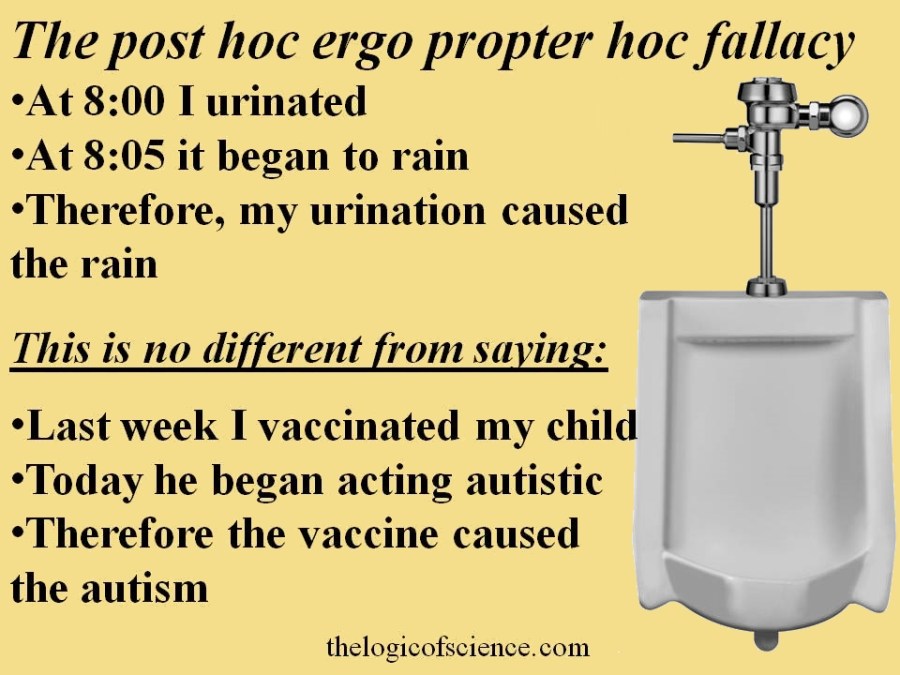
What comes to mind here is a quote often attributed to Einstein: “if you can’t explain it to a 6-year old, you don’t understand it yourself.” Every 6-year old will understand that these two things are NOT the same. Say to a 6-year old: ‘I think it started to rain because you just went for a pee,’ and they’ll laugh at your silliness. Say to a 6-year old: “your brother is acting a bit weirdly, you think it’s to do with the fact that he was recently vaccinated?” and they’ll consider the possibility, just like if you were to say, “your brother is acting a bit weirdly, you think it’s because he did not sleep enough?” Even a 6-year old can see the difference between these two statements: linking urinating and rain is ridiculous; linking unusual behavior to recently being vaccinated not necessarily so.
This is not to argue that there is any causation between vaccination and the autistic behavior, of course. But even as it may seem ridiculous, it’s not something that can a priori be ruled out. We know that science has not found any link, so you can use that science as an argument if you were to talk with someone who wonders whether there is a link. But if you phrase it purely like above, it sounds like you take parents for fools. It comes across as smug and patronizing. It is exactly this talking down at people that makes some of them distrustful of science and scientists.
As Einstein’s quote suggests, Fallacy Man indeed does not seem to understand the essential point of ‘post hoc ergo propter hoc. In Wikipedia it says: “The fallacy lies in a conclusion based *solely* on the order of events, rather than taking into account other factors potentially responsible for the result that might rule out the connection.” In other words, ‘post hoc ergo propter hoc’ does not in itself say anything about whether the two events are linked, it only says that chronology alone is not sufficient evidence to say they are. The two events *may* have nothing to do with each other, but they *could* also be linked.
Common sense a priori rules out a link in the first statement above, but this is not necessarily the case with the second statement. So they are not the same. As Fallacy Man calls himself a man of science, he should know that when considering informal fallacies, context is as important as form and content.
Just to be clear: none of what I write here attributes any truth whatsoever to the second statement.
Several things, first, for someone who is criticizing me for supposedly ignoring context, you seem to have totally ignored the fact that this meme and analogy came from articles (https://thelogicofscience.com/2015/10/12/100-bad-arguments-against-vaccines/ and https://thelogicofscience.com/2015/01/27/the-rules-of-logic-part-3-logical-fallacies/#Post%20hoc%20ergo%20propter%20hoc) that I wrote explaining the fallacy in much greater detail, including explaining that the fallacy only occurs when using temporal association alone to argue that event A caused event B without other evidence, and that the events may actually be linked but the temporal relationship can’t establish that. I have literally written entire posts about the fact that a fallacy only shows that the argument is bad and a bad argument tells you nothing about the conclusion (e.g., https://thelogicofscience.com/2017/03/27/the-fallacy-fallacy-reject-the-argument-not-the-conclusion/). Notice that the meme doesn’t say, “therefore vaccines DON’T cause autism” (that would be a fallacy fallacy). It only shows that the underlying logic is flawed. Maybe try actually reading my articles on this topic before accusing me of not understanding it.
Second, you have completely missed the point of the analogy which is simply to illustrate the fact that event A preceding event B does not mean that event A caused event B. Anti-vaccers absolutely do argue frequently that autism (or various other things) MUST be caused by vaccines BECAUSE they know someone who developed it shortly after vaccination (as was happening in the article that I was responding to when I posted this meme). Logically speaking, that argument is no different from the urination argument. They are both equally logically flawed. They both contain the same logical fallacy. The fact that the conclusion to one of them is, in concept, possible, while the other is not is completely irrelevant. Actually, that’s not entirely true, it’s not irrelevant it is the exact purpose of the analogy. If someone accepts that the first argument is logically flawed, then to be consistent, they must accept that the second argument is logically flawed, because they both have the same logical structure (i.e., they both contain the same logical fallacy).
Please see this article for more information on why these sorts of analogies are actually very useful tools for determining whether an argument is good. https://thelogicofscience.com/2015/09/14/the-rules-of-logic-part-7-using-consistent-reasoning-to-compare-apples-and-oranges/
Third, you have badly misunderstood the 6 year old thing. That statement is about explaining something in a way that a 6-year old can understand. it has nothing to do with whether something seems plausible to a six-year old. The fact that a 6-year old might think these two things are not logically the same would in no way invalidate the analogy. It would only mean that 6-year olds have a poor grasp of how consistent reasoning works (also note that I was endeavoring to explain this to a six year old, so the test is really quite irrelevant here). Having said that, I’d actually contend that this argument would work for 6-year olds, because by your own admission, a 6-year old would realize that the first example is ridiculous, from which it is easy to get them to accept that the fact that one event happened before the other doesn’t mean they are related. You said, “Even a 6-year old can see the difference between these two statements: linking urinating and rain is ridiculous; linking unusual behavior to recently being vaccinated not necessarily so” and that is precisely the point of the analogy. Both examples suffer the same logical blunder, so by demonstrating the blunder where it is obvious, it helps people to identify it where it is not obvious.

 The Logic of Science

What comes to mind here is a quote often attributed to Einstein: “if you can’t explain it to a 6-year old, you don’t understand it yourself.” Every 6-year old will understand that these two things are NOT the same. Say to a 6-year old: ‘I think it started to rain because you just went for a pee,’ and they’ll laugh at your silliness. Say to a 6-year old: “your brother is acting a bit weirdly, you think it’s to do with the fact that he was recently vaccinated?” and they’ll consider the possibility, just like if you were to say, “your brother is acting a bit weirdly, you think it’s because he did not sleep enough?” Even a 6-year old can see the difference between these two statements: linking urinating and rain is ridiculous; linking unusual behavior to recently being vaccinated not necessarily so.
This is not to argue that there is any causation between vaccination and the autistic behavior, of course. But even as it may seem ridiculous, it’s not something that can a priori be ruled out. We know that science has not found any link, so you can use that science as an argument if you were to talk with someone who wonders whether there is a link. But if you phrase it purely like above, it sounds like you take parents for fools. It comes across as smug and patronizing. It is exactly this talking down at people that makes some of them distrustful of science and scientists.
As Einstein’s quote suggests, Fallacy Man indeed does not seem to understand the essential point of ‘post hoc ergo propter hoc. In Wikipedia it says: “The fallacy lies in a conclusion based *solely* on the order of events, rather than taking into account other factors potentially responsible for the result that might rule out the connection.” In other words, ‘post hoc ergo propter hoc’ does not in itself say anything about whether the two events are linked, it only says that chronology alone is not sufficient evidence to say they are. The two events *may* have nothing to do with each other, but they *could* also be linked.
Common sense a priori rules out a link in the first statement above, but this is not necessarily the case with the second statement. So they are not the same. As Fallacy Man calls himself a man of science, he should know that when considering informal fallacies, context is as important as form and content.
Just to be clear: none of what I write here attributes any truth whatsoever to the second statement.
LikeLike
Several things, first, for someone who is criticizing me for supposedly ignoring context, you seem to have totally ignored the fact that this meme and analogy came from articles (https://thelogicofscience.com/2015/10/12/100-bad-arguments-against-vaccines/ and
https://thelogicofscience.com/2015/01/27/the-rules-of-logic-part-3-logical-fallacies/#Post%20hoc%20ergo%20propter%20hoc) that I wrote explaining the fallacy in much greater detail, including explaining that the fallacy only occurs when using temporal association alone to argue that event A caused event B without other evidence, and that the events may actually be linked but the temporal relationship can’t establish that. I have literally written entire posts about the fact that a fallacy only shows that the argument is bad and a bad argument tells you nothing about the conclusion (e.g., https://thelogicofscience.com/2017/03/27/the-fallacy-fallacy-reject-the-argument-not-the-conclusion/). Notice that the meme doesn’t say, “therefore vaccines DON’T cause autism” (that would be a fallacy fallacy). It only shows that the underlying logic is flawed. Maybe try actually reading my articles on this topic before accusing me of not understanding it.
Second, you have completely missed the point of the analogy which is simply to illustrate the fact that event A preceding event B does not mean that event A caused event B. Anti-vaccers absolutely do argue frequently that autism (or various other things) MUST be caused by vaccines BECAUSE they know someone who developed it shortly after vaccination (as was happening in the article that I was responding to when I posted this meme). Logically speaking, that argument is no different from the urination argument. They are both equally logically flawed. They both contain the same logical fallacy. The fact that the conclusion to one of them is, in concept, possible, while the other is not is completely irrelevant. Actually, that’s not entirely true, it’s not irrelevant it is the exact purpose of the analogy. If someone accepts that the first argument is logically flawed, then to be consistent, they must accept that the second argument is logically flawed, because they both have the same logical structure (i.e., they both contain the same logical fallacy).
Please see this article for more information on why these sorts of analogies are actually very useful tools for determining whether an argument is good. https://thelogicofscience.com/2015/09/14/the-rules-of-logic-part-7-using-consistent-reasoning-to-compare-apples-and-oranges/
Third, you have badly misunderstood the 6 year old thing. That statement is about explaining something in a way that a 6-year old can understand. it has nothing to do with whether something seems plausible to a six-year old. The fact that a 6-year old might think these two things are not logically the same would in no way invalidate the analogy. It would only mean that 6-year olds have a poor grasp of how consistent reasoning works (also note that I was endeavoring to explain this to a six year old, so the test is really quite irrelevant here). Having said that, I’d actually contend that this argument would work for 6-year olds, because by your own admission, a 6-year old would realize that the first example is ridiculous, from which it is easy to get them to accept that the fact that one event happened before the other doesn’t mean they are related. You said, “Even a 6-year old can see the difference between these two statements: linking urinating and rain is ridiculous; linking unusual behavior to recently being vaccinated not necessarily so” and that is precisely the point of the analogy. Both examples suffer the same logical blunder, so by demonstrating the blunder where it is obvious, it helps people to identify it where it is not obvious.
LikeLike